

Mughal Troops Chase the Armies of Da'ud (1574-1575) After the capture of Patna, Akbar had returned to Delhi and entrusted Munʿim Khan with the further conquest of Bengal. Da'ud had fled to Odisha . Ho
Credit: Manohar Das · Public domain · source

Portrait of Raja Man Singh of Amber, ca. 1590
Credit: Unknown authorUnknown author · Public domain · source
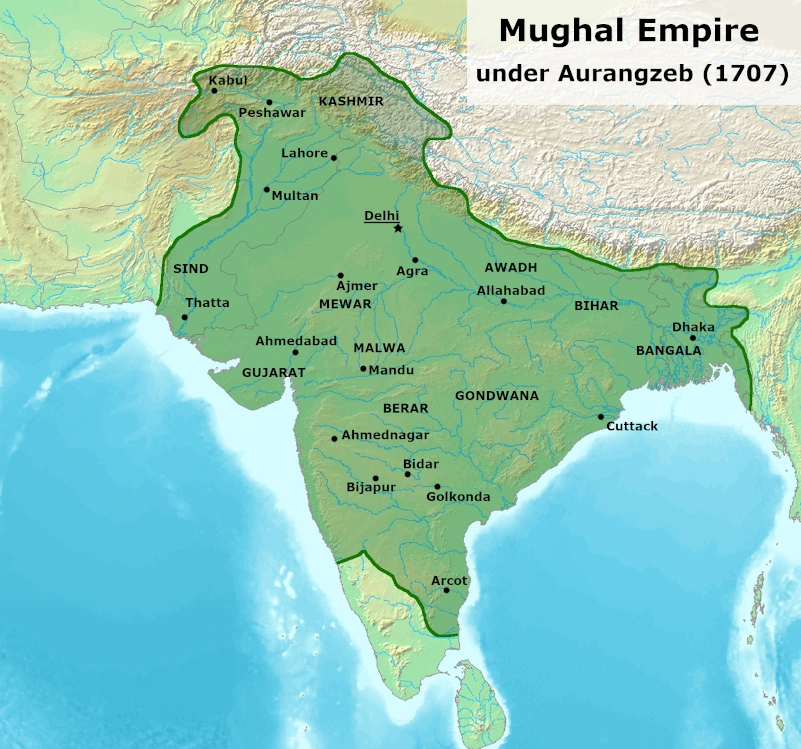
Map study
Mughal Empire in 1707 near the end of Aurangzeb’s reign; this is not Babur’s or Akbar’s territorial extent.
- Read the source date and legend before interpreting territorial extent.
- Compare core regions, neighbouring powers and geographic barriers; historical borders and influence are approximate and changed over time.
Credit: Avantiputra7 · CC BY-SA 4.0 · sourceConverted to WebP on an opaque white background; proportionally resized without cropping. Original cartography and legend retained.
Origins, purpose and institutional character
The word mansab, of Arabic origin, means rank or position. The Mughal mansabdari system drew upon Central Asian traditions of graded military organisation but developed into a distinctive Indian imperial institution. Akbar consolidated it during the 1570s and refined its rules throughout his reign. It should therefore be understood as an evolving system rather than an arrangement created fully formed on a single date.
Mansabdari placed nobles within a numerical hierarchy directly linked to the emperor. It served three connected purposes: determining precedence at court, calculating remuneration, and specifying military obligations. By granting ranks to Turanis, Iranis, Indian Muslims, Rajputs and other groups, the monarchy incorporated diverse elites into a common framework of imperial service. This did not eliminate factional politics, but it gave the emperor a shared institutional language for managing competing nobles.
A mansab was a rank, not the name of a particular job. A mansabdar might serve as a provincial governor, military commander or another senior official. Civil and military functions consequently overlapped. Not every Mughal employee was a mansabdar, however, and rank alone does not reveal a person's territorial jurisdiction or daily duties.
Timeline
1570s
Akbar consolidates graded imperial service through the mansabdari system.
Later reign of Akbar
The dual distinction between zat and sawar becomes established.
1605–1627
Jahangir introduces the du-aspah sih-aspah distinction.
1628–1658
Shah Jahan modifies contingent requirements and payment arrangements.
Later seventeenth century
Expansion of the service elite and prolonged warfare intensify pressure on productive jagir assignments.
Zat, sawar and the ranking hierarchy
By the later years of Akbar's reign, a mansab normally had two numerical components: zat and sawar. Zat expressed the holder's personal standing and helped determine personal salary and precedence. Sawar indicated the cavalry establishment that the holder was expected to maintain and the corresponding military allowance. Thus, a rank of 3,000 zat and 2,000 sawar did not mean that the noble necessarily commanded 5,000 cavalrymen; the two figures measured different things.
The sawar rank was ordinarily no higher than the zat rank under Akbar's normal arrangements, though rules and exceptions evolved under later rulers. Nobles with the same zat could have different sawar ranks and therefore different military obligations. Categories could also be distinguished according to whether the sawar component equalled the zat component, reached at least half of it, or fell below half.
Ranks ranged from relatively small numbers to several thousand. Abul Fazl described 66 grades, of which 33 were in use. The highest ranks were exceptional and often associated with princes, while ceilings and practices changed over time. For examination purposes, it is safer to recognise this changing hierarchy than to treat any single maximum rank as valid throughout Mughal history.
The cavalry number was a prescribed establishment, not a reliable headcount for every campaign. Muster rules, remissions, deployment conditions and later concessions affected actual contingents. Neither zat nor sawar should therefore be read mechanically as the number of soldiers physically present.
Rank, remuneration and military service
- 1. Emperor grants or revises a mansab
- 2. Zat and sawar define status and prescribed obligations
- 3. Cash payment or jagir revenue supports remuneration
- 4. Mansabdar recruits troopers and maintains horses
- 5. Officials verify the establishment through musters, dagh and chehra
- 6. Service and imperial decisions influence promotion, transfer or dismissal
Appointment, military obligations and imperial supervision
The emperor possessed the final authority to appoint, promote, reduce or dismiss mansabdars. The mir bakhshi, the principal official concerned with the military establishment, played a central role in processing appointments, maintaining service records and organising inspections. These functions linked recruitment and promotion to the imperial court rather than to an independently hereditary military aristocracy.
Mansabdars recruited and maintained cavalry contingents from the resources assigned to them. Troopers depended immediately upon their commanders, but the state attempted to verify that paid establishments actually existed. The dagh system branded horses, while chehra records described troopers for identification. Together, these checks sought to prevent substitution of inferior horses, fictitious recruitment and the presentation of the same personnel at multiple inspections.
Horse quality mattered because mounted warfare was central to Mughal campaigning. The number of horses was not necessarily identical to the number of cavalrymen, since service requirements could include additional mounts. Mansabdari cavalry also did not constitute the entire Mughal armed force: artillery, infantry, elephants and other personnel formed important components.
Mansabs were not automatically hereditary. A deceased noble's son might receive imperial employment or rank, but required a fresh grant. Imperial claims upon a deceased noble's estate, including the settlement of outstanding obligations, reinforced royal authority, although actual treatment varied. The system combined dependence on powerful commanders with attempts to prevent their resources from becoming permanently autonomous.
| Term | Meaning | Common error |
|---|---|---|
| Zat | Personal rank, status and salary basis | Treating it as the actual cavalry strength |
| Sawar | Cavalry establishment and associated allowance | Adding it to zat to calculate troop numbers |
| Jagir | Assignment of revenue | Equating it with ownership of land |
| Zamindar | Holder of locally rooted rights and revenue-related functions | Treating every zamindar as a mansabdar |
| Dagh and chehra | Horse branding and descriptive troop records | Confusing inspection devices with revenue assessments |
Payment, jagirs and revenue administration
Mansabdars could be paid in cash or through jagirs. A jagir assigned the revenue of specified territories towards remuneration; it did not normally transfer ownership of the soil. The jagirdar collected authorised revenue through administrative intermediaries and used the proceeds to meet personal and military expenses. Land revenue was therefore the financial bridge between agrarian production and the imperial service establishment.
Mansabdari and jagirdari were closely connected but were not identical. Mansabdari determined rank and service obligations, whereas jagirdari concerned revenue assignment. Similarly, a jagirdar should not be confused with a zamindar. Zamindars possessed locally rooted claims, functions and often hereditary rights; a service jagirdar normally held an imperial assignment that could be transferred.
Transfer of jagirs helped prevent nobles from developing permanent territorial power bases. Nevertheless, some arrangements differed from ordinary transferable assignments. Watan jagirs, associated especially with incorporated hereditary ruling houses such as Rajput chiefs, preserved a connection with ancestral territories. Khalisa lands, by contrast, yielded revenue directly to the imperial treasury rather than being assigned as ordinary service jagirs.
An important fiscal distinction was between jama, the assessed or recorded revenue demand, and hasil, the amount actually realised. A jagir's paper valuation might exceed its collections because of conflict, resistance, agricultural distress or administrative weakness. Such gaps could make it difficult for a mansabdar to maintain the prescribed contingent even when the nominal assignment appeared sufficient.
Later modifications, strains and historical significance
Jahangir introduced the du-aspah sih-aspah distinction within the sawar establishment. It enhanced military obligations and allowances for a designated component, conventionally associated with two-horse and three-horse service, without necessarily raising zat. It enabled the emperor to reward selected nobles or strengthen their military contribution without changing their personal position in the hierarchy.
Under Shah Jahan, fractional contingent requirements and adjustments based on the revenue yield of jagirs further modified the relationship between nominal rank, pay and actual service. These measures illustrate administrative adaptation, but also warn against assuming that Akbar's arrangements remained unchanged under every successor.
Under Aurangzeb, prolonged Deccan warfare and the incorporation of additional nobles intensified pressure on revenue assignments. Historians discuss a jagirdari crisis involving the mismatch between claims upon revenue and adequately productive assignments. Insecurity of tenure and inadequate collections could encourage short-term extraction, burden cultivators and weaken military effectiveness. The severity and causes of these pressures varied regionally and remain debated.
Mansabdari was thus both an instrument of integration and a source of structural vulnerability. It enabled the Mughal emperor to organise a diverse ruling elite and mobilise resources across a large empire. Yet its functioning depended on reliable revenue, credible inspections and effective imperial arbitration. It should not be treated as identical to European hereditary feudalism or as the sole explanation for Mughal decline.
Real-world case studies
Raja Man Singh: integration of a Rajput ruling house
Raja Man Singh of Amber became a leading mansabdar under Akbar, commanding imperial armies and serving in provincial administration, including Bengal. His career shows how Rajput elites could retain dynastic identities while participating in the Mughal service hierarchy.
The Deccan: conquest versus realisable revenue
Aurangzeb annexed Bijapur in 1686 and Golconda in 1687. Continuing warfare and contested control nevertheless limited dependable revenue collection in parts of the Deccan. Territorial expansion therefore did not automatically provide securely productive assignments sufficient to finance expanding military commitments.
Previous year questions
No source-linked PYQ is available here yet. Use the practice questions below.
Practice questions
Practice MCQ 1
With reference to Mughal mansabdari, consider the following statements: 1. Zat indicated personal rank. 2. Sawar represented a cavalry obligation. 3. Zat and sawar must be added to determine the actual cavalry strength. Which statements are correct?
- A. 1 and 2 only
- B. 2 and 3 only
- C. 1 and 3 only
- D. 1, 2 and 3
Practice MCQ 2
Which statement best describes an ordinary Mughal service jagir?
- A. A hereditary transfer of ownership over all village land
- B. A normally transferable revenue assignment supporting remuneration
- C. A territory whose revenue necessarily went directly to the imperial treasury
- D. An office responsible exclusively for branding horses
Practice MCQ 3
Consider the following pairs: 1. Dagh — branding of horses; 2. Chehra — descriptive records of troopers; 3. Du-aspah sih-aspah — automatic hereditary succession to mansab. How many pairs are correctly matched?
- A. Only one
- B. Only two
- C. All three
- D. None
Mains practice · Explain how mansabdari linked imperial integration with military and fiscal administration. What strains affected its functioning in the later Mughal period? Answer in 250 words.
- Define mansab and distinguish zat from sawar.
- Explain incorporation of diverse elites and imperial control over appointments.
- Connect cavalry maintenance with cash payments and jagir assignments.
- Discuss dagh, chehra and the mir bakhshi.
- Analyse jama–hasil gaps, warfare and pressure on productive assignments.
- Avoid presenting mansabdari as the sole cause of Mughal decline.
Further reading
- NCERT, Themes in Indian History, Part II, Kings and Chronicles.
- NCERT, Our Pasts II, The Mughal Empire.
- Satish Chandra, Medieval India: From Sultanat to the Mughals, Part II.
- Abul Fazl, Ain-i-Akbari, translated editions.
- M. Athar Ali, The Mughal Nobility Under Aurangzeb.
Preparing for UPSC Civil Services? Get classroom teaching, answer-writing evaluation and mentorship at Pragnya IAS Academy, Ashok Nagar — see why aspirants choose us for IAS coaching in Hyderabad.