
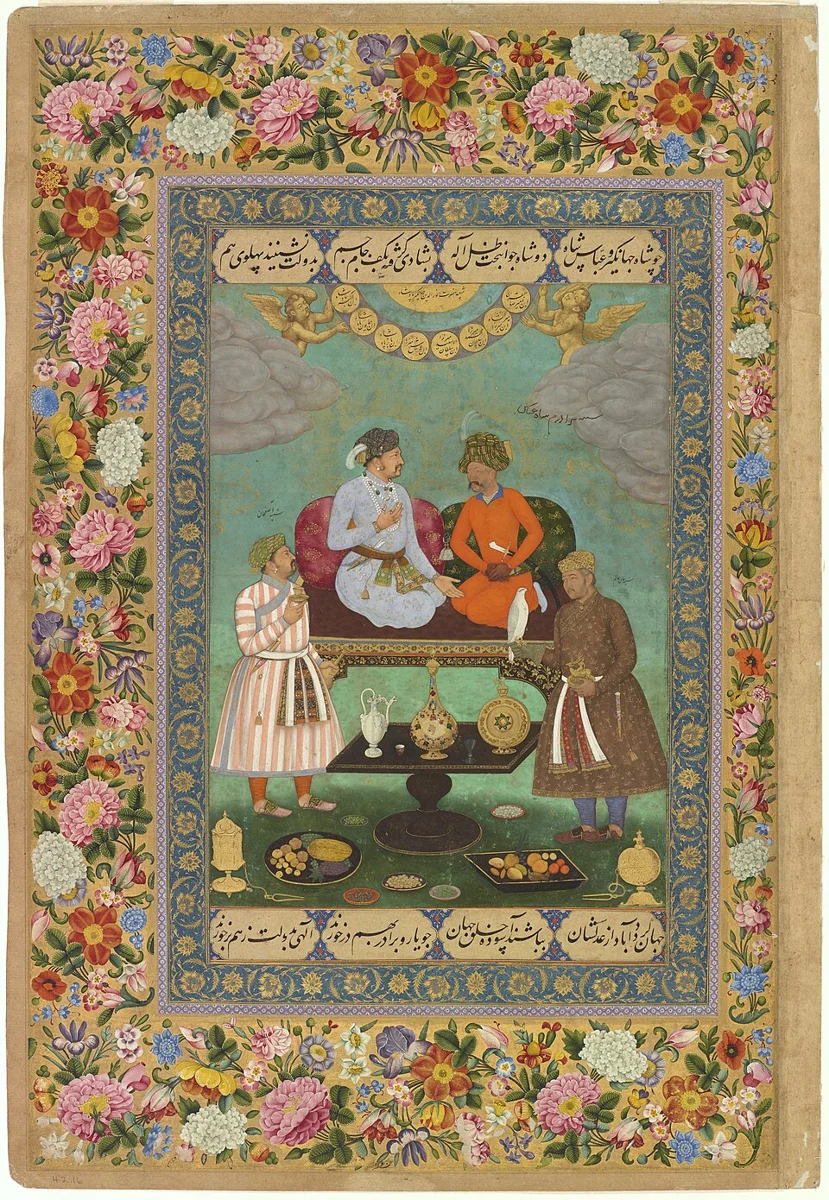
Jahangir welcoming Shah Abbas in an imagined court encounter, circa 1618; Mughal diplomatic imagery.
Credit: Bishandas (attribution) · Public domain · sourceResized and converted to WebP; uncropped.
1. Accession, sources and imperial government
Jahangir was born in 1569 to Akbar and a Rajput princess of Amber who held the title Mariam-uz-Zamani. His original name, Salim, recalled the Sufi saint Shaikh Salim Chishti. Before succeeding Akbar, Salim established a rival court at Allahabad and challenged his father’s authority. In 1602, Bir Singh Bundela killed Akbar’s close associate Abu’l Fazl at Salim’s instigation. Despite this troubled relationship, Salim secured the throne after Akbar’s death in 1605.
Jahangir largely retained the administrative framework inherited from Akbar: the mansabdari hierarchy, jagir assignments, provincial government and an agrarian revenue system associated with the earlier reign. The du-aspah sih-aspah arrangement developed under him allowed selected mansabdars to maintain additional cavalry obligations without a corresponding increase in their zat rank. For examination purposes, zat indicated personal rank and status, while sawar denoted the cavalry component of a mansab.
His accession regulations presented the emperor as a dispenser of justice. The celebrated chain of justice, or zanjir-i-adl, linked the imperial residence at Agra with a point accessible to petitioners. Such measures expressed an ideal of direct royal accountability; they should not be mistaken for evidence of equal access to justice throughout the empire.
The principal personal source is the Tuzuk-i-Jahangiri, also called the Jahangirnama. It records imperial decisions, court events, rewards, observations of nature and the emperor’s own assessments. Jahangir did not personally write the entire surviving narrative, which was continued by others. Like all royal memoirs, it requires critical reading alongside chronicles, inscriptions and European accounts.
Timeline
1569
Birth of Prince Salim at Fatehpur Sikri.
1605–1606
Jahangir succeeds Akbar; Khusrau rebels, and Guru Arjan is executed in 1606.
1611
Marriage to Mehr-un-Nisa, subsequently known as Nur Jahan.
1615–1619
Settlement with Mewar in 1615; Sir Thomas Roe’s embassy operates during 1615–1619.
1622–1626
Loss of Kandahar and Khurram’s rebellion are followed by Mahabat Khan’s seizure of the emperor in 1626.
1627–1628
Jahangir dies in 1627; Shah Jahan formally ascends the throne in 1628.
2. Nur Jahan, succession struggles and court politics
Jahangir married Mehr-un-Nisa, the widow of Sher Afghan, in 1611. Known as Nur Jahan, she became an unusually influential Mughal consort. Her father, Mirza Ghiyas Beg, received the title Itimad-ud-Daulah, while her brother Asaf Khan rose to prominence. Her authority is reflected in imperial orders, patronage and coins bearing her name alongside Jahangir’s. Nevertheless, describing Jahangir as merely her puppet overlooks his continuing political agency and the shifting alliances within the nobility.
Prince Khurram, the future Shah Jahan, initially benefited from association with this family. In 1612 he married Arjumand Banu Begum, Asaf Khan’s daughter, later known as Mumtaz Mahal. Subsequently, Nur Jahan’s daughter Ladli Begum married Prince Shahryar, creating a competing succession connection. Historians sometimes describe a Nur Jahan junta, but it was neither a formal institution nor a permanently united political bloc.
Dynastic tensions marked the reign. Prince Khusrau rebelled in 1606 and was defeated and imprisoned. Khurram’s rebellion during 1622–1625 disrupted imperial politics. In 1626, the commander Mahabat Khan seized Jahangir near the Jhelum while attempting to protect his position against court rivals. Nur Jahan’s political manoeuvring helped restore the emperor’s freedom. After Jahangir died in 1627, Asaf Khan helped secure Khurram’s succession; Shah Jahan formally ascended the throne in 1628.
From court alliance to succession conflict
- 1. Nur Jahan’s marriage strengthens her family’s court position.
- 2. Khurram initially cooperates with the influential family network.
- 3. Ladli Begum’s marriage to Shahryar creates a rival succession connection.
- 4. Khurram’s rebellion deepens divisions within the imperial elite.
- 5. After Jahangir’s death, Asaf Khan supports Khurram’s accession.
3. Territorial policy and European contacts
The settlement with Mewar in 1615 was a major political achievement. Following pressure from campaigns led by Khurram, Rana Amar Singh accepted Mughal suzerainty. The Rana was not compelled to attend the imperial court personally; his son Karan Singh entered Mughal service. Mewar recovered its territories, including Chittor, but could not repair Chittor’s fortifications. No matrimonial alliance was imposed. The agreement illustrates accommodation with a prestigious Rajput house rather than its complete administrative absorption.
In the Deccan, Mughal expansion faced Malik Ambar, the influential statesman and military leader of Ahmadnagar. His mobile warfare, use of local terrain and alliances repeatedly checked Mughal advances. Khurram obtained temporary successes, including a settlement in 1617, but Jahangir did not permanently annex the entire Ahmadnagar kingdom. In the northwest, Shah Abbas I of Persia captured Kandahar in 1622, weakening Mughal control over an important strategic and commercial gateway. Kangra Fort, by contrast, fell to the Mughals in 1620.
European commercial competition also intensified. William Hawkins reached Jahangir’s court in 1609, but failed to obtain a secure, lasting commercial settlement. Following the English naval victory over the Portuguese near Swally in 1612, English commercial activity at Surat gained firmer footing. Sir Thomas Roe, ambassador of James I, attended the Mughal court during 1615–1619 and sought trading privileges for the East India Company. These contacts concerned commerce and diplomatic access, not British territorial sovereignty in India.
| Person or subject | Correct association | Prelims caution |
|---|---|---|
| Ustad Mansur | Natural-history painting under Jahangir | Do not confuse with a court historian. |
| Nur Jahan | Patron of Itimad-ud-Daulah’s tomb | The tomb is not Jahangir’s mausoleum. |
| Sir Thomas Roe | Ambassador of James I, 1615–1619 | He visited Jahangir, not Akbar. |
| Malik Ambar | Resistance to Mughal expansion from Ahmadnagar | He was not a Mughal provincial governor. |
| Kandahar | Captured by Shah Abbas I in 1622 | Distinguish this loss from later Mughal–Safavid contests. |
4. Religion, justice and society
Jahangir broadly continued the incorporation of diverse elites into Mughal service and did not restore the jizya abolished by Akbar. He interacted with Hindu ascetics, Muslim religious figures and Jesuit missionaries. His court’s interest in Christian imagery also influenced painting. However, cultural curiosity coexisted with coercive religious acts, and his reign cannot accurately be characterised as either uniformly tolerant or uniformly intolerant.
The execution of Guru Arjan, the fifth Sikh Guru, in 1606 was a decisive development in Mughal–Sikh relations. Jahangir’s memoir connects imperial suspicion with the Guru’s growing following and his encounter with the rebel prince Khusrau. Political and religious considerations overlapped; reducing the episode to a single motive is misleading. Guru Hargobind subsequently emphasised temporal as well as spiritual authority. Jahangir also ordered action against certain religious institutions and images, including the Varaha image at Pushkar, demonstrating the limits of imperial accommodation.
5. Painting, architecture and historical significance
Mughal painting achieved exceptional refinement under Jahangir. Compared with Akbar’s extensive illustrated narratives, his patronage placed greater emphasis on individual portraits, album paintings, close observation of animals and plants, and symbolic representations of kingship. Ustad Mansur specialised in natural-history studies, while Abu’l Hasan was celebrated for sophisticated court painting. Bishandas was particularly associated with portraiture. European engravings contributed motifs such as halos, angels and spatial effects, which artists adapted rather than simply copied.
Jahangir recorded striking observations of birds, animals and unusual natural phenomena. His artistic patronage therefore matters not only for cultural history but also for the history of observation and knowledge. Nevertheless, allegorical paintings asserting Mughal superiority should not be read as literal records of meetings or diplomatic events.
Architecture remained significant, although the reign is especially associated with painting. Nur Jahan commissioned the tomb of Itimad-ud-Daulah at Agra during the 1620s. Its white marble, delicate screens and coloured stone inlay anticipate features prominent under Shah Jahan. Akbar’s tomb at Sikandra was completed during Jahangir’s reign. Jahangir’s own tomb at Lahore was constructed after his death, an important distinction when matching monuments with reigns.
Jahangir’s Painting: Diplomacy and Imperial Self-Representation
The supplied metadata identifies a painting of Jahangir welcoming the Safavid ruler Shah Abbas. It is directly relevant to Jahangir’s cultural patronage and relations with Iran, but should not be read as a record of an actual meeting. The two sovereigns never met in person. Such imagined encounters helped articulate imperial status and diplomatic aspirations. Under Jahangir, portraiture and close observation flourished alongside allegorical compositions: artistic naturalism did not necessarily imply historical literalism.
Mughal–Safavid relations combined diplomatic exchanges with rivalry over Kandahar, a strategic frontier centre linking northern India, Afghanistan and Iran. Its loss to the Safavids during Jahangir’s reign highlights the gap between imperial representation and political outcomes. The metadata also associates the composition with a European clockwork object, offering a starting point for studying the circulation of luxury goods and artistic ideas at the Mughal court. However, its attribution is inconsistent: the title names Abu’l Hasan, while the description also mentions Bishandas. These were distinct artists, so authorship requires verification against an authoritative collection catalogue rather than confident repetition of mixed metadata.
- For Prelims, distinguish Abu’l Hasan, associated with Jahangir’s court painting, from Bishandas, noted for portraits produced during a Mughal embassy to Persia.
- For Mains, use court paintings as evidence of patronage, political ideals and cross-cultural exchange, not automatically as documentary records of events.
- Separate stylistic naturalism from factual accuracy: a carefully rendered ruler or imported object can appear within an entirely imagined diplomatic scene.
Real-world case studies
Mewar, 1615: Negotiated imperial integration
The settlement preserved the Rana’s dignity while securing recognition of Mughal supremacy. Exemption from personal court attendance and the absence of a compulsory marriage alliance made submission politically acceptable. It demonstrates that Mughal expansion could combine military pressure with differentiated terms for regional rulers.
Ustad Mansur’s dodo: Art as historical evidence
A painting widely attributed to Ustad Mansur depicts the now-extinct dodo alongside other birds. It illustrates the circulation of exotic fauna through Indian Ocean networks and the Mughal court’s interest in close visual observation. Such works are valuable historical evidence, although artistic attribution and the circumstances of observation require scrutiny.
Previous year questions
No source-linked PYQ is available here yet. Use the practice questions below.
Practice questions
Practice MCQ 1
With reference to Jahangir’s reign, consider the following statements: 1. Rana Amar Singh was required to attend the Mughal court personally under the 1615 settlement. 2. Kandahar was captured by Shah Abbas I in 1622. 3. Kangra Fort was captured by the Mughals in 1620. Which of the statements given above are correct?
- A. 1 and 2 only
- B. 2 and 3 only
- C. 1 and 3 only
- D. 1, 2 and 3
Practice MCQ 2
Which one of the following pairs is incorrectly matched?
- A. Ustad Mansur — Studies of birds and animals
- B. Sir Thomas Roe — Embassy from James I
- C. Nur Jahan — Patronage of Itimad-ud-Daulah’s tomb
- D. Malik Ambar — Author of Tuzuk-i-Jahangiri
Practice MCQ 3
The du-aspah sih-aspah arrangement under Jahangir is best understood as:
- A. A mechanism for increasing selected mansabdars’ cavalry obligations without a corresponding increase in zat rank
- B. A new tax imposed exclusively on merchants at Surat
- C. A system replacing jagir assignments with hereditary ownership
- D. A treaty dividing the Deccan between the Mughals and the Safavids
Mains practice · Jahangir’s reign combined institutional continuity with distinctive political and cultural developments. Discuss. Answer in 250 words.
- Establish continuity with Akbar in mansabdari, jagirdari, revenue administration and elite incorporation.
- Explain Nur Jahan’s influence without treating the emperor as entirely powerless.
- Contrast accommodation with Mewar and gains at Kangra with Deccan resistance and the loss of Kandahar.
- Discuss European commercial contacts and their limited political significance at this stage.
- Balance religious accommodation against Guru Arjan’s execution and other coercive acts.
- Highlight portraiture, natural-history painting, memoir writing and Nur Jahan’s architectural patronage.
Further reading
- Satish Chandra, Medieval India, NCERT: Mughal political history and culture.
- NCERT, Themes in Indian History, Part II: Kings and Chronicles.
- Jahangir, The Jahangirnama, translated by Wheeler M. Thackston.
- Archaeological Survey of India: official information on Itimad-ud-Daulah’s tomb and Akbar’s tomb at Sikandra.
- The Metropolitan Museum of Art: Heilbrunn Timeline of Art History essays on Mughal painting.
- https://commons.wikimedia.org/wiki/File:12_Abu%27l_Hasan_Jahangir_Welcoming_Shah_%27Abbas,_ca._1618,_Freer_Gallery_of_Art,_Washington_DC.jpg
Preparing for UPSC Civil Services? Get classroom teaching, answer-writing evaluation and mentorship at Pragnya IAS Academy, Ashok Nagar — see why aspirants choose us for IAS coaching in Hyderabad.