
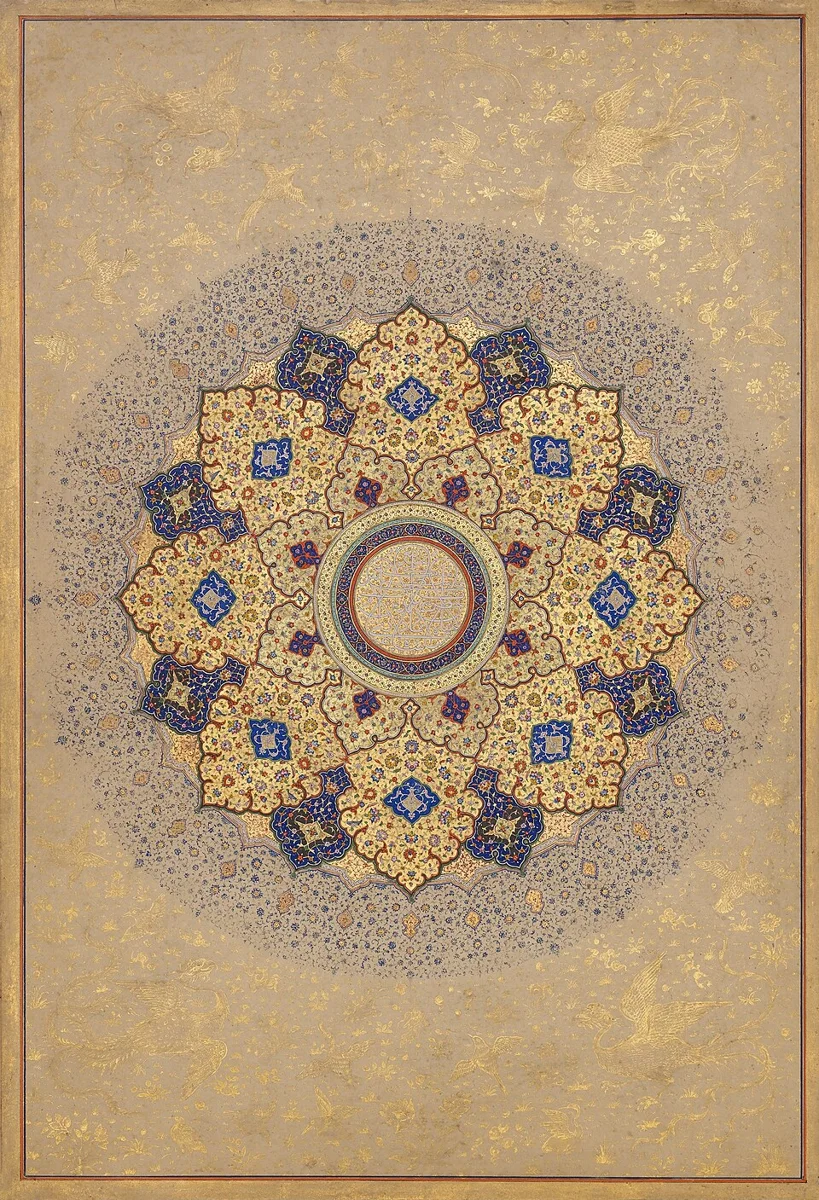
Album rosette bearing Shah Jahan’s imperial titles, illustrating Mughal courtly manuscript culture.
Credit: Unknown authorUnknown author · Public domain · sourceResized and converted to WebP; uncropped.
1. Accession and the character of kingship
Prince Khurram gained military and administrative experience under Jahangir, notably through campaigns connected with Mewar and the Deccan. Jahangir conferred the title Shah Jahan on him in 1617. His position nevertheless became insecure amid the political influence of Nur Jahan and competing claims within the imperial family. Khurram rebelled against his father in 1622, but was subsequently reconciled. After Jahangir’s death, Asaf Khan, Nur Jahan’s brother and Khurram’s father-in-law, helped secure his accession. The elimination of rival princes demonstrated the violence inherent in Mughal succession politics.
Shah Jahan’s monarchy emphasised dynastic prestige, carefully regulated court ceremony and the emperor’s position as the source of justice and honour. The Peacock Throne, completed in the 1630s, embodied this vision through jewels and precious materials. Audience halls, royal appearances and elaborate gift-giving made political hierarchy visible. Yet this ceremonial splendour rested on institutions inherited largely from Akbar: the mansabdari system, revenue assignments through jagirs and a provincial administration staffed by a diverse imperial nobility.
- Mughal succession followed no binding rule of primogeniture; seniority alone did not guarantee the throne.
- Asaf Khan should not be confused with his father, Mirza Ghiyas Beg, who held the title Itimad-ud-Daulah.
Timeline
1592
Prince Khurram is born at Lahore.
1628
Shah Jahan ascends the Mughal throne.
1631–1632
Mumtaz Mahal dies in 1631; construction of the Taj Mahal begins in 1632.
1636
The Deccan settlement ends the attempted Nizam Shahi revival and regulates relations with Bijapur and Golconda.
1638–1639
Mughals acquire Kandahar in 1638; construction of Shahjahanabad and its palace-fort begins in 1639.
1646–1653
The Balkh expedition ends in withdrawal; Kandahar is lost in 1649 and subsequent recovery attempts fail.
1657–1658
The emperor’s illness triggers a succession struggle; Aurangzeb secures power and confines Shah Jahan.
1666
Shah Jahan dies at Agra Fort.
2. Territorial expansion and the limits of imperial power
The early reign faced rebellions associated with Khan Jahan Lodi and the Bundelas. In the Deccan, Mughal forces captured Daulatabad in 1633 and imprisoned the Nizam Shahi ruler of Ahmadnagar. Resistance continued under Shahji Bhonsle, who supported another claimant. The settlement of 1636 ended this attempted revival, partitioned former Ahmadnagar territories and reorganised relations with Bijapur and Golconda. Bijapur accepted restrictive treaty obligations, while Golconda acknowledged Mughal suzerainty and tribute. Neither kingdom was annexed by Shah Jahan; their final annexation occurred under Aurangzeb in 1686 and 1687 respectively.
The north-western frontier was less rewarding. Kandahar, strategically situated between the Mughal and Safavid spheres, came under Mughal control in 1638 when its governor Ali Mardan Khan surrendered it. The Safavids recovered it in 1649. Three Mughal attempts to regain it, ending with Dara Shikoh’s expedition in 1653, failed. The Balkh-Badakhshan expedition of 1646–1647 likewise ended in withdrawal because of difficult terrain, supply problems and resistance. These campaigns reveal the limits of projecting military power beyond the empire’s strongest revenue and logistical bases.
In Bengal, Mughal forces attacked the Portuguese settlement at Hooghly in 1632. Disputes involved Portuguese fortifications, trading practices, slave-taking and the treatment of local inhabitants. The episode was a confrontation with a particular settlement rather than the expulsion of all Portuguese people or European traders from India.
From imperial illness to Aurangzeb’s ascendancy
- 1. Shah Jahan falls seriously ill in 1657.
- 2. Four princes mobilise resources and assert competing claims.
- 3. Aurangzeb allies with Murad and wins at Dharmat in April 1658.
- 4. Dara Shikoh is defeated at Samugarh in May 1658.
- 5. Aurangzeb secures Agra and confines Shah Jahan.
- 6. Further campaigns and elimination of rivals consolidate Aurangzeb’s authority.
3. Administration, economy and religious policy
The mansabdari-jagirdari framework linked military service, rank and fiscal resources. Mansabdars held numerical ranks expressed through zat and sawar, while jagirs normally assigned revenue rights rather than ownership of the soil. Transfers helped prevent officials from establishing permanent territorial power bases. However, differences between assessed revenue and actual collections, competition for productive assignments and the expenses of campaigning complicated administration. Agrarian revenue financed both the army and the court; peasants, zamindars and local intermediaries were therefore central to the working of the empire.
The reign witnessed substantial textile production, craft specialisation and long-distance trade. Indian cotton textiles, silk and indigo attracted Asian and European merchants, while bullion flowed into commercial centres. Surat was a major western port, and Agra, Lahore and other cities supported specialised manufacturing. The English and Dutch East India Companies expanded commercial activity but remained traders operating within Indian political structures, not territorial rulers. Prosperity was uneven: the severe famine of 1630–1632 in Gujarat and the Deccan, aggravated by warfare and disruption, exposed the vulnerability of cultivators and labourers.
Shah Jahan’s public religious posture was more conventionally Islamic than Akbar’s. Some orders restricted temple construction or targeted particular temples, but policy varied with political context. Hindu nobles, including Rajputs, continued to serve the empire. Jizya was not reimposed during his reign; Aurangzeb restored it in 1679. An exam answer should therefore distinguish court orthodoxy and selective coercion from claims of a uniform, empire-wide exclusion of non-Muslims.
| Monument | Location | Exam-relevant feature |
|---|---|---|
| Taj Mahal | Agra | Marble mausoleum for Mumtaz Mahal; riverfront garden complex with stone inlay. |
| Red Fort | Delhi | Palace-fort of Shahjahanabad; construction began in 1639 and the court moved there in 1648. |
| Jama Masjid | Delhi | Major congregational mosque completed in 1656. |
| Moti Masjid | Agra Fort | White-marble mosque; distinct from Aurangzeb’s mosque in Delhi’s Red Fort. |
| Shalimar Gardens | Lahore | Terraced garden developed in 1641–1642, integrating water channels and fountains. |
4. Architecture, urbanism and court culture
Shahjahani architecture refined earlier Mughal experiments through axial planning, symmetry, balanced proportions, white marble, cusped arches and delicate ornament. Red sandstone remained important, especially in monumental enclosures. Pietra dura, also known in India as parchinkari, used fitted pieces of coloured stone to produce floral and other designs. Calligraphy, carved marble relief and jali screens complemented this technique. These features were not all invented under Shah Jahan; their distinctive achievement lay in their coordinated and technically accomplished use.
The Taj Mahal at Agra was begun in 1632. Its principal mausoleum was substantially completed by 1648, while associated work continued into the early 1650s. The complex combines a monumental gateway, a divided garden, a mosque and a balancing building commonly called the jawab. Unlike many garden tombs, its mausoleum stands at the northern, riverfront end of the garden rather than its centre. Shahjahanabad, founded in 1639, connected the Red Fort, Jama Masjid, bazaars and residential quarters within a new imperial urban setting.
Other major works include the Moti Masjid at Agra Fort, additions to the Agra and Lahore forts, and Shalimar Gardens at Lahore. Court painting favoured polished portraiture and formal representations of imperial ceremony. Persian histories such as Abdul Hamid Lahori’s Padshahnama recorded campaigns and court life. Their detailed information is valuable, but their celebratory purpose requires critical reading alongside travellers’ accounts, material remains and administrative evidence.
- Distinguish Shah Jahan’s Moti Masjid at Agra Fort from Aurangzeb’s Moti Masjid inside Delhi’s Red Fort.
- Delhi’s Jama Masjid was completed in 1656; the Red Fort belongs to Shah Jahan, not Akbar.
5. Succession crisis and historical assessment
Shah Jahan’s serious illness in 1657 triggered competition among his sons Dara Shikoh, Shah Shuja, Aurangzeb and Murad Bakhsh. Dara enjoyed proximity to the emperor, but Aurangzeb possessed extensive provincial and military experience. Aurangzeb and Murad defeated the imperial army led by Jaswant Singh at Dharmat in April 1658, followed by Dara’s defeat at Samugarh near Agra in May. Aurangzeb then secured Agra and confined his father. Dara was executed in 1659, while the other rival brothers were subsequently eliminated or displaced.
Shah Jahan remained in Agra Fort, attended by his daughter Jahanara, until his death in 1666. He was buried beside Mumtaz Mahal in the Taj Mahal. His reign is sometimes labelled a Mughal golden age, particularly for architecture and court culture. This description should be qualified: impressive artistic production coexisted with famine, agrarian extraction and costly military setbacks. Monumental expenditure alone cannot explain later Mughal decline, which involved a longer interaction of political, military, regional and fiscal pressures.
Shah Jahan: Imperial Titles and Album Patronage
The supplied metadata identifies this work as a shamsa, a sun-like ornamental rosette traditionally placed at the beginning of Mughal albums. Its reported inscription names Shihabuddin Muhammad Shah Jahan and invokes the continuation of his rule and sovereignty. This makes it directly relevant to Shah Jahan’s imperial self-representation: royal titles and blessings articulated an ideal of legitimate, enduring kingship rather than merely identifying an individual.
Shah Jahan’s cultural patronage extended beyond monumental buildings to painting, calligraphy and illuminated albums. Mughal albums, often called muraqqas, assembled paintings and calligraphic specimens within carefully designed borders. Such objects connected artistic refinement with courtly prestige and imperial authority. Read alongside the Taj Mahal and Shahjahanabad, this rosette broadens the study of his reign from architecture to the portable arts through which the court expressed sovereignty. However, the metadata alone does not establish the object’s precise date, artist, original album or circumstances of production.
- Prelims distinction: a shamsa is an ornamental sunburst or rosette; a muraqqa is an album. Neither term denotes a building type or an administrative office.
- Mains application: use imperial titulature and manuscript patronage to explain how Mughal political authority was communicated through language, artistic craftsmanship and courtly display.
- Evidence limit: the reported religious title expresses a claim to legitimacy, not proof of uniform religious policy. Assess governance through additional sources, and do not treat an imperial blessing as evidence of actual political stability.
Real-world case studies
Kandahar: strategic importance versus logistical capacity
Kandahar guarded routes between Iran, Afghanistan and the Indian subcontinent. Its acquisition in 1638 enhanced Mughal frontier security, but Safavid recovery in 1649 exposed weaknesses in siege capability and supply arrangements. The failed recovery expeditions show why territorial ambition must be assessed against terrain, transport, artillery and the opponent’s defensive strength.
Shahjahanabad: architecture as political organisation
The new capital placed the palace-fort beside the Yamuna and linked imperial authority with mosques, markets and elite residences. Jahanara’s patronage of Chandni Chowk and associated urban facilities illustrates the role of royal women in shaping commercial and civic space. The city functioned as an administrative and economic centre, not merely an architectural display.
Previous year questions
No source-linked PYQ is available here yet. Use the practice questions below.
Practice questions
Practice MCQ 1
With reference to Shah Jahan’s Deccan policy, consider the following statements: 1. The settlement of 1636 ended the attempted revival of the Nizam Shahi kingdom. 2. Bijapur and Golconda were both annexed to the Mughal Empire in 1636. Which of the statements given above is/are correct?
- A. 1 only
- B. 2 only
- C. Both 1 and 2
- D. Neither 1 nor 2
Practice MCQ 2
Which one of the following monuments was built under Aurangzeb rather than Shah Jahan?
- A. Jama Masjid, Delhi
- B. Moti Masjid, Agra Fort
- C. Moti Masjid, Delhi Red Fort
- D. Taj Mahal, Agra
Practice MCQ 3
Arrange the following events in chronological order: 1. Battle of Samugarh 2. Mughal acquisition of Kandahar from Ali Mardan Khan 3. Beginning of Shahjahanabad’s construction 4. Safavid recovery of Kandahar.
- A. 2–3–4–1
- B. 3–2–1–4
- C. 2–4–3–1
- D. 4–2–3–1
Mains practice · Shah Jahan’s reign represented both the splendour of Mughal imperial culture and the limits of Mughal expansion. Discuss. Answer in 250 words.
- Introduce the reign as a period of substantial imperial resources and elaborate kingship.
- Explain architecture and urban patronage through the Taj Mahal, Shahjahanabad, Red Fort and Jama Masjid.
- Connect cultural production with agrarian revenue, crafts and international trade.
- Contrast the Deccan settlement of 1636 with failures in Balkh and Kandahar.
- Discuss famine, fiscal demands and logistical constraints without assuming uniform economic decline.
- Use the succession crisis to illustrate the vulnerability created by competing dynastic claims.
- Conclude with a qualified assessment of the golden-age description.
Further reading
- NCERT, Themes in Indian History, Part II, chapter Kings and Chronicles in editions containing the Mughal court chapter.
- Satish Chandra, Medieval India: From Sultanat to the Mughals, Part II.
- Archaeological Survey of India: official monument information on the Taj Mahal, Agra Fort and Red Fort.
- UNESCO World Heritage Centre: Taj Mahal and Red Fort Complex.
- Abdul Hamid Lahori, Padshahnama, translated selections, for contemporary court historiography.
- https://commons.wikimedia.org/wiki/File:Rosette,_Titles_of_Shah_Jahan.jpg
Preparing for UPSC Civil Services? Get classroom teaching, answer-writing evaluation and mentorship at Pragnya IAS Academy, Ashok Nagar — see why aspirants choose us for IAS coaching in Hyderabad.