
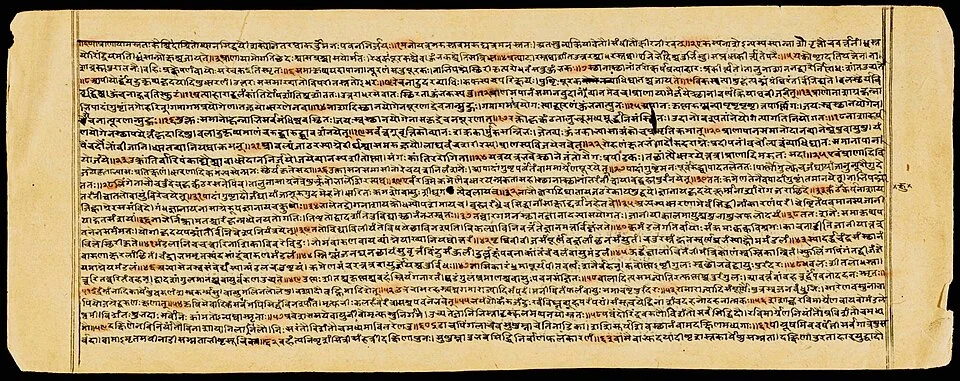
Manuscript of Hemachandra’s Sanskrit Yogasastra, an example of medieval Jain scholarly literature.
Credit: Ms Sarah Welch · CC BY-SA 4.0 · sourceResized and converted to WebP; uncropped.
1. Origins, oral transmission and the Jain canon
Jain literature developed around the teachings of the Tirthankaras, especially Mahavira, the twenty-fourth Tirthankara, who lived in the sixth–fifth centuries BCE. Jain tradition attributes the organisation of his teachings to his chief disciples, the ganadharas. These teachings were preserved through memorisation and recitation rather than through a single text written by Mahavira. Consequently, the traditional antiquity of a teaching must be distinguished from the date of a surviving compilation or manuscript.
The canonical teachings are commonly called Agamas. Jain accounts describe an early body of fourteen Purvas, subsequently associated with the twelfth Anga, Drishtivada. The twelve Angas formed a central organisational framework. Shvetambaras accept eleven surviving Angas but consider Drishtivada lost. Digambaras maintain that the original Angas and Purvas were lost through the gradual decline of oral transmission; they therefore do not recognise the surviving Shvetambara canon as the original authoritative collection.
Tradition connects an early attempt to collect the teachings at Pataliputra with Sthulabhadra and a period of famine. Such accounts should not be treated as precisely dated contemporary records. A major Shvetambara council at Valabhi in Gujarat, generally placed in the fifth century CE, is associated with Devardhigani Kshamashramana and the collection and writing down of the canon. Valabhi did not establish a canon accepted by all Jains.
- Exam distinction: the loss of the original canon in Digambara belief does not mean the absence of authoritative Digambara literature.
- Textual transmission involved memorisation, recitation, commentary, copying and preservation in manuscript libraries.
Timeline
Sixth–fifth centuries BCE
Mahavira teaches; Jain tradition traces canonical transmission to his disciples.
Early centuries CE
Foundational Digambara writings and influential Prakrit philosophical works develop; precise dates remain debated.
Fifth century CE
The Valabhi council is associated with the compilation and writing down of the Shvetambara canon.
Eighth–ninth centuries CE
Major Digambara commentarial and universal-history works are produced.
Twelfth century CE
Hemachandra produces influential grammatical, narrative and scholarly works in Gujarat.
2. Shvetambara canonical literature
Shvetambara texts are conventionally grouped into Angas, Upangas, Chedasutras, Mulasutras, Prakirnakas and individual supplementary works. A commonly cited Murtipujaka enumeration recognises forty-five Agamas, although classifications and accepted totals differ across Shvetambara groups. Sthanakavasi and Terapanthi traditions generally accept thirty-two. Thus, statements that all Jains recognise one fixed number of canonical books are misleading.
The Acharanga Sutra, the first Anga, discusses ascetic conduct, restraint and non-injury, and includes material concerning Mahavira’s ascetic life. The Sutrakritanga examines doctrines and competing viewpoints while defending Jain discipline. The Bhagavati Sutra, also called Vyakhyaprajnapti, is a large question-and-answer work addressing doctrine, cosmology and other subjects. The Upasakadasanga concerns exemplary lay followers and their religious commitments.
The Uttaradhyayana Sutra combines ethical instruction, doctrinal exposition and narratives, and is classified among the Mulasutras in the familiar canonical scheme. The Chedasutras concern monastic discipline and procedures for dealing with transgressions. The Kalpa Sutra, traditionally attributed to Bhadrabahu, includes accounts of Tirthankaras, monastic lineage and rules for the rainy-season retreat. Especially prominent in Shvetambara Paryushana observances, it is not one of the twelve Angas. Traditional attribution should not automatically be equated with the date of every part of its surviving text.
- Acharanga: ascetic conduct and non-violence.
- Bhagavati: extensive doctrinal dialogue.
- Kalpa Sutra: Tirthankara biographies, lineage and monastic observances.
How to evaluate a Jain text as historical evidence
- 1. Identify the text, language and sectarian setting
- 2. Distinguish composition from redaction and manuscript date
- 3. Determine its genre and purpose
- 4. Compare its claims with inscriptions and archaeology
- 5. Draw conclusions with explicit chronological limits
3. Digambara texts and shared philosophical literature
Two foundational Digambara works are the Shatkhandagama and the Kasayapahuda. The Shatkhandagama, associated with Pushpadanta and Bhutabali, treats karma in great detail and is traditionally connected with knowledge transmitted by Dharasena. The Kasayapahuda, attributed to Gunadhara, focuses on passions and their relationship to bondage. Their dates remain debated; both belong to the early centuries of the Common Era rather than being surviving manuscripts from Mahavira’s lifetime.
Kundakunda, a highly influential Digambara teacher, composed Prakrit works including the Samayasara, Pravachanasara and Panchastikayasara. They examine the soul, fundamental categories of reality and liberation, often distinguishing the ultimate standpoint from everyday or practical description. The Dhavala commentary associated with Virasena and the Jayadhavala, continued and completed by Jinasena, represent the extensive commentarial scholarship surrounding foundational Digambara texts.
The Tattvartha Sutra, attributed to Umasvati or Umasvamin, systematically presents Jain philosophy in Sanskrit and is respected by both Shvetambaras and Digambaras, though recensions and interpretations differ. Its opening formulation identifies right faith, right knowledge and right conduct as the path to liberation. Jain philosophical literature explains karma as subtle matter binding the soul, alongside concepts such as anekantavada, or the many-sided character of reality, and syadvada, or conditioned predication. These doctrines require qualified judgments, not the claim that every assertion is equally true.
- Do not confuse the Jain Triratna with the Buddhist Three Jewels: Buddha, Dhamma and Sangha.
- Anekantavada concerns the complexity of reality; syadvada concerns qualified ways of expressing judgments about it.
| Text | Author or attribution | Main association |
|---|---|---|
| Kalpa Sutra | Traditionally Bhadrabahu | Shvetambara biographies and monastic observances |
| Shatkhandagama | Pushpadanta and Bhutabali | Digambara karma doctrine |
| Samayasara | Kundakunda | Soul and liberation |
| Tattvartha Sutra | Umasvati/Umasvamin | Systematic Sanskrit philosophy |
| Paumacariya | Vimalasuri | Prakrit Jain Rama narrative |
| Ganitasarasangraha | Mahaviracharya | Mathematics |
4. Languages, narratives and regional contributions
Jain authors used several languages rather than a single sacred language. Ardhamagadhi is particularly associated with Shvetambara canonical literature, Jain Shauraseni with important Digambara works, and Jain Maharashtri with narratives and commentaries. Sanskrit became a major medium for philosophy, logic and systematic scholarship. Apabhramsha and regional languages widened literary participation. These associations are useful for examinations but should not be treated as exclusive compartments.
Vimalasuri’s Paumacariya is an early Prakrit Jain retelling of the Rama story. It illustrates how Jain authors reworked shared narrative traditions to express their own ethics and cosmology. Jinasena’s Adipurana and Gunabhadra’s Uttarapurana together constitute the Mahapurana, presenting the careers of illustrious figures within Jain universal history. Their narratives should be read as religious literature rather than straightforward political chronicles.
Jain contributions extend well beyond religious doctrine. The twelfth-century polymath Hemachandra worked in Gujarat under Chaulukya patronage and produced the Siddha-Hema-Shabdanushasana on grammar and the Trishashtishalakapurushacharitra on sixty-three illustrious persons. In Kannada, Pampa’s Adipurana and Ranna’s Ajitapurana exemplify Jain literary patronage. In Tamil, the Civaka Cintamani is associated with the Jain author Tiruttakkatevar. The religious affiliation of Tiruvalluvar, author of the Tirukkural, remains disputed and should not be stated as conclusively Jain.
- Jain scholars also contributed to mathematics: Mahaviracharya composed the ninth-century Ganitasarasangraha.
- Literary language, author, patron and doctrinal affiliation are separate facts; questions may combine them to create misleading pairs.
5. Historical value and methods of interpretation
Jain literature provides evidence for monastic organisation, lay religious life, ethical debates, trade, towns and patronage. Narratives often describe merchants and householders, while disciplinary texts illuminate relations between itinerant ascetics and settled society. Works such as Hemachandra’s Parishishtaparvan preserve traditions about early teachers and rulers, including Chandragupta Maurya, but were composed much later than many events they describe.
Historical reconstruction therefore requires attention to genre and chronology. A rule prescribing ideal behaviour does not prove that everyone followed it; a later biography is not contemporary testimony. Historians compare literary accounts with inscriptions, archaeology and other textual traditions. Jain manuscript repositories, or bhandaras, preserve palm-leaf and paper manuscripts, commentaries and illustrated texts. Their importance lies both in textual preservation and in evidence for scribal practices, donation, painting and networks of learning.
- Separate the date of composition, later redaction, commentary and surviving manuscript.
- Use literary evidence critically without dismissing its value for social and intellectual history.
Hemachandra’s Yogasastra and Jain Literary Traditions
The supplied metadata identifies this manuscript as an incomplete copy of Hemachandra’s Yogasastra, a Sanskrit work associated with the Shvetambara tradition. Hemachandra was a medieval Jain scholar whose writings illustrate the breadth of Jain intellectual activity beyond canonical teachings. Although studied alongside ancient Indian religious traditions, this work belongs to their medieval development. The Yogasastra connects ethical discipline and meditative practice with Jain understandings of bondage and liberation. It therefore shows why Jain literature should not be reduced either to monastic rules or to biographies of the Tirthankaras.
For literary history, distinguish a work’s composition from the production of a surviving manuscript copy. The metadata describes this witness as preserving the final eight chapters of a twelve-chapter work; its incompleteness does not mean that the original composition had only eight chapters. Sanskrit is the language, while Devanagari is the script. Shared terminology or practices across Jain, Buddhist and Brahmanical yoga traditions can support comparison, but do not establish identical doctrines or a particular direction of borrowing.
- Canon versus scholarship: a text’s Jain authorship does not automatically make it an Agama; the Yogasastra represents later systematic scholarship.
- Language diversity: Jain literature includes Prakrit, Sanskrit and regional-language works; associating all Jain texts exclusively with Prakrit is incorrect.
- Evidence limits: one manuscript documents textual transmission, not universal Jain practice. Sectarian affiliation, intended audience and normative prescriptions must be distinguished from lived behaviour.
Real-world case studies
Jaisalmer manuscript bhandaras
Jain repositories at Jaisalmer in Rajasthan preserve religious and non-religious manuscripts in several languages. Their collections demonstrate how temple institutions, scholars and donors sustained learning beyond the preservation of sectarian scripture.
Illustrated Kalpa Sutra manuscripts
Surviving illustrated Kalpa Sutra manuscripts from western India, especially Gujarat and Rajasthan, are important examples of manuscript painting. They connect religious reading and festival observance with mercantile patronage, calligraphy and book production.
Previous year questions
No source-linked PYQ is available here yet. Use the practice questions below.
Practice questions
Practice MCQ 1
Consider the following statements: 1. Shvetambaras recognise eleven surviving Angas. 2. Digambaras accept the Valabhi compilation as the original Jain canon. 3. Drishtivada is traditionally associated with the fourteen Purvas. Which statements are correct?
- A. 1 and 2 only
- B. 1 and 3 only
- C. 2 and 3 only
- D. 1, 2 and 3
Practice MCQ 2
Which pair is incorrectly matched?
- A. Samayasara — Kundakunda
- B. Paumacariya — Vimalasuri
- C. Ganitasarasangraha — Hemachandra
- D. Tattvartha Sutra — Umasvati
Practice MCQ 3
Which statement best describes the linguistic character of Jain literature?
- A. All canonical and philosophical works were composed in Sanskrit.
- B. Ardhamagadhi is associated with Shvetambara Agamas, while important Digambara works use Jain Shauraseni.
- C. Jain authors avoided regional languages.
- D. Pali was the exclusive language of the Jain canon.
Mains practice · Jain literature is both a repository of religious thought and a source for India’s cultural history. Discuss with examples and indicate its limitations as historical evidence. Answer in 250 words.
- Explain oral transmission and the different sectarian positions on the canon.
- Illustrate ethical and philosophical content through Acharanga, Samayasara and Tattvartha Sutra.
- Discuss multilingual contributions, narrative adaptations, mathematics and grammar.
- Mention manuscript preservation, patronage and painting.
- Distinguish normative texts and later traditions from contemporary evidence; advocate corroboration.
Further reading
- NCERT, Themes in Indian History, Part I: Thinkers, Beliefs and Buildings.
- Upinder Singh, A History of Ancient and Early Medieval India.
- Padmanabh S. Jaini, The Jaina Path of Purification.
- National Mission for Manuscripts: namami.gov.in.
- L. D. Institute of Indology, Ahmedabad: manuscript collections and publications.
- https://commons.wikimedia.org/wiki/File:12th-century_Yogasastra,_Hemachandra_Jainism,_Sanskrit,_1_mm_Devanagari_script.jpg
Preparing for UPSC Civil Services? Get classroom teaching, answer-writing evaluation and mentorship at Pragnya IAS Academy, Ashok Nagar — see why aspirants choose us for IAS coaching in Hyderabad.