
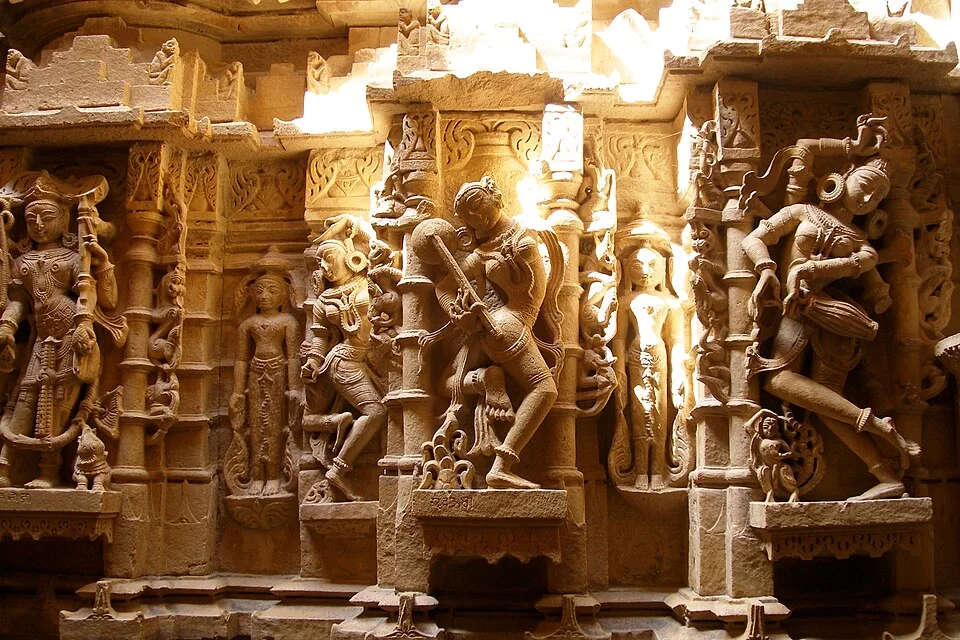
Jain temple art at Jaisalmer Fort, Rajasthan: a medieval comparison for studying ancient Jain traditions.
Credit: Vyacheslav Argenberg · CC BY 4.0 · sourceResized and converted to WebP; uncropped.
1. Religious foundations and distinctive visual language
Jain art developed around the worship of the twenty-four Tirthankaras of the present cosmic cycle and the ideals of ahimsa, aparigraha and liberation from karma. The first Tirthankara is Rishabhanatha, also called Adinatha, and the twenty-fourth is Mahavira. A Tirthankara image represents spiritual perfection rather than a creator god. Its restrained expression, balanced proportions and still posture communicate detachment from worldly activity.
Two principal postures dominate Jain sculpture: seated meditation, usually in padmasana, and standing kayotsarga, literally abandonment of attachment to the body. In kayotsarga, the figure stands erect with arms hanging beside the body. The stillness of these images contrasts with the animated attendants, dancers, animals and decorative motifs that often surround them. Jain temple art therefore should not be understood as uniformly austere: elaborate ornamentation frames the liberated being’s serenity.
Individual Tirthankaras are identified through lanchhanas, or distinguishing emblems, usually placed on the pedestal. Important examples are the bull of Rishabhanatha, elephant of Ajitanatha, horse of Sambhavanatha, conch of Neminatha and lion of Mahavira. Parshvanatha, the twenty-third Tirthankara, is especially recognisable by a canopy of serpent hoods. Rishabhanatha may also display long locks falling onto the shoulders.
Other features include the shrivatsa mark on the chest, halo, triple parasol, fly-whisk bearers and attendant yakshas and yakshis. Ambika is associated with Neminatha, while Padmavati is associated with Parshvanatha. Digambara Tirthankara images are nude; Shvetambara worship commonly includes clothed or ornamented images. Sectarian attribution should nevertheless use inscriptions and context rather than a single visual detail.
Timeline
First century BCE
Major early activity at the Jain caves of Udayagiri–Khandagiri, associated with Kharavela’s Kalinga.
Early centuries CE
Mathura flourishes as a centre of Jain images, ayagapatas and donative inscriptions.
Ninth–tenth centuries CE
Principal development of Ellora’s Jain cave group.
981 CE
Consecration of the monumental Bahubali at Shravanabelagola.
1031 CE
Foundation of Vimal Vasahi at Mount Abu.
Fifteenth century CE
Construction of Ranakpur’s celebrated Adinatha temple.
2. Early evidence: Mathura and eastern Indian caves
Mathura was a major early centre of Jain art, particularly during the early centuries CE. Excavations at Kankali Tila revealed Tirthankara images, inscriptions, architectural fragments and ayagapatas. These votive tablets carry auspicious symbols, sacred structures or Jina figures and illuminate the transition towards developed image worship. They also demonstrate that Jain sacred architecture included stupas, not only temples.
Mathura’s characteristic mottled red sandstone was used by Jain, Buddhist and Brahmanical patrons. Consequently, material and sculptural style alone cannot determine an image’s religious identity. Inscriptions and diagnostic symbols are crucial. Donative records from Mathura reveal patronage by women and lay communities as well as religious specialists, showing how urban networks supported Jain institutions.
The polished nude torso from Lohanipur near Patna is frequently interpreted as an early Jain ascetic image and assigned to the Mauryan period. However, its precise date and identification remain debated. It should not be presented as an unquestionably identified image of a particular Tirthankara.
Udayagiri and Khandagiri, near Bhubaneswar in Odisha, preserve rock-cut caves associated with Jain ascetics, especially from the first century BCE. Their generally small cells suited ascetic residence, while façades contain narrative and decorative reliefs. Rani Gumpha is a notable two-storeyed cave. The Hathigumpha inscription of Kharavela, engraved in Prakrit using Brahmi script, is a key source for ancient Kalinga. These hills must not be confused with the Gupta-period Udayagiri caves near Vidisha in Madhya Pradesh.
Identifying a Jain artwork
- 1. Establish the site, material and approximate period.
- 2. Identify the central figure’s posture and bodily features.
- 3. Look for pedestal emblems, serpent hoods or Bahubali’s creepers.
- 4. Examine attendants, inscriptions and architectural context.
- 5. Confirm the identification using multiple features rather than one shared motif.
3. Rock-cut and structural architecture
Jain patrons participated in India’s wider architectural traditions rather than developing one uniform, exclusive temple style. Rock-cut excavation, northern Nagara forms, southern temple features and regional decorative idioms were adapted to Jain worship. A sanctuary housing a Jina, pillared halls and subsidiary shrines are common components, although their arrangement varies across periods and regions.
At Badami in Karnataka, Cave 4 is a Jain excavation, generally dated to around the late sixth or seventh century CE. It contains images including Mahavira, Parshvanatha and Bahubali. At Ellora in Maharashtra, the Jain group comprises Caves 30–34, chiefly developed in the ninth and tenth centuries. Indra Sabha and Jagannatha Sabha are prominent examples. Their shrines, sculpted pillars and richly carved ceilings show that rock-cut Jain architecture could imitate structural temples.
The Dilwara temples at Mount Abu in Rajasthan are celebrated for finely carved marble, including ornate ceilings, pillars and toranas. Vimal Vasahi, dedicated to Adinatha, was founded in 1031 CE by Vimala Shah. Luna Vasahi, dedicated to Neminatha, was built in the thirteenth century under the patronage of Vastupala and Tejapala. These temples are major expressions of western Indian temple craftsmanship associated with the Maru-Gurjara tradition.
Ranakpur’s fifteenth-century Adinatha temple, associated with Dharna Shah and the patronage of Rana Kumbha, is famous for its chaumukha, or four-faced, conception and complex pillared interior. At Shatrunjaya near Palitana in Gujarat, numerous temples form a sacred hill landscape. Such complexes developed through successive building and renovation campaigns; assigning the entire ensemble to one ruler or year is misleading.
| Site | Present location | Diagnostic feature |
|---|---|---|
| Kankali Tila | Mathura, Uttar Pradesh | Ayagapatas, early Jina images and Jain stupa remains |
| Udayagiri–Khandagiri | Near Bhubaneswar, Odisha | Ascetic caves; Hathigumpha inscription |
| Ellora | Maharashtra | Jain Caves 30–34; Indra Sabha |
| Shravanabelagola | Karnataka | Monolithic Bahubali commissioned by Chamundaraya |
| Dilwara | Mount Abu, Rajasthan | Elaborate marble temple carving |
| Sittannavasal | Tamil Nadu | Jain cave shrine with surviving mural paintings |
4. Southern traditions, monumental images and painting
Karnataka became a major centre of Jain patronage under the Western Gangas and through support from sections of the Chalukya, Rashtrakuta and Hoysala elites. Jain temples in Karnataka are commonly called basadis. Their distribution illustrates the relationship between religious establishments, political patrons, merchants and regional artistic workshops.
The approximately 17.4-metre-high monolithic Bahubali at Shravanabelagola stands on Vindhyagiri, also called Indragiri. Commissioned by the Western Ganga minister and general Chamundaraya, it was consecrated in 981 CE. Bahubali, also known as Gommateshwara, was the son of Rishabhanatha; he is not one of the twenty-four Tirthankaras. Creepers winding around his legs signify prolonged motionless meditation. Later monumental Bahubali images at Karkala and Venur continued this regional tradition.
Sittannavasal in Tamil Nadu preserves paintings in a Jain rock-cut shrine. Generally associated with early medieval Pandya patronage, the surviving paintings include lotus-pond imagery, animals and human figures. They are important evidence that Jain artistic patronage extended beyond sculpture and architecture to mural painting.
Western Indian Jain manuscript painting flourished in Gujarat and Rajasthan, especially during the later medieval period. Illustrated copies of the Kalpasutra and Kalakacharya narratives were preserved in temple libraries called bhandaras. Palm-leaf manuscripts were followed by paper manuscripts. Angular figures, prominent eyes, strong outlines and bright colours characterise much of this tradition, although styles changed over time. Merchant patronage and the religious merit attached to copying and donating texts sustained manuscript production.
5. Interpretation and examination distinctions
Jain art provides evidence for religious practice, commercial wealth, craft specialisation and cultural exchange. Inscriptions are especially valuable because they can identify donors, teachers, sectarian lineages and dates more securely than stylistic impressions. Patronage was not exclusively royal: ministers, merchants, women and organised lay communities were important participants.
For image-based questions, begin with posture and distinguishing attributes. A meditating figure is not automatically the Buddha: examine the pedestal emblem, serpent canopy, chest mark and attendants. Bahubali is distinguished by creepers and must not be confused with Mahavira. Similarly, a stupa is not necessarily Buddhist, as Mathura’s Jain remains demonstrate.
For site-based questions, learn paired associations: Kankali Tila–Mathura, Udayagiri–Khandagiri–Odisha, Ellora–Maharashtra, Dilwara–Mount Abu, Ranakpur–Rajasthan and Shravanabelagola–Karnataka. Finally, separate chronology from syllabus labels. Jain art belongs to the study of ancient religious traditions, but several of its most famous monuments were constructed in the medieval period.
Jaisalmer’s Jain Temple Art: Continuity and Chronology
The metadata identifies this image with a Jain temple in Jaisalmer Fort, Rajasthan, making it directly relevant to Jain art. However, the description’s use of “ancient” should not be accepted as a precise historical classification. Jaisalmer’s celebrated Jain temple complex belongs principally to the medieval period. It therefore illustrates the later development of Jain artistic traditions rather than serving as evidence for their earliest forms. The metadata does not establish the particular temple, carved subject or date represented.
Jain temple art places the liberated Tirthankara at the centre of worship while also accommodating elaborate architectural decoration and attendant deities. Richly ornamented sacred spaces are not necessarily inconsistent with an ascetic religious ideal: they reflect lay devotion, patronage and the creation of settings for worship. For ancient India, stronger chronological anchors include Jain votive tablets, known as ayagapatas, and Tirthankara sculptures from Mathura. Comparing these with medieval Rajasthan helps trace changes in artistic media and temple settings without assuming an unchanged style across regions and centuries.
- Iconography: Tirthankaras commonly appear seated in meditation or standing in kayotsarga. Individual identification may require emblems, inscriptions or distinctive attributes; posture alone is insufficient.
- Chronology and geography: Distinguish Jaisalmer in Rajasthan from ancient Mathura in Uttar Pradesh. Shared religious affiliation does not imply the same period or artistic school.
- Evidence and interpretation: Ornate carving alone cannot establish Jain affiliation, sect or patron. Use inscriptions, securely identified images and architectural context before drawing historical conclusions.
Real-world case studies
Kankali Tila: reconstructing a community through art
Mathura’s Jain remains combine inscriptions, images and votive tablets. Studied together, they reveal lay participation and established sacred institutions rather than merely a succession of sculptural styles. The site also challenges the assumption that stupas belonged exclusively to Buddhism.
Shravanabelagola: a living monumental tradition
The Bahubali monolith remains a centre of pilgrimage and ceremonial anointing through the Mahamastakabhisheka, generally held at twelve-year intervals. It links tenth-century patronage with continuing ritual practice and illustrates the conservation needs of an exposed monument that remains actively worshipped.
Previous year questions
No source-linked PYQ is available here yet. Use the practice questions below.
Practice questions
Practice MCQ 1
Consider the following pairs: 1. Rishabhanatha — Bull 2. Neminatha — Conch 3. Mahavira — Elephant. How many pairs are correctly matched?
- A. Only one
- B. Only two
- C. All three
- D. None
Practice MCQ 2
With reference to Jain art, consider the following statements: 1. Bahubali is one of the twenty-four Tirthankaras. 2. Ayagapatas are associated with the Jain remains at Mathura. 3. Ellora contains Jain rock-cut caves. Which statements are correct?
- A. 1 and 2 only
- B. 2 and 3 only
- C. 1 and 3 only
- D. 1, 2 and 3
Practice MCQ 3
Which of the following is correctly matched?
- A. Sittannavasal — Jain manuscript library in Gujarat
- B. Hathigumpha inscription — Gupta-period Udayagiri near Vidisha
- C. Vimal Vasahi — Adinatha temple at Mount Abu
- D. Kankali Tila — Monolithic Bahubali in Karnataka
Mains practice · Jain art combines a distinctive religious iconography with participation in wider Indian artistic traditions. Discuss with suitable examples. Answer in 250 words.
- Explain kayotsarga, meditative stillness, lanchhanas and the ideal of liberation.
- Use Mathura to demonstrate shared materials and workshops alongside distinct religious identities.
- Discuss regional architectural forms through Ellora, Dilwara and Karnataka’s basadis.
- Include Bahubali sculpture, Sittannavasal murals and western Indian manuscripts.
- Highlight royal, ministerial, merchant and female patronage.
- Conclude that doctrinal distinctiveness coexisted with regional artistic exchange.
Further reading
- NCERT, An Introduction to Indian Art, Part I: post-Mauryan art and temple architecture.
- NCERT, Themes in Indian History, Part I: Thinkers, Beliefs and Buildings.
- Archaeological Survey of India: official information on Ellora, Udayagiri–Khandagiri and Sittannavasal.
- UNESCO World Heritage Centre: Ellora Caves.
- Government Museum, Mathura: Jain sculpture and Kankali Tila collections.
- Karnataka Tourism: Shravanabelagola.
- https://commons.wikimedia.org/wiki/File:Jaisalmer,_India,_Jaisalmer_Fort,_Jain_Temple,_Art_4.jpg
Preparing for UPSC Civil Services? Get classroom teaching, answer-writing evaluation and mentorship at Pragnya IAS Academy, Ashok Nagar — see why aspirants choose us for IAS coaching in Hyderabad.