

Some pained grey ware sites ca. 1100-800 bc on map. Also earlier Late Harappan, Cemetery H, Ochre coloyured pottery and Copper Hoard sites
Credit: Merikanto · CC BY 4.0 · source
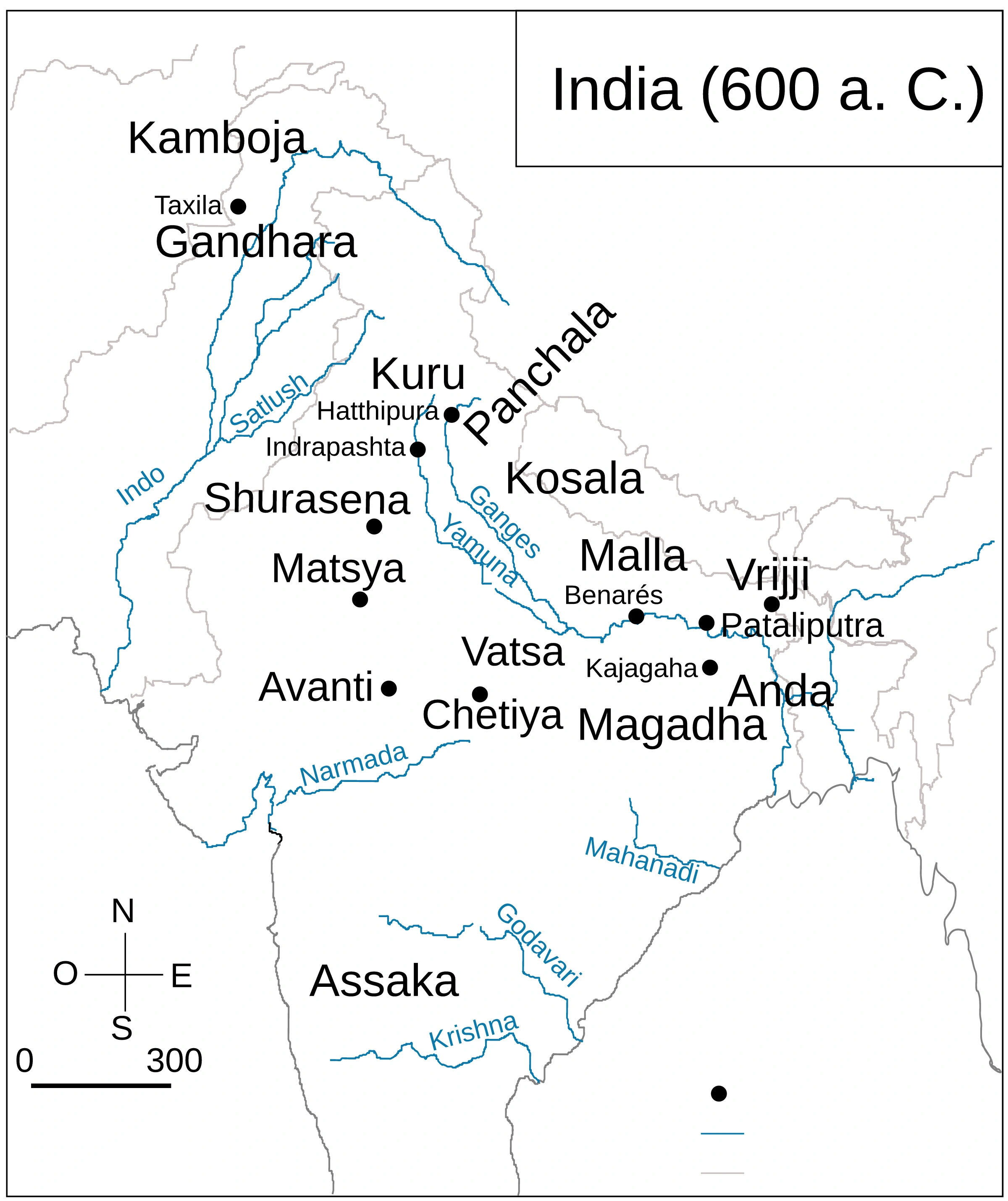
Map study
Sixteen Mahajanapadas: approximate ancient regional locations; compare Magadha and the Gangetic cluster with the northwest.
- Read the source date and legend; distinguish territory, influence and geographic location.
- Historical boundaries and reference memberships are not live political or operational data.
Credit: Rowanwindwhistler; Ski · CC BY-SA 4.0 · sourceConverted to WebP on an opaque white background; proportionally resized without cropping. Original cartography and legend retained.
Meaning, chronology and historical sources
Janapada combines jana, meaning a people or community, with pada, meaning foot or foothold. In historical usage, it refers to the territory occupied by a people and, increasingly, to the political community associated with that territory. Its importance lies in the gradual connection of collective identity, settled residence and political authority. It should not be understood as a modern nation-state with precisely surveyed borders, uniform administration or equal citizenship.
The transition towards janapadas is especially associated with the later Vedic period, conventionally dated to approximately 1000–600 BCE. Earlier Rigvedic society was organised substantially through kinship and chiefly leadership, although agriculture and settled habitation were already present. Over time, some communities occupied more durable territories, absorbed other groups and developed stronger political institutions. Jana and janapada therefore represent overlapping forms of organisation rather than two completely separate historical stages.
Evidence comes from later Vedic texts, including the Brahmanas, alongside archaeological remains. Buddhist and Jain literature provides a fuller picture of territorial polities in the subsequent period. These texts were composed and transmitted over extended periods and often reflect ritual, religious or normative concerns. Historians therefore compare literary traditions with settlement evidence rather than treating every textual description as a direct administrative record.
- Use later Vedic evidence to explain the formation of territorial communities.
- Use early Buddhist and Jain evidence cautiously when discussing their later political development.
Timeline
Approximately 1500–1000 BCE
Early Vedic society: kinship-based communities and chiefly leadership were prominent, alongside pastoralism and agriculture.
Approximately 1000–600 BCE
Later Vedic period: territorial consolidation, agricultural expansion and the prominence of Kuru-Panchala.
Around the sixth century BCE
Major territorial polities, known as mahajanapadas, became prominent in northern India.
Sixth–fifth centuries BCE
Interstate rivalry and expansion, particularly involving Magadha, reshaped the political landscape.
From communities to territories: geography and settlement
The principal geographical shift was from the north-western zones prominent in the Rigveda towards the upper Ganga–Yamuna doab and adjoining plains. This was not a single, uniform migration or a complete abandonment of older settlements. Different communities expanded, interacted and settled at different rates. The later Vedic political landscape included the Kuru and Panchala regions, while traditions concerning Kosala and Videha reflect the growing importance of areas farther east.
The Kurus occupied areas broadly corresponding to parts of present-day Haryana, Delhi and western Uttar Pradesh. Their formation is commonly associated with the coming together of earlier Bharata and Puru groups. Panchala lay mainly farther east in the upper Gangetic region, including parts of present-day western and central Uttar Pradesh. Kuru-Panchala became an influential centre for the systematisation of Vedic ritual and elite social norms.
Territorial consolidation involved clusters of villages, cultivated fields, grazing grounds, routes and places of political or ritual importance. Boundaries were often fluid and could change through warfare, alliance and incorporation. Painted Grey Ware, generally dated approximately to 1200–600 BCE with regional variation, occurs at many sites in north-western India and the upper Gangetic plain. Its distribution is relevant to this setting, but it does not independently establish the identity or borders of a particular janapada.
- Map focus: locate the Punjab-Haryana region, Ganga–Yamuna doab and the plains extending eastwards towards Kosala and Videha.
- Avoid identifying every Painted Grey Ware site as the capital or settlement of a named Vedic polity.
A simplified model of janapada formation
- 1. Communities expand settlement and interact with neighbouring groups
- 2. Agriculture and durable village networks become more important
- 3. Territorial identities and claims over resources strengthen
- 4. Chiefs mobilise contributions, military support and ritual legitimacy
- 5. Competition and incorporation enlarge some polities into mahajanapadas
Economic foundations and social differentiation
More stable agriculture supported the emergence of territorially organised communities. Cattle remained important as wealth, but cultivated land and agricultural output acquired greater significance. Later Vedic texts mention ploughing and crops such as barley and rice. Expanding cultivation could support larger settlements and sustain chiefs, ritual specialists and craft producers through contributions from cultivators.
Iron objects appear at several sites relevant to the later Vedic period, and textual expressions such as shyama ayas and krishna ayas are generally interpreted as referring to iron. Nevertheless, iron should not be presented as the single cause of janapada formation. Early iron assemblages included weapons and other objects, while the scale and timing of agricultural use varied. Environmental conditions, labour organisation, settlement expansion and political relationships were also important.
Social differentiation became more pronounced. Brahmanas and Kshatriyas developed mutually supporting claims to ritual and political authority, while Vaishyas were associated with productive activities and contributions to rulers. Shudras occupied a subordinate position in the normative varna framework. These categories did not describe every local society uniformly. Likewise, the growth of social hierarchy should not be mistaken for a fully developed later caste system or a universal regime of private landownership.
- Bali, initially a contribution or offering, increasingly acquired the character of a more regular exaction.
- Surplus production enabled political expansion, but extraction was not yet uniformly organised through an elaborate revenue bureaucracy.
| Feature | Jana | Janapada | Mahajanapada |
|---|---|---|---|
| Primary emphasis | A people or community | A territorially rooted community or realm | A major territorial polity |
| Typical historical context | Prominent in early Vedic accounts | Formation especially associated with the later Vedic period | Prominent around the sixth century BCE |
| Political organisation | Chiefly leadership and kinship ties | Increasing territorial authority | Larger monarchies or gana-sanghas |
| Examples | Bharatas and Purus | Kuru and Panchala in their earlier territorial development | Magadha, Kosala, Vatsa and Avanti |
| Essential caution | Not necessarily entirely nomadic | Not a modern state with fixed boundaries | Not invariably monarchical |
Political authority, assemblies and royal rituals
As communities became more territorially rooted, the rajan increasingly claimed authority over land and its inhabitants rather than functioning only as the leader of a kin group. Kingship tended towards greater hereditary continuity, although succession was not necessarily automatic or uncontested. Warfare, protection, redistribution and the mobilisation of contributions helped sustain chiefly authority.
The sabha and samiti continued to feature in Vedic political life. Their precise composition and functions are debated and probably changed across regions and periods. They should not be equated with modern legislatures or institutions of universal participation. The general movement towards stronger kingship could reduce the influence of wider assemblies, but the evidence does not support one identical constitutional arrangement for all janapadas.
Royal sacrifices strengthened political legitimacy. The rajasuya marked royal consecration; the vajapeya conveyed prestige and superiority; and the ashvamedha expressed expansive claims to sovereignty. These rituals linked rulers with Brahmana specialists and publicly displayed resources and status. The purohita advised and supported the ruler through ritual expertise, while the senani had military responsibilities. Such offices indicate differentiated leadership, not necessarily a large standing army or a centralised civil service.
- Ritual sovereignty and effective territorial control were related but not identical.
- Do not assume that all territorial polities were monarchies; non-monarchical traditions became particularly visible in the subsequent period.
From janapadas to mahajanapadas: significance and limits
By about the sixth century BCE, competition, incorporation and expansion had produced several larger polities conventionally called mahajanapadas. The Buddhist Anguttara Nikaya lists sixteen, including Kuru, Panchala, Kosala, Magadha, Vatsa and Avanti. Jain traditions preserve a different list, reminding us that these accounts reflect particular geographical and historical perspectives rather than an unchanging political map.
The distinction is primarily one of scale and political development. Janapada was a broader term for a territorial community or realm; mahajanapada indicated a major polity. Not every janapada became a mahajanapada, and the older term did not disappear. Some larger polities were monarchies, while others, such as the Vajji confederacy, had gana-sangha arrangements dominated by ruling lineages rather than democratic citizenship.
Janapada formation helped establish the territorial foundations of early Indian state development. The more visible expansion of towns, trade, coinage and administrative extraction belongs particularly to the mahajanapada phase and the second urbanisation. For examination purposes, distinguish the gradual later Vedic formation of territorial societies from the more consolidated political and urban landscape of the sixth century BCE onward.
- A useful sequence is kin-based community, territorial consolidation and larger polity, but it was not a compulsory path followed everywhere.
- The rise of Magadha represents a later phase of interstate competition, not the beginning of all janapadas.
Real-world case studies
Kuru-Panchala: a political and ritual centre
Kuru-Panchala illustrates how territorial consolidation and Vedic ritual culture reinforced each other. Later Vedic literature associates this region with influential rulers and ritual specialists. It offers a stronger basis for explaining early territorial organisation than projecting the institutions of the later Magadhan empire backwards.
Hastinapura: archaeology and historical caution
Excavations directed by B. B. Lal at Hastinapura in Uttar Pradesh in 1950–52 revealed a Painted Grey Ware occupation and evidence interpreted as flooding. These findings illuminate settlement history in the upper Gangetic plain. They do not independently prove the historicity of the Mahabharata narrative or establish dates for its events.
Previous year questions
No source-linked PYQ is available here yet. Use the practice questions below.
Practice questions
Practice MCQ 1
Which of the following best describes the historical significance of janapada formation?
- A. The replacement of agriculture by long-distance trade
- B. The increasing association of communities and political authority with territory
- C. The immediate establishment of a uniform imperial administration
- D. The disappearance of kinship from political life
Practice MCQ 2
Consider the following statements: 1. Kuru-Panchala was an important centre of later Vedic culture. 2. Painted Grey Ware by itself establishes the precise boundaries of named janapadas. 3. Every mahajanapada was governed by a hereditary monarch. Which of the statements given above is/are correct?
- A. 1 only
- B. 1 and 2 only
- C. 2 and 3 only
- D. 1, 2 and 3
Practice MCQ 3
With reference to later Vedic political life, consider the following pairs: 1. Rajasuya — Royal consecration 2. Senani — Military leadership 3. Bali — Exclusively a voluntary offering throughout the period. How many of the above pairs are correctly matched?
- A. Only one
- B. Only two
- C. All three
- D. None
Mains practice · The emergence of janapadas marked territorial consolidation rather than the sudden creation of fully developed states. Explain with reference to later Vedic society. Answer in 150 words.
- Define jana and janapada and establish the approximate later Vedic chronology.
- Explain settled agriculture, village networks, surplus mobilisation and community incorporation.
- Discuss stronger kingship, royal sacrifices and continuing kinship institutions.
- Use Kuru-Panchala as the principal example.
- Distinguish janapadas from later mahajanapadas and avoid technological determinism about iron.
- Conclude that political development was gradual and regionally uneven.
Further reading
- NCERT, Our Pasts–I: Kingdoms, Kings and an Early Republic.
- NCERT, Themes in Indian History, Part I: Kings, Farmers and Towns.
- R. S. Sharma, India's Ancient Past: chapters on later Vedic society and territorial states.
- Upinder Singh, A History of Ancient and Early Medieval India: From the Stone Age to the 12th Century.
- Archaeological Survey of India, Ancient India, Nos. 10–11: B. B. Lal's report on excavations at Hastinapura.
Preparing for UPSC Civil Services? Get classroom teaching, answer-writing evaluation and mentorship at Pragnya IAS Academy, Ashok Nagar — see why aspirants choose us for IAS coaching in Hyderabad.