

INDIA, Kushan Empire. Kanishka I. Circa AD 127-151. AV Dinar (20mm, 7.99 g, 12h). Main mint in Baktria (Balkh?). Late phase. ÞAONANOÞAO KA NhÞKI KOÞANO, Kanishka standing left, holding goad and scepte
Credit: User:LouisAragon (uploader) · CC BY-SA 2.5 · source

Standing Buddha-MA 6284-IMG 8459-gradient
Credit: Rama · CC BY-SA 3.0 fr · source
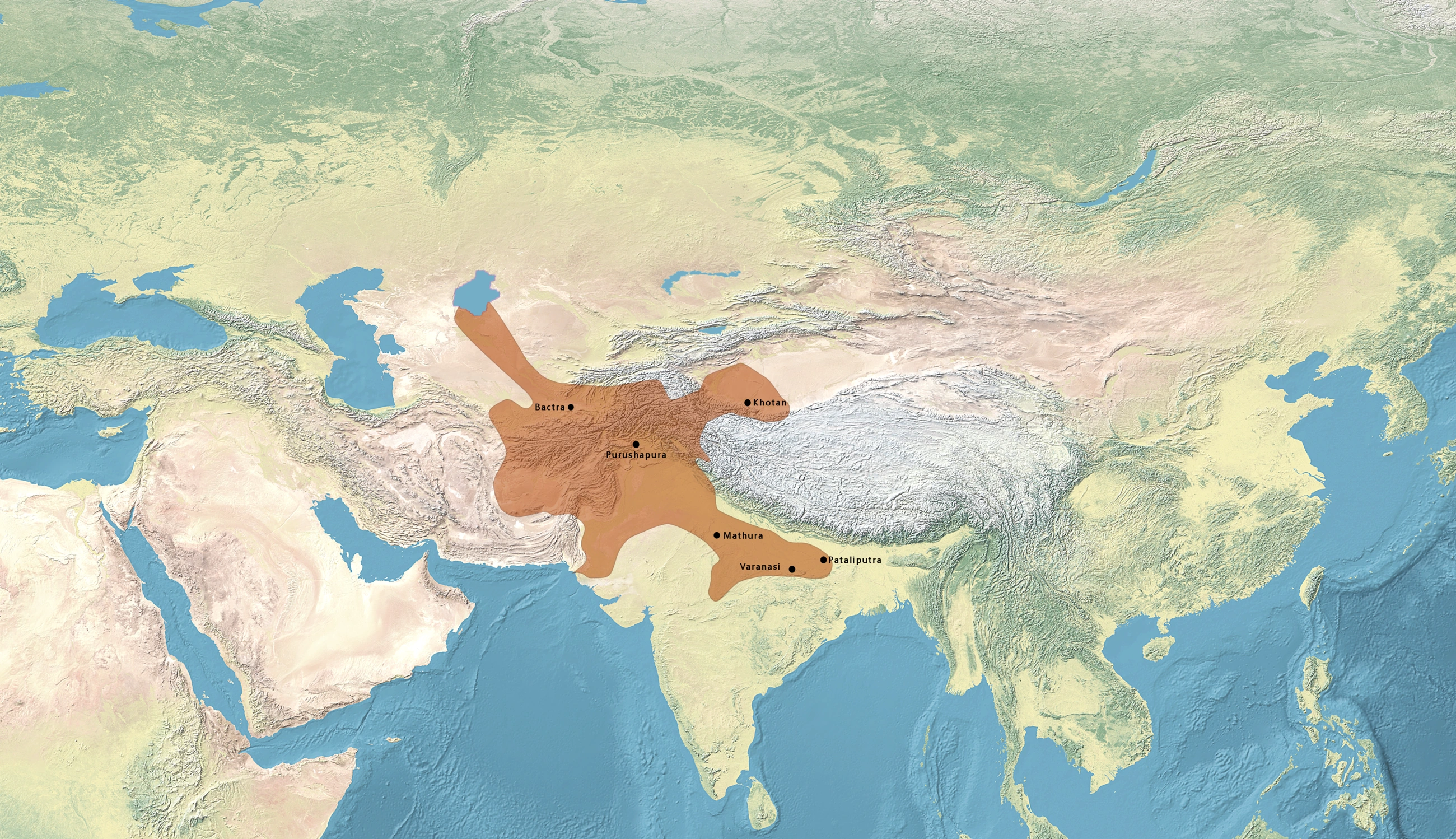
Map study
Kushan-era reconstruction: locate Central Asian–northwestern Indian routes. This is not the territorial extent of earlier Indo-Greek or Shaka kingdoms.
- Read the source date and legend; distinguish territory, influence and geographic location.
- Historical boundaries and reference memberships are not live political or operational data.
Credit: Natural Earth base map; source contributors credited on linked file page · CC BY-SA 4.0 · sourceConverted to WebP on an opaque white background; proportionally resized without cropping. Original cartography and legend retained.
Origins, expansion and historical sources
The Kushanas arose within the Yuezhi confederation, whose movements across Central Asia followed pressure from the Xiongnu during the second century BCE. Chinese historical accounts describe the Yuezhi settling in the Bactrian region, broadly north of the Hindu Kush, and dividing into five principalities. The Guishuang, identified with the Kushanas, eventually established supremacy over the others. Their history illustrates the importance of migration and interaction between Central Asia and the Indian subcontinent.
Kujula Kadphises consolidated Kushana power during the first century CE and expanded towards Afghanistan and north-western India. Evidence from the Rabatak inscription identifies a royal succession including Kujula Kadphises, Vima Taktu, Vima Kadphises and Kanishka. Vima Kadphises strengthened Kushana authority and issued substantial gold coinage. Under Kanishka, Kushana rule encompassed Bactria, Afghanistan, Gandhara and substantial parts of northern India, including Mathura. The precise limits of eastern control remain debated; inscriptions claiming extensive conquest should not automatically be treated as proof of uniform administration.
Reconstruction depends on coins, inscriptions, archaeology, Chinese histories and Buddhist literary traditions. The Rabatak inscription, discovered in Afghanistan, is particularly important for genealogy, royal claims and the use of Bactrian. Mathura inscriptions illuminate local religious donations and officials. Buddhist accounts preserve valuable memories of Kanishka, but many were composed considerably later and must be checked against contemporary evidence.
Timeline
Second century BCE
Yuezhi migrations culminated in settlement in the Bactrian region.
First century CE
Kujula Kadphises consolidated Kushana power and expanded towards north-western India.
Late first–early second century CE
Vima Kadphises strengthened the empire and issued substantial gold coinage.
Around 127 CE
Commonly accepted modern placement of Kanishka I’s accession and the beginning of his era.
Third century CE
Sasanian expansion and regional political changes reduced Kushana power.
Kanishka, chronology and political organisation
Kanishka I is remembered as the dynasty’s most prominent ruler and an important Buddhist patron. Purushapura, present-day Peshawar, was a principal imperial centre, while Mathura functioned as another major centre. The empire connected territories on both sides of the Hindu Kush rather than forming a state confined to the Indian plains. Control over routes, towns and regional elites was therefore central to its political structure.
Kushana chronology requires particular caution. Older historical writing often identified Kanishka’s accession with the beginning of the Shaka Era in 78 CE. Much modern scholarship instead places the beginning of his era around 127 CE. The Shaka Era itself begins in 78 CE, but its foundation should not be confidently attributed to Kanishka. Questions involving dates should be read carefully, separating an established calendar date from a disputed identification of its founder.
Kushana royal titles included maharaja, rajatiraja and devaputra, expressing great kingship, superiority over other rulers and a divine association. Administration employed regional officials, including kshatrapas and mahakshatrapas. Imperial government accommodated local institutions and religious establishments rather than reproducing the Mauryan system exactly. Royal statues and dynastic sanctuaries, including the devakula at Mat near Mathura, indicate the cultivation of royal prestige and dynastic commemoration.
How Kushana connectivity supported cultural exchange
- 1. Political consolidation across Bactria, Afghanistan and northern India
- 2. Access to interconnected routes and urban markets
- 3. Movement of merchants, monks, artisans and donations
- 4. Support for monasteries, workshops and religious literature
- 5. Circulation of Buddhist teachings and artistic forms across regions
Trade, towns and coinage
The Kushana Empire occupied a strategic position between the Indian subcontinent, Central Asia and the Iranian world. Routes through Bactria, Kabul, Gandhara and the upper Indus connected with wider networks conventionally called the Silk Roads. Mathura linked north-western routes with the Ganga-Yamuna region. These were intersecting overland and maritime networks, not a single road controlled entirely by one empire.
Silk, textiles, precious stones, spices and other commodities moved through these networks, accompanied by merchants, monks, artisans and diplomatic contacts. Trade with the Roman world formed part of the broader commercial setting, including Indian Ocean exchanges through western Indian ports. Political stability and access to routes could assist commerce, but the extent of direct Kushana control over particular ports and distant markets should not be assumed.
Kushana coinage is a major source for economic and cultural history. Vima Kadphises and his successors issued prominent gold series, while copper coins supported other transactions. Coins bear royal portraits, titles and diverse divine figures. Kanishka’s issues initially used Greek legends and subsequently Bactrian written in an adapted Greek script. Gold coins reveal access to bullion and high-value exchange, but do not establish that the entire economy was monetised or that all Kushana gold came from Rome.
| Feature | Gandhara | Mathura |
|---|---|---|
| Core region | North-western Pakistan and eastern Afghanistan | Mathura region, Uttar Pradesh |
| Common materials | Grey schist and stucco | Mottled red sandstone |
| Stylistic background | Classical Mediterranean-derived and regional influences | Strong indigenous sculptural and yaksha traditions |
| Typical treatment | Deep drapery folds and wavy hair | Robust bodies and relatively light clothing |
| Religious subjects | Predominantly Buddhist surviving sculpture | Buddhist, Jain and Brahmanical sculpture |
Religious patronage and intellectual exchange
Kushana religious life was plural rather than exclusively Buddhist. Coin types include Buddha and deities associated with Iranian, Greek and Indian traditions. Oesho is commonly associated with Shiva, although the deity’s historical interpretation is more complex than a simple one-to-one identification. Such imagery suggests rulers addressed varied populations and religious constituencies; it does not by itself reveal the private convictions of every king.
Buddhist tradition associates Kanishka with a council in Kashmir, commonly called the Fourth Buddhist Council in Indian historical surveys. Accounts connect it with Sarvastivada scholastic activity and the compilation of authoritative commentaries. It should not be described uncritically as the meeting that founded Mahayana Buddhism. Council numbering also differs across Buddhist traditions, making both the location and the tradition important in examination questions.
Mahayana ideas and bodhisattva devotion developed over time, while Kushana-era routes and institutions helped Buddhist texts, practices and images circulate towards Central Asia and China. Ashvaghosha, author of the Buddhacharita, is traditionally associated with Kanishka. Other famous names are also linked with his court in later accounts, but the historicity and chronology of such associations vary. Patronage came not only from kings but also from merchants, monks, nuns and lay donors.
Gandhara, Mathura and the Kushana legacy
Kushana patronage and wider social prosperity supported two major artistic centres: Gandhara and Mathura. Gandhara, centred in present-day north-western Pakistan and eastern Afghanistan, commonly used grey schist and also stucco. Its sculptures display classical Mediterranean-derived conventions, including deeply modelled drapery, wavy hair and naturalistic bodily treatment. These features were adapted to Buddhist themes rather than merely copied from foreign models.
Mathura artists commonly worked in mottled red sandstone associated with nearby quarries. Their sculpture drew strongly on indigenous traditions, including yaksha imagery, and typically emphasised robust bodies, frontal presentation and relatively light clothing. Mathura produced Buddhist, Jain and Brahmanical images as well as royal portraits. The simultaneous importance of both centres makes the claim that only Gandhara created anthropomorphic Buddha images misleading.
Kushana political power weakened during the third century CE, particularly with Sasanian expansion into former western territories and the growth of regional powers. Kushano-Sasanian authorities and smaller Kushana successor formations occupied parts of the former imperial space. This was an uneven transformation, not a single empire-wide collapse on one date. The enduring legacy included influential gold coinage, Buddhist artistic forms and the integration of northern India into Eurasian networks. For Prelims, connect each dynasty, ruler, inscription, script, deity and art material without treating cultural borrowing as evidence of political conquest.
Real-world case studies
Rabatak inscription: revising a royal genealogy
Discovered in Afghanistan in 1993, this Bactrian inscription records Kanishka’s royal lineage and imperial claims. Its naming of Vima Taktu between Kujula Kadphises and Vima Kadphises helped clarify Kushana succession. It demonstrates how epigraphy can revise reconstructions previously based largely on coin sequences and later texts.
Mathura: patronage beyond the royal court
Kushana-period remains from Mathura include Buddhist images and Jain material from Kankali Tila. Donative inscriptions reveal the participation of religious communities and lay supporters. The evidence shows why cultural production should be understood through urban society and diverse donors, not attributed solely to Kanishka’s patronage.
Previous year questions
No source-linked PYQ is available here yet. Use the practice questions below.
Practice questions
Practice MCQ 1
Consider the following statements about the Kushanas: 1. They emerged from the Yuezhi political milieu. 2. The Rabatak inscription is composed in Bactrian. 3. Their political authority was restricted to territories south of the Hindu Kush. Which of the statements given above are correct?
- A. 1 and 2 only
- B. 2 and 3 only
- C. 1 and 3 only
- D. 1, 2 and 3
Practice MCQ 2
Which one of the following statements about Kushana-period art is correct?
- A. Mathura sculpture was exclusively Buddhist.
- B. Gandhara sculpture commonly used grey schist and displayed classical Mediterranean-derived influences.
- C. Mathura artists primarily used imported white marble.
- D. Anthropomorphic Buddha images were produced only in Gandhara.
Practice MCQ 3
With reference to Kanishka I, consider the following statements: 1. His foundation of the Shaka Era in 78 CE is universally accepted. 2. Buddhist tradition associates him with a council in Kashmir. 3. His coinage includes deities from different religious traditions. Which of the statements given above are correct?
- A. 1 only
- B. 1 and 2 only
- C. 2 and 3 only
- D. 1, 2 and 3
Mains practice · The Kushana Empire was a zone of interaction between India and Central Asia rather than merely a foreign dynasty ruling northern India. Discuss with reference to commerce, religion and art. Answer in 250 words.
- Introduce Yuezhi origins and the empire’s trans-Hindu Kush geography.
- Explain the connection of Bactria, Gandhara and Mathura with wider commercial networks.
- Use gold coinage and multilingual evidence to illustrate economic and cultural interaction.
- Discuss Buddhist patronage alongside religious plurality and non-royal donations.
- Compare Gandhara and Mathura as distinct but interacting artistic traditions.
- Conclude with cultural circulation while avoiding claims of complete Kushana control over all Silk Roads.
Further reading
- NCERT, Themes in Indian History, Part I: Kings, Farmers and Towns; Thinkers, Beliefs and Buildings.
- R. S. Sharma, India’s Ancient Past.
- Upinder Singh, A History of Ancient and Early Medieval India.
- UNESCO, History of Civilizations of Central Asia, Volume II.
- British Museum collection database: Kushana coins and Gandhara sculpture.
- Government of India, National Portal: National Calendar, for the Shaka Era.
Preparing for UPSC Civil Services? Get classroom teaching, answer-writing evaluation and mentorship at Pragnya IAS Academy, Ashok Nagar — see why aspirants choose us for IAS coaching in Hyderabad.