
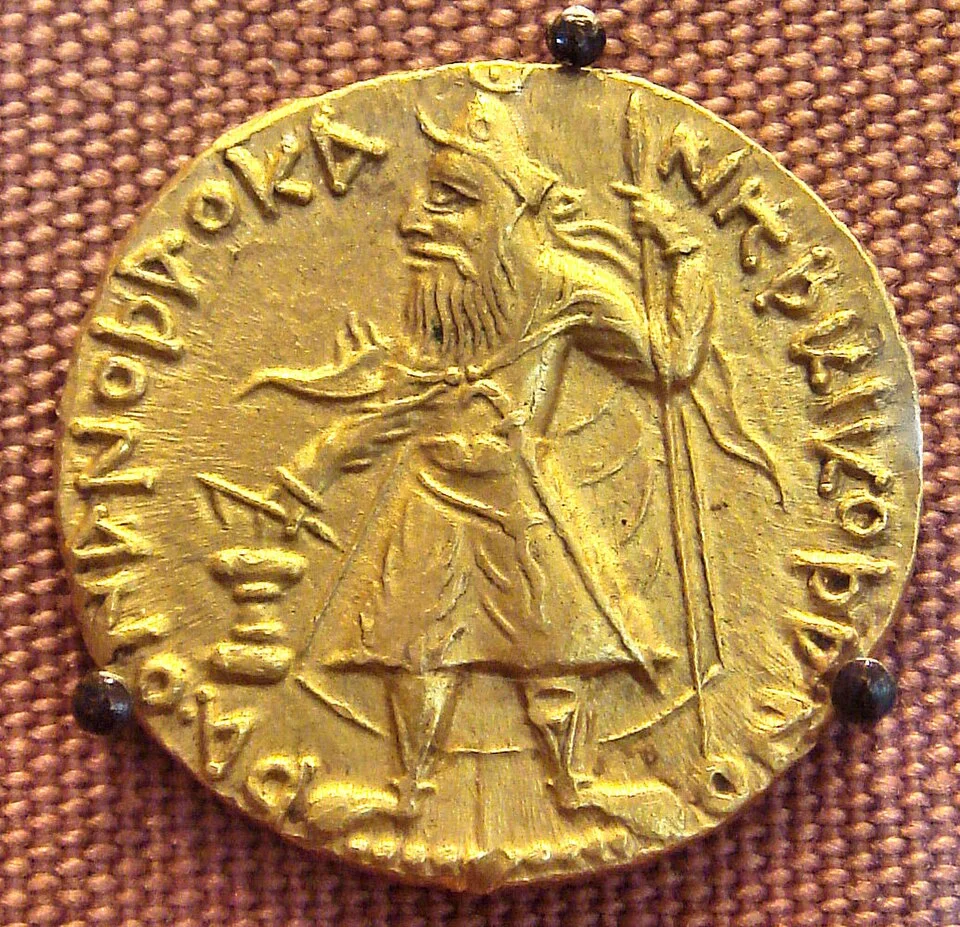
Gold coin attributed to Kanishka, held at the British Museum; illustrative numismatic evidence.
Credit: No machine-readable author provided. World Imaging assumed (based on copyright claims). · Public domain · sourceResized and converted to WebP; uncropped.
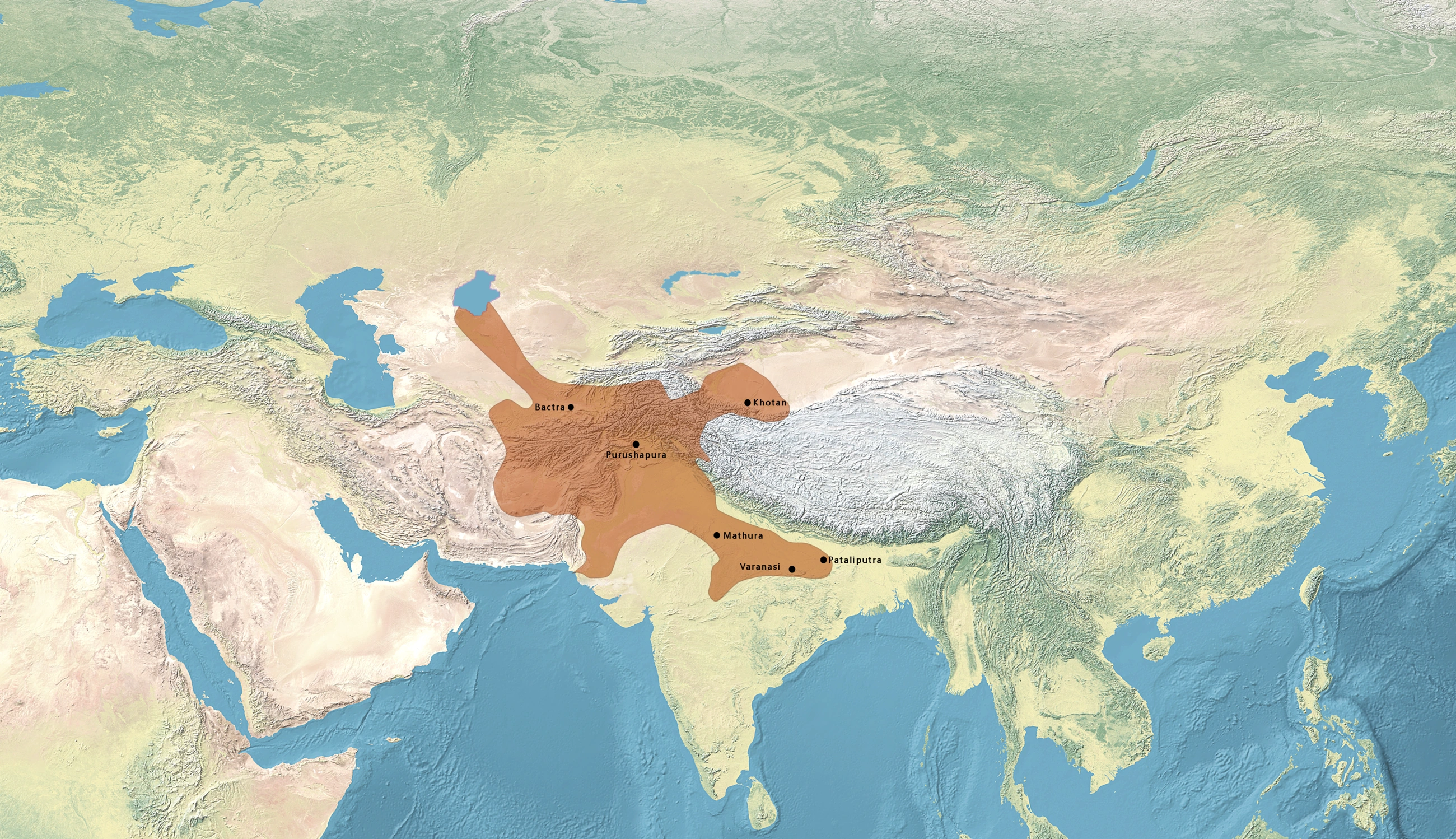
Map study
Kushan-era reconstruction: locate Central Asian–northwestern Indian routes. This is not the territorial extent of earlier Indo-Greek or Shaka kingdoms.
- Read the source date and legend; distinguish territory, influence and geographic location.
- Historical boundaries and reference memberships are not live political or operational data.
Credit: Natural Earth base map; source contributors credited on linked file page · CC BY-SA 4.0 · sourceConverted to WebP on an opaque white background; proportionally resized without cropping. Original cartography and legend retained.
1. Kushan origins, chronology and sources
Kanishka I belongs to the history of the Kushan Empire, a transregional power that developed after the decline of Mauryan authority. The Kushans emerged from one of the principal groups of the Yuezhi, who had migrated westward into Bactria. Kujula Kadphises consolidated Kushan power, while subsequent rulers extended it towards Afghanistan and the Indian subcontinent. Kanishka inherited this expanding political formation rather than founding the dynasty.
His accession date is an important examination caution. Older scholarship and many textbook summaries associated Kanishka with 78 CE, the starting point of the Saka era. A widely accepted modern reconstruction places his accession around 127 CE and distinguishes the Kanishka era from the Saka era. Candidates should recognise both conventions and avoid treating the earlier identification as an uncontested fact. The precise length of his reign also remains debated.
Evidence comes from coins, inscriptions, sculpture, Buddhist literature and Chinese accounts. The Rabatak inscription, discovered in Afghanistan in 1993, is particularly valuable because it names Kanishka and identifies his predecessors: Kujula Kadphises, Vima Taktu and Vima Kadphises. Written in Bactrian using an adapted Greek script, it illuminates royal genealogy, language and religious patronage. Later pilgrimage accounts preserve important traditions but cannot automatically be read as eyewitness testimony about his reign.
Timeline
Second century BCE
Yuezhi movements towards Central Asia form part of the background to the later emergence of Kushan power.
First century CE
Kujula Kadphises consolidates Kushan power; later rulers expand towards the Indian subcontinent.
Around 127 CE
Widely accepted modern dating of Kanishka I’s accession; older reconstructions used 78 CE.
Kanishka’s reign, second century CE
Royal patronage, varied coin issues and major Buddhist and artistic activity mark the Kushan imperial landscape.
1993
Discovery of the Rabatak inscription provides important evidence for Kushan genealogy and Kanishka’s kingship.
2. Empire, political centres and commercial geography
Kanishka ruled a realm linking Bactria and Afghanistan with Gandhara, the north-western subcontinent and areas around Mathura. Purushapura, modern Peshawar, was a principal royal centre, while Mathura was a major political, commercial and religious hub. This geography made the Kushan state a bridge between Central Asian and Indian historical developments rather than merely a kingdom within present-day national boundaries.
The Rabatak inscription lists several Indian cities, including Saketa, Kausambi and Pataliputra, within its account of royal authority. Such statements must be evaluated as imperial claims: they do not independently establish continuous direct administration across every named locality. Territorial boundaries changed, and the precise extent of Kanishka’s eastern conquests remains uncertain. Kushan inscriptions elsewhere indicate the use of officials bearing titles such as kshatrapa and mahakshatrapa, suggesting provincial arrangements rather than necessarily uniform centralised administration.
Kushan-controlled regions intersected overland routes often grouped under the term Silk Roads. These connected China, Central Asia, the Iranian world and the Mediterranean, while routes through the subcontinent connected inland centres with maritime commerce. Gold and copper coinages facilitated different kinds of exchange and advertised royal authority. Trade, urban production and donations to monasteries reinforced one another, although commerce should not be explained solely as a consequence of one ruler’s policies.
How Kushan connectivity supported cultural exchange
- 1. Political links join Central Asian and north Indian centres
- 2. Commercial routes carry merchants, goods and money
- 3. Rulers and other donors support monasteries and workshops
- 4. Monks, texts and images circulate across regions
- 5. Buddhist traditions and artistic forms acquire wider reach
3. Buddhist patronage and the Kashmir council
Kanishka is remembered as an important patron of Buddhism. A monumental stupa at Purushapura, associated with the archaeological site of Shah-ji-ki-Dheri near Peshawar, became a celebrated pilgrimage landmark. Later Chinese pilgrims described its fame and scale. Royal and non-royal patronage supported monasteries along commercial routes, helping Buddhist institutions participate in the movement of texts, teachers and artistic forms between India and Central Asia.
A Buddhist council held in Kashmir is traditionally associated with Kanishka. In common Indian examination accounts, it is called the Fourth Buddhist Council, located at Kundalvana and presided over by Vasumitra, with Ashvaghosha associated with it. However, these details derive from later traditions, and council numbering differs between Buddhist communities. Theravada traditions recognise a different fourth council in Sri Lanka. Consequently, there was no universally accepted Buddhist sequence culminating in Kanishka’s council.
The Kashmir council is especially connected with Sarvastivada scholasticism and the compilation or systematisation of Abhidharma commentaries, notably the Mahavibhasha tradition. It should not simply be described as the event that founded Mahayana Buddhism. Mahayana developed gradually through multiple communities and textual traditions. Kanishka’s age was important for its wider historical environment, but Sarvastivada and Mahayana are not interchangeable labels. Traditions also connect Ashvaghosha, author of the Buddhacharita, with Kanishka; such court associations require more caution than contemporary epigraphic evidence.
| Feature | Gandhara | Mathura |
|---|---|---|
| Core region | North-western subcontinent and adjoining Afghanistan | Mathura region of northern India |
| Common material | Schist; stucco in the wider tradition | Mottled red sandstone |
| Stylistic tendency | Classical influences, wavy hair and prominent robe folds | Robust figures and lighter or close-fitting drapery |
| Religious production | Especially associated with Buddhist sculpture | Buddhist, Jain and Brahmanical sculpture |
| Kushan connection | Major artistic flourishing under Kushan-era patronage | Major artistic centre with royal and religious images |
4. Religious diversity, inscriptions and coinage
Kanishka’s religious policy cannot be understood through Buddhist patronage alone. His coins display a varied pantheon, including Iranian deities such as Nana and Mao, Greek-derived divine figures, the Buddha and Oesho, commonly associated with Shiva. These issues reveal the empire’s culturally diverse environment and the use of religious imagery to communicate sovereignty. They do not provide a simple measure of the numerical strength of each religious community.
Early issues employed Greek legends, while Bactrian legends written in Greek characters became prominent. Some coins explicitly identify the Buddha with the legend BODDO. Royal images commonly show the king in a heavy coat and boots, reflecting Central Asian conventions of elite dress. Titles expressing elevated sovereignty, including forms equivalent to king of kings, placed Kushan monarchy within a wider Iranian and Central Asian political vocabulary.
The Rabatak inscription invokes Nana and other deities and records a royal religious foundation. It therefore complements Buddhist narratives by presenting a different dimension of royal patronage. For historians, coins and inscriptions are especially useful because they supply names, titles, languages and iconography close to the ruler’s lifetime. Nevertheless, even contemporary sources express political and religious messages. The strongest reconstruction compares them with archaeological contexts and literary evidence instead of treating any one category as complete.
5. Gandhara, Mathura and Kanishka’s historical significance
The Kushan period was a major phase in the development of anthropomorphic Buddha and bodhisattva images. Gandhara, centred in the north-western subcontinent and adjoining Afghanistan, drew on Hellenistic, Roman, Iranian and local artistic elements. Its sculptures frequently show deeply arranged robes, wavy hair and carefully modelled facial features. Schist was widely used, while stucco also became important in the broader Gandharan tradition.
Mathura developed an equally significant sculptural tradition, often using mottled red sandstone. Its figures commonly display robust bodies, a strong frontal presence and relatively light or close-fitting garments. The region produced Buddhist, Jain and Brahmanical images, demonstrating that artistic production crossed religious boundaries. The standing Kanishka statue from Mat near Mathura, now lacking its head, is an important example of royal representation through costume, inscription and monumental form.
Neither school was created by Kanishka personally, and the emergence of Buddha images should not be assigned exclusively to one ruler or one location. Artistic change involved workshops, monastic demand, merchants and other donors over time. Kanishka’s larger significance lies in the interaction of imperial integration, religious institutions and commercial mobility. For Prelims, the most productive connections are Kushan genealogy, Purushapura and Mathura, the chronology debate, Sarvastivada traditions, Bactrian inscriptions and the distinguishing features of Gandhara and Mathura art.
Kanishka: Coinage as Evidence of Kushan Rule
The supplied metadata identifies this object as a gold coin of Kanishka in the British Museum. Such coinage is directly relevant to studying Kushan kingship, monetary circulation and connections linking north-western India with Afghanistan and Central Asia. Coins can preserve royal names, titles, languages and religious imagery, helping historians reconstruct political claims alongside inscriptions. However, the metadata does not identify this coin’s legend, deity, mint or findspot; none of these details should be inferred from its attribution or present museum location.
Across Kanishka’s coinage, varied divine representations reflect an imperial environment shaped by multiple religious traditions. This diversity cautions against treating his celebrated Buddhist patronage as evidence of an exclusively Buddhist state. His reign also belongs to the wider context of Gandhara and Mathura artistic production and long-distance exchange. Gold issues are relevant to discussions of monetary resources and commerce, but one coin cannot establish trade volumes, prosperity across social groups or the precise boundaries of Kushan authority. Numismatic evidence is strongest when assessed with inscriptions, archaeological contexts and critically evaluated literary traditions.
- Chronology: Kanishka’s accession is commonly placed around 127 CE; do not automatically equate it with the Saka era beginning in 78 CE.
- Religion: Buddhist patronage and religiously diverse coinage are compatible; distinguish royal support for a tradition from exclusive religious allegiance.
- Evidence: Museum location is not archaeological provenance. A ruler’s coin found somewhere may indicate circulation, not necessarily direct political control.
Real-world case studies
Rabatak: inscription against textbook simplification
The Rabatak inscription from Afghanistan supplies a named royal genealogy and evidence of Bactrian as an imperial language. Its invocation of Nana also complicates the image of Kanishka as an exclusively Buddhist monarch. It demonstrates how a new inscription can refine chronology and political history without resolving every question about territorial control.
Shah-ji-ki-Dheri: archaeology and Buddhist memory
Excavations at Shah-ji-ki-Dheri near Peshawar uncovered remains associated with the celebrated Kanishka stupa and a relic casket. The site links material archaeology with traditions preserved by Buddhist pilgrims. The identification is historically important, but descriptions of the monument from later centuries should not automatically be projected unchanged onto its original construction.
Previous year questions
No source-linked PYQ is available here yet. Use the practice questions below.
Practice questions
Practice MCQ 1
With reference to the Rabatak inscription, consider the following statements: 1. It is written in Bactrian using an adapted Greek script. 2. It identifies predecessors of Kanishka. 3. It establishes that Kanishka patronised Buddhism to the exclusion of other religions. Which of the statements given above are correct?
- A. 1 and 2 only
- B. 2 and 3 only
- C. 1 and 3 only
- D. 1, 2 and 3
Practice MCQ 2
Which one of the following most accurately describes the Buddhist council traditionally associated with Kanishka?
- A. It is universally recognised as the Fourth Council by all Buddhist traditions.
- B. It is associated with Kashmir and Sarvastivada scholastic traditions.
- C. It first committed the Pali canon to writing in Sri Lanka.
- D. It conclusively marks the foundation of Mahayana Buddhism.
Practice MCQ 3
Consider the following pairs: 1. Purushapura — Peshawar 2. Mathura sculpture — Mottled red sandstone 3. Kanishka’s coinage — Exclusively Buddhist imagery. How many pairs are correctly matched?
- A. Only one
- B. Only two
- C. All three
- D. None
Mains practice · Kanishka’s historical significance extends beyond his reputation as a Buddhist patron. Discuss with reference to political geography, material evidence and artistic developments. Answer in 250 words.
- Introduce the Kushan Empire as a link between Central Asia and northern India.
- Explain the significance of Purushapura, Mathura and commercial routes.
- Use the Rabatak inscription and coins to demonstrate genealogy, language and religious diversity.
- Discuss Buddhist patronage while distinguishing Sarvastivada council traditions from the gradual growth of Mahayana.
- Compare Gandhara and Mathura without attributing their entire development to one ruler.
- Conclude with cultural connectivity and acknowledge uncertainties in chronology and territorial claims.
Further reading
- NCERT, Themes in Indian History, Part I: Kings, Farmers and Towns; Thinkers, Beliefs and Buildings.
- R. S. Sharma, India’s Ancient Past, Oxford University Press.
- Upinder Singh, A History of Ancient and Early Medieval India, Pearson.
- British Museum Collection Online: Kanishka coins and the Kanishka reliquary.
- Encyclopaedia Iranica: entries on Kanishka and the Kushan dynasty.
- https://commons.wikimedia.org/wiki/File:KanishkaCoin3.JPG
Preparing for UPSC Civil Services? Get classroom teaching, answer-writing evaluation and mentorship at Pragnya IAS Academy, Ashok Nagar — see why aspirants choose us for IAS coaching in Hyderabad.