
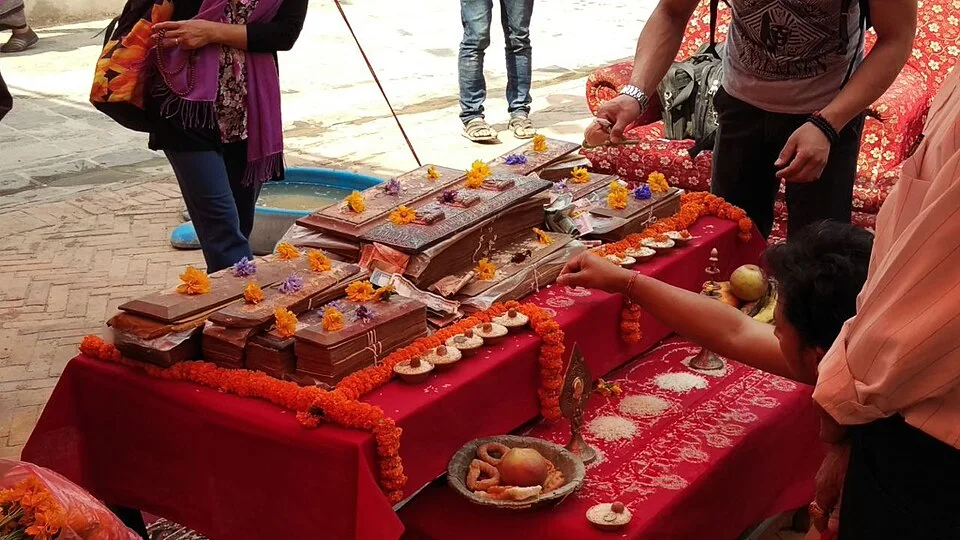
Navagrantha manuscript worship before recitation, illustrating the ritual reception of Mahayana scriptures.
Credit: Alexoneill · CC BY 4.0 · sourceResized and converted to WebP; uncropped.
1. Origins and historical setting
Mahayana was not a new religion founded in opposition to Buddhism, but a set of developments within Buddhist communities. Its early literature began taking shape around the first century BCE and the first centuries CE, although the dating of individual texts remains debated. It shared foundational Buddhist concerns with suffering, karma, rebirth, liberation and the cultivation of ethical conduct. Its distinctiveness lay particularly in its understanding of the path to Buddhahood and its recognition of additional scriptures as authoritative teachings of the Buddha.
Its growth occurred in a world of monasteries, urban centres, commercial networks and long-distance exchange. The northwestern subcontinent and connections with Central Asia were important, while other regions, including the Deccan and Andhra, also contributed to its development. Mahayana should not be reduced to a lay rebellion against monastic Buddhism: monks played major roles in composing, preserving and transmitting its texts. Mahayana practitioners could share monasteries and disciplinary lineages with Buddhists who did not accept Mahayana scriptures.
Kanishka, the Kushana ruler of the second century CE, is important for Buddhist patronage and transregional exchange. However, the council traditionally associated with him in Kashmir is linked principally to Sarvastivada scholastic traditions. The familiar claim that this council formally founded Mahayana or produced a single, definitive Mahayana–Hinayana split is historically misleading. The movement evolved over centuries, and the earliest substantial dated Chinese translations by Lokaksema in the late second century CE provide firm evidence of its early circulation.
- Exam approach: distinguish gradual religious development from textbook shorthand about a single Buddhist council.
- Mahayana identity concerned scriptures, ideals and practices; it did not necessarily entail a separate monastic ordination system.
Timeline
Around the first century BCE onward
Early Mahayana textual traditions begin taking shape; precise origins and dating remain debated.
Second century CE
Kushana patronage and transregional networks support Buddhist exchange; Lokaksema translates Mahayana texts into Chinese in the late second century.
Second–third centuries CE
Nagarjuna develops arguments central to Madhyamaka philosophy.
Fourth–fifth centuries CE
Asanga and Vasubandhu contribute foundational Yogachara works.
Early fifth century CE
Kumarajiva’s translations strengthen the transmission of Mahayana literature in China.
Seventh century CE
Xuanzang studies in India, including at Nalanda, and later undertakes major translation work in China.
2. Bodhisattva ideal, compassion and religious practice
The defining Mahayana ideal is the bodhisattva: one who seeks complete Buddhahood for the benefit of all beings. The concept of a bodhisattva existed earlier, especially in accounts of the Buddha’s previous lives, but Mahayana presented this path as an aspiration for a wider community of practitioners. Bodhicitta, the resolve to attain awakening for universal welfare, marks entry into this orientation. The bodhisattva combines compassion with wisdom rather than treating personal liberation as the sole objective.
The path is commonly organised around six paramitas, or perfections: generosity, ethical conduct, patience, energetic effort, meditation and wisdom. Some texts expand the list to ten. Upaya-kaushalya, or skill in means, describes adapting teachings to the needs and capacities of different beings. The common phrase that a bodhisattva simply “postpones nirvana” is useful only as an introductory shorthand; Mahayana traditions offer more complex accounts of awakening that avoid both bondage to samsara and withdrawal from compassionate activity.
Mahayana devotional worlds include numerous Buddhas and advanced bodhisattvas. Avalokiteshvara is associated with compassion, Manjushri with wisdom, and Amitabha with the western Pure Land, Sukhavati. Maitreya, the future Buddha, is significant across multiple Buddhist traditions and is not exclusively Mahayana. Worship, offerings, pilgrimage, merit-making, meditation and the copying or recitation of sutras coexisted with rigorous philosophical enquiry.
- The three-body doctrine distinguishes dharmakaya, sambhogakaya and nirmanakaya: broadly, the truth body, enjoyment body and manifested body of a Buddha.
- Mahayana does not discard morality or meditation; it places them within the wider aspiration to universal Buddhahood.
The bodhisattva path: a simplified conceptual sequence
- 1. Recognise suffering and cultivate compassion
- 2. Generate bodhicitta
- 3. Undertake the bodhisattva aspiration and commitments
- 4. Cultivate the paramitas
- 5. Develop wisdom with compassionate skill in means
- 6. Seek complete Buddhahood for the benefit of all beings
3. Scriptures and philosophical schools
Mahayana sutras were composed and transmitted over long periods, frequently in Sanskrit or Buddhist Hybrid Sanskrit, though their linguistic history is varied. Many survive fully only in Chinese or Tibetan translation. Important textual groups include the Prajnaparamita literature, which explores the perfection of wisdom; the Lotus Sutra, associated with skill in means and the One Vehicle; the Vimalakirti Nirdesha, featuring an exemplary lay protagonist; and Pure Land sutras concerning Amitabha and Sukhavati. No single collection functioned as an identical canon for all Mahayana communities.
Madhyamaka, associated especially with Nagarjuna around the second to third centuries CE, explains shunyata, or emptiness. Things lack svabhava, an independent, inherent essence, because they arise dependently. Emptiness therefore does not mean that nothing exists or that actions have no consequences. It challenges the tendency to regard persons and phenomena as self-sufficient realities. The distinction between conventional and ultimate truth helps explain how ordinary experience and ethical responsibility remain meaningful.
Yogachara developed systematically in the early centuries CE and is especially associated with Asanga and Vasubandhu, broadly dated to the fourth–fifth centuries. It examines cognition, the construction of experience and the transformation of consciousness. Its concepts include vijnaptimatra, often translated as “representation-only”, and alayavijnana, or storehouse consciousness. Describing Yogachara merely as the claim that the external world is imaginary obscures interpretive debates. Both Yogachara and Madhyamaka seek liberation through overcoming ignorance, despite important differences in analysis.
- Useful association: Nagarjuna–Madhyamaka–emptiness.
- Useful association: Asanga and Vasubandhu–Yogachara–analysis of cognition.
| Term | Meaning or association | Important caution |
|---|---|---|
| Bodhicitta | Aspiration to Buddhahood for the welfare of all beings | Not merely a general feeling of kindness |
| Paramitas | Perfections cultivated on the bodhisattva path | Six are commonly listed; some texts give ten |
| Shunyata | Emptiness of independent, inherent existence | Not denial of conventional reality or karma |
| Upaya-kaushalya | Skill in means suited to different capacities | Especially prominent in the Lotus Sutra |
| Avalokiteshvara | Bodhisattva associated with compassion | Distinct from Amitabha, who is a Buddha |
4. Institutions, art and transmission across Asia
Monastic centres, translators, pilgrims and traders carried Mahayana beyond India. Nalanda in present-day Bihar became a major centre of Buddhist learning from the Gupta period onward. Its curriculum was not exclusively Mahayana: Buddhist philosophy, logic, grammar and other subjects were studied. The Chinese pilgrim Xuanzang studied there in the seventh century, including under Shilabhadra, and transmitted important Indian Buddhist learning to China.
Overland networks connected northwestern India with Central Asian oases and China, while maritime routes linked India with Southeast Asia and East Asia. Kumarajiva’s early fifth-century translations and Xuanzang’s seventh-century translations helped shape Chinese Buddhism. From China, Mahayana traditions spread to Korea and Japan, producing diverse schools such as Tiantai, Huayan, Chan and Pure Land. Tibetan Buddhism developed on a Mahayana foundation while also incorporating extensive Vajrayana systems.
Mahayana encouraged rich representations of bodhisattvas, celestial Buddhas and Buddha-fields. Nevertheless, the emergence of anthropomorphic Buddha images at Gandhara and Mathura around the early centuries CE cannot be attributed exclusively to Mahayana. Buddha images and devotional practices also occur in non-Mahayana traditions. Art-historical attribution should therefore consider inscriptions, iconography and context rather than assuming that every Buddha statue indicates Mahayana affiliation.
- Padmapani, the lotus-bearing form of Avalokiteshvara, is a frequent identification point in Buddhist art.
- Vajrayana is historically related to Mahayana but is distinguished by esoteric initiation, mantras, mandalas and specialised ritual practices.
5. Comparisons and common examination traps
Mahayana and Theravada share the Buddha’s fundamental concern with liberation from suffering, ethical discipline, meditation and insight. Mahayana particularly elevates the universal bodhisattva aspiration, whereas the arahant ideal is prominent in Theravada. This is a difference of emphasis, not proof that Theravada lacks compassion or any concept of the bodhisattva. Likewise, Mahayana includes disciplined monastic life rather than being simply a religion of householders.
Theravada preserves its canonical literature in Pali and is especially influential today in Sri Lanka, Myanmar, Thailand, Cambodia and Laos. Mahayana relies on different textual collections preserved prominently in Chinese and Tibetan as well as surviving Sanskrit works. Language and geography are useful comparative indicators, but neither supplies an infallible classification of every Buddhist text or historical community.
For statement-based questions, avoid absolute claims: Mahayana was not created by Kanishka alone; Sanskrit was not its only language; image worship was not its exclusive possession; and shunyata does not mean nihilism. “Hinayana”, meaning “Lesser Vehicle”, originated as a disparaging designation in some Mahayana literature. When discussing actual historical schools, use their specific names, such as Theravada or Sarvastivada, wherever possible.
- Keep three analytical levels separate: philosophical school, monastic disciplinary lineage and devotional practice.
- Treat Buddhist traditions as internally diverse and historically changing, not as rigidly opposed blocks.
Mahayana Scriptures and the Veneration of Texts
The supplied metadata identifies a Navagrantha ritual centred on nine Buddhist scriptures, including the Aṣṭasāhasrikā Prajñāpāramitā and the Lotus Sutra. This makes the image directly relevant to Mahayana: scriptures could function not only as sources of doctrine but also as objects of veneration, recitation and merit-making. Prajñāpāramitā literature connects the bodhisattva path with wisdom concerning emptiness, while the Lotus Sutra develops themes of skilful means and the universal promise of Buddhahood. These texts nevertheless belong to a diverse literary tradition, not a single uniform creed.
For Ancient India, this ritual offers a comparative illustration of the continuing reception of Buddhist literature associated with Indian traditions; it is not archaeological evidence for a particular ancient Indian ceremony. The metadata mentions vajrācārya officiants, protective texts and maṇḍala offerings, indicating a ritual setting that should not be treated as representative of all Mahayana communities. It supplies neither a secure location nor an ancient date. The example therefore helps explain how textual devotion, philosophical study and ritual practice can coexist, without establishing when or where those combinations first developed.
- Bodhisattva ideal: bodhicitta is the aspiration to attain Buddhahood for all beings; compassion and wisdom are complementary, not competing, commitments.
- Doctrinal distinction: emptiness means the absence of intrinsic, independent existence; it should not be confused with nihilism or the denial of conventional reality.
- Exam caution: manuscript or image worship alone cannot identify Mahayana; Mahayana and Vajrayana overlap historically, but are not interchangeable labels.
Real-world case studies
Ajanta: bodhisattva imagery in the Deccan
The celebrated Padmapani painting in Cave 1 at Ajanta, Maharashtra, belongs to the later phase of the site's artistic activity, broadly associated with the fifth-century Vakataka period. Its lotus-bearing bodhisattva illustrates the prominence of compassionate figures in Buddhist visual culture. Ajanta also contains much earlier caves, so the entire complex should not be assigned to one date or one uniform religious phase.
Borobudur: Mahayana beyond India
Borobudur in Central Java, Indonesia, was constructed in the eighth–ninth centuries under the Shailendra dynasty. Its terraced arrangement, Buddhist reliefs and numerous Buddha images demonstrate the adaptation of Buddhist sacred architecture in Southeast Asia. Reliefs drawing on the Gandavyuha tradition illustrate the quest for awakening, making the monument a valuable example of Mahayana’s transregional influence.
Previous year questions
No source-linked PYQ is available here yet. Use the practice questions below.
Practice questions
Practice MCQ 1
With reference to Mahayana Buddhism, consider the following statements: 1. Bodhicitta involves the aspiration to attain Buddhahood for the benefit of all sentient beings. 2. Shunyata necessarily implies that ethical actions have no consequences. 3. Mahayana practitioners could share monastic disciplinary lineages with non-Mahayana Buddhists. Which of the statements given above are correct?
- A. 1 and 2 only
- B. 2 and 3 only
- C. 1 and 3 only
- D. 1, 2 and 3
Practice MCQ 2
Which one of the following pairs is incorrectly matched?
- A. Nagarjuna — Madhyamaka
- B. Asanga — Yogachara
- C. Avalokiteshvara — Compassion
- D. Amitabha — Future Buddha succeeding Shakyamuni
Practice MCQ 3
Which of the following provides the most accurate account of the historical development of Mahayana?
- A. It was founded by a decree issued at Kanishka’s Buddhist council.
- B. It developed gradually through new scriptures, ideals and practices within Buddhist communities.
- C. It rejected monastic discipline and restricted religious practice to householders.
- D. It alone introduced and used anthropomorphic images of the Buddha.
Mains practice · Explain the distinctive religious and philosophical features of Mahayana Buddhism. How did its transmission contribute to cultural exchange between India and other Asian regions? Answer in 250 words.
- Introduce Mahayana as a gradual development within Buddhism rather than a movement with a single founder.
- Explain bodhicitta, the bodhisattva path, compassion, wisdom and the paramitas.
- Outline Madhyamaka and Yogachara without equating emptiness with nihilism.
- Discuss monasteries, trade routes, translators and pilgrims as channels of transmission.
- Use Nalanda, Xuanzang, Ajanta and Borobudur as examples.
- Conclude with adaptation and diversity rather than depicting Asian Buddhism as a uniform Indian export.
Further reading
- NCERT, Themes in Indian History, Part I, chapter: Thinkers, Beliefs and Buildings.
- Upinder Singh, A History of Ancient and Early Medieval India.
- Paul Williams, Mahayana Buddhism: The Doctrinal Foundations.
- UNESCO World Heritage Centre: Ajanta Caves, Borobudur Temple Compounds, and Archaeological Site of Nalanda Mahavihara.
- Archaeological Survey of India: official information on Ajanta and Nalanda.
- https://commons.wikimedia.org/wiki/File:Navagrantha_P%C4%81%E1%B9%ADha.jpg
Preparing for UPSC Civil Services? Get classroom teaching, answer-writing evaluation and mentorship at Pragnya IAS Academy, Ashok Nagar — see why aspirants choose us for IAS coaching in Hyderabad.