
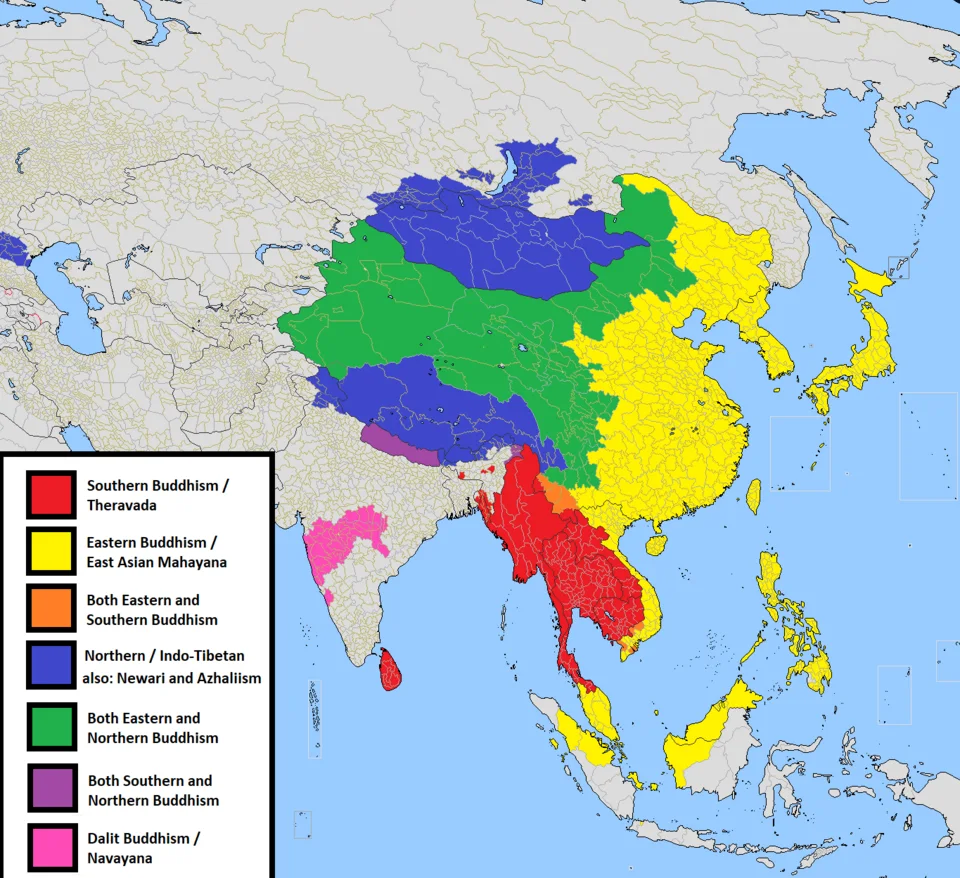
Map of major modern Buddhist traditions, illustrating Theravada’s regional context rather than ancient boundaries.
Credit: Javierfv1212 · CC BY-SA 3.0 · sourceResized and converted to WebP; uncropped.
1. Identity and historical origins
Theravada is a Buddhist tradition that presents itself as preserving the teaching and discipline transmitted by the early elders of the sangha. It belongs to the broader historical family associated with the Sthaviras, one of the groupings that emerged as the early Buddhist community differentiated into schools. However, a simple equation between the earliest Sthaviras and present-day Theravada is misleading: institutional lineages, doctrinal classifications and regional identities developed over centuries.
The historical Buddha taught in the middle Gangetic region during the first millennium BCE. Theravada accepts the Buddha as a fully awakened teacher who discovered and explained the path to liberation. It does not posit a creator god as the source of salvation. Deities appear in its cosmology, but they remain within samsara, the cycle of rebirth, and are not permanent or omnipotent beings.
Sri Lankan chronicles, especially the Dipavamsa and Mahavamsa, connect the island’s Buddhist establishment with Mahinda, traditionally identified as Ashoka’s son. Sanghamitta is credited with bringing a branch of the Bodhi tree and establishing the community of Buddhist nuns. These accounts are central to Theravada historical memory, but they were written centuries after the events. Ashokan inscriptions establish royal support for Buddhism and wide diplomatic contacts; they do not independently confirm every detail of the later chronicles.
- Geographical anchor: Anuradhapura in Sri Lanka, especially the Mahavihara.
- Historical caution: Buddhist councils and school genealogies are described differently in different traditions.
Timeline
Third century BCE
Sri Lankan tradition places Mahinda’s mission and Sanghamitta’s arrival during the reign of Devanampiya Tissa.
First century BCE
Traditional dating of the writing down of the Pali canon in Sri Lanka.
Fifth century CE
Buddhaghosa works in Sri Lanka and composes the Visuddhimagga.
Eleventh century CE
Bagan under Anawrahta becomes a major centre of Buddhist patronage in Myanmar.
Twelfth–fourteenth centuries CE
Sri Lankan-linked monastic networks strengthen Theravada across mainland Southeast Asia.
2. Teachings and the path to liberation
Theravada centres on the Four Noble Truths: dukkha, its origin in craving, its cessation, and the path leading to cessation. Dukkha includes suffering, instability and the inability of conditioned existence to provide lasting satisfaction. The Noble Eightfold Path comprises right view, intention, speech, action, livelihood, effort, mindfulness and concentration. These are commonly organised into wisdom, ethical conduct and mental cultivation.
Three characteristics frame its understanding of existence: anicca, impermanence; dukkha, unsatisfactoriness; and anatta, not-self. Anatta rejects an enduring, independent self underlying the changing aggregates of experience. Dependent origination explains how phenomena arise through conditions rather than through a permanent creator or self. Karma refers especially to intentional action and its consequences; it should not be confused with fatalism or the claim that every experience results exclusively from past deeds.
The arhat, or arahant in Pali, is a person who has eliminated the defilements responsible for continued rebirth. Nibbana, the Pali equivalent of nirvana, is liberation through the extinguishing of greed, hatred and delusion. It is neither entry into a permanent heavenly world nor the destruction of an eternal soul. Theravada also recognises the bodhisatta, a being progressing towards Buddhahood; therefore, saying that it entirely rejects the bodhisattva concept is incorrect.
Meditative training includes samatha, cultivation of tranquillity and concentration, and vipassana, insight into the nature of experience. Their relationship varies across teachers and lineages. Ethical discipline and wisdom remain indispensable: reducing Theravada to a meditation technique misses its comprehensive religious and philosophical framework.
- Shared Buddhist foundations include the Four Noble Truths, karma, rebirth and liberation.
- The arhat ideal is prominent, but generosity, compassion and concern for others are also important.
Threefold training: a mutually reinforcing path
- 1. Sila: cultivate ethical conduct through speech, action and livelihood
- 2. Samadhi: develop the mind through effort, mindfulness and concentration
- 3. Panna: deepen wisdom through right view and intention
- 4. Liberation: eliminate craving and defilements, realising nibbana
3. Scriptures, language and intellectual traditions
The Pali Tipitaka is Theravada’s canonical foundation. The Vinaya Pitaka concerns monastic discipline and the organisation of the sangha. The Sutta Pitaka contains discourses arranged into five Nikayas: Digha, Majjhima, Samyutta, Anguttara and Khuddaka. The Abhidhamma Pitaka offers systematic analyses of experience and mental and material phenomena. The Dhammapada and the canonical Jataka verses belong to the Khuddaka Nikaya, while much familiar Jataka narrative detail comes from commentarial literature.
Pali is a Middle Indo-Aryan literary language. It should not simply be identified as the Buddha’s exact spoken language or as an exclusively Sri Lankan language. Buddhist teachings circulated orally before being written down. According to Sri Lankan tradition, the canon was committed to writing during the reign of Vattagamani Abhaya, conventionally placed in the first century BCE, amid threats to the continuity of oral transmission.
Commentaries helped explain and organise the inherited scriptures. Buddhaghosa, active in Sri Lanka in the fifth century CE, was especially influential. His Visuddhimagga, or Path of Purification, synthesises ethical discipline, concentration and wisdom. It is a major post-canonical manual, not a fourth division of the Tipitaka. The Mahavamsa is similarly a historical-religious chronicle, not a Pitaka.
- Remember the distinction between canonical texts, commentaries, meditation manuals and chronicles.
- Theravada preserves a complete Tipitaka in Pali, but early Buddhist literature also survives in other languages and traditions.
| Text or collection | Status | Principal significance |
|---|---|---|
| Vinaya Pitaka | Canonical | Monastic rules and institutional discipline |
| Sutta Pitaka | Canonical | Discourses organised into five Nikayas |
| Abhidhamma Pitaka | Canonical | Systematic analysis of phenomena |
| Visuddhimagga | Post-canonical manual | Buddhaghosa’s synthesis of the path of purification |
| Mahavamsa | Chronicle | Sri Lankan royal and Buddhist historical traditions |
4. Sangha, lay society and regional expansion
The sangha consists of ordained practitioners governed by the Vinaya. Monastic life ideally involves restraint, study, meditation and dependence on offerings rather than ordinary household accumulation. Lay followers support monasteries through dana, or generosity, and commonly observe the Five Precepts: abstaining from killing, stealing, sexual misconduct, false speech and intoxicants. Merit-making, festivals, pilgrimage and devotional practices connect monasteries with wider society.
Theravada Buddhism spread through overlapping movements of monks, merchants, manuscripts and royal patronage. Sri Lanka was an important source of ordination lineages and textual authority, but transmission was not simply a one-way export. Southeast Asian centres repeatedly exchanged monks and learning with the island. In Myanmar, the eleventh-century Bagan kingdom under Anawrahta was a major centre of Buddhist patronage, although its religious landscape included multiple traditions.
Sri Lankan-linked monastic networks gained influence in mainland Southeast Asia during the second millennium CE. Theravada became closely associated with the Sukhothai kingdom and later Thai polities; it also became dominant in Cambodia and Laos. These changes were gradual and did not immediately eliminate Brahmanical practices, local spirit worship or older Buddhist traditions. Religious coexistence and adaptation are essential to understanding the region.
Ordination history also reveals institutional change. The ancient Sri Lankan bhikkhuni lineage ceased to function locally, while modern efforts have revived women’s higher ordination through transnational Buddhist cooperation. Recognition of these ordinations remains contested among some Theravada authorities.
- Monasteries have historically served as centres of education, manuscript preservation and cultural production.
- Modern Indian Theravada institutions exist, but Ambedkar’s Navayana should not automatically be classified as Theravada.
5. Distinctions and common examination traps
Theravada and Mahayana share substantial foundations, including the authority of the Buddha, ethical cultivation and liberation from suffering. They differ in scriptural authority, doctrinal interpretation and the emphasis placed on particular spiritual ideals. Mahayana gives special prominence to the bodhisattva path directed towards Buddhahood for the benefit of all beings and accepts a wider body of sutras. However, neither tradition is internally uniform.
Hinayana, literally a lesser vehicle, is a polemical expression found in some Mahayana literature. It referred broadly to positions criticised by those authors, not to one precisely bounded living school. Using it as an exact synonym for Theravada is historically inaccurate. Likewise, early Buddhist art’s use of symbols such as the Bodhi tree or empty throne cannot be turned into a claim that Theravada permanently prohibited Buddha images. Buddha-image worship is widespread in Theravada countries.
For Prelims, connect Theravada with the Pali canon, Sri Lanka, the arhat ideal and mainland Southeast Asia, while avoiding absolute statements. Pali does not contain all Buddhist literature; Theravada is not the only tradition that values monastic discipline; and compassion is not exclusive to Mahayana.
- Avoid equating Theravada with unchanged Buddhism from the Buddha’s lifetime.
- Distinguish the historical spread of a tradition from later claims about its origins.
Theravada: Modern Distribution and Ancient Connections
The supplied metadata identifies this image as a map of major modern Buddhist traditions, making it relevant to Theravada’s contemporary geographical setting. Theravada is especially prominent in Sri Lanka, Myanmar, Thailand, Cambodia and Laos. This distribution helps explain the tradition’s transregional character, but it must not be read as a map of ancient Buddhist schools. Modern religious predominance reflects successive processes of transmission, patronage, institutional reform and interaction with local traditions; it does not imply religious uniformity within national borders.
For ancient Indian history, Theravada is important through its connections with early Buddhist teachings, monastic lineages and the Pali Tipitaka. Sri Lanka became a crucial centre for preserving and interpreting this textual tradition, while maritime and overland networks connected South Asia with Southeast Asia. These overseas traditions provide comparative and transmission contexts, not direct archaeological evidence for Buddhism at particular Indian sites. The arhat ideal and emphasis on monastic discipline are important study themes, but neither should be treated as wholly exclusive to Theravada.
- Textual distinction: The Pali Tipitaka comprises Vinaya, Sutta and Abhidhamma; its preservation does not establish that the Buddha taught exclusively in Pali.
- Terminological caution: Theravada is not interchangeable with all early Buddhist schools or with “Hinayana,” a polemical label rather than a neutral synonym.
- Map-reading limit: Use modern distribution to contextualise living traditions; reconstruct ancient Indian affiliations using dated inscriptions, texts and archaeological evidence.
Real-world case studies
Anuradhapura: religion, kingship and sacred geography
The Mahavihara, traditionally founded under Devanampiya Tissa, became a leading centre of Theravada learning. The Sri Maha Bodhi links the island’s sacred geography to Bodh Gaya through the tradition of Sanghamitta’s mission. Together, monastery, royal patronage and pilgrimage illustrate how Buddhism acquired durable institutions beyond India.
Kuthodaw Pagoda: preserving scripture in stone
At Mandalay in Myanmar, King Mindon sponsored the inscription of the Pali Tipitaka on 729 marble slabs in the nineteenth century. Each slab is housed in a small shrine at the Kuthodaw complex. The project demonstrates the continuing relationship between royal legitimacy, textual preservation and public Buddhist monuments.
Previous year questions
UPSC Prelims 2013
Which of the following best describes the Buddhist concept of Nirvana?
- A. Extinction of the flame of desire
- B. Complete annihilation of self
- C. A state of bliss and rest
- D. A mental stage beyond all comprehension
Practice questions
Practice MCQ 1
Consider the following pairs: 1. Vinaya Pitaka — Monastic discipline; 2. Visuddhimagga — One of the three canonical Pitakas; 3. Mahavamsa — Sri Lankan chronicle. Which pairs are correctly matched?
- A. 1 only
- B. 1 and 3 only
- C. 2 and 3 only
- D. 1, 2 and 3
Practice MCQ 2
With reference to Theravada Buddhism, consider the following statements: 1. It recognises the bodhisatta concept. 2. It regards deities as eternal creators beyond samsara. 3. Buddha-image worship is found in its living traditions. Which statements are correct?
- A. 1 and 2 only
- B. 2 only
- C. 1 and 3 only
- D. 1, 2 and 3
Practice MCQ 3
Which of the following groups consists entirely of countries where Theravada is the predominant Buddhist tradition?
- A. Sri Lanka, Thailand and Laos
- B. Japan, Myanmar and Cambodia
- C. Sri Lanka, Bhutan and Thailand
- D. Mongolia, Laos and Myanmar
Mains practice · Explain the principal features of Theravada Buddhism and examine the role of Sri Lanka in its transmission to Southeast Asia. Answer in 250 words.
- Define Theravada without treating it as synonymous with all early Buddhism.
- Explain the Pali Tipitaka, Four Noble Truths, threefold training and arhat ideal.
- Discuss Mahinda traditions, Anuradhapura, the Mahavihara and Buddhaghosa.
- Connect ordination networks, royal patronage, maritime contacts and manuscript circulation.
- Use Myanmar and Thailand as examples; emphasise gradual expansion and reciprocal exchanges.
- Conclude that transmission combined doctrinal continuity with regional adaptation.
Further reading
- NCERT, Themes in Indian History, Part I: Thinkers, Beliefs and Buildings.
- NCERT, Our Pasts–I: New Questions and Ideas.
- UNESCO World Heritage Centre: Sacred City of Anuradhapura.
- UNESCO Memory of the World: Maha Lawkamarazein or Kuthodaw Inscription Shrines.
- Rupert Gethin, The Foundations of Buddhism.
- SuttaCentral: translations and comparative resources for early Buddhist texts.
- https://commons.wikimedia.org/wiki/File:Buddhist_sects.png
Preparing for UPSC Civil Services? Get classroom teaching, answer-writing evaluation and mentorship at Pragnya IAS Academy, Ashok Nagar — see why aspirants choose us for IAS coaching in Hyderabad.