
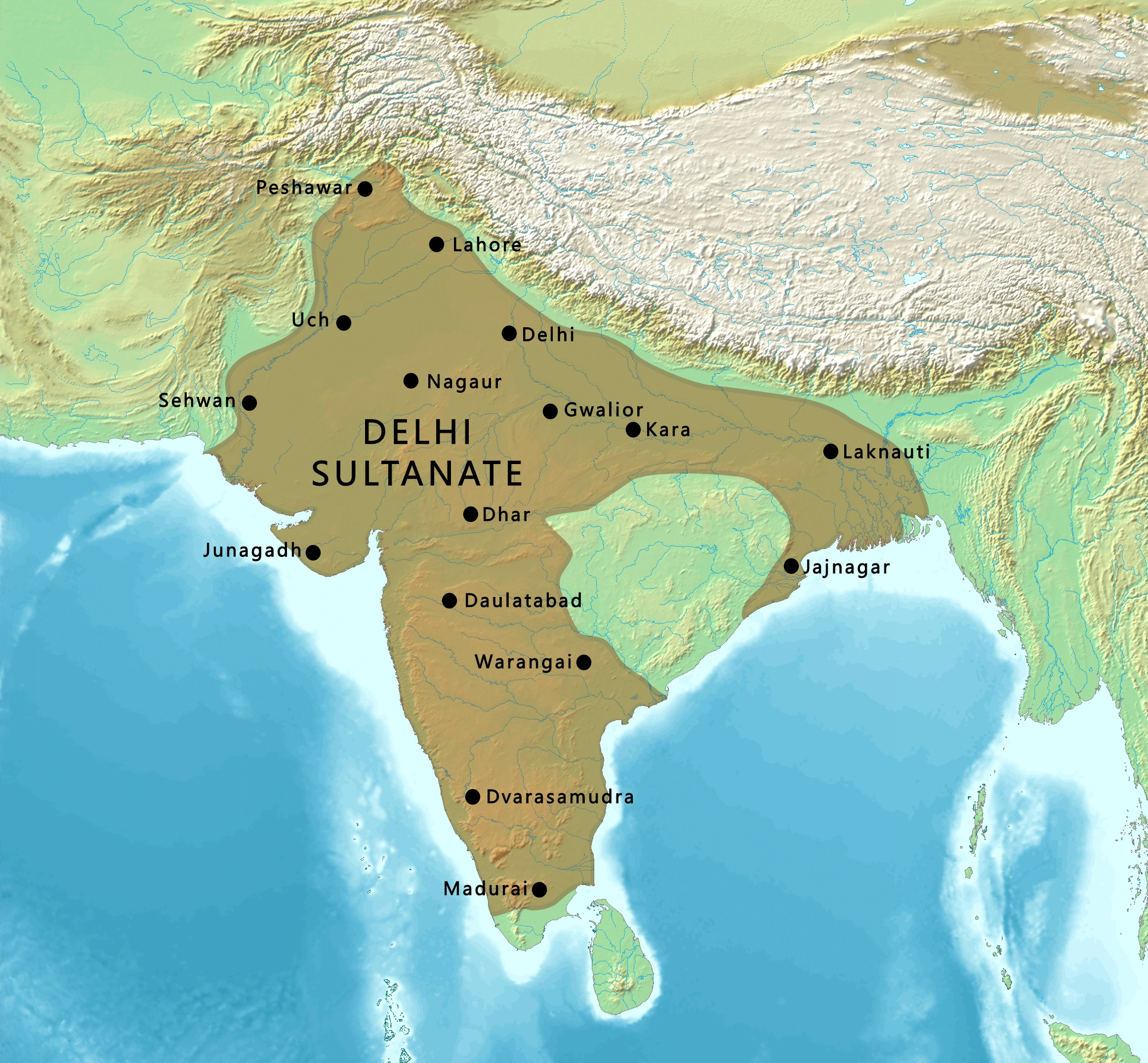
Map study
Delhi Sultanate territorial overview: regional orientation, not the exact boundary of every Sultan’s reign.
- Read the source date and legend before interpreting territorial extent.
- Compare core regions, neighbouring powers and geographic barriers; historical borders and influence are approximate and changed over time.
Credit: Koba-chan; DEMIS base map · CC BY-SA 3.0 · sourceConverted to WebP on an opaque white background; proportionally resized without cropping. Original cartography and legend retained.
1. Origins, terminology and historical sources
The Mamluk dynasty emerged from the Ghurid conquests of northern India. Muhammad Ghori’s victory over Prithviraja III at the Second Battle of Tarain in 1192 facilitated Turkish expansion, although conquest and consolidation remained prolonged processes. Ghori generally governed his Indian acquisitions through commanders, notably Qutb-ud-din Aibak. After Ghori’s death in 1206, his territories fragmented among competing successors, and Aibak assumed independent authority in India.
The conventional name Slave dynasty requires qualification. Aibak, Iltutmish and Balban had experienced slavery before rising through military service, but not every ruler of the dynasty had been a slave. Elite military slavery could provide training, patronage and access to high office; it should not be confused with the absence of social coercion. Historians also use the terms Mamluk dynasty and early Turkish rulers. Political loyalty often centred on a master’s household, creating both opportunities for advancement and intense competition after his death.
Important narrative sources include Hasan Nizami’s Taj-ul-Maasir and Minhaj-i-Siraj’s Tabaqat-i-Nasiri. Ziya-ud-din Barani’s later Tarikh-i-Firuz Shahi is especially influential for understanding Balban’s monarchy. These chronicles reflect courtly, religious and elite perspectives rather than neutral descriptions of society. Coins, inscriptions and surviving buildings help historians check political claims, titles, chronology and patterns of patronage.
- Do not confuse the Indian Mamluks with the separate Mamluk Sultanate of Egypt and Syria.
- The dynasty’s authority was uneven: control of major towns and routes did not imply uniform administration across every claimed territory.
Timeline
1206
Muhammad Ghori dies; Aibak establishes independent rule in India.
1211
Iltutmish takes the throne after defeating Aram Shah.
1216–1229
Iltutmish defeats Yildiz, overcomes Qabacha and obtains Abbasid caliphal recognition.
1236–1240
Raziyya rules the Delhi Sultanate.
1246–1266
Nasir-ud-din Mahmud reigns; Balban becomes the dominant deputy.
1266–1287
Balban rules; Prince Muhammad dies fighting Mongols in 1285.
1290
Jalal-ud-din Khalji establishes the Khalji dynasty.
2. Aibak and Iltutmish: from conquest to consolidation
Qutb-ud-din Aibak ruled from 1206 to 1210 and relied heavily on Lahore as a political base. Remembered as Lakh Baksh, or giver of lakhs, he patronised early mosques and began construction of the Qutb Minar. He died at Lahore after falling from his horse while playing chaugan, a form of polo. Aram Shah briefly succeeded him, but influential groups at Delhi supported Iltutmish, who defeated Aram Shah and took power in 1211.
Iltutmish, ruling until 1236, is often regarded as the effective consolidator of the Delhi Sultanate. He defeated Taj-ud-din Yildiz at Tarain in 1216 and overcame Nasir-ud-din Qabacha by 1228. These struggles helped separate the emerging Delhi state from rival claims based in Ghazni, Sind and the Punjab. He also asserted authority over Bengal and campaigned against regional powers, although distant provinces repeatedly challenged central control.
The Mongol advance introduced a major strategic danger. In 1221, Chinggis Khan pursued the Khwarazmian prince Jalal al-Din towards the Indus. Iltutmish avoided committing his kingdom to the fugitive’s cause, reducing the immediate risk of direct Mongol confrontation. In 1229, recognition from the Abbasid caliph enhanced his prestige, without making Delhi an administratively subordinate province of the caliphate.
Iltutmish strengthened Delhi’s position as the principal political centre and helped establish influential silver tanka and copper jital coinages. He also organised revenue assignments and a corps of leading slave officers. These measures supported military expansion, but dependence on powerful commanders left a persistent problem of controlling the nobility.
- Tarain, 1192: Muhammad Ghori defeated Prithviraja III.
- Tarain, 1216: Iltutmish defeated Yildiz; this was a different conflict.
Simplified working of an iqta assignment
- 1. Sultan assigns revenue rights over a territory to a military officer.
- 2. Muqti collects authorised revenue through local arrangements.
- 3. Collections support assigned troops and administrative expenses.
- 4. Muqti provides military service and maintains order.
- 5. Central authority seeks accounts and surplus revenue and may transfer the holder.
3. Raziyya and the struggle over succession
Succession was not governed by a consistently enforced rule of primogeniture. A ruler’s nomination, family connections, military strength and acceptance by influential nobles all mattered. Iltutmish preferred his daughter Raziyya as successor, but after his death the nobles initially elevated Rukn-ud-din Firuz. His short and unpopular rule ended in 1236, allowing Raziyya to claim the throne.
Raziyya attempted to exercise sovereign authority rather than remain dependent on court factions. Chroniclers describe her public political role and departure from expected female seclusion. Her promotion of Jamal-ud-din Yaqut, an officer of Abyssinian origin associated with the royal stables, challenged the privileges of Turkish nobles. Gender prejudice reinforced opposition, but her downfall also reflected factional struggles and disputes over appointments. Claims about a romantic relationship with Yaqut should not be treated as established fact.
Raziyya was overthrown in 1240. After marrying Altunia, the rebellious governor of Tabarhinda, she unsuccessfully attempted to recover power and was killed near Kaithal. Further instability preceded the accession of Nasir-ud-din Mahmud in 1246. During his reign, Balban became the dominant minister and deputy. The influential nobles conventionally called the Chahalgani or Turkan-i-Chihalgani were a courtly power group, not a constitutional council with permanently fixed membership.
- Raziyya’s reign illustrates the interaction of gender, military patronage and aristocratic resistance.
- Nasir-ud-din Mahmud ruled from 1246 to 1266; Balban succeeded him as sultan.
| Ruler | Reign | Key association | Exam caution |
|---|---|---|---|
| Qutb-ud-din Aibak | 1206–1210 | Foundation of independent rule; beginning of Qutb Minar | Did not complete the entire minaret |
| Iltutmish | 1211–1236 | Consolidation; tanka and jital; recognition in 1229 | Did not invent the iqta system |
| Raziyya | 1236–1240 | Sovereign authority challenged by nobles | Opposition involved gender and factional politics |
| Nasir-ud-din Mahmud | 1246–1266 | Balban’s ascendancy as deputy | His reign preceded Balban’s kingship |
| Balban | 1266–1287 | Royal ceremonial, internal security and frontier defence | Not primarily remembered for extensive conquests |
4. Balban: monarchy, internal security and the frontier
Balban’s reign, 1266–1287, sought to restore the prestige of a monarchy weakened by factional politics. Drawing on Persian traditions of kingship, he portrayed the sovereign as possessing exceptional dignity and divine sanction. Elaborate court etiquette, including sijda, or prostration, and paibos, or kissing the ruler’s feet, reinforced distance between the sultan and his subjects. Such practices could generate tension with Islamic views of equality and worship.
Balban curbed overmighty nobles and weakened the political influence of the old Chahalgani grouping. He cultivated an intelligence network through barids and insisted that officers report misconduct. His approach is commonly described in textbooks as a policy of blood and iron: harsh punishment and military coercion were used to establish security. Campaigns against the Mewatis, disorder in the Ganga-Yamuna doab and resistance in Katehar sought to protect Delhi, revenue collection and communications.
North-western defence received sustained attention because Mongol raids threatened the Punjab and approaches to Delhi. Balban strengthened frontier positions and placed trusted commanders in exposed areas. His son and designated heir, Prince Muhammad, died fighting Mongols in 1285, creating a major succession problem. Balban also personally suppressed Tughril’s rebellion in Bengal. Following his death, weak succession and factional conflict undermined the ruling house, enabling Jalal-ud-din Khalji to seize power in 1290.
- Balban prioritised consolidation and security rather than extensive territorial conquest.
- His frontier policy shows that Mongol pressure shaped military organisation and political priorities before the Khalji period.
5. Institutions, society and architectural legacy
The iqta system linked revenue collection with military and administrative service. An iqta was an assignment of revenue from a territory, not necessarily ownership of its soil. Its holder, called an iqtadar or muqti, maintained troops and met assigned expenses from collections. The centre claimed authority to transfer holders, scrutinise accounts and demand surplus revenue, although its practical capacity varied. The system was neither invented by Iltutmish nor identical to a modern salaried bureaucracy.
Agrarian revenue supported the state, while towns housed soldiers, administrators, merchants and craftspeople. Persian developed as the principal language of courtly administration, but local intermediaries and existing social structures remained important. Conquest produced destruction and political displacement alongside new settlements, commercial connections and cultural patronage. A purely religious explanation of every conflict obscures struggles over revenue, territory and aristocratic power.
Early Sultanate architecture combined new requirements for mosques, minarets and tombs with the skills and materials available to Indian builders. The Quwwat-ul-Islam mosque at Delhi incorporated reused material from earlier religious buildings. Aibak began the Qutb Minar and Iltutmish extended it; subsequent rulers also repaired or altered the monument. Iltutmish’s tomb, dated 1235, displays elaborate carving, while Balban’s tomb is commonly cited among the earliest surviving uses of a true arch in Indo-Islamic architecture.
- Distinguish corbelled construction, using projecting horizontal courses, from a true arch built with wedge-shaped voussoirs.
- The Alai Darwaza belongs to Alauddin Khalji’s reign, not the Mamluk period.
Real-world case studies
The Qutb complex: reading a layered monument
The Qutb complex in Delhi demonstrates why monuments should not be attributed wholesale to one dynasty or ruler. Aibak initiated the minaret, Iltutmish added to it, and later rulers undertook repairs. The nearby Alai Darwaza was built under Alauddin Khalji in 1311. Comparing inscriptions, construction techniques and phases of patronage allows architectural evidence to refine political chronology.
Bengal and the limits of centralisation
Tughril’s rebellion during Balban’s reign illustrates the difficulties of governing distant provinces. Bengal’s distance from Delhi and its substantial resources enabled governors to develop independent ambitions. Balban’s personal intervention restored authority, but dependence on force and trusted appointments showed that ceremonial claims of absolute monarchy did not guarantee routine administrative control.
Previous year questions
No source-linked PYQ is available here yet. Use the practice questions below.
Practice questions
Practice MCQ 1
With reference to Iltutmish, consider the following statements: 1. He defeated Taj-ud-din Yildiz at Tarain. 2. He received recognition from the Abbasid caliph in 1229. 3. He introduced the practice of revenue assignments for the first time in the Islamic world. Which of the statements given above are correct?
- A. 1 and 2 only
- B. 2 and 3 only
- C. 1 and 3 only
- D. 1, 2 and 3
Practice MCQ 2
Which one of the following best describes an iqta under the early Delhi Sultanate?
- A. An invariably hereditary grant of absolute ownership over agricultural land
- B. A revenue assignment supporting specified military and administrative obligations
- C. A tax imposed exclusively on maritime merchants
- D. A council responsible for electing the sultan
Practice MCQ 3
Consider the following pairs: 1. Raziyya: Promotion of Jamal-ud-din Yaqut 2. Balban: Suppression of Tughril’s rebellion in Bengal 3. Aibak: Construction of the Alai Darwaza. How many of the above pairs are correctly matched?
- A. Only one
- B. Only two
- C. All three
- D. None
Mains practice · The principal achievement of the Mamluk rulers was the conversion of a fragile military conquest into a more durable Sultanate. Discuss with reference to Iltutmish and Balban. Answer in 250 words.
- Begin with the fragmentation of Ghurid authority after 1206 and the challenges of rival commanders, regional resistance and uncertain succession.
- Explain Iltutmish’s victories over Yildiz and Qabacha, consolidation around Delhi and cautious response to Mongol expansion.
- Link coinage, caliphal recognition and iqta organisation to resources and political legitimacy.
- Discuss Balban’s royal ceremonial, control over nobles, intelligence network and internal security measures.
- Evaluate frontier defence and the suppression of rebellion in Bengal.
- Conclude that consolidation remained incomplete because provincial autonomy, aristocratic rivalry and succession crises persisted.
Further reading
- NCERT, Our Pasts–II, chapter on the Delhi Sultans.
- Satish Chandra, History of Medieval India, chapters on the early Delhi Sultanate.
- Peter Jackson, The Delhi Sultanate: A Political and Military History.
- Archaeological Survey of India: official information on the Qutb complex.
- UNESCO World Heritage Centre: Qutb Minar and its Monuments, Delhi.
- Minhaj-i-Siraj, Tabaqat-i-Nasiri, translated selections, read with attention to courtly perspective.
Preparing for UPSC Civil Services? Get classroom teaching, answer-writing evaluation and mentorship at Pragnya IAS Academy, Ashok Nagar — see why aspirants choose us for IAS coaching in Hyderabad.