

Iltutmish Tomb in Delhi 1860
Credit: Samuel Bourne (30 October 1834 – 24 April 1912) · Public domain · source

This is a photo of ASI monument number
Credit: Parth.rkt · CC BY-SA 3.0 · source
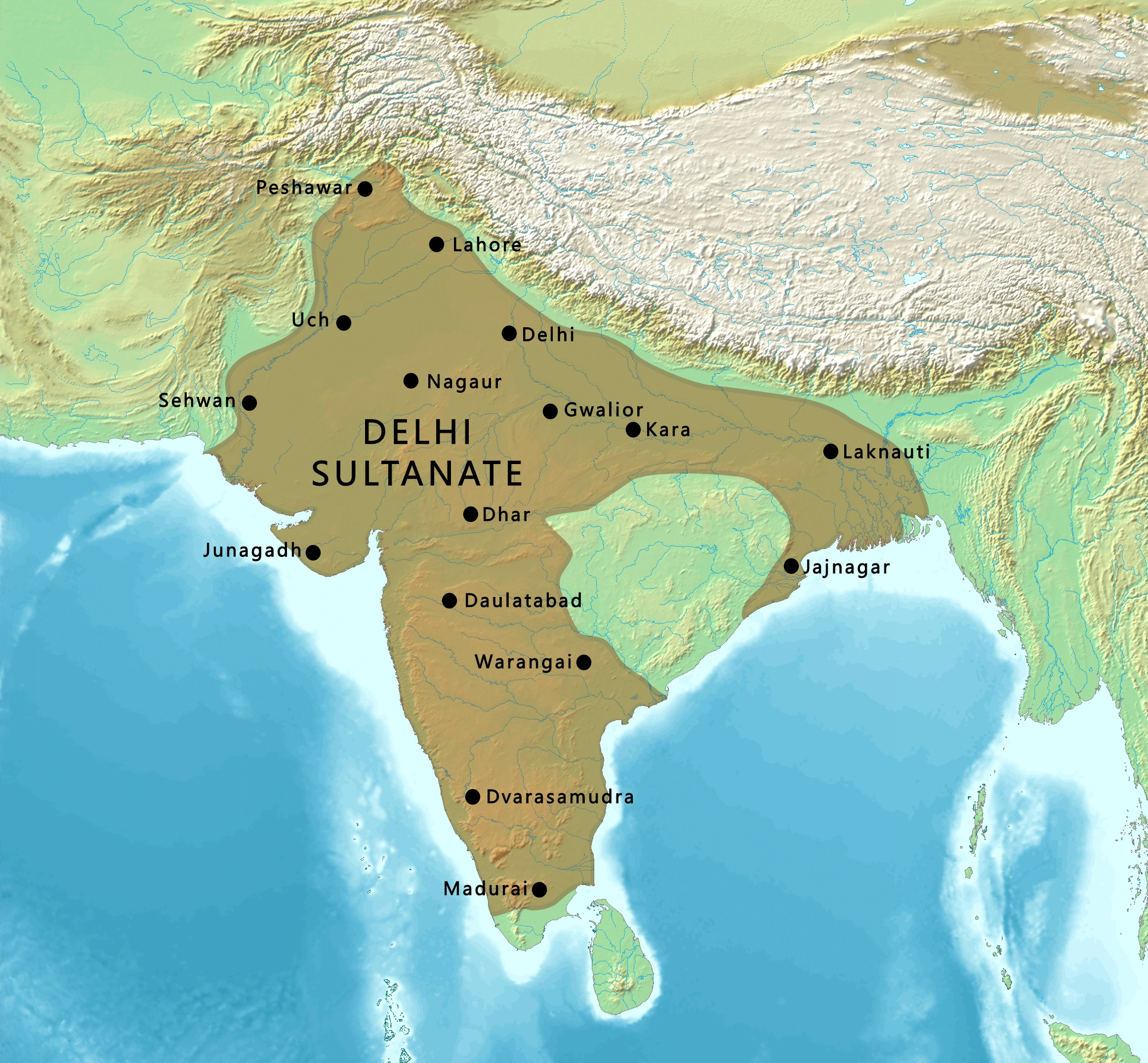
Map study
Delhi Sultanate territorial overview: regional orientation, not the exact boundary of every Sultan’s reign.
- Read the source date and legend before interpreting territorial extent.
- Compare core regions, neighbouring powers and geographic barriers; historical borders and influence are approximate and changed over time.
Credit: Koba-chan; DEMIS base map · CC BY-SA 3.0 · sourceConverted to WebP on an opaque white background; proportionally resized without cropping. Original cartography and legend retained.
Origins, accession and historical significance
Iltutmish belonged to an Ilbari Turkish background and entered the military-slave networks through which many officers of the early Sultanate rose to power. Purchased by Qutb al-Din Aibak, he gained responsibility, married Aibak’s daughter and served as governor of Badaun. Military slavery in this setting did not necessarily imply permanent political exclusion: selected slaves received training and patronage and could become commanders, governors and rulers.
After Aibak’s death in 1210, Aram Shah briefly occupied the throne. Influential groups at Delhi invited Iltutmish to assume power, and he defeated Aram Shah in 1211. His accession was not universally accepted. Commanders who considered themselves his equals or superiors, regional governors and rival inheritors of Ghurid authority challenged him. The immediate problem was therefore not simply territorial expansion but establishing an enforceable hierarchy under the Delhi sultan.
Aibak is conventionally identified as the founder of the Delhi Sultanate, while Iltutmish is regarded as its effective consolidator. He made Delhi, rather than Lahore, the enduring centre of his authority. This distinction is important for examinations: Iltutmish neither initiated the Ghurid conquest of northern India nor founded every institution associated with the Sultanate, but he gave its early political and administrative arrangements greater coherence.
Timeline
1211
Iltutmish defeats Aram Shah and becomes sultan.
1216
Defeats Yildiz at Tarain.
1221
Avoids alignment with Jalal al-Din Mangburni during the Mongol advance.
1228–1229
Qubacha’s power collapses; Iltutmish subsequently receives Abbasid investiture.
1236
Iltutmish dies; Rukn al-Din Firuz and then Raziyya occupy the throne.
Political consolidation and the Mongol challenge
Iltutmish’s western rivals included Taj al-Din Yildiz, associated with Ghazni, and Nasir al-Din Qubacha, who controlled territories around Multan, Uch and Sindh. Yildiz asserted superior authority over the former Ghurid possessions. Iltutmish defeated him at Tarain in 1216, weakening the claim that Delhi remained subordinate to a ruler based beyond the northwestern frontier. This battle must not be confused with the better-known battles of Tarain fought in 1191 and 1192.
The struggle against Qubacha continued until 1228, when Iltutmish’s campaigns broke his power; Qubacha drowned in the Indus while attempting to escape. In the east, Bengal and Bihar repeatedly challenged Delhi’s authority. Iltutmish campaigned against the Khalji rulers of Bengal in 1225, while his son Nasir al-Din Mahmud subsequently strengthened Delhi’s position there. Renewed intervention around 1230 illustrates how distant provincial control remained contested rather than permanently settled by one victory.
Campaigns against Rajput strongholds included the recovery of Ranthambore in 1226 and the capture of Gwalior in 1231. Operations against Bhilsa and Ujjain in 1234–1235 extended his military reach into central India, but a successful raid should not automatically be treated as evidence of durable provincial administration.
In 1221, Chinggis Khan pursued the Khwarazmian prince Jalal al-Din Mangburni towards the Indus. Iltutmish avoided committing the Delhi Sultanate to an alliance with the fugitive prince. His cautious response helped avert an immediate confrontation with the Mongols while his own position was still insecure. It was a policy of strategic restraint, not a military defeat of Chinggis Khan.
How Iltutmish consolidated the Sultanate
- 1. Secure the throne against rival claimants
- 2. Defeat competing Ghurid successor rulers
- 3. Reassert authority over provinces and strategic forts
- 4. Support military administration through revenue assignments
- 5. Strengthen currency and public legitimacy
Administration, nobility and monetary organisation
Iltutmish consolidated the iqta system, under which designated territories or their revenues were assigned to officers in return for service. The holder, commonly called an iqtadar or muqti, supported troops and performed administrative duties from the assigned revenues. An iqta was not an unrestricted grant of private ownership over land. It represented a delegation of fiscal and administrative claims, although the centre’s ability to supervise holders varied considerably.
The system helped the ruler maintain a military establishment without paying every officer entirely in cash from the central treasury. Transfers and appointments could limit the growth of autonomous local power, but powerful assignment-holders could also resist the centre. The elaborate auditing and tighter controls associated with later sultans should not all be projected backwards onto Iltutmish’s reign.
Iltutmish promoted a body of trusted Turkish slave-officers, conventionally associated with the Turkan-i Chahalgani or corps of Forty. These Shamsi nobles, named after his regnal title Shams al-Din, became highly influential after his death. The term should not be understood as a modern cabinet with a fixed constitutional membership. Personal loyalty initially strengthened monarchy, but the collective power of leading nobles later complicated succession and royal control.
His monetary reforms established the silver tanka and copper jital as important standards in the Sultanate’s currency system. The silver tanka weighed approximately 11 grams. Their significance lay in creating recognisable coinage for taxation, payments and exchange, rather than in introducing coins to India for the first time. The tanka must also be distinguished from the silver rupiya associated with Sher Shah’s sixteenth-century monetary reforms.
| Item | Correct association | Distinction |
|---|---|---|
| Tarain, 1216 | Iltutmish defeats Yildiz | Not the Prithviraj–Muhammad Ghori battles |
| Tanka and jital | Silver and copper monetary standards | Not Sher Shah’s rupiya |
| Iqta | Revenue assignment linked to service | Not absolute private landownership |
| Investiture, 1229 | Recognition by the Abbasid caliph | Not direct administration from Baghdad |
| Succession, 1236 | Rukn al-Din Firuz precedes Raziyya | Raziyya was not the immediate successor |
Legitimacy, religion and architectural patronage
In 1229, Iltutmish received investiture from the Abbasid caliph al-Mustansir in Baghdad. The robe of honour and formal recognition enhanced his prestige among Muslim political and religious elites. Caliphal recognition supported his claim to legitimate sovereignty, but it did not mean that Baghdad administered Delhi or supplied its effective military power. His authority continued to depend primarily on conquest, resources and political support within the subcontinent.
The khutba, the sermon delivered at Friday congregational prayer, and sikka, coinage bearing a ruler’s authority, were important expressions of sovereignty. Religious recognition, royal titles and public monuments reinforced claims already established through force and administration. For historical analysis, symbolic legitimacy and practical independence should therefore be examined together rather than treated as opposites.
Iltutmish continued construction of the Qutb Minar, which Aibak had begun, adding three storeys. The monument subsequently underwent repairs and alterations, including work under Firuz Shah Tughlaq. His patronage also included the Hauz-i Shamsi reservoir, dated to 1230, and Sultan Ghari, built in 1231 as the tomb of his son Nasir al-Din Mahmud. His own tomb, constructed in 1235 within the Qutb complex, displays rich carved inscriptions and ornament. These works connected political authority with religious patronage, water provision and dynastic remembrance.
Succession, sources and examination distinctions
The death of Iltutmish’s capable son Nasir al-Din Mahmud in 1229 disrupted his succession plans. Iltutmish subsequently favoured his daughter Raziyya, whose administrative ability he recognised. Nevertheless, after his death in 1236, leading nobles initially placed Rukn al-Din Firuz on the throne. Raziyya assumed power later that year following the collapse of this arrangement.
The succession crisis revealed a central limitation of his achievement: a strong ruler could consolidate territory without establishing an uncontested rule of succession. Nobles, members of the royal household and urban political groups remained important participants in choosing and challenging rulers. Raziyya’s accession was therefore neither the automatic application of primogeniture nor an immediate, uncontested succession to her father.
Minhaj-i Siraj’s Tabaqat-i Nasiri is a major narrative source for the early Sultanate. Like other court-connected chronicles, it should be read with attention to patronage, religious assumptions and elite perspectives. Coins, inscriptions and surviving monuments provide complementary evidence. For Prelims, distinguish Iltutmish’s consolidation from Aibak’s foundation, Balban’s later assertion of monarchy and Alauddin Khalji’s market regulations.
Real-world case studies
Strategic restraint on the northwestern frontier
The crisis of 1221 illustrates how avoiding war could support state-building. By withholding support from Jalal al-Din against Chinggis Khan, Iltutmish reduced the risk of involving his fragile kingdom in a much larger conflict.
Sultan Ghari and dynastic memory
Sultan Ghari in Delhi commemorates Nasir al-Din Mahmud, Iltutmish’s son and governor in Bengal. Built in 1231, it is widely regarded as the earliest surviving monumental Islamic mausoleum in India and links architectural patronage with succession and royal remembrance.
Previous year questions
No source-linked PYQ is available here yet. Use the practice questions below.
Practice questions
Practice MCQ 1
Consider the following statements about Iltutmish: 1. He defeated Yildiz at Tarain. 2. He received investiture from the Abbasid caliph. 3. He introduced Alauddin Khalji’s system of market price controls. Which statements are correct?
- A. 1 and 2 only
- B. 2 and 3 only
- C. 1 and 3 only
- D. 1, 2 and 3
Practice MCQ 2
Which description best explains an iqta under the early Delhi Sultanate?
- A. An unrestricted hereditary ownership grant
- B. A revenue assignment supporting service and administration
- C. A tax imposed exclusively on maritime trade
- D. A council responsible for choosing the caliph
Practice MCQ 3
Which is the correct chronological sequence?
- A. Abbasid investiture → accession → defeat of Yildiz → death
- B. Accession → Abbasid investiture → defeat of Yildiz → death
- C. Accession → defeat of Yildiz → Abbasid investiture → death
- D. Defeat of Yildiz → accession → death → Abbasid investiture
Mains practice · Why is Iltutmish regarded as the effective consolidator of the Delhi Sultanate? Discuss the achievements and limitations of his state-building. Answer in 250 words.
- Explain the contested inheritance after Aibak’s death.
- Discuss Yildiz, Qubacha, eastern provinces and strategic forts.
- Assess restraint during the Mongol crisis.
- Explain iqta organisation, coinage and trusted military officers.
- Evaluate caliphal recognition and Delhi-centred authority.
- Conclude with provincial instability and the succession crisis.
Further reading
- NCERT, Our Pasts–II, chapter on the Delhi Sultans.
- Satish Chandra, Medieval India: From Sultanat to the Mughals, Part One.
- Archaeological Survey of India: Qutb Minar complex and Sultan Ghari monument information.
- UNESCO World Heritage Centre: Qutb Minar and its Monuments, Delhi.
- Minhaj-i Siraj, Tabaqat-i Nasiri, translated by H. G. Raverty.
Preparing for UPSC Civil Services? Get classroom teaching, answer-writing evaluation and mentorship at Pragnya IAS Academy, Ashok Nagar — see why aspirants choose us for IAS coaching in Hyderabad.