
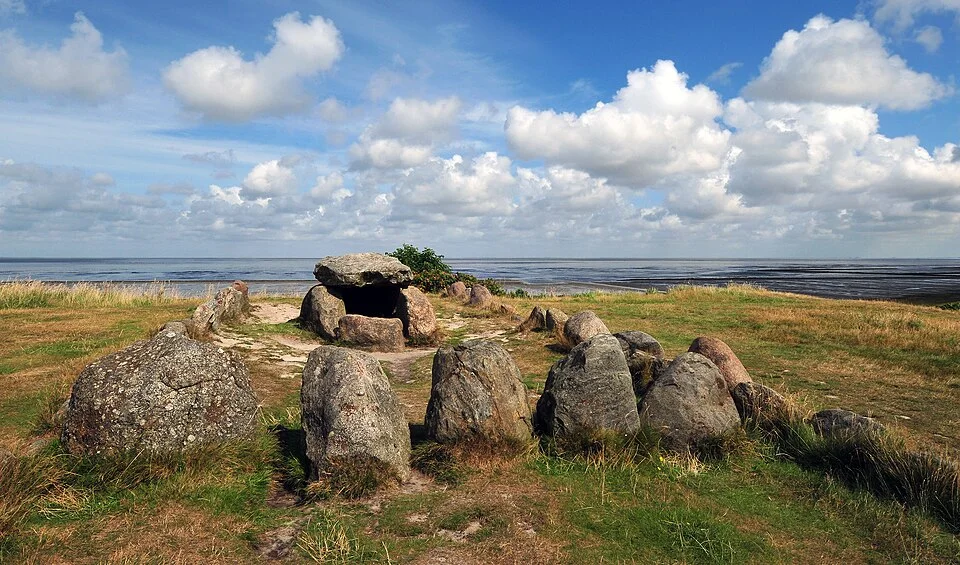
Harhoog dolmen, Germany: a comparative example, not evidence of Indian megalithic cultures.
Credit: Michael Gäbler · CC BY 3.0 · sourceResized and converted to WebP; uncropped.
1. Meaning, chronology and geographical distribution
Megalithic archaeology studies monuments constructed with large stones and the communities associated with them. Many monuments mark graves, but some are memorials without identifiable human remains. Archaeologists also discuss associated urn burials and other funerary forms within the broader megalithic cultural complex, even when large stones are absent. Consequently, megalithic is primarily a descriptive archaeological term, not the name of a dynasty, religion or uniform civilisation.
In peninsular India, the principal horizon is broadly dated to about 1200 BCE–300 CE, although this is a working range rather than a universal boundary. Some regional beginnings are earlier, while monument-building and burial practices survived considerably later elsewhere. Recent claims concerning exceptionally early iron use must be evaluated site by site; the date of an iron-bearing deposit cannot automatically establish the age of every nearby monument. Megalithic traditions overlap both the Iron Age and the early historical period.
Major concentrations occur in Karnataka, Tamil Nadu, Kerala, Andhra Pradesh, Telangana and the Vidarbha region of Maharashtra. Important sites include Brahmagiri and Hire Benakal in Karnataka, Adichanallur and Kodumanal in Tamil Nadu, Porkalam in Kerala, and Junapani and Naikund in Maharashtra. Megaliths also occur outside the peninsula, including Kashmir and northeastern India. Their geographical spread does not establish a single origin or a uniform chronological sequence.
- For Prelims, distinguish monument type, archaeological culture and historical community.
- Living megalithic traditions among some Khasi and Naga communities should not be treated as direct proof of unchanged continuity from prehistoric peninsular cultures.
2. Monument types and burial practices
A dolmen generally consists of upright stone slabs supporting a capstone, often forming an above-ground chamber. A cist is a box-like burial chamber made from slabs, usually below ground. Some chambers have a circular opening or port-hole in a side slab. Stone circles comprise standing stones or boulders arranged around a burial or monument. A cairn is a mound of stones, while a menhir is a single upright stone that may serve a commemorative function.
Regional diversity is especially evident in Kerala, where rock-cut burial chambers and distinctive umbrella stones and hat stones occur. Umbrella stones are commonly called kudakkal, while hat stones are called topikkal. Urn burials place human remains within ceramic containers; sarcophagi are terracotta coffins, sometimes supported on legs. These categories can occur together within a cemetery, and the visible surface marker need not reveal the exact form of the burial beneath it.
Burial practices included primary deposition of a body and secondary deposition of selected bones after an earlier stage of treatment or decomposition. Some graves contain multiple individuals or evidence of repeated use. Offerings may include pottery, weapons, tools, ornaments and animal remains. Such deposits support interpretations involving remembrance, funerary ritual and social identity. However, identifying a specific deity or reconstructing a precise doctrine of the afterlife usually goes beyond what the evidence can demonstrate.
- A monument without skeletal remains may be a memorial, but poor preservation or disturbance must also be considered.
- Dolmen and cist are not interchangeable terms; stone circles can mark several different burial arrangements.
How archaeologists interpret a megalithic site
- 1. Survey the monuments, nearby settlements and landscape
- 2. Record architecture and excavate stratigraphically
- 3. Analyse human remains, pottery, tools and environmental evidence
- 4. Establish chronology using suitable samples and archaeological context
- 5. Compare burial and settlement evidence before interpreting society
3. Economy, technology and exchange
Megalithic-associated communities followed mixed economic strategies adapted to local environments. Archaeobotanical evidence from different sites includes millets, rice, pulses and other crops, while faunal remains indicate cattle, sheep and goats, alongside hunting in some settings. It is therefore misleading to describe all such communities as either nomadic pastoralists or settled rice cultivators. Their subsistence varied between river valleys, dry uplands, forest margins and coastal zones.
Iron technology is a major feature of many peninsular assemblages. Excavations have recovered axes, sickles, knives, spearheads, arrowheads and other implements. Iron tools could assist cultivation, woodworking and craft production, while weapons also served martial or ceremonial purposes. Nevertheless, an object deposited in a grave is not necessarily a straightforward record of everyday work. Iron was used alongside stone, copper alloys, ceramics and other materials rather than replacing them immediately.
Black-and-Red Ware is a frequent ceramic category, characterised by contrasting black and red surfaces produced through controlled firing conditions. Other wares also occur, including red and black wares. Beads made from carnelian, agate, quartz and other materials reveal specialised manufacture and exchange. Kodumanal provides particularly valuable evidence for craft activity. Connections with early historical settlements show that megalithic-associated societies were not necessarily isolated from trade, emerging towns or wider political developments.
- Black-and-Red Ware occurs in several archaeological cultures and cannot independently establish a megalithic date.
- Distinguish evidence for iron use from evidence for local smelting: furnaces, slag and production debris are especially important for identifying manufacture.
| Form | Identifying feature | Examination caution |
|---|---|---|
| Dolmen | Upright slabs supporting a capstone | Often above ground; not synonymous with cist |
| Cist | Slab-built, box-like burial chamber | Usually below ground; may have a port-hole |
| Stone circle | Circular arrangement of stones or boulders | May surround different burial types |
| Cairn | Mound or heap of stones | Can occur together with a stone circle |
| Menhir | Single upright stone | May be commemorative rather than a grave marker |
| Urn burial | Human remains deposited in a ceramic container | May belong to the broader complex without large stones |
4. Society, belief and historical interpretation
Constructing large monuments required labour, planning and access to stone. Differences in monument size, architecture and grave goods may indicate distinctions of wealth, prestige, age, occupation or community identity. Richly furnished graves therefore suggest social differentiation, but do not by themselves prove a rigid caste system, monarchy or hereditary warrior aristocracy. Collective burial and repeated use may reflect kinship or other corporate groups, although these interpretations require contextual support.
The transition from prehistoric to early historical societies was uneven. In Tamil Nadu and adjoining regions, some megalithic-associated sites overlap with the period of Tamil-Brahmi inscriptions and early Tamil literature. Sangam texts refer to warfare, commemoration and varied funerary practices, offering useful comparative evidence. However, literary descriptions cannot be mechanically assigned to every excavated burial. Likewise, identifying all megalith builders as speakers of one language or members of a single ethnic population is not archaeologically justified.
Interpretation must account for preservation and excavation bias. Monumental cemeteries are conspicuous and often survive better than houses built from perishable materials. As a result, burial evidence can exaggerate the prominence of weapons, ornaments and ritual in reconstructions of daily life. Settlement excavations, plant and animal remains, metallurgical analysis, radiocarbon dating and landscape surveys help produce a fuller understanding of these communities.
- Possible ancestor commemoration should be presented as an interpretation, not a universally proven belief.
- Archaeological phases can overlap: the Neolithic, Iron Age and early historical period did not begin simultaneously throughout India.
5. Important sites and examination approach
Brahmagiri in Karnataka is significant because Mortimer Wheeler’s 1947 excavations helped establish a relative sequence involving Stone Axe, megalithic and early historical cultural phases. These phase names belong to the history of archaeological research and should not be converted into a rigid chronology for the whole peninsula. Hire Benakal, also in Karnataka, is noted for its extensive dolmen landscape. Adichanallur in the Thamirabarani valley of Tamil Nadu is especially associated with urn burials and varied funerary objects.
Vidarbha sites such as Naikund, Mahurjhari and Junapani provide evidence concerning iron technology, ornaments and burial architecture. Kodumanal in Tamil Nadu links cemetery archaeology with a settlement known for bead-making and iron-working evidence. For Prelims, learn site–state pairs, monument definitions and the limits of material indicators. Statements containing only, always or exclusively are particularly suspect when they equate megaliths with iron, Black-and-Red Ware, southern India or one burial custom.
- Map clusters rather than memorising isolated names: Karnataka, the Tamil region, Kerala and Vidarbha are especially useful.
- Conservation must protect the surrounding archaeological landscape, not just individual standing stones.
Megaliths: Similar Monuments, Different Cultural Contexts
The supplied metadata identifies Harhoog on Sylt, Germany, as an extended dolmen associated with the Funnelbeaker culture, probably dating to around 3000 BCE. It offers a comparative example of a megalithic tomb. A dolmen generally comprises upright stone supports and a covering slab, forming a chamber. Similar architectural labels occur in accounts of Indian megaliths, but resemblance alone does not establish shared ancestry, migration or direct cultural contact.
For Ancient India, the central evidence comes from regional archaeological contexts, especially the Iron Age and early historical Deccan and southern peninsula. Megalithic traditions include dolmens, stone circles, cists and other funerary or commemorative arrangements; some associated burial forms do not involve monumental stones. Their interpretation depends on excavation, burial contents, associated settlements and dating evidence rather than stone size alone. The metadata also states that Harhoog was relocated, so its present setting should not be treated as its original archaeological context. This German monument illustrates comparison, not the chronology, material culture or social organisation of Indian communities.
- Chronology: Megalithic describes a monument-building tradition, not a universal chronological stage; European Neolithic examples must not determine Indian dates.
- Classification: A stone circle may mark a burial below ground, while a cist is a slab-built chamber; these terms are not interchangeable.
- Interpretation: Grave goods can inform discussions of technology, exchange and social differentiation, but cannot independently establish ethnicity, language or rigid caste identities.
Real-world case studies
Kodumanal: linking burials with production
Kodumanal, on the Noyyal River in Tamil Nadu, has both settlement and burial evidence. Bead-manufacturing remains, iron-working evidence and inscribed pottery illuminate specialised crafts and early historical connections. The site demonstrates why a cemetery should be studied alongside habitation evidence rather than treated as a complete picture of community life.
Hire Benakal: conserving a funerary landscape
Hire Benakal in Karnataka’s Koppal district preserves a substantial group of megalithic monuments, particularly dolmens, in a rocky landscape. It illustrates the relationship between available stone, monument construction and funerary space. Protecting such sites requires attention to encroachment, quarrying and disturbance of archaeological deposits as well as the survival of visible structures.
Previous year questions
No source-linked PYQ is available here yet. Use the practice questions below.
Practice questions
Practice MCQ 1
With reference to Indian megalithic cultures, consider the following statements: 1. All megalithic monuments contain human remains. 2. Black-and-Red Ware is found outside megalithic contexts as well. 3. Some peninsular megalithic traditions continued into the early historical period. Which of the statements given above are correct?
- A. 1 and 2 only
- B. 2 and 3 only
- C. 1 and 3 only
- D. 1, 2 and 3
Practice MCQ 2
Which one of the following pairs is incorrectly matched?
- A. Adichanallur — Tamil Nadu
- B. Hire Benakal — Karnataka
- C. Naikund — Maharashtra
- D. Porkalam — Telangana
Practice MCQ 3
A box-like burial chamber constructed from stone slabs, usually below ground, is best described as a:
- A. Menhir
- B. Cairn
- C. Cist
- D. Stone circle
Mains practice · Megalithic burials provide important but incomplete evidence about Iron Age societies in peninsular India. Discuss. Answer in 250 words.
- Define megalithic traditions and indicate their regional and chronological diversity.
- Explain how architecture and grave goods illuminate technology, exchange and social differentiation.
- Discuss iron implements, ceramics, beads and varied mortuary practices.
- Identify limitations arising from preservation, ritual selection and the predominance of cemetery excavations.
- Use Kodumanal and Brahmagiri to demonstrate the importance of settlement evidence and stratigraphy.
- Avoid equating material culture directly with caste, language or ethnicity.
Further reading
- NCERT, Our Pasts–I, chapter: What Books and Burials Tell Us.
- Upinder Singh, A History of Ancient and Early Medieval India: From the Stone Age to the 12th Century.
- Archaeological Survey of India, Indian Archaeology—A Review, relevant excavation reports: asi.nic.in.
- Tamil Nadu Department of Archaeology, publications on Kodumanal and Adichanallur: tnarch.gov.in.
- https://commons.wikimedia.org/wiki/File:Megalithic_grave_Harhoog_in_Keitum,_Sylt,_Germany.jpg
Preparing for UPSC Civil Services? Get classroom teaching, answer-writing evaluation and mentorship at Pragnya IAS Academy, Ashok Nagar — see why aspirants choose us for IAS coaching in Hyderabad.