
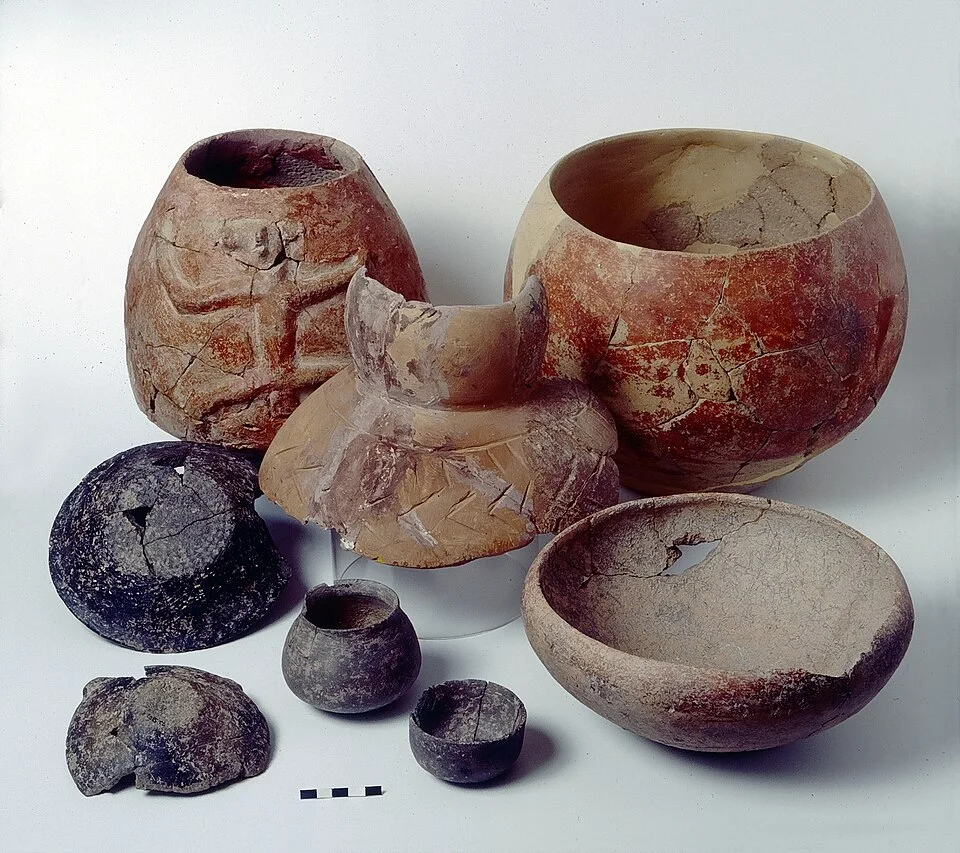
Pottery identified as Early Chalcolithic from Hazireah; a comparative illustration, not evidence for Indian cultures.
Credit: Yosef Garfinkel · CC BY 4.0 · sourceResized and converted to WebP; uncropped.
Meaning, chronology and archaeological interpretation
The term Chalcolithic combines the Greek words for copper and stone. It describes archaeological communities using copper objects together with stone implements, especially blades, axes and grinding equipment. Copper was relatively scarce and soft, so its appearance did not make stone technology obsolete. Bronze, an alloy usually of copper and tin, must be distinguished from unalloyed copper. Communities conventionally called Chalcolithic could possess occasional bronze objects without having the extensive bronze metallurgy associated with major Bronze Age civilisations.
In Indian history, the expression usually refers to regional, predominantly non-urban farming cultures outside the principal Harappan urban system. Many flourished during the third and second millennia BCE, while some continued into the early first millennium BCE. These dates are broad guides rather than fixed boundaries. Some settlements had earlier Neolithic antecedents; elsewhere, farming and copper use appear together in the available archaeological record. Chalcolithic is therefore a technological and archaeological category, not a single ethnic group or a uniform stage reached simultaneously everywhere.
Archaeologists identify these cultures through recurring combinations of pottery, tools, houses, burials and settlement patterns. A ceramic style does not by itself establish a language, tribe or political kingdom. Radiocarbon dates, stratigraphy and comparisons between sites help reconstruct chronology. For examination purposes, regional associations are generally more dependable than attempting to memorise one exact beginning and ending date for every culture.
- Do not treat Chalcolithic as synonymous with Harappan, although the two overlapped in time and sometimes interacted.
- Do not assume that every Chalcolithic settlement lacked bronze or that every copper object belongs to a Chalcolithic culture.
Timeline
Approximately 3000–1500 BCE
Broad conventional span of the Ahar–Banas cultural tradition; individual sites have differing sequences.
Approximately 2400–2000 BCE
Kayatha culture flourishes in central India.
Approximately 1900–1400 BCE
Malwa culture develops across central India and extends into parts of the Deccan.
Approximately 1400–1000 BCE
Early Jorwe phase, including substantial settled farming communities in Maharashtra.
Approximately 1000–700 BCE
Late Jorwe occupation continues at selected sites, notably Inamgaon.
Major regional cultures and sites
The Ahar–Banas culture occupied southeastern Rajasthan, especially the Banas basin and adjoining areas. Important sites include Ahar near Udaipur, Gilund and Balathal. Its mature regional development is commonly placed broadly between about 3000 and 1500 BCE, though individual sequences vary. Black-and-red pottery with white-painted designs is a characteristic marker. Stone and mud construction, farming and copper working are important features. Proximity to the copper-bearing Aravalli region gave these communities access to a valuable metallurgical resource.
Kayatha, near Ujjain on the Chhoti Kali Sindh, is the type-site of a central Indian culture generally dated to about 2400–2000 BCE. Its diagnostic pottery includes sturdy brown-slipped ware painted with dark designs, alongside other ceramic groups. Copper objects and stone-blade tools demonstrate technological coexistence. The Malwa culture, conventionally dated to about 1900–1400 BCE, is represented at Navdatoli and Maheshwar on the Narmada and at other central Indian and Deccan sites. Coarse buff or orange pottery painted with dark geometric and other motifs is particularly characteristic.
The Jorwe culture, named after a site on the Pravara in Maharashtra, generally spans about 1400–700 BCE. Inamgaon on the Ghod, Daimabad on the Pravara, Nevasa and Jorwe are important sites. Its pottery is typically well-fired red or orange ware with black-painted designs; spouted vessels and carinated bowls are familiar forms. At Inamgaon, an Early Jorwe phase is followed by a Late Jorwe phase, conventionally divided around 1000 BCE. Daimabad also preserves earlier occupation, including a Late Harappan phase, making it unsuitable for a one-site–one-culture assumption.
- Ochre Coloured Pottery and Copper Hoards are important to the wider copper-using horizon of northern India, but their association is not uniform or conclusively established everywhere.
- Eastern sites such as Chirand and Pandu Rajar Dhibi illustrate regional Neolithic–Chalcolithic developments beyond Rajasthan, central India and Maharashtra.
How a Chalcolithic assemblage is interpreted
- 1. Establish the stratigraphic context of houses, objects and burials.
- 2. Compare pottery forms, fabrics and painted designs.
- 3. Identify metals, stone tools and evidence of craft production.
- 4. Study plant remains, animal bones and settlement surroundings.
- 5. Use scientific dates and regional comparisons to reconstruct cultural change.
Subsistence, crafts and exchange
The economic foundation was usually mixed farming and livestock keeping, supplemented by hunting, fishing and gathering. Wheat and barley were important in several western and central Indian assemblages; pulses, millets and rice occurred in varying proportions according to region and period. Crop lists should not be generalised across all sites. Charred seeds, animal bones, grinding stones and storage facilities provide the main evidence. Cattle, sheep and goats were significant domestic animals, while wild animal remains show that agriculture did not eliminate older subsistence practices.
Settlements often stood near rivers, cultivable soils and grazing grounds. Seasonal rainfall and the differing requirements of winter and summer crops influenced agricultural strategies. Storage pits and large jars suggest the management of food reserves, although they do not automatically prove taxation or state-controlled surplus collection. At some sites, changes in crops, livestock and house forms indicate adjustments to environmental stress and altered mobility rather than a sudden disappearance of the population.
Craft production included pottery making, copper working, stone-blade manufacture, bead making and the working of bone and shell. Copper axes, chisels, fishhooks and ornaments occur in different assemblages, but stone and organic implements remained essential. Carnelian, jasper, chalcedony and shell objects indicate access to resources beyond immediate village surroundings. Such finds support interregional exchange, including contacts with Harappan and post-Harappan networks, without demonstrating political control by a distant city.
- Copper ores required extraction and smelting; possession of copper objects alone does not prove local smelting.
- Black-and-red ware reflects controlled firing conditions and is not an exclusive identifier of one culture or period.
| Culture | Core region | Important sites | Characteristic evidence |
|---|---|---|---|
| Ahar–Banas | Southeastern Rajasthan | Ahar, Gilund, Balathal | Black-and-red ware with white painting; copper use |
| Kayatha | Western Madhya Pradesh | Kayatha | Brown-slipped painted pottery; copper and stone tools |
| Malwa | Central India, with extensions into the Deccan | Navdatoli, Maheshwar | Buff or orange pottery with dark painted designs |
| Jorwe | Mainly Maharashtra | Jorwe, Inamgaon, Nevasa, Daimabad | Red or orange pottery with black painting; spouted vessels |
Settlements, society and mortuary practices
Most known settlements were villages containing circular, rectangular or irregular houses built with mud, stone foundations and wattle-and-daub. Floors, hearths, storage jars and work areas reveal household activities. Some larger settlements contained substantial walls or differentiated spaces, but these should not automatically be equated with Harappan urban planning. Gilund has yielded a substantial mud-brick complex and seal impressions, offering evidence for organised storage or administrative activity within a regional Chalcolithic setting.
Differences in house size, access to valuable objects and burial treatment suggest varying degrees of social differentiation. However, archaeology rarely permits precise identification of caste, kingship or hereditary office in these communities. Burials beneath or near house floors are known from some sites. At several Deccan sites, infants were buried in urns, sometimes using two pots placed mouth to mouth. Adult burial forms varied, and exceptional examples at Inamgaon caution against treating one burial custom as universal.
Terracotta human and animal figurines, unusual installations and mortuary offerings may illuminate ritual life, but their interpretation requires restraint. Female figurines are often described in older textbooks as mother goddesses; this label remains an interpretation rather than a securely deciphered religious identity. Unlike a readable inscription, an object rarely states its own ritual meaning.
- Avoid inferring a uniform religion from a few figurines or burial objects.
- Material inequality can indicate social ranking, but does not by itself establish a fully developed state.
Transformation and historical significance
Chalcolithic cultures did not end through one subcontinental event. Some settlements were abandoned, others contracted, and others continued with changing ceramics, subsistence or metal technologies. At Inamgaon, Late Jorwe changes have been linked to increasing aridity and a greater emphasis on pastoral adaptations. Environmental explanations must nevertheless be assessed alongside local ecology, settlement decisions and changing exchange relationships.
These cultures are significant because they reveal the expansion and diversification of village agriculture beyond the Harappan cities. They demonstrate regional craft specialisation, exchange, social differentiation and adaptation to river valleys, plateaus and semi-arid environments. Their relationship with later iron-using communities differed across regions; iron did not replace copper and stone everywhere at the same moment. For Prelims, the safest approach is to connect each culture with its geographical zone, principal sites and diagnostic material evidence.
- Exam trap: a site may contain successive occupations belonging to several archaeological cultures.
- Exam trap: broad cultural dates are approximate and should not override well-established site-specific evidence.
Pottery as Evidence for Chalcolithic Cultures
The supplied metadata identifies this pottery as Early Chalcolithic and associates it with Hazireah. It offers a comparative example for understanding pottery in Chalcolithic archaeology, rather than evidence for Indian cultural sequences. The metadata alone does not establish its fabric, decoration, manufacturing technique, excavation context or precise chronology. Such characteristics should not be inferred from the title.
In India, archaeologists distinguish cultures such as Ahar–Banas, Kayatha, Malwa and Jorwe through recurring combinations of pottery, tools, settlement remains and other finds. Ceramics help reconstruct relative chronology, food preparation, storage and exchange, but pottery alone cannot establish copper use, subsistence or social organisation. These interpretations require associated evidence such as metal objects, furnaces, botanical remains and animal bones. Chalcolithic means the use of copper alongside stone; it does not imply that every household possessed copper tools or that all regions passed through an identical developmental sequence.
- Chronology: Indian Chalcolithic traditions overlapped with Harappan and post-Harappan contexts; treat them as regional sequences, not a single uniformly dated stage.
- Identification: Black-and-red ware occurs in multiple archaeological contexts. A ceramic label alone is insufficient to identify a culture, period or population.
- Interpretation: For Mains, connect pottery with settlement and subsistence evidence. An archaeological culture is an analytical grouping, not automatically an ethnic, linguistic or political community.
Real-world case studies
Inamgaon: reconstructing a Deccan farming community
Excavations by Deccan College at Inamgaon in Maharashtra revealed successive Malwa and Jorwe occupations. Houses, storage facilities, botanical remains, animal bones and burials allow unusually detailed reconstruction of village life. Changes during the Late Jorwe phase have been interpreted as adaptations to drier conditions, with a greater pastoral emphasis. The site illustrates why subsistence must be reconstructed from several independent categories of evidence.
Gilund: organisation beyond the household
Gilund in Rajasthan belongs to the Ahar–Banas tradition. Excavations revealed a large mud-brick complex and numerous seal impressions. These suggest organised handling or control of stored goods and contacts beyond the local settlement. They qualify the simplistic picture of all Chalcolithic communities as isolated, undifferentiated villages, without proving that Gilund was a Harappan-style city or a centralised state.
Previous year questions
No source-linked PYQ is available here yet. Use the practice questions below.
Practice questions
Practice MCQ 1
Consider the following pairs: 1. Ahar–Banas — Southeastern Rajasthan; 2. Kayatha — Western Madhya Pradesh; 3. Jorwe — Coastal Odisha. How many pairs are correctly matched?
- A. Only one
- B. Only two
- C. All three
- D. None
Practice MCQ 2
With reference to Indian Chalcolithic cultures, consider the following statements: 1. Copper completely replaced stone tools. 2. Some overlapped chronologically with the Harappan civilisation. 3. A single site can contain successive occupations of different archaeological cultures. Which statements are correct?
- A. 1 and 2 only
- B. 2 and 3 only
- C. 1 and 3 only
- D. 1, 2 and 3
Practice MCQ 3
Which statement best reflects the archaeological interpretation of Chalcolithic material?
- A. Every female figurine conclusively represents an identical mother-goddess cult.
- B. Black-and-red ware is exclusive to the Ahar–Banas culture.
- C. Non-local shell and stone beads can indicate exchange networks.
- D. Any copper object proves that copper ore was smelted at the settlement.
Mains practice · Indian Chalcolithic cultures demonstrate regional diversity rather than a uniform technological stage. Discuss with reference to settlements, subsistence and material culture. Answer in 250 words.
- Define Chalcolithic as the coexistence of copper and stone technologies.
- Compare Ahar–Banas, Kayatha, Malwa and Jorwe geographical settings and pottery traditions.
- Explain mixed farming, livestock keeping and regionally variable crop assemblages.
- Discuss village architecture, craft specialisation and interregional exchange.
- Use Inamgaon and Gilund to illustrate adaptation and organisational complexity.
- Conclude with uneven transitions and caution against equating archaeological cultures with ethnic identities.
Further reading
- R. S. Sharma, Ancient India, old NCERT textbook: Neolithic and Chalcolithic communities.
- Upinder Singh, A History of Ancient and Early Medieval India: From the Stone Age to the 12th Century.
- H. D. Sankalia, S. B. Deo and Z. D. Ansari, Chalcolithic Navdatoli.
- M. K. Dhavalikar, H. D. Sankalia and Z. D. Ansari, Excavations at Inamgaon.
- Archaeological Survey of India, Indian Archaeology—A Review, excavation reports at asi.nic.in.
- https://commons.wikimedia.org/wiki/File:Early_Chalcolithic_pottery_from_Hazireah.jpg
Preparing for UPSC Civil Services? Get classroom teaching, answer-writing evaluation and mentorship at Pragnya IAS Academy, Ashok Nagar — see why aspirants choose us for IAS coaching in Hyderabad.