
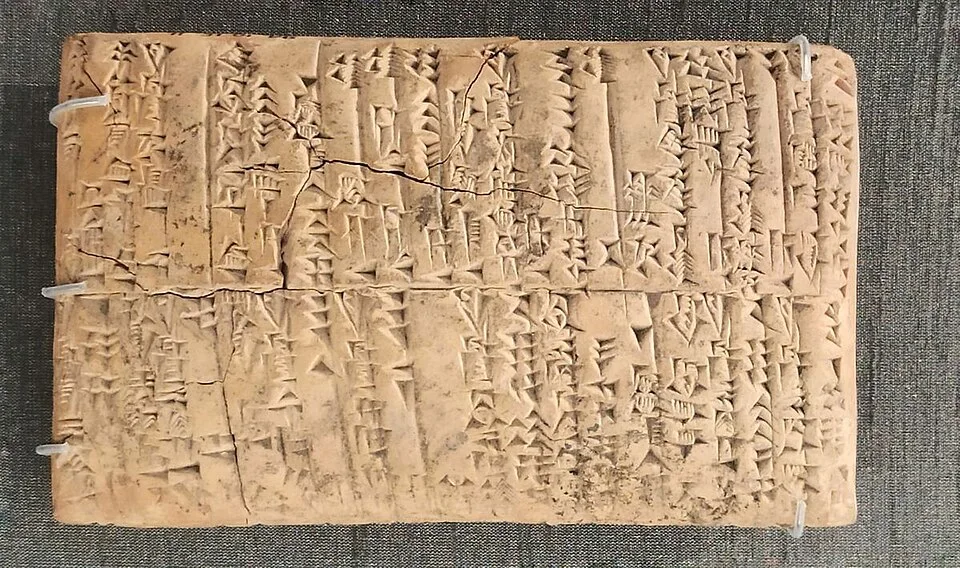
Mesopotamian tablet described as recording barley deposited at a “village of Meluhha”; external evidence relevant to Harappan contacts.
Credit: SpeakingArch · CC BY-SA 4.0 · sourceResized and converted to WebP; uncropped.
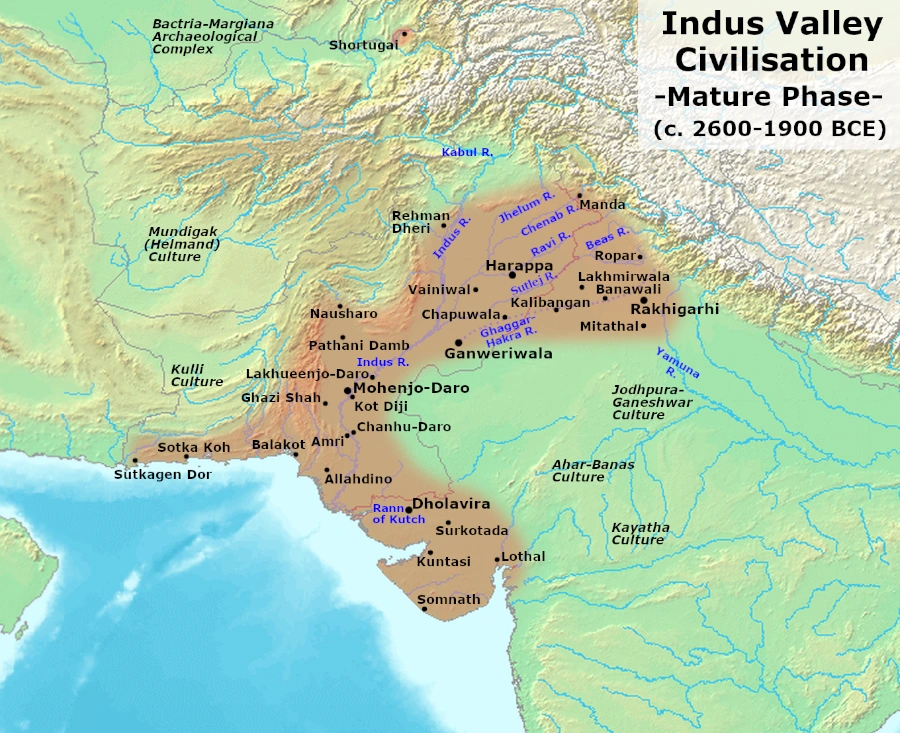
Map study
Mature Harappan civilisation, c. 2600–1900 BCE: settlement distribution, not the territory of a single empire.
- Read the source date and legend before interpreting territorial extent.
- Compare core regions, neighbouring powers and geographic barriers; historical borders and influence are approximate and changed over time.
Credit: Avantiputra7 · CC BY-SA 3.0 · sourceConverted to WebP on an opaque white background; proportionally resized without cropping. Original cartography and legend retained.
1. Historical setting and the identification of Meluhha
The Indus Civilization and Mesopotamian urban societies were contemporaries within a wider Bronze Age world. During the Mature Harappan phase, approximately 2600–1900 BCE, cities such as Harappa, Mohenjo-daro and Dholavira supported specialised crafts, organised exchange and extensive regional networks. Mesopotamian cities required imported metals, timber and stones because the southern alluvial plain lacked many of these resources. This complementary geography encouraged commerce across the Persian Gulf and Arabian Sea.
Mesopotamian cuneiform sources refer to Meluhha, Dilmun and Magan. Most scholars associate third-millennium BCE Meluhha with the Indus region because its listed products, maritime connections and archaeological associations fit northwestern South Asia. However, Meluhha should not be treated as an exactly mapped state or as a securely established Harappan self-designation. References to the name in much later periods may have different geographical meanings.
Dilmun was centred on Bahrain during important phases of Gulf commerce, with connections extending to the eastern Arabian coast and islands such as Failaka. Magan is generally identified with the Oman peninsula, including parts of present-day Oman and the United Arab Emirates. These were distinct regions rather than alternative names for the Indus Civilization. Their importance lay in production, exchange and the movement of goods between distant markets.
- Examination distinction: Meluhha indicates the probable Indus connection; Dilmun and Magan identify separate Gulf trading regions.
- Contemporaneity and exchange do not establish a common political system or a shared language.
Timeline
c. 2600–1900 BCE
Mature Harappan urbanism overlaps with extensive exchange across the Arabian Sea and Persian Gulf.
Twenty-fourth–twenty-third centuries BCE
Sargon's inscription refers to ships from Meluhha, Magan and Dilmun docking at Akkad.
Late third millennium BCE
Mesopotamian texts and the Shu-ilishu seal provide evidence of Meluhhan goods, people and linguistic mediation.
After c. 1900 BCE
Harappan urban transformation accompanies changes in the earlier pattern of interregional commerce.
2. Written and archaeological evidence
A royal inscription of Sargon of Akkad, who ruled in the twenty-fourth and twenty-third centuries BCE under commonly used chronologies, states that ships from Meluhha, Magan and Dilmun docked at Akkad. This is important evidence for maritime contact, although royal inscriptions can celebrate power and prosperity rather than provide neutral commercial statistics. References under later rulers, including Gudea of Lagash, also connect overseas regions with valued materials.
A cylinder seal belonging to Shu-ilishu identifies him as an interpreter of the Meluhhan language. It suggests that communication with Meluhhan speakers required linguistic mediation and that people, not merely objects, moved through these exchange networks. Some Mesopotamian documents also mention Meluhhan individuals or communities. Such evidence supports a foreign presence but does not establish the size of any Harappan merchant colony.
Archaeological evidence includes Harappan-type seals, distinctive carnelian beads and other South Asian-associated objects found in Mesopotamia and Gulf settlements. Finds from sites such as Ur help connect textual references with material remains. Nevertheless, an imported object may have reached its destination through several intermediaries. Its presence alone does not prove that a Harappan merchant personally visited the site.
Mesopotamian writing can be read, whereas the Indus script remains undeciphered. Consequently, historians can examine Mesopotamian descriptions of overseas exchange but cannot securely read Harappan contracts, cargo lists or personal accounts. A sound interpretation therefore combines texts, archaeological contexts, craft techniques and material analysis rather than relying on either texts or visual similarities alone.
- Strong evidence comes from the convergence of readable texts and securely contextualised archaeological finds.
- Avoid claims that Indus inscriptions have revealed named trade treaties or commercial agreements.
Illustrative movement of a Harappan craft product
- 1. Raw material obtained from a regional resource zone
- 2. Specialist workshop manufactures beads or other finished goods
- 3. Inland exchange brings goods to a coastal outlet
- 4. Maritime transport proceeds directly or through Gulf intermediaries
- 5. Goods reach Mesopotamian consumers and redistribution networks
3. Routes, coastal settlements and intermediaries
The maritime network connected the Indus delta and Gujarat coast with the Makran coast, the Oman peninsula, Bahrain and southern Mesopotamia. Coastal sailing and staged journeys probably played an important role. Navigation depended on knowledge of winds, currents, freshwater sources and sheltered landing places. It is unnecessary to assume that every voyage followed the same route or that every consignment travelled directly between an Indus settlement and a Mesopotamian city.
Sutkagen-dor, near the Iran–Pakistan border in the Makran region, and Balakot, near the Arabian Sea coast, illustrate the western and coastal reach of Harappan settlement. Lothal in Gujarat combined craft production with access to waterways leading towards the Gulf of Khambhat. Its large brick-lined basin is traditionally interpreted as a dockyard, although its precise function and ancient access to the sea remain debated.
Overland networks also mattered. Shortugai in northern Afghanistan demonstrates Harappan connections beyond the Indus plains and is often discussed in relation to access to lapis lazuli and other regional resources. Inland routes linked resource zones, workshops and urban markets to coastal outlets. Gulf intermediaries could then redistribute goods, making the network a combination of inland transport, coastal exchange and longer sea passages.
- Direct contact and intermediary trade were compatible features of the same network.
- A coastal settlement is not automatically a proven international port; its interpretation depends on archaeological and environmental evidence.
| Name | Usual identification | Exam significance |
|---|---|---|
| Meluhha | Indus region in third-millennium BCE contexts | Strong identification, but exact boundaries uncertain |
| Dilmun | Bahrain and adjoining Gulf areas | Important intermediary in maritime exchange |
| Magan | Oman peninsula | Associated particularly with copper and maritime commerce |
| Akkad | Mesopotamian imperial capital; exact site unconfirmed | Sargon's inscription mentions overseas ships at its quay |
| Lothal | Gujarat, India | Craft and trading settlement with a basin traditionally interpreted as a dockyard |
4. Commodities and the organisation of exchange
Carnelian beads are among the most informative objects associated with Harappan external exchange. Long barrel-shaped beads and white-decorated, conventionally termed etched, carnelian beads required specialised production techniques. Gujarat workshops, including Chanhudaro's wider counterpart at Lothal, formed part of an extensive Harappan craft economy; Chanhudaro itself lay in Sindh. Shell objects, ivory products and timber also feature in reconstructions of trade, supported in varying degrees by archaeology and Mesopotamian references.
Mesopotamian texts associate Meluhha with valued woods, carnelian and other exotic materials. However, ancient commodity names do not always translate securely into modern botanical or mineral categories. Lapis lazuli originated especially in Afghanistan and could move through several networks; its presence in Mesopotamia does not prove exclusively Harappan mediation. Cotton was known to the Harappans, but evidence for the scale of cotton-textile exports to Mesopotamia is much weaker than evidence for bead exchange.
Copper from the Oman peninsula circulated through Gulf networks and is relevant to Harappan external procurement. Yet Harappan communities obtained raw materials from multiple sources, including the Indian subcontinent. Standardised weights and seals indicate organised transactions and systems of identification or control. They do not prove modern coinage, a single state trading monopoly or an identical accounting system across the Indus and Mesopotamia.
- Distinguish the geological source of a material from the workshop that transformed it and the merchant network that distributed it.
- Preserved beads and seals are more archaeologically visible than perishable cargoes such as wood and textiles.
5. Significance, change and interpretive limits
Mesopotamian links reveal the Harappan Civilization as a participant in interregional exchange rather than an isolated urban culture. Overseas demand may have encouraged specialised craftsmanship, while merchants and interpreters enabled interaction across linguistic boundaries. Nevertheless, most Harappan economic activity rested on agriculture, pastoralism, crafts and exchange within South Asia. Foreign commerce was significant without necessarily being the principal foundation of the entire civilisation.
After about 1900 BCE, Harappan urban systems underwent regional transformations, and the earlier pattern of long-distance exchange changed. These developments should not be reduced to the disappearance of a single market. River changes, climatic pressures, settlement shifts and alterations in production and exchange interacted differently across regions. Nor did all trade end abruptly: Gulf and South Asian networks continued in altered forms.
For UPSC, the central skill is to distinguish well-supported connections from excessive inference. The identification of Meluhha with the Indus region is strong but not a precisely bounded geographical equation. The movement of Harappan-associated goods is demonstrable, while exact cargo volumes, contractual arrangements and the political identity of merchants remain uncertain.
- Trade contact does not demonstrate Mesopotamian colonisation of the Indus region.
- The decline of Mature Harappan cities was a complex transformation, not a securely established consequence of foreign-trade collapse alone.
Meluhha in Mesopotamian Records
The supplied metadata identifies this object as a Mesopotamian administrative tablet recording a barley deposit associated with a “village of Meluhha”. It is directly relevant because cuneiform references to Meluhha form an important textual strand in studying Harappan connections with western Asia. Meluhha is widely associated with the Indus region, but the term’s geographical scope and the meaning of individual references require contextual interpretation. This is a Mesopotamian source, not an artefact excavated at an Indian Harappan site.
An administrative record can illuminate economic organisation and the presence of a Meluhha-associated place-name within Mesopotamian records. It does not, by itself, establish that the recorded barley came from the Indus region or that every inhabitant of the named settlement was Harappan. The metadata’s reading should be checked against a scholarly publication of the inscription before drawing detailed conclusions. For ancient Indian history, such external texts gain explanatory strength when considered alongside seals, beads and other archaeological evidence of exchange through the Persian Gulf. Together, these sources support commercial interaction without demonstrating Mesopotamian political authority over Harappan settlements.
- Distinguish Meluhha as a broad geographical designation from a local “village of Meluhha”; the latter may suggest a community association, not territorial identity.
- Separate commodity accounting from trade provenance: a barley deposit is not automatically evidence of barley imported from the Indus region.
- For Prelims and Mains, combine textual and archaeological evidence, while remembering that Mesopotamian cuneiform does not decipher the still-undeciphered Indus script.
Real-world case studies
Shu-ilishu: interpreting across cultures
The inscription on Shu-ilishu's cylinder seal identifies an interpreter of the Meluhhan language. This provides unusually direct evidence for linguistic mediation in Bronze Age exchange. It supports contact with Meluhhan speakers but neither deciphers the Indus script nor establishes which language the Harappans spoke.
Lothal: interpreting a trading settlement
Excavations at Lothal revealed bead-making evidence, seals, weights and a large brick-lined basin. These discoveries make it a useful example of craft production connected with exchange. The basin's conventional dockyard interpretation should be distinguished from the more securely established evidence of settlement and manufacturing.
Previous year questions
No source-linked PYQ is available here yet. Use the practice questions below.
Practice questions
Practice MCQ 1
Which of the following pairs are correctly matched? 1. Meluhha — Indus region 2. Dilmun — Bahrain region 3. Magan — Oman peninsula
- A. 1 and 2 only
- B. 2 and 3 only
- C. 1 and 3 only
- D. 1, 2 and 3
Practice MCQ 2
The seal of Shu-ilishu is particularly significant because it provides evidence of:
- A. A bilingual inscription deciphering the Indus script
- B. An interpreter associated with the Meluhhan language
- C. Akkadian military occupation of Harappa
- D. Coinage shared by the Indus and Mesopotamian civilisations
Practice MCQ 3
Consider the following statements: 1. Harappan-associated objects in Mesopotamia could have arrived through intermediaries. 2. Lapis lazuli found in Mesopotamia necessarily proves direct Harappan trade. 3. Standardised Harappan weights do not by themselves establish the use of coinage. Which statements are correct?
- A. 1 and 2 only
- B. 2 and 3 only
- C. 1 and 3 only
- D. 1, 2 and 3
Mains practice · Assess the evidence for Harappan contacts with Mesopotamia. What are the limitations of using this evidence to reconstruct the organisation of overseas trade? Answer in 250 words.
- Introduce the chronological overlap and the Meluhha identification.
- Discuss Sargon's inscription, the Shu-ilishu seal and archaeological finds.
- Explain maritime routes and the roles of Dilmun and Magan.
- Use beads, seals and weights to discuss crafts and transactions.
- Distinguish direct voyages from intermediary exchange.
- Conclude with undeciphered Indus writing, uncertain commodity identifications and the lack of reliable trade-volume data.
Further reading
- NCERT, Themes in Indian History, Part I, chapter: Bricks, Beads and Bones.
- Upinder Singh, A History of Ancient and Early Medieval India, chapter on the Harappan Civilization.
- Jonathan Mark Kenoyer, Ancient Cities of the Indus Valley Civilization.
- Archaeological Survey of India, excavation reports and publications on Lothal.
- UNESCO World Heritage Centre, Qal’at al-Bahrain – Ancient Harbour and Capital of Dilmun.
- https://commons.wikimedia.org/wiki/File:Mesopotamian_Tablet,_now_housed_in_the_Indian_Galleries_of_the_British_Museum_mentions_a_barley_deposit_in_the_granary_of_the_%22village_of_Meluhha%22.jpg
Preparing for UPSC Civil Services? Get classroom teaching, answer-writing evaluation and mentorship at Pragnya IAS Academy, Ashok Nagar — see why aspirants choose us for IAS coaching in Hyderabad.