

This is a photo of ASI monument number
Credit: Kinkhab · CC BY-SA 4.0 · source

Silver rupee,Lahore mint,struck in Aban month of Ilahi
Credit: Drnsreedhar1959 · CC BY-SA 3.0 · source
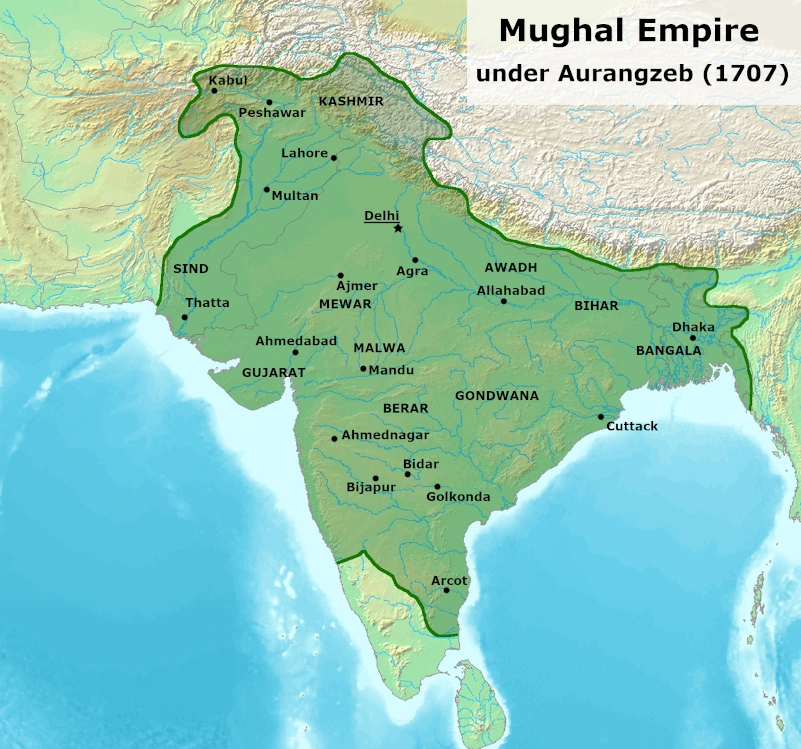
Map study
Mughal Empire in 1707 near the end of Aurangzeb’s reign; this is not Babur’s or Akbar’s territorial extent.
- Read the source date and legend before interpreting territorial extent.
- Compare core regions, neighbouring powers and geographic barriers; historical borders and influence are approximate and changed over time.
Credit: Avantiputra7 · CC BY-SA 4.0 · sourceConverted to WebP on an opaque white background; proportionally resized without cropping. Original cartography and legend retained.
1. Economic foundations and historical sources
Agriculture sustained the majority of the population and furnished the largest share of Mughal state income. Yet the economy was not simply a collection of isolated, self-sufficient villages. Rural households sold produce to meet revenue obligations and purchase necessities; market towns connected cultivators with merchants, artisans and administrative centres. Imperial capitals such as Agra, Delhi and Lahore concentrated elite consumption, military expenditure and specialised crafts. Regional ecology shaped production, ranging from irrigated wheat cultivation in northern plains to rice-growing Bengal and commercial crops in Gujarat.
The economy combined household production, village services, merchant-financed manufacture and imperial establishments. Political integration, roads, mints and administrative demand facilitated exchange, although warfare, tolls, insecurity and local power struggles could interrupt it. Expansion of cultivation often involved settlement of new lands, forest clearance and negotiations with local chiefs. Economic conditions varied considerably across regions and between the relatively consolidated sixteenth-century empire and the contested late seventeenth-century Deccan.
Sources must be read critically. The Ain-i Akbari, completed in the 1590s, describes institutions under Akbar and supplies extensive revenue and price information. European travellers such as François Bernier and commercial records of the English and Dutch companies illuminate trade and production. However, official texts may describe administrative ideals, while travellers sometimes misunderstood Indian property relations. Bernier’s claim that the emperor owned all land should not be accepted as a complete description of actual rights.
2. Agriculture, cultivation and rural society
Food production included rice, wheat, barley, millets and pulses. Cotton, sugarcane, indigo and oilseeds linked agriculture with manufacturing and commercial markets. Tobacco, introduced through Portuguese connections around the beginning of the seventeenth century, spread rapidly despite restrictions under Jahangir. Crop choices depended on rainfall, soil, irrigation, demand and access to credit. Wells, tanks, canals and devices such as the Persian wheel supported cultivation, but large areas remained dependent on the monsoon.
The peasantry was socially and economically differentiated. Some cultivators had substantial plough cattle, implements and access to irrigation, while others depended on borrowing, tenancy or wage labour. Khud-kasht generally referred to resident cultivators, whereas pahi-kasht denoted cultivators working outside their home village. These categories varied locally and should not be treated as a rigid, empire-wide hierarchy. Women contributed substantially to sowing, weeding, harvesting, processing and household manufacture, although official records rarely capture their work adequately.
Zamindars exercised hereditary claims, collected dues and often maintained armed followers. Some controlled only a few villages; others were powerful chiefs. Village headmen and accountants mediated between cultivators and the revenue administration. Land rights were consequently layered: cultivators, zamindars and the state held different claims rather than a single modern ownership title. Famines and warfare could devastate this agrarian base. The Gujarat–Deccan famine of 1630–1632 illustrates how failed harvests and disruption could undermine both livelihoods and revenue.
Simplified operation of zabt-based cash assessment
- 1. Measure cultivated land using standardised units.
- 2. Record crops and relevant land categories.
- 3. Estimate normal yields and prices; use ten-year averages under dahsala.
- 4. Apply prescribed rates to determine assessed revenue, or jama.
- 5. Collect revenue through administrative and local intermediaries.
- 6. Record actual realisation, or hasil, for the treasury or revenue assignee.
3. Revenue assessment, collection and assignments
Akbar’s revenue reforms, associated prominently with Raja Todar Mal, built on earlier practices, including those of Sher Shah. Under zabt, cultivated land was measured and revenue assessed through standardised rates. The dahsala arrangement, introduced around 1580, used average yields and prices for the preceding ten years to derive cash assessments. The assessed demand was commonly calculated at about one-third of average produce. This was an assessment norm, not proof that every cultivator everywhere paid an identical proportion.
Zabt worked best where reliable measurement, crop information and administrative supervision were available. It was important in core northern territories but was not universal throughout the empire. Other methods included batai or ghalla-bakhshi, involving division of produce; kankut, estimating output through an appraisal of land and crops; and nasaq, generally associated with aggregate assessment drawing on previous demands. Collection methods could be adapted to local conditions, and cash assessment did not eliminate all payment in kind.
For assessment purposes, polaj was regularly cultivated land; parauti was temporarily left fallow; chachar had remained uncultivated for three or four years; and banjar for five years or more. These categories distinguished cultivation history rather than ownership. Another crucial distinction is jama, the assessed revenue, versus hasil, the revenue actually realised. Jagirs assigned revenue to maintain officials and troops, while khalisa revenue accrued directly to the imperial treasury. Frequent jagir transfers discouraged permanent territorial consolidation but could also encourage short-term extraction by assignees.
| Term | Meaning | Prelims distinction |
|---|---|---|
| Zabt and dahsala | Measured assessment; ten-year averages used for cash rates | Dahsala did not mean a permanent ten-year revenue settlement. |
| Jama and hasil | Assessed revenue and realised revenue | Recorded demand could exceed actual receipts. |
| Mansab and jagir | Official rank and revenue assignment | Rank was not ownership of the assigned territory. |
| Khalisa and jagir | Direct treasury revenue and assigned revenue | The distinction concerned the destination of revenue. |
| Zamindar and jagirdar | Local hereditary claimant and normally transferable revenue assignee | Their institutional roles were distinct, although individuals could hold overlapping positions. |
| Hundi and coin | Credit or remittance instrument and metallic currency | A hundi was not a denomination minted by the state. |
4. Crafts, commerce and monetary institutions
Textiles were the leading manufacturing sector. Gujarat, Bengal and the Coromandel coast supplied cotton fabrics to domestic and overseas markets; Bengal also produced silk, while Kashmir was known for shawls. Indigo processing, sugar refining, metalworking, shipbuilding and saltpetre production were other significant activities. Many artisans worked in households or small workshops, sometimes receiving merchant advances. Imperial karkhanas produced, stored or supplied goods for the court and state; they were not factories in the modern mechanised sense.
Trade operated at several scales. Banjaras carried bulk commodities, especially grain, using pack animals, and supplied towns and armies. Merchants linked inland marts with ports such as Surat, Hooghly and Masulipatnam. Bengal’s rivers provided relatively inexpensive transport. Indian merchants traded across the Indian Ocean alongside Portuguese, Dutch and English companies. The companies initially participated within established Asian commercial networks rather than creating overseas trade from nothing.
The monetary system centred on the silver rupee, alongside gold mohurs and copper dams. Mughal rulers continued and expanded the standardised silver currency associated with Sher Shah. Sarrafs tested and exchanged coins and also provided financial services. Hundis functioned as instruments of credit and remittance, reducing the need to move specie physically. Export demand for textiles, indigo and saltpetre encouraged inflows of silver and gold. Monetisation was substantial, but it coexisted with barter, payments in kind and pronounced regional differences.
5. Fiscal pressures and interpreting economic change
The mansabdari and jagirdari systems connected revenue extraction with military organisation. A mansab determined an officer’s official rank and obligations; a jagir was one means of financing the corresponding salary and establishment. Jagirs were normally transferable assignments rather than hereditary private estates. A gap between the paper value of an assignment and actual receipts could leave an officer unable to meet obligations and intensify pressure on cultivators and local intermediaries.
Late seventeenth-century warfare, especially prolonged campaigning in the Deccan under Aurangzeb, increased expenditure and disrupted some producing regions. Competition for productive jagirs, difficulties in collection and resistance by zamindars and peasants complicated imperial finance. Historians describe aspects of these tensions as the jagirdari crisis or agrarian crisis, but explanations differ. Neither label should be reduced to a single universally accepted cause of Mughal decline.
Political fragmentation did not produce uniform economic collapse. During the eighteenth century, commercial activity and textile production remained important in several successor states even as particular cities and routes suffered. For examinations, distinguish declining imperial fiscal control from the fortunes of the wider economy. Similarly, European descriptions of prosperity do not establish equal welfare: flourishing exports and wealthy courts could coexist with indebted cultivators, vulnerable artisans and severe subsistence crises.
Real-world case studies
Surat: a port linking inland production and overseas trade
Following Akbar’s conquest of Gujarat in 1572–1573, Surat became a major Mughal maritime gateway. It connected inland textile-producing centres with the Red Sea, Persian Gulf and wider Indian Ocean. The English established a factory there in 1613. Surat also served pilgrims travelling towards Mecca. Its merchants, including the prominent seventeenth-century trader Virji Vora, demonstrate the importance of Indian capital and credit alongside European company activity.
Bengal: commercial prosperity amid rural vulnerability
Seventeenth-century Bengal combined productive rice agriculture with cotton textiles, silk and river-based transport. Dhaka became particularly associated with fine cotton fabrics, including muslin. Merchant advances connected weavers with distant markets, but could also create dependence on financiers. Bengal illustrates why agricultural abundance, specialised manufacturing and export success must be examined separately from the bargaining power and living standards of individual producers.
Previous year questions
No source-linked PYQ is available here yet. Use the practice questions below.
Practice questions
Practice MCQ 1
With reference to Mughal revenue administration, consider the following statements: 1. Jama denoted assessed revenue, whereas hasil denoted actual realisation. 2. Dahsala fixed the revenue demand permanently for every successive ten-year period. 3. Zabt was applied uniformly throughout all Mughal territories. Which of the statements given above is/are correct?
- A. 1 only
- B. 1 and 2 only
- C. 2 and 3 only
- D. 1, 2 and 3
Practice MCQ 2
Which one of the following correctly describes a jagir under the Mughal administration?
- A. A hereditary ownership title over all agricultural land in a province
- B. A revenue assignment commonly used to finance an official’s salary and establishment
- C. A tax imposed exclusively on maritime imports
- D. A village credit instrument issued by a sarraf
Practice MCQ 3
Consider the following pairs relating to the Mughal economy: 1. Sarraf — coin testing, money changing and financial services 2. Banjara — transport of bulk commodities 3. Hundi — imperial copper coin. How many of the pairs given above are correctly matched?
- A. Only one
- B. Only two
- C. All three
- D. None
Mains practice · The Mughal economy combined commercial dynamism with a revenue-intensive agrarian order. Examine this statement. Answer in 250 words.
- Explain agriculture’s central role in production and state finance.
- Discuss zabt, dahsala and the distinction between jama and hasil.
- Connect mansabdari and jagirdari with military expenditure and collection pressures.
- Illustrate commercial dynamism through textiles, ports, bullion inflows, sarrafs and hundis.
- Highlight regional variation, unequal producer bargaining power and vulnerability to famine and warfare.
- Conclude that commercial prosperity and agrarian distress could coexist; declining imperial control did not imply uniform economic collapse.
Further reading
- NCERT, Themes in Indian History, Part II: Peasants, Zamindars and the State.
- Satish Chandra, Medieval India: From Sultanat to the Mughals, Part II.
- Irfan Habib, The Agrarian System of Mughal India, 1556–1707.
- Abu’l Fazl, Ain-i Akbari, translated by H. Blochmann and H. S. Jarrett.
- Reserve Bank of India, Monetary Museum: Indian coinage and monetary history resources.
Preparing for UPSC Civil Services? Get classroom teaching, answer-writing evaluation and mentorship at Pragnya IAS Academy, Ashok Nagar — see why aspirants choose us for IAS coaching in Hyderabad.