
![Manuscript painting of a display of jewellery, from an illustrated 'Ain-i-Akbari' manuscript commissioned by the Sikh Empire [Lahore State]
Dating: dated ca.1822–23 by Bonhams [1895 Bk.? which would m](https://thumb.wikimedia.org/wikipedia/commons/thumb/4/4d/Manuscript_painting_of_a_display_of_jewellery%2C_from_an_illustrated_%27Ain-i-Akbari%27_manuscript_commissioned_by_the_Sikh_Empire.jpg/960px-Manuscript_painting_of_a_display_of_jewellery%2C_from_an_illustrated_%27Ain-i-Akbari%27_manuscript_commissioned_by_the_Sikh_Empire.jpg?utm_source=commons.wikimedia.org&utm_campaign=imageinfo&utm_content=thumbnail)
Manuscript painting of a display of jewellery, from an illustrated 'Ain-i-Akbari' manuscript commissioned by the Sikh Empire [Lahore State] Dating: dated ca.1822–23 by Bonhams [1895 Bk.? which would m
Credit: Unknown artist (however the paintings look similar to known works ascribed/attributed to Imam Bakhsh Lahori but this is · Public domain · source

Diwan-i-Khas, Fatehpur-Sikri, Uttar Pradesh, India.
Credit: Clément Bardot · CC BY-SA 4.0 · source
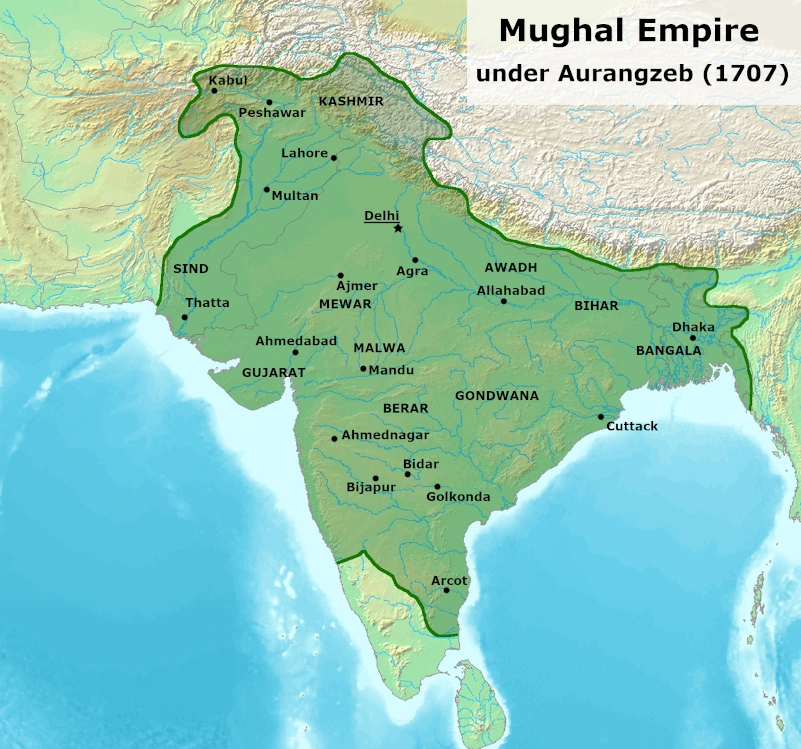
Map study
Mughal Empire in 1707 near the end of Aurangzeb’s reign; this is not Babur’s or Akbar’s territorial extent.
- Read the source date and legend before interpreting territorial extent.
- Compare core regions, neighbouring powers and geographic barriers; historical borders and influence are approximate and changed over time.
Credit: Avantiputra7 · CC BY-SA 4.0 · sourceConverted to WebP on an opaque white background; proportionally resized without cropping. Original cartography and legend retained.
1. Monarchy, legitimacy and central government
The Mughal emperor stood at the apex of executive, military and judicial authority. Governance drew upon Timurid traditions, Persianate political culture, Islamic institutions and existing Indian administrative practices. Nevertheless, effective rule depended on nobles, local landed intermediaries and negotiated relationships with regional elites. The empire should therefore not be understood as a modern, uniformly administered centralised state.
Under Akbar, imperial authority acquired an especially expansive ideological foundation. Abu’l Fazl described sovereignty through concepts such as divine illumination, or farr-i izadi. Sulh-i kul, meaning universal peace, provided an ethical framework for accommodating different religious communities. Recruitment of Rajputs and other Indian groups broadened the service elite alongside Turanis, Iranis and other nobles. Persian was the principal language of higher administration and record-keeping.
The central diwan, often designated diwan-i ala, supervised revenue and financial administration. The mir bakhshi dealt with the military service establishment, including recommendations concerning appointments and promotions, troop verification and associated records. The mir saman supervised the imperial household, stores and karkhanas, which produced and supplied goods for the court. The sadr-us sudur supervised religious endowments and charitable grants, while the qazi-ul-quzat headed the judicial establishment. Titles and the distribution of duties varied over time.
Authority was deliberately distributed rather than concentrated in a single minister. Revenue accounts, military verification and executive commands passed through different officials. News writers, or waqia-navis, and other intelligence channels informed the court about provincial developments. These arrangements enabled supervision but could not eliminate patronage, corruption or delays across a vast empire.
Timeline
1540–1545
Sher Shah’s reign strengthened revenue and administrative practices that formed part of the background to later Mughal reforms.
1556–1605
Akbar’s reign saw the consolidation of mansabdari, provincial administration and systematic revenue assessment.
1580
Akbar organised the empire into 12 subas; dahsala arrangements developed around this period.
1605–1627
Jahangir introduced the du-aspa sih-aspa distinction within the mansabdari framework.
Late seventeenth century
Deccan warfare and growing pressure on revenue assignments intensified military-fiscal tensions.
2. Provinces, districts and local administration
Akbar’s provincial reorganisation of 1580 established 12 subas. The basic territorial hierarchy was suba, sarkar and pargana or mahal, with villages forming the local base. These terms should not be treated as perfectly uniform modern administrative units: a mahal was particularly associated with revenue assessment, and territorial arrangements changed with expansion and local circumstances.
The subadar, also called sipahsalar or nazim in different contexts, headed provincial executive and military administration. The provincial diwan supervised revenue and accounts and communicated through the central financial establishment. This separation created a check on the governor. Provincial bakhshis, qazis, sadrs and news writers performed specialised functions broadly corresponding to those at the centre.
At the district and local levels, the faujdar maintained order and supplied armed support when necessary, including for revenue collection. His jurisdiction did not always coincide neatly with a sarkar. The amil or amalguzar handled revenue work. At the pargana level, the shiqdar dealt with policing and executive matters, while the qanungo preserved information about local revenue practices. Village headmen, often called muqaddams, and patwaris assisted collection and maintained village records.
In towns, the kotwal was concerned with policing, security, markets and civic regulation. Qazis administered justice, but actual legal practice also accommodated customary law, community institutions and imperial orders. Village panchayats continued to handle many local disputes. Mughal administration thus combined imperial offices with institutions rooted in local society.
Simplified operation of the mansab–jagir arrangement
- 1. The emperor appoints a mansabdar and fixes his zat and sawar ranks.
- 2. The administration calculates personal remuneration and military allowances.
- 3. Payment is arranged through cash or a revenue assignment.
- 4. Where a jagir is assigned, the holder collects authorised revenue through the existing local machinery.
- 5. The mansabdar maintains the prescribed contingent and submits to verification.
- 6. The court may revise rank, transfer the assignment or demand service elsewhere.
3. Mansabdari and the military service structure
The mansabdari system organised imperial service through numerical ranks. Mansabdars performed military as well as civil duties; there was no rigid separation between a modern civil service and an officer corps. Appointment, promotion and transfer depended formally on the emperor. Rank was not automatically hereditary, although influential service families could retain considerable political advantage.
In its developed form under Akbar, a mansab had two components. Zat expressed a noble’s personal standing and determined the basis of personal remuneration. Sawar indicated the cavalry establishment he was required to maintain and the allowance associated with it. Thus, a mansabdar with 5,000 zat and 3,000 sawar did not simply possess two equivalent status numbers. Actual service requirements were affected by regulations, concessions and later modifications.
Inspection sought to prevent fictitious musters and substitution of inferior animals. Dagh referred to horse branding, while descriptive rolls of soldiers were known as chehra. The mir bakhshi’s establishment played an important role in military verification. Jahangir introduced the du-aspa sih-aspa distinction, which increased mounted obligations and allowances for a specified portion of the sawar rank without necessarily raising zat.
Mansabdars could receive remuneration in cash or through revenue assignments. They maintained contingents that served alongside other imperial forces, including artillery and directly employed cavalrymen such as ahadis. The arrangement allowed the emperor to mobilise substantial forces without paying every soldier directly from the central treasury. Its weakness was dependence on accurate accounts, effective inspections and sufficient realisable revenue.
| Terms | First term | Second term |
|---|---|---|
| Zat / Sawar | Personal rank and basis of personal salary | Cavalry obligation and associated allowance |
| Jagirdar / Zamindar | Holder of an assigned revenue entitlement, generally transferable | Holder of varied hereditary local rights, dues and authority |
| Jagir / Khalisa | Revenue assigned to a grantee, commonly for remuneration | Revenue reserved for the imperial treasury |
| Jama / Hasil | Assessed revenue | Revenue actually realised |
| Subadar / Provincial diwan | Provincial executive and military head | Provincial revenue and financial supervisor |
| Zabt / Batai | Measurement-based assessment using crop rates | Assessment through division of produce |
4. Jagirs, zamindars and land-revenue assessment
A jagir was an assignment of revenue, commonly made in lieu of salary. It did not ordinarily transfer ownership of the soil to the jagirdar. Jagirs were generally transferable, helping prevent officials from establishing permanent local power bases. Watan jagirs associated with hereditary homelands, especially of incorporated chiefs, formed an important qualification. Khalisa lands yielded revenue directly to the imperial treasury.
Zamindars were distinct from jagirdars. They possessed varied hereditary claims, customary dues and local social authority, often supported by armed retainers. Some were village-level intermediaries, while others were powerful chiefs. They assisted revenue collection but could also resist imperial demands. Describing every zamindar as either a modern landlord or merely a salaried collector obscures this diversity.
Land revenue was the chief fiscal resource. Under zabt, cultivated area was measured and assessment depended on crop-specific schedules. Akbar’s dahsala arrangements, developed around 1580, used averages of produce and prices over ten years to establish cash rates. The state demand under the standard formulation approximated one-third of average produce. Actual burdens and collection practices varied. Dahsala did not freeze assessment for ten years, and zabt did not operate uniformly throughout the empire.
Other methods included batai or ghalla-bakhshi, involving division of produce; kankut, involving estimation of the crop with reference to area and yield; and nasaq, a broadly estimated assessment often drawing on previous demand or collection. Cultivation categories included polaj, regularly cultivated land; parauti, temporarily fallow land; chachar, land left uncultivated for three or four years; and banjar, land uncultivated for five years or more. Their treatment reflected the state’s interest in extending cultivation.
Jama denoted assessed revenue, whereas hasil denoted actual realisation. A large difference between them could leave a jagirdar unable to meet salary and military obligations. Revenue administration must therefore be studied as a relationship among the treasury, service nobility, local intermediaries and cultivators, rather than as measurement alone.
5. Sources, strengths and structural tensions
Abu’l Fazl’s Ain-i Akbari, the third part of the Akbarnama, is a major source for imperial regulations, offices, revenue statistics and the service establishment. It presents the empire from the court’s perspective and often records administrative ideals. Farmans, revenue papers, regional records and other contemporary accounts help test how closely practice matched prescription.
The system’s strengths were graded service, elaborate records, transferable assignments and the incorporation of diverse elites. Its effectiveness nevertheless depended on agricultural productivity and political cooperation. Frequent jagir transfers could discourage long-term investment and encourage short-term extraction, while zamindari resistance or peasant flight reduced collections.
During the later seventeenth century, prolonged warfare, especially in the Deccan, expansion of the service establishment and competition for productive assignments intensified fiscal pressure. Historians connect these problems with a jagirdari crisis, but debate its scale and relationship to agrarian distress. It is misleading to attribute Mughal decline to one administrative defect: regional politics, warfare and changing relations among social groups also mattered.
Real-world case studies
Raja Man Singh of Amber: incorporation through imperial service
Raja Man Singh served Akbar as a leading commander and provincial governor, including in Bengal. His career illustrates how a Rajput ruling house could retain a regional political base while participating in the imperial service hierarchy. Mughal integration depended not simply on conquest but also on negotiated cooperation with established elites.
The Deccan campaigns: expansion and fiscal pressure
Aurangzeb’s annexations of Bijapur in 1686 and Golconda in 1687 enlarged the empire, but prolonged campaigning and resistance made reliable collection difficult in many areas. Nominal additions to assessed revenue did not automatically create readily realisable income. The Deccan demonstrates why the distinction between jama and hasil is essential to understanding military finance.
Previous year questions
No source-linked PYQ is available here yet. Use the practice questions below.
Practice questions
Practice MCQ 1
With reference to Mughal mansabdari, consider the following statements: 1. Zat indicated the personal rank of a mansabdar. 2. Sawar referred to the cavalry obligation attached to his rank. 3. A mansab necessarily conferred hereditary ownership of a specified territory. Which of the statements given above are correct?
- A. 1 and 2 only
- B. 2 and 3 only
- C. 1 and 3 only
- D. 1, 2 and 3
Practice MCQ 2
Which one of the following best describes the dahsala system under Akbar?
- A. A settlement fixing each cultivator’s revenue unchanged for ten years
- B. A method using ten-year averages of produce and prices to establish cash assessment rates
- C. A uniform division of harvested produce throughout the empire
- D. A grant exempting all newly cultivated land permanently from revenue
Practice MCQ 3
Consider the following pairs concerning Mughal administration: 1. Mir bakhshi — Military service establishment 2. Mir saman — Imperial household and karkhanas 3. Qanungo — Command of imperial artillery 4. Kotwal — Urban policing and civic regulation. How many pairs are correctly matched?
- A. Only one
- B. Only two
- C. Only three
- D. All four
Mains practice · The Mughal administrative system combined centralised imperial authority with dependence on local intermediaries. Discuss with reference to mansabdari, jagirdari and revenue administration. Answer in 250 words.
- Introduce the emperor’s authority and the differentiated central and provincial offices.
- Explain imperial control through rank, inspections and transferable revenue assignments.
- Distinguish service-based jagirdars from locally rooted zamindars.
- Show dependence on village officials, customary rights and regional knowledge for collection.
- Discuss the gap between jama and hasil and the limits of uniform assessment.
- Conclude that negotiated local cooperation sustained central power, while fiscal and military pressures could weaken it.
Further reading
- NCERT, Themes in Indian History, Part II: Peasants, Zamindars and the State.
- NCERT, Our Pasts II: The Mughals.
- Satish Chandra, Medieval India: From Sultanat to the Mughals, Part II.
- Abu’l Fazl, Ain-i Akbari, translated by H. Blochmann and H. S. Jarrett.
- Irfan Habib, The Agrarian System of Mughal India, 1556–1707.
Preparing for UPSC Civil Services? Get classroom teaching, answer-writing evaluation and mentorship at Pragnya IAS Academy, Ashok Nagar — see why aspirants choose us for IAS coaching in Hyderabad.