

Hathigumpha inscription (2020) Satakani
Credit: Kevin Standage (kevinstandage1@googlemail.com) INDIAN TRAVEL PHOTOGRAPHY · CC BY-SA 2.0 · source

Village and Pagoda below Patna Azimabad, on the Ganges. From: A Picturesque Tour Along the River Ganges and Jumna in India (London: R. Ackermann, 1824) This is plate 11 from Charles Ramus Forrest's 'A
Credit: Thomas Sutherland / After Charles Ramus Forrest · Public domain · source
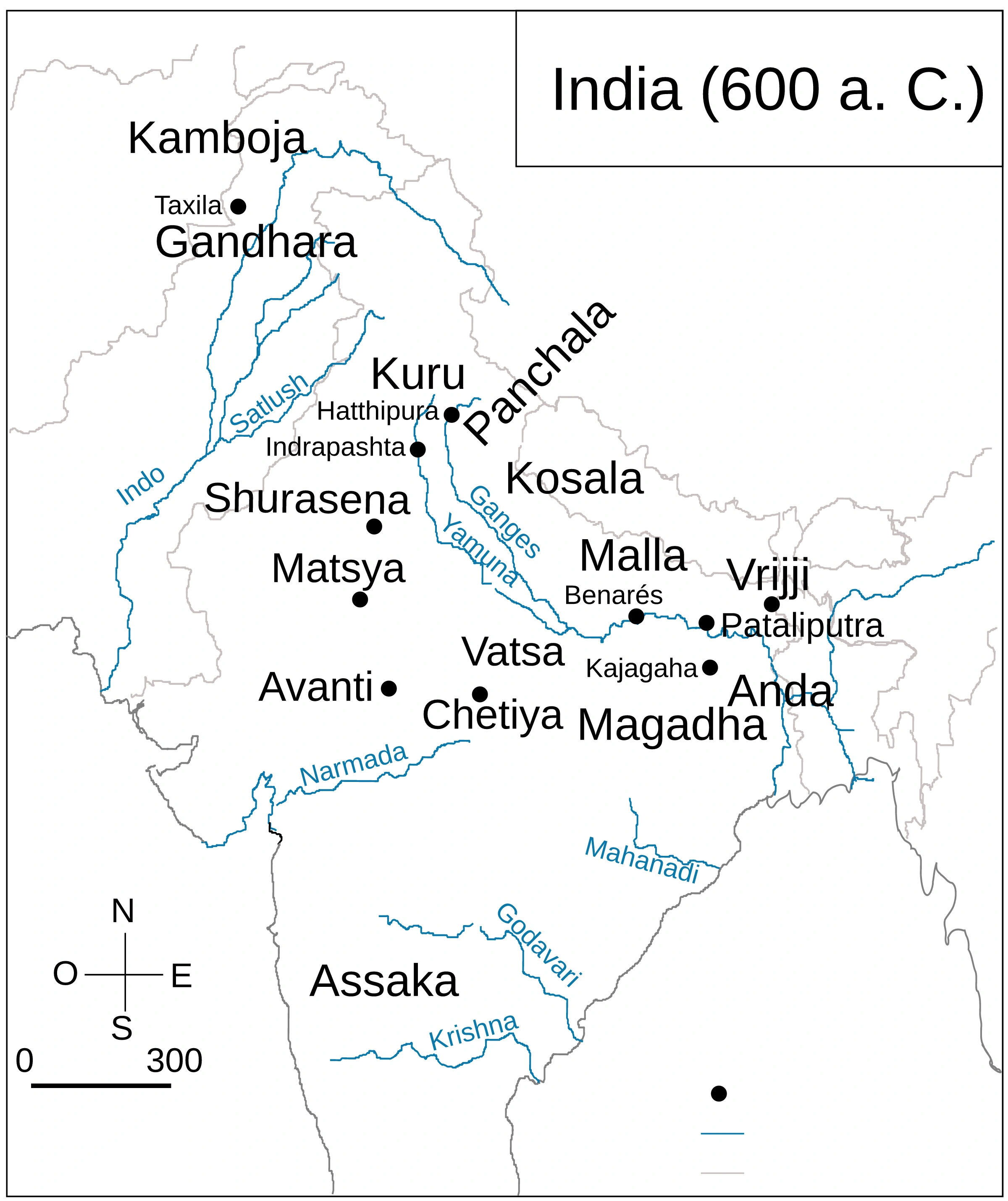
Map study
Sixteen Mahajanapadas: approximate ancient regional locations; compare Magadha and the Gangetic cluster with the northwest.
- Read the source date and legend; distinguish territory, influence and geographic location.
- Historical boundaries and reference memberships are not live political or operational data.
Credit: Rowanwindwhistler; Ski · CC BY-SA 4.0 · sourceConverted to WebP on an opaque white background; proportionally resized without cropping. Original cartography and legend retained.
1. Chronology, sources and historical uncertainty
The Nandas succeeded the Shishunagas as rulers of Magadha during the fourth century BCE. A frequently used textbook chronology places their rule around 345–322 BCE, but this is a conventional reconstruction rather than a securely established sequence of dated reigns. Their fall to Chandragupta Maurya around 322–321 BCE is more firmly situated within the chronology of Alexander’s invasion and the emergence of the Mauryan Empire.
The principal Indian sources are the Puranas, Buddhist chronicles such as the Mahavamsa, and Jain narrative traditions, including Hemachandra’s much later Parishishtaparvan. These works differ over names, family relationships and the number of rulers. Puranic accounts generally describe Mahapadma followed by eight sons; Buddhist tradition presents nine Nandas and identifies the last as Dhana Nanda. These genealogies should not be mechanically combined into one certain king-list.
Greek and Roman writers, including Diodorus, Curtius and Plutarch, preserve information about the powerful eastern kingdom known during Alexander’s campaigns. Their accounts were transmitted or composed later and contain variant royal names and numerical exaggerations. The Hathigumpha inscription of Kharavela supplies another retrospective reference to a Nanda ruler. No securely identified contemporary Nanda royal inscription provides a detailed administrative history.
- For Prelims, distinguish conventional dates from securely dated events.
- For source-based questions, remember that later literary traditions are evidence, but not contemporary official records.
Timeline
Fourth century BCE
Nanda rule succeeds the Shishunaga dynasty in Magadha; the exact accession date is disputed.
Conventionally around 345 BCE onward
Mahapadma Nanda’s rise and expansion are placed within the conventional short chronology of the dynasty.
326 BCE
Alexander’s army refuses to advance beyond the Beas; the Nanda heartland remains unconquered.
Around 322–321 BCE
Chandragupta Maurya overthrows Nanda rule and establishes the Mauryan dynasty.
2. Rulers, social origins and territorial expansion
Mahapadma Nanda is the dynasty’s founder in the Puranic tradition. The Puranas associate him with a Shudra mother and portray him as a destroyer of Kshatriya ruling houses. Other traditions connect the family with humble parentage, sometimes involving a barber. These accounts indicate contested claims to social status and political legitimacy; they do not establish an independently verified caste genealogy. Hostile descriptions may also reflect the concerns of later authors.
Mahapadma is described as ekarat, or sole sovereign, and sarva-kshatrantaka, destroyer of all Kshatriyas. These are claims of exceptional supremacy, not proof that he controlled the whole subcontinent. Puranic lists associate his conquests with several ruling lineages, including the Panchalas, Kashis, Haihayas and Kalingas. They suggest extensive expansion, but the precise boundaries, sequence of campaigns and duration of control remain uncertain.
The most secure political core was Magadha and the middle Gangetic region. Wider influence is commonly reconstructed across substantial parts of northern India, while the Kalinga connection has support in a later inscription. Assertions of Nanda domination far into the Deccan require greater caution. Dhana Nanda is remembered as the final ruler displaced by Chandragupta; identifying him with the eastern king named Agrammes or Xandrames in classical accounts is conventional, not beyond dispute.
Analytical model of Nanda state power
- 1. Fertile Gangetic agriculture and river-based exchange
- 2. Mobilisation of surplus and revenue
- 3. Maintenance of substantial armed forces
- 4. Expansion of Magadhan political authority
- 5. A powerful territorial core inherited by the Mauryas
3. Economic foundations, army and administration
Nanda power rested on advantages developed through Magadha’s earlier expansion. The fertile alluvial plains supported agricultural surplus and a substantial population. The Ganga and its tributaries facilitated transport, communication and commerce. Access to mineral-bearing areas of eastern India and forest resources, including elephants, strengthened the material base of warfare. Pataliputra’s riverine location helped connect the Gangetic heartland with surrounding regions.
Literary traditions consistently associate the Nandas with enormous wealth and heavy taxation. This supports a broad picture of strong revenue mobilisation, but does not establish particular tax rates or a complete fiscal code. Agricultural revenues and levies associated with trade probably sustained the court and army. Northern Black Polished Ware, urban settlements and punch-marked coins belong to the wider early historic economic setting; none can automatically be treated as uniquely Nanda.
Classical accounts describe an exceptionally large eastern army. One frequently cited account gives approximately 200,000 infantry, 20,000 cavalry, 2,000 chariots and several thousand elephants. Figures vary between authors and cannot be treated as audited military returns. Their chief significance is the reputation of the Gangetic kingdom for manpower and elephant warfare. Maintaining such forces would have required substantial revenue, supplies and command arrangements, although the details of Nanda institutions remain poorly documented.
Do not project the administrative system described in the Arthashastra, or institutions documented under Ashoka, directly onto Nanda rule. Centralised authority is a reasonable inference; named departments and precise regulations require separate evidence.
| Source | Information associated with the Nandas | Caution |
|---|---|---|
| Puranas | Mahapadma, eight sons, destruction of Kshatriya houses | Genealogies and regnal durations vary. |
| Buddhist chronicles | Nine Nandas and the last ruler Dhana Nanda | Compiled after the events described. |
| Jain narratives | Dynastic origins and traditions about Chandragupta and Chanakya | Narrative details require corroboration. |
| Greek and Roman accounts | Eastern kingdom, royal origins and large military forces | Variant names and army figures complicate interpretation. |
| Hathigumpha inscription | Retrospective references to a Nanda king in relation to Kalinga | Later evidence with disputed readings and chronological details. |
4. Alexander, the fall of the Nandas and Mauryan succession
Alexander invaded northwestern India in 326 BCE and defeated Porus at the Hydaspes, modern Jhelum. His army subsequently reached the Hyphasis, modern Beas, where the soldiers refused to march farther east. War-weariness, prolonged campaigning and apprehension about powerful kingdoms ahead contributed to this decision. Reports of large armies and war elephants in the Gangetic region formed part of the background, but should not be presented as the sole cause.
The Nanda heartland remained outside Alexander’s conquests. There was no recorded battle between Alexander and Dhana Nanda. Classical references to the Prasii and Gangaridae describe eastern political and geographical groupings whose exact relationship is debated. It is therefore misleading to portray Alexander as having defeated Magadha or reached Pataliputra.
Around 322–321 BCE, Chandragupta Maurya displaced the Nandas and established Mauryan rule. Indian traditions associate his success with Chanakya, also known as Kautilya or Vishnugupta. Stories of Chanakya’s humiliation at the Nanda court and his subsequent vow of revenge are influential literary narratives, not securely documented contemporary events. Likewise, later accounts of oppression and unpopularity cannot alone explain the overthrow. The transition involved political and military contestation whose detailed course is uncertain.
5. Historical significance and examination approach
The Nandas represent the culmination of Magadha’s pre-Mauryan expansion. They helped establish the scale of resource mobilisation and military organisation that made a larger territorial empire possible. Chandragupta inherited a strategically located political centre and a wealthy Gangetic core, even though direct continuity between particular Nanda and Mauryan offices cannot be demonstrated.
Their reported social origins are also important. They show that political authority could be acquired by a dynasty not accepted as traditionally Kshatriya in influential literary accounts. However, this does not prove the disappearance of social hierarchy or the existence of an egalitarian state. Similarly, hostile Brahmanical portrayals do not by themselves establish a definite anti-Brahmanical policy or an exclusive dynastic religious allegiance.
For examinations, organise the topic around five connections: Magadha’s geography, Mahapadma’s expansion, fiscal and military strength, Alexander’s eastern limit and Chandragupta’s accession. Keep Nanda evidence separate from Mauryan evidence. Megasthenes belongs to Chandragupta’s period, while Ashokan edicts and the Lion Capital at Sarnath belong to Ashoka. Neither supplies direct evidence for Nanda court administration.
Real-world case studies
Hathigumpha: evidence for a Nanda connection with Kalinga
Kharavela’s Hathigumpha inscription at Udayagiri near Bhubaneswar, generally assigned to the first century BCE, refers retrospectively to a canal associated with a Nanda king. It also contains a passage commonly interpreted as recording the recovery of a Jina image or sacred object previously taken away by a Nanda ruler. Readings and chronological interpretations are debated. The inscription supports a historical memory of Nanda involvement in Kalinga, but it cannot establish precise provincial boundaries or identify every episode securely with Mahapadma.
Previous year questions
No source-linked PYQ is available here yet. Use the practice questions below.
Practice questions
Practice MCQ 1
With reference to the Nanda dynasty, consider the following statements: 1. Mahapadma Nanda is associated with the title ekarat in the Puranic tradition. 2. A securely identified corpus of contemporary Nanda royal inscriptions describes its administration. 3. The Nandas immediately preceded the Mauryas in Magadha. Which of the statements given above are correct?
- A. 1 and 2 only
- B. 1 and 3 only
- C. 2 and 3 only
- D. 1, 2 and 3
Practice MCQ 2
Which one of the following correctly describes Alexander’s relationship with the Nanda kingdom?
- A. He defeated Dhana Nanda at Pataliputra.
- B. He appointed Chandragupta as governor of Magadha.
- C. His soldiers refused to advance beyond the Beas before reaching the Nanda heartland.
- D. He annexed Kalinga after crossing the Ganga.
Practice MCQ 3
A retrospective reference to a canal associated with a Nanda king occurs in which of the following?
- A. Hathigumpha inscription of Kharavela
- B. Prayaga Prashasti of Samudragupta
- C. Aihole inscription of Pulakeshin II
- D. Rummindei pillar inscription of Ashoka
Mains practice · Assess the contribution of the Nanda dynasty to the emergence of Magadha as an imperial power. What limitations do the available sources impose on this assessment? Answer in 250 words.
- Situate the Nandas between the Shishunaga and Mauryan dynasties.
- Explain the agricultural, riverine and strategic advantages of Magadha.
- Discuss territorial expansion, revenue mobilisation and military strength.
- Connect the Nanda political core with the subsequent Mauryan expansion without assuming complete institutional continuity.
- Evaluate conflicting genealogies, hostile origin stories and exaggerated army figures.
- Use Hathigumpha as retrospective corroboration, while noting its interpretive limitations.
Further reading
- R. S. Sharma, India’s Ancient Past, Oxford University Press.
- Upinder Singh, A History of Ancient and Early Medieval India, Pearson.
- NCERT, Themes in Indian History, Part I, chapter Kings, Farmers and Towns.
- Archaeological Survey of India: resources on Udayagiri and Khandagiri caves.
- Epigraphia Indica, Volume XX: study of the Hathigumpha inscription.
Preparing for UPSC Civil Services? Get classroom teaching, answer-writing evaluation and mentorship at Pragnya IAS Academy, Ashok Nagar — see why aspirants choose us for IAS coaching in Hyderabad.