

This photograph of the Sthambha (free standing pillar) and Chandragupta basadi (Jain temple) built by the en:Western Ganga Dynasty was taken by self (Dinesh Kannambadi) at Chandragiri hill, en:Shravan
Credit: Dineshkannambadi (talk) 01:06, 21 May 2008 (UTC) · CC BY-SA 3.0 · source

Junagadh inscription of Rudradaman (complete)
Credit: JF. Fleet · Public domain · source
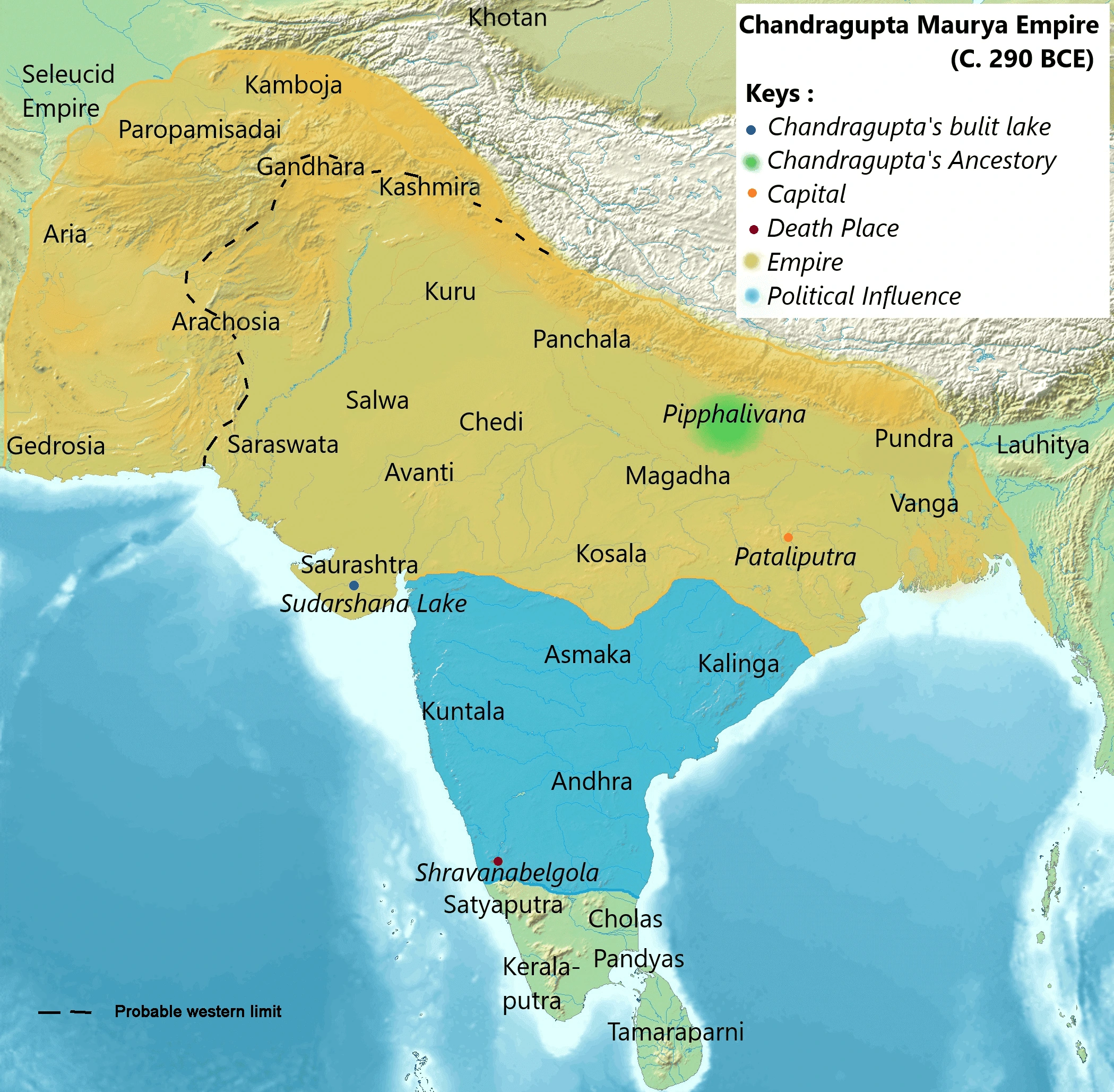
Map study
Chandragupta Maurya’s empire around 290 BCE; compare this extent with the later Ashokan map.
- Read the source date and legend before interpreting territorial extent.
- Compare core regions, neighbouring powers and geographic barriers; historical borders and influence are approximate and changed over time.
Credit: Joshua Jonathan · CC0 · sourceConverted to WebP on an opaque white background; proportionally resized without cropping. Original cartography and legend retained.
1. Historical setting and the foundation of Mauryan power
Chandragupta emerged during a period of major political change in the late fourth century BCE. Magadha had already expanded under earlier dynasties, and the Nandas controlled a powerful kingdom centred on the middle Gangetic plain. Its agrarian resources, access to minerals, important river routes and established revenue machinery provided a strong foundation for imperial expansion. Chandragupta therefore did not create a large state from nothing: he captured and extended an existing centre of power.
Alexander’s invasion of north-western India in 326 BCE and his withdrawal disrupted regional politics. After Alexander’s death in 323 BCE, struggles among his successors weakened the coherence of Macedonian authority in the east. Chandragupta took advantage of this changing environment, although the precise sequence of his campaigns in Magadha and the north-west cannot be reconstructed with certainty.
Around 321 BCE, he overthrew the Nanda dynasty and established Mauryan rule at Pataliputra. Later traditions commonly identify the defeated ruler as Dhana Nanda. Chanakya is credited with organising Chandragupta’s rise, devising political strategies and helping eliminate opposition. The broad association is central to Indian historical tradition, but colourful stories about disguises, childhood incidents and individual stratagems should not be treated as independently verified contemporary evidence.
Timeline
326 BCE
Alexander campaigns in north-western India, altering the regional political setting.
323 BCE
Alexander dies; succession struggles affect Macedonian-held territories.
Around 321 BCE
Chandragupta overthrows the Nandas and establishes Mauryan rule.
Around 305–303 BCE
Conflict and subsequent settlement between Chandragupta and Seleucus I Nicator.
Around 297 BCE
Bindusara succeeds Chandragupta; later Jain tradition associates Chandragupta’s retirement with southern India.
2. Sources and the problem of historical reconstruction
Evidence comes from Greek and Roman writings, Sanskrit political literature, Buddhist and Jain traditions, and archaeology. Classical writers such as Justin, Plutarch, Strabo and Appian preserve information about Chandragupta or his political setting. Their works differ in date and purpose, and some depend on earlier accounts now lost. The identification of Sandrocottus with Chandragupta provides an important chronological link between Indian history and the Hellenistic world.
Megasthenes, associated with the court of Seleucus, visited Chandragupta’s court and wrote the Indica. The original text has not survived; quotations and summaries remain in later authors. His account is valuable for Pataliputra, administration and society, but it also contains misunderstandings and idealised descriptions. His classification of Indian society into seven groups, for example, should not be equated mechanically with the fourfold varna system.
The Arthashastra is traditionally attributed to Kautilya, identified with Chanakya or Vishnugupta. It discusses revenue, espionage, diplomacy, warfare and statecraft. However, the surviving text contains multiple layers and is not universally regarded as a verbatim administrative handbook from Chandragupta’s reign. Vishakhadatta’s Mudrarakshasa, composed centuries later, dramatises Chanakya’s efforts to secure Mauryan power and win over Rakshasa, the former Nanda minister.
Buddhist and Jain sources preserve different accounts of Chandragupta’s ancestry and early life. Their divergence makes confident claims about his caste or precise lineage unsafe. Archaeological discoveries at Pataliputra illuminate the Mauryan capital, but assigning individual remains exclusively to Chandragupta requires caution.
Analytical sequence of Mauryan state formation, not a precise campaign chronology
- 1. Magadha’s accumulated agrarian and fiscal resources provide a territorial base
- 2. Political disruption creates opportunities in northern and north-western India
- 3. Chandragupta replaces Nanda rule and consolidates authority
- 4. Military expansion and diplomacy strengthen the empire
- 5. Succession to Bindusara sustains the Mauryan dynastic framework
3. Expansion and the settlement with Seleucus
Chandragupta extended Mauryan authority over the Gangetic heartland and substantial parts of north-western India. The empire connected productive agricultural regions with strategic routes linking the subcontinent to Afghanistan and the Iranian world. Nevertheless, maps showing sharply defined borders throughout his reign imply greater certainty than the surviving evidence permits. The full southern extent of his personal conquests is especially difficult to establish.
Seleucus I Nicator, one of Alexander’s successors and founder of the Seleucid kingdom, advanced towards India around 305 BCE. Conflict with Chandragupta was followed by a settlement conventionally placed around 303 BCE. Classical accounts indicate territorial concessions by Seleucus and the transfer of 500 war elephants from Chandragupta. The territorial adjustment is usually associated with lands in present-day Afghanistan and adjoining regions, although the exact boundaries remain debated.
The agreement also included epigamia, a term interpreted as a marriage alliance or an arrangement permitting intermarriage. It does not securely establish the popular story that Chandragupta married a named daughter of Seleucus. Diplomatic relations followed, with Megasthenes associated with Chandragupta’s court. The elephants contributed significantly to Seleucus’s military resources and were important at the Battle of Ipsus in 301 BCE.
| Source | Useful for | Main caution |
|---|---|---|
| Megasthenes’ Indica | Court, capital and descriptions of society | Survives only through later quotations and summaries |
| Arthashastra | Statecraft, revenue, diplomacy and administration | Layered prescriptive text; not a straightforward reign-specific record |
| Mudrarakshasa | Literary memory of Chanakya and Mauryan consolidation | A later Sanskrit drama, not an eyewitness chronicle |
| Greek and Roman historical accounts | Identification of Sandrocottus and relations with Seleucus | Often later compositions using lost sources |
| Jain traditions | Bhadrabahu, renunciation and Shravanabelagola | Details recorded substantially after Chandragupta’s lifetime |
4. Kingship, administration and the economic base
Chandragupta’s achievement depended on sustaining a large army and mobilising resources across extensive territory. The Mauryan state is generally characterised by a powerful monarchy, officials, revenue collection, provincial administration and intelligence networks. However, much of the detailed evidence comes from the Arthashastra, Megasthenes as transmitted by later writers, and inscriptions of Ashoka. Features documented for Ashoka must not automatically be assigned to his grandfather.
Pataliputra stood near important river junctions and commanded communications across the Gangetic plain. Megasthenes describes a large fortified city with a moat and a timber palisade. Such evidence points to the importance of strategic location, defence and urban administration. Agricultural surplus supported the court, officials and armed forces; trade routes, crafts and market exchange added to the economic resources available to the state.
The Arthashastra envisages systematic taxation, supervision of economic activities, punishment through danda and diplomacy through alliances, war and negotiation. Its saptanga framework describes seven elements of the state, including the ruler, ministers, territory and population, fort, treasury, army and ally. These ideas help explain ancient statecraft, but remain prescriptive concepts rather than proof that every measure was implemented under Chandragupta.
5. Jain tradition, succession and historical significance
According to later Jain tradition, Chandragupta relinquished kingship, accompanied the teacher Bhadrabahu to southern India during a famine and spent his final years at Shravanabelagola in present-day Karnataka. He is said to have undertaken sallekhana, the Jain practice of voluntarily reducing food and bodily attachments at the end of life under prescribed religious conditions. Chandragiri Hill preserves the memory of this association. The account is historically important, but its details are not corroborated by contemporary Mauryan inscriptions.
Bindusara succeeded Chandragupta around 297 BCE. Ashoka, Bindusara’s son, later inherited and further shaped the empire. Chandragupta’s principal significance lies in establishing the dynastic and territorial framework within which this later history unfolded. His career also demonstrates interaction between South Asian state formation and the Hellenistic political world.
For Prelims, distinguish three generations: Chandragupta founded the empire and negotiated with Seleucus; Bindusara succeeded him; Ashoka issued the major surviving Mauryan royal inscriptions and promoted dhamma. Chandragupta Maurya must also be distinguished from Chandragupta I and Chandragupta II of the much later Gupta dynasty.
Real-world case studies
Sudarshana Lake: a later inscription recalling Chandragupta’s administration
Rudradaman I’s Junagadh inscription, dated around 150 CE, records that the Sudarshana Lake near Girnar in Gujarat was originally constructed by Pushyagupta, a provincial administrator under Chandragupta Maurya. It also refers to works under Ashoka. Although issued centuries later, this inscription provides an important retrospective record of Mauryan involvement in irrigation and regional administration in western India.
Shravanabelagola: separating commemorative tradition from contemporary evidence
Chandragiri Hill at Shravanabelagola in Karnataka is associated with Bhadrabahu and Chandragupta in Jain tradition. It illustrates how sacred landscapes preserve historical memory. The famous monolithic statue of Gommateshwara or Bahubali, however, stands on Vindhyagiri and was commissioned by Chamundaraya in 981 CE; it is not a Mauryan monument or a statue of Chandragupta.
Previous year questions
No source-linked PYQ is available here yet. Use the practice questions below.
Practice questions
Practice MCQ 1
With reference to Chandragupta Maurya, consider the following statements: 1. Classical accounts identify him with Sandrocottus. 2. The complete original text of Megasthenes’ Indica survives. 3. His settlement with Seleucus reportedly involved the transfer of 500 war elephants to Seleucus. Which of the statements given above are correct?
- A. 1 and 2 only
- B. 1 and 3 only
- C. 2 and 3 only
- D. 1, 2 and 3
Practice MCQ 2
Which one of the following sources records the construction of the Sudarshana Lake under Chandragupta Maurya’s administrator Pushyagupta?
- A. Ashoka’s Rummindei pillar inscription
- B. Samudragupta’s Prayaga Prashasti
- C. Rudradaman I’s Junagadh inscription
- D. Kharavela’s Hathigumpha inscription
Practice MCQ 3
Consider the following pairs: 1. Mudrarakshasa — Vishakhadatta 2. Indica — Kautilya 3. Shravanabelagola — Jain tradition concerning Chandragupta’s last years. How many of the pairs given above are correctly matched?
- A. Only one
- B. Only two
- C. All three
- D. None
Mains practice · Explain the significance of Chandragupta Maurya in early Indian state formation. What limitations do the available sources impose on reconstructing his reign? Answer in 250 words.
- Locate his rise within Magadha’s expansion and the political changes following Alexander’s campaigns.
- Discuss the overthrow of the Nandas, Pataliputra and the consolidation of extensive territorial authority.
- Explain the Seleucid settlement as an example of military power combined with diplomacy.
- Connect state formation with agrarian surplus, revenue mobilisation, communications and armed forces.
- Assess the fragmentary Indica, the layered Arthashastra and later literary and religious traditions.
- Use the Junagadh inscription as valuable but retrospective evidence.
- Conclude by separating Chandragupta’s foundational role from institutions and policies securely documented only under later Mauryas.
Further reading
- NCERT, Themes in Indian History, Part I: Kings, Farmers and Towns.
- R. S. Sharma, India’s Ancient Past.
- Upinder Singh, A History of Ancient and Early Medieval India.
- Romila Thapar, Early India: From the Origins to AD 1300.
- Archaeological Survey of India: publications and epigraphic material on Junagadh, Pataliputra and Mauryan archaeology.
Preparing for UPSC Civil Services? Get classroom teaching, answer-writing evaluation and mentorship at Pragnya IAS Academy, Ashok Nagar — see why aspirants choose us for IAS coaching in Hyderabad.