
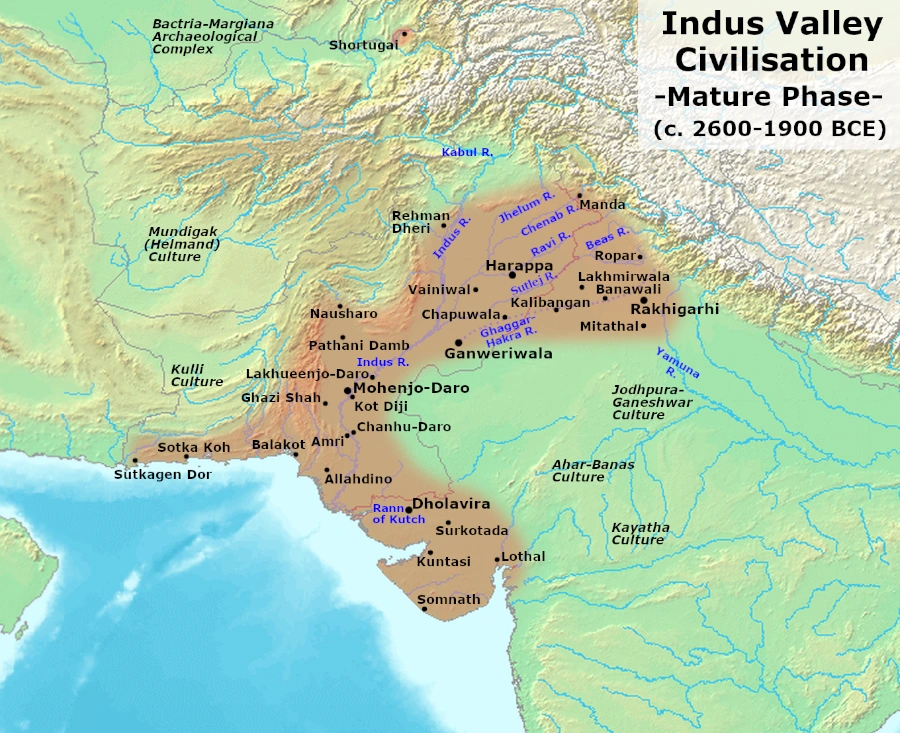
Map study
Mature Harappan civilisation, c. 2600–1900 BCE: settlement distribution, not the territory of a single empire.
- Read the source date and legend before interpreting territorial extent.
- Compare core regions, neighbouring powers and geographic barriers; historical borders and influence are approximate and changed over time.
Credit: Avantiputra7 · CC BY-SA 3.0 · sourceConverted to WebP on an opaque white background; proportionally resized without cropping. Original cartography and legend retained.
1. Meaning, geographical setting and historical significance
The Harappan Civilization was a Bronze Age civilization whose settlements extended across the Indus basin and adjoining regions, including present-day Pakistan and north-western and western India. Important concentrations occurred in Sindh, Punjab, Haryana, Rajasthan and Gujarat. The term Indus Valley Civilization remains conventional, but Harappan Civilization better accommodates sites outside the valley proper. Harappa and Mohenjo-daro were major centres, while Dholavira and Rakhigarhi demonstrate the geographical breadth of urban development.
Its origins must be understood at several levels. Food production began before cities; villages grew before regional settlement networks; and regional cultures preceded the widespread standardisation associated with Mature Harappan society. Thus, an early agricultural date from a settlement does not establish that a fully developed urban civilization existed at that date. The civilization's characteristic combination included planned settlements, drainage, specialised crafts, standardised weights, seals and a writing system.
River plains, piedmont zones and coastal environments offered complementary resources. Farming communities obtained stone, metals and other materials through exchange networks connecting distant ecological zones. Urbanism developed through interaction among these regions rather than through the isolated growth of a single city. Harappan civilization was broadly contemporary with major Bronze Age societies in Mesopotamia and Egypt, though their institutions and cultural expressions differed.
Timeline
Approximately 7000 BCE onward
Conventional beginning of the early farming sequence at Mehrgarh; a background to later regional developments.
Approximately 3300–2600 BCE
Early Harappan phase: growth of regional settlement systems, crafts and exchange.
Approximately 2600–1900 BCE
Mature Harappan phase: widespread urbanism and interregional standardisation.
Approximately 1900–1300 BCE
Late Harappan phase: de-urbanisation and regional transformations, with locally varying chronologies.
1921–1922
Excavations at Harappa under Daya Ram Sahni and investigations at Mohenjo-daro by Rakhal Das Banerji helped reveal the civilization.
1924
John Marshall publicly announced the discovery of the ancient civilization.
2. Agricultural foundations and competing explanations of origins
Mehrgarh provides a major archaeological sequence for studying the transition towards farming and settled life in the north-western subcontinent. Its earliest occupation is conventionally placed around 7000 BCE. Early communities cultivated wheat and barley and kept domesticated animals; some early levels lacked pottery. Later developments included pottery production, increasingly elaborate crafts and wider exchange. Mehrgarh represents an important background to Harappan development, not a Mature Harappan city existing thousands of years before Harappa.
Other areas followed their own trajectories. Settlements in the Indus plains, the Ghaggar-Hakra region and Gujarat contributed distinct pottery traditions, subsistence strategies and craft practices. Bhirrana in Haryana has yielded claims for a very early cultural sequence, but the interpretation and correlation of such dates require care. The age of a dated sample must be distinguished from the age of a particular cultural phase and from the beginning of urban civilization.
Older explanations sometimes treated Harappan urbanism as a derivative of Mesopotamian influence. Archaeological sequences now strongly support substantial local development, accompanied by external contacts. Trade could transmit materials, techniques and ideas without proving that cities were founded by migrants from another civilization. Equally, local development does not establish a particular modern ethnic identity or conclusively identify the Harappan language. Both require evidence beyond pottery continuity or settlement antiquity.
Broad pathway of development, not a universal sequence for every site
- 1. Early farming and herding settlements
- 2. Growth of regional village and exchange networks
- 3. Early Harappan settlement expansion and craft specialisation
- 4. Mature Harappan urban integration around 2600 BCE
- 5. Uneven de-urbanisation and regionalisation after 1900 BCE
3. Early Harappan development and the urban transition
The Early Harappan period, conventionally approximately 3300–2600 BCE, witnessed expanding settlements, greater craft specialisation and increasingly connected exchange networks. Archaeologists identify regional traditions such as Ravi, Hakra, Amri, Kot Diji and Sothi-Siswal, although these labels do not all describe identical date ranges or equivalent archaeological units. They should be understood as overlapping regional developments rather than a rigid sequence through which every settlement passed.
Kot Diji in Sindh and Kalibangan in Rajasthan preserve important evidence for occupation preceding the Mature Harappan phase. Early settlements could possess fortifications, organised layouts and substantial craft activity. At Kalibangan, a field surface associated with the Early Harappan occupation preserves intersecting furrows, conventionally interpreted as evidence of plough cultivation. Such evidence shows that agricultural organisation and settlement planning had antecedents before the mature urban system.
Around 2600 BCE, several regions experienced major changes in settlement organisation and material culture. Standardised weights, distinctive seals, writing and shared craft conventions became prominent across a wide area. Some settlements expanded or were reorganised, while others declined or were abandoned. This transition was therefore neither a universal overnight transformation nor simply the uninterrupted enlargement of every village. Scholars also use the term Integration Era for the period of extensive interregional cultural integration.
| Stage | Approximate chronology | Principal significance | Common error |
|---|---|---|---|
| Early farming background | Seventh millennium BCE onward at Mehrgarh | Food production and settled village life | Calling early farming settlements Mature Harappan cities |
| Early Harappan | 3300–2600 BCE | Regional cultures and expanding settlement networks | Assuming all regional traditions were identical |
| Mature Harappan | 2600–1900 BCE | Urban integration and extensive standardisation | Inferring a proven single empire from shared artefacts |
| Late Harappan | 1900–1300 BCE | Regionalisation and persistence of selected traditions | Assuming complete cultural disappearance around 1900 BCE |
4. Mature and Late Harappan phases
The Mature Harappan period, approximately 2600–1900 BCE, represents the fullest expression of the civilization's urban system. Harappa, Mohenjo-daro and Dholavira illustrate large settlements with differentiated spaces and substantial infrastructure. Widely shared brick proportions, commonly 1:2:4 in thickness, width and length, standardised weights and recurring seal forms indicate strong conventions. Nevertheless, construction materials, settlement layouts and water-management arrangements differed. Cultural integration should not automatically be equated with a single centrally governed empire.
Long-distance exchange connected Harappan communities with the Persian Gulf and Mesopotamia. Mesopotamian references to Meluhha are generally associated with the Indus region. These contacts help place Harappan society within a broader Bronze Age chronology, but external textual references cannot replace securely dated local archaeological sequences. The mature phase is the most appropriate chronological setting for questions about the civilization's characteristic urban features.
After approximately 1900 BCE, many major urban centres contracted or lost their earlier functions. Writing, seals and standardised systems became less widespread, while settlement and material culture became more regionalised. Late Harappan developments, conventionally extending to approximately 1300 BCE, included Cemetery H in Punjab and other regional traditions. Changing monsoon conditions, river dynamics, economic networks and local adaptations contributed in varying combinations. A single invasion or one flood cannot adequately explain the geographically uneven transformation.
5. Dating methods and examination cautions
Harappan chronology combines relative and absolute dating. Stratigraphy establishes the sequence of archaeological layers, while pottery typology and changing artefact assemblages help compare phases within and between sites. Radiocarbon dating estimates the age of suitable organic materials, such as charcoal or seeds. Calibration converts radiocarbon measurements into calendar-age estimates. Context matters: an old timber sample, intrusive material or redeposited charcoal may not date the activity an excavator intends to investigate.
Archaeologists therefore work with date ranges and multiple lines of evidence rather than treating every published date as an exact historical year. BCE dates run backwards numerically: 3300 BCE is earlier than 2600 BCE. BP ordinarily means before 1950, and an uncalibrated radiocarbon age should not be mechanically converted into a calendar BCE date. Broad phase boundaries are analytical conventions, not dates supplied by deciphered Harappan records.
For Prelims, separate the dates of ancient occupation from the modern discovery of sites. Also distinguish the conventional urban chronology from claims about the earliest farming or pre-urban occupation. Harappa's role as the type-site does not prove that it was the civilization's first settlement or political capital. Finally, Late Harappan does not mean wholly non-Harappan: continuity in some crafts and subsistence practices accompanied the weakening of the earlier urban order.
Real-world case studies
Mehrgarh: distinguishing foundations from civilization
Mehrgarh links early agriculture, settled habitation and craft development within a long archaeological sequence. Its location near the Bolan Pass also highlights connections between uplands and plains. It supports an explanation involving deep regional roots, but its earliest occupation cannot be used as the starting date of Mature Harappan urbanism.
Dholavira: a locally distinctive urban trajectory
Dholavira, on Khadir island in the Rann of Kachchh, preserves successive stages of settlement development and decline. Its extensive stone construction and reservoir system illustrate adaptation to a distinctive environment within the broader Harappan world. Inscribed on the UNESCO World Heritage List in 2021, it demonstrates why shared civilizational features must be studied alongside local sequences.
Previous year questions
No source-linked PYQ is available here yet. Use the practice questions below.
Practice questions
Practice MCQ 1
Consider the following statements: 1. The earliest farming occupation at Mehrgarh predates the Mature Harappan phase. 2. The Mature Harappan phase is conventionally dated to approximately 2600–1900 BCE. 3. Every Early Harappan settlement developed into a Mature Harappan city. Which of the statements given above are correct?
- A. 1 and 2 only
- B. 2 and 3 only
- C. 1 and 3 only
- D. 1, 2 and 3
Practice MCQ 2
Which one of the following best explains the archaeological term Late Harappan?
- A. The period immediately before agriculture appeared in the Indus region
- B. The modern period following the discovery of Harappa
- C. Regional developments following Mature Harappan urbanism, with both continuity and change
- D. A uniformly dated phase in which all Harappan settlements disappeared
Practice MCQ 3
With reference to Harappan chronology, consider the following statements: 1. Stratigraphy assists in establishing relative chronological sequences. 2. An uncalibrated radiocarbon age is necessarily identical to a calendar age. 3. A dated sample must be assessed in relation to its archaeological context. Which of the statements given above are correct?
- A. 1 only
- B. 1 and 3 only
- C. 2 and 3 only
- D. 1, 2 and 3
Mains practice · The emergence and decline of Harappan urbanism were long, regionally differentiated processes rather than isolated events. Discuss with archaeological examples. Answer in 250 words.
- Distinguish early food-producing communities from Early, Mature and Late Harappan phases.
- Use Mehrgarh for agricultural foundations and Kot Diji or Kalibangan for pre-urban developments.
- Explain integration around 2600 BCE through settlement growth, crafts, weights, seals and exchange.
- Use Dholavira to illustrate regional adaptation within shared cultural conventions.
- Explain post-1900 BCE regionalisation through interacting environmental and economic changes.
- Conclude that neither purely external origins nor a single catastrophic ending adequately explains the evidence.
Further reading
- NCERT, Themes in Indian History, Part I: Bricks, Beads and Bones.
- NCERT, Our Pasts I: In the Earliest Cities.
- Archaeological Survey of India: excavation publications and Indian Archaeology—A Review.
- UNESCO World Heritage Centre: Dholavira: a Harappan City.
- Upinder Singh, A History of Ancient and Early Medieval India: From the Stone Age to the 12th Century.
Preparing for UPSC Civil Services? Get classroom teaching, answer-writing evaluation and mentorship at Pragnya IAS Academy, Ashok Nagar — see why aspirants choose us for IAS coaching in Hyderabad.