
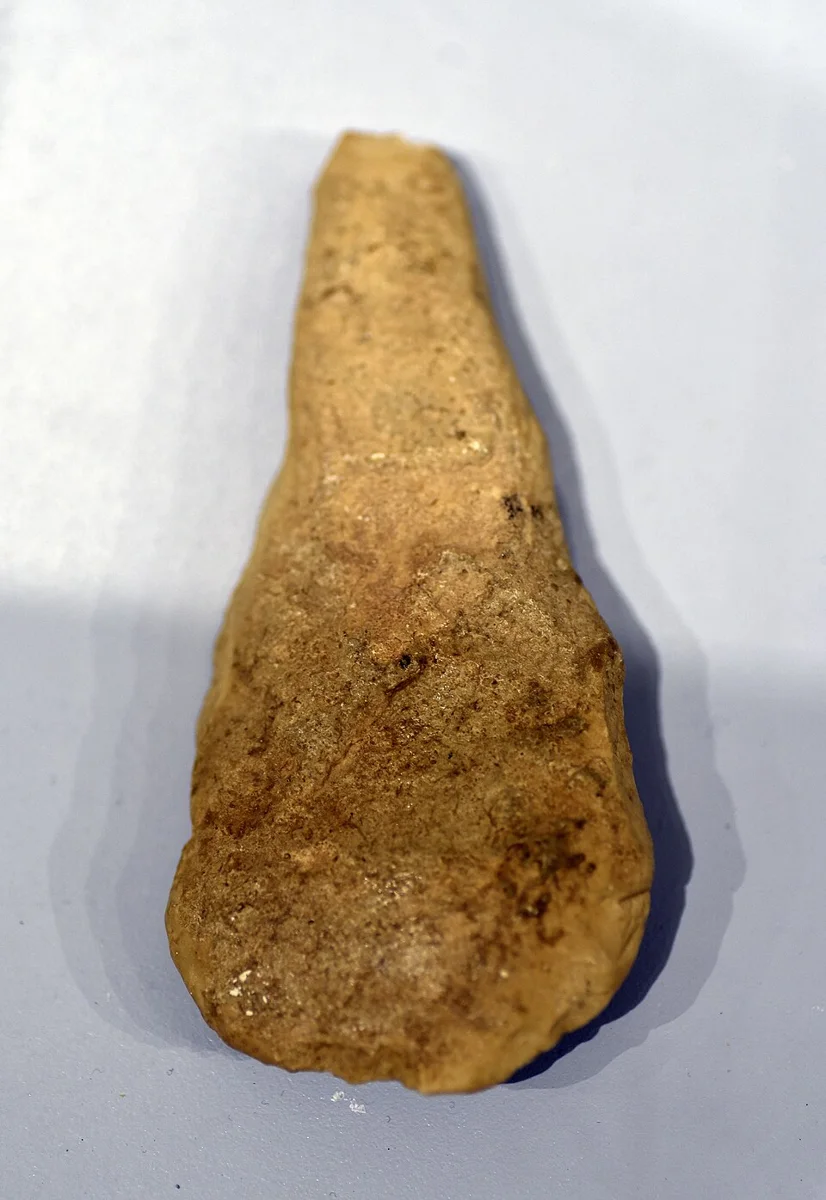
Acheulean hand-axe attributed to Sulaymaniyah, Iraq; a comparative example, not Indian archaeological evidence.
Credit: Osama Shukir Muhammed Amin FRCP(Glasg) · CC BY-SA 4.0 · sourceResized and converted to WebP; uncropped.
1. Meaning, chronology and archaeological evidence
The Palaeolithic, or Old Stone Age, is the earliest major phase of the Stone Age. In South Asia, it largely belongs to the Pleistocene geological epoch, which lasted from about 2.58 million to 11,700 years ago. Its beginning is identified through archaeological evidence of stone-tool manufacture, not simply through the start of the geological epoch. Prehistory refers to periods without written records; knowledge therefore comes from tools, animal remains, sediments, fossils and other material traces.
The Lower, Middle and Upper Palaeolithic are distinguished principally by technological patterns. Older Indian textbook schemes often place the Middle Palaeolithic at approximately 150,000–40,000 years ago and the Upper Palaeolithic at about 40,000–10,000 years ago. These are useful introductory ranges, not fixed boundaries. New dating, especially at Attirampakkam, indicates much earlier Middle Palaeolithic developments in some regions. Technologies also overlapped, making a single nationwide timetable misleading.
Archaeologists study stratigraphy, tool manufacturing methods and the relationship between artefacts and their depositional environments. Luminescence dating, palaeomagnetism and cosmogenic-nuclide methods help establish older chronologies. Radiocarbon dating is generally useful only for suitable organic material from roughly the last 50,000 years; it cannot directly date a million-year-old stone handaxe. A tool found on the surface may also have been displaced from its original context.
- Core: a stone mass from which pieces are removed.
- Flake: a piece detached from a core by deliberate striking or pressure.
- Assemblage: a group of archaeological objects associated with a particular context.
Timeline
Approximately 1.5 million years ago
Early Acheulian occupation at Attirampakkam provides securely dated evidence of Lower Palaeolithic activity.
Approximately 385,000–172,000 years ago
The reported Middle Palaeolithic sequence at Attirampakkam demonstrates the antiquity of technological change in southeastern India.
Approximately 40,000–10,000 years ago
Conventional broad range for the Indian Upper Palaeolithic; regional chronologies and technological overlaps require qualification.
1863
Robert Bruce Foote discovers a Palaeolithic handaxe at Pallavaram.
1982
Arun Sonakia discovers the Narmada hominin fossil at Hathnora.
2. Lower Palaeolithic: core tools and the Acheulian
Lower Palaeolithic assemblages include choppers, chopping tools, handaxes, cleavers and flakes. A handaxe is commonly bifacial, meaning that both faces were worked, often producing a pointed end and cutting edges. A cleaver typically has a broad transverse cutting edge. These tools could serve several purposes, including carcass processing and working wood or plant materials. Their names do not imply that every specimen performed only one task.
The Acheulian technological tradition is especially associated with handaxes and cleavers. In India, important evidence comes from Attirampakkam and Pallavaram in Tamil Nadu, the Hunsgi–Baichbal valleys in Karnataka, Isampur in Karnataka, and numerous sites in central and western India. Research at Attirampakkam placed its earliest Acheulian occupation at approximately 1.5 million years ago, establishing a major reference point for early human presence in South Asia.
The Soanian tradition, named after the Soan Valley in present-day Pakistan, is associated especially with pebble and flake tools in the northwestern subcontinent and Siwalik region. It should not be treated as a straightforward chronological stage that uniformly preceded the Acheulian. Differences in raw materials, activities and site histories complicate this relationship. Quartzite was widely used, while local availability also encouraged the use of limestone, chert and other suitable rocks.
- Pallavaram is important for the history of prehistoric research, not because it is necessarily India's oldest site.
- Bifacial shaping is a technological feature; it does not by itself establish the precise age or maker of a tool.
A simplified prepared-core reduction sequence
- 1. Select a suitable stone nodule.
- 2. Shape the core's surfaces and establish appropriate convexities.
- 3. Prepare a striking platform.
- 4. Strike to detach a flake of a planned form.
- 5. Use the flake directly or retouch its edge.
3. Middle and Upper Palaeolithic technological changes
Middle Palaeolithic technology placed greater emphasis on flakes obtained from prepared cores. In the Levallois method, a core was shaped in advance so that a flake of a broadly predetermined form could be detached. Scrapers, points and other retouched flakes occur in these assemblages. Prepared-core production indicates planning of the reduction sequence, although archaeological categories should not be converted into simplistic rankings of human intelligence.
At Attirampakkam, a study published in 2018 reported a transition towards Middle Palaeolithic technology around 385,000 years ago, with the sequence continuing to approximately 172,000 years ago. This significantly revised older regional chronologies. Nevertheless, tool forms alone cannot establish which hominin species made them or prove a particular migration route. Middle Palaeolithic evidence also occurs at sites in the Narmada region, Rajasthan, the Deccan and southern India.
Upper Palaeolithic assemblages show a greater emphasis on blades, bladelets and tools such as burins. A blade is conventionally an elongated flake at least twice as long as it is wide. Burins have a chisel-like working edge and may have been used to work hard materials. Important Indian occurrences include Patne in Maharashtra, parts of the Kurnool region in Andhra Pradesh, and sites in the Belan and Son valleys. Patne has yielded ostrich eggshell beads and an engraved eggshell fragment, evidence relevant to discussions of ornamentation and symbolic behaviour.
- Bone tools occur at some sites but are not equally abundant throughout the Indian Upper Palaeolithic.
- Microlithic technology developed before the Holocene in parts of South Asia; small tools are therefore not automatically Mesolithic.
| Phase | Technological emphasis | Representative tools | Selected Indian sites or regions |
|---|---|---|---|
| Lower Palaeolithic | Core working and large cutting tools; flakes also present | Handaxes, cleavers, choppers | Attirampakkam, Pallavaram, Isampur, Hunsgi |
| Middle Palaeolithic | Prepared-core and flake production | Scrapers, points, Levallois flakes | Attirampakkam, Narmada region, Rajasthan |
| Upper Palaeolithic | Greater emphasis on elongated blanks | Blades, bladelets, burins | Patne, Kurnool region, Belan and Son valleys |
4. Subsistence, environment and settlement
Palaeolithic communities obtained food through gathering, hunting, scavenging and, where conditions allowed, exploitation of aquatic resources. The relative importance of these activities varied across landscapes and seasons. Stone artefacts survive better than wood, fibres and plant foods, creating a preservation bias: a stone-rich archaeological record does not mean that other materials were unimportant in everyday life.
Sites occur beside rivers and lakes, near raw-material sources, on open surfaces and within caves or rock shelters. Water, animal movements, edible vegetation and access to workable stone influenced occupation. Isampur is particularly valuable as a quarry-cum-workshop, while the Hunsgi–Baichbal valleys reveal the use of a varied landscape. Not every concentration of artefacts marks a permanent residential camp; some represent brief toolmaking or resource-processing visits.
Pleistocene climatic fluctuations changed rainfall, river behaviour and vegetation. South Asia did not experience a uniform landscape of continental ice sheets; climatic effects differed considerably between Himalayan, peninsular and other environments. Mobility was an important adaptive strategy. Archaeology does not support projecting settled agriculture, pottery-based village life or rigid caste institutions onto Palaeolithic societies. Likewise, the existence of stone tools at a site does not establish controlled fire use without independent evidence.
- A factory or workshop site preserves evidence of tool production, such as cores, unfinished tools and waste flakes.
- Occupation duration and group organisation must be inferred cautiously rather than assumed from tool types.
5. Human remains, rock shelters and examination relevance
The Indian Palaeolithic record contains many stone artefacts but relatively few hominin fossils. A partial hominin cranium discovered by Arun Sonakia at Hathnora in the Narmada Valley in 1982 is a major find. Its age and taxonomic placement remain debated. It is therefore safer to identify it as the Narmada hominin than to assign it confidently to one species or one precisely dated cultural phase.
Bhimbetka in Madhya Pradesh combines evidence of long prehistoric occupation with an extensive rock-art tradition. Its rock shelters became a UNESCO World Heritage property in 2003. An important distinction is that early occupation does not make every painting equally ancient: the paintings belong to different periods, including substantial Mesolithic and later components. Rock shelters, occupation deposits and visible artwork must be evaluated separately.
For Prelims, connect each cultural phase with its characteristic technology and major sites, while avoiding absolute statements. The Palaeolithic-to-Mesolithic transition was neither simultaneous across India nor a sudden replacement of all earlier tools. The broader historical significance lies in understanding early dispersals, technological planning and adaptation to diverse environments. Interpretations of language, beliefs and social relations are much less secure than observations about stone-working techniques.
- Common traps: all prehistoric people lived in caves; all rock art is Palaeolithic; every microlith is Mesolithic; each tool tradition corresponds to one human species.
- Distinguish the archaeological age of a site from the nineteenth- or twentieth-century date of its discovery.
Acheulean Hand-Axes: Technology and Evidence
The supplied metadata identifies an Acheulean hand-axe from Sulaymaniyah, Iraq, dated approximately 250,000 years ago. It is relevant as a comparative example of a major Palaeolithic tool tradition, not as evidence from an Indian site. Acheulean assemblages commonly include hand-axes and cleavers, often shaped by removing flakes from both faces. Such bifacial working reflects controlled stone reduction and planning. However, the metadata alone cannot establish this specimen’s manufacturing sequence, raw material, use-wear or excavation context.
In India, Acheulean technology is associated with the Lower Palaeolithic and is documented at sites such as Attirampakkam and Isampur. Studying cores, flakes and finished tools together helps archaeologists reconstruct production, raw-material procurement and site activities. A hand-axe should not automatically be understood as a hafted axe or a specialised hunting weapon: functions require supporting evidence, including use-wear and archaeological context. Similar tool forms across regions allow technological comparison, but do not by themselves demonstrate migration, direct cultural contact or identical dates. Indian sequences must therefore be understood through locally established stratigraphy and dating rather than by transferring the Iraqi attribution.
- Prelims distinction: Acheulean denotes a technological tradition, not a human species, ethnic community or single universally dated period.
- Chronology caution: the metadata’s approximate age applies to this attributed Iraqi specimen, not to the beginning or duration of India’s Acheulean.
- Mains approach: connect tools with environmental adaptation and subsistence cautiously; stone artefacts preserve only part of behaviour and cannot independently establish language, beliefs or social organisation.
Real-world case studies
Attirampakkam: revising the Indian chronology
Research at Attirampakkam, in the Kortallaiyar basin of Tamil Nadu, illustrates how excavation and scientific dating can transform prehistoric narratives. Publications in 2011 and 2018 established an early Acheulian chronology and reported a much earlier Middle Palaeolithic transition than older textbook schemes suggested. The site also demonstrates why technological change cannot automatically be equated with the arrival of a particular human species.
Isampur: reconstructing tool manufacture
At Isampur in Karnataka's Hunsgi–Baichbal region, local limestone exposures supplied material for Acheulian tools. Cores, manufacturing debris and tools at different production stages allow archaeologists to reconstruct reduction sequences. Unlike an isolated handaxe, this quarry-cum-workshop preserves evidence of raw-material procurement and manufacturing decisions.
Previous year questions
No source-linked PYQ is available here yet. Use the practice questions below.
Practice questions
Practice MCQ 1
Consider the following pairs: 1. Acheulian tradition — Handaxes and cleavers; 2. Levallois method — Prepared-core flake production; 3. Upper Palaeolithic — Predominance of polished agricultural axes. Which of the pairs given above are correctly matched?
- A. 1 and 2 only
- B. 2 and 3 only
- C. 1 and 3 only
- D. 1, 2 and 3
Practice MCQ 2
With reference to Indian Palaeolithic archaeology, consider the following statements: 1. Pallavaram is associated with Robert Bruce Foote's discovery in 1863. 2. Hathnora is associated with a hominin fossil discovery. 3. All paintings at Bhimbetka belong to its earliest Palaeolithic occupation. Which of the statements given above are correct?
- A. 1 only
- B. 2 and 3 only
- C. 1 and 2 only
- D. 1, 2 and 3
Practice MCQ 3
Which one of the following conclusions is most justified by the discovery of cores, unfinished handaxes and abundant stone-working debris beside a suitable rock exposure?
- A. The site necessarily supported a permanent agricultural village.
- B. Stone-tool manufacture probably occurred at the site.
- C. The site's occupants certainly belonged to Homo sapiens.
- D. The artefacts can be directly dated by radiocarbon analysis of the stone.
Mains practice · Explain the principal technological changes across India's Palaeolithic cultures. Why should these changes not be interpreted as a uniform, linear sequence across the subcontinent? Answer in 250 words.
- Define the Palaeolithic and distinguish technological classification from geological chronology.
- Explain Acheulian large cutting tools, Middle Palaeolithic prepared-core technologies and Upper Palaeolithic blade production.
- Use Attirampakkam, Isampur and Patne as examples.
- Discuss regional environments, raw materials, overlapping technologies and new scientific dates.
- Avoid equating a tool tradition directly with a hominin species.
- Conclude that the sequence reflects diverse adaptive histories rather than simultaneous nationwide stages.
Further reading
- NCERT, Our Pasts–I: From Hunting–Gathering to Growing Food.
- R. S. Sharma, India's Ancient Past: chapters on the Stone Age.
- Upinder Singh, A History of Ancient and Early Medieval India: From the Stone Age to the 12th Century.
- UNESCO World Heritage Centre: Rock Shelters of Bhimbetka.
- Pappu and colleagues, Early Pleistocene Presence of Acheulian Hominins in South India, Science, 2011.
- Akhilesh and colleagues, Early Middle Palaeolithic culture in India around 385–172 ka reframes Out of Africa models, Nature, 2018.
- https://commons.wikimedia.org/wiki/File:Hand-axe_from_Sulaymaniyah,_Iraq._Acheulean_period,_c._250,000_years_ago._Sulaymaniyah_Museum,_Iraq.jpg
Preparing for UPSC Civil Services? Get classroom teaching, answer-writing evaluation and mentorship at Pragnya IAS Academy, Ashok Nagar — see why aspirants choose us for IAS coaching in Hyderabad.