

Mesolithic Rock painting, Bhimbetka, Raisen district, Madhya Pradesh, India.
Credit: Yann (talk) · CC BY-SA 4.0 · source

1. A scraper, wt 18g.2. A four-sided geometric microlith. c6000BC.3. Straight-backed microliths, Late Mesolithic.4. Nine cores, wt406g.5. 68 blades, wt 154g.Forty waste flakes, wt343g.
Credit: Surrey County Council, David Williams, 2005-11-15 12:22:32 · CC BY-SA 4.0 · source
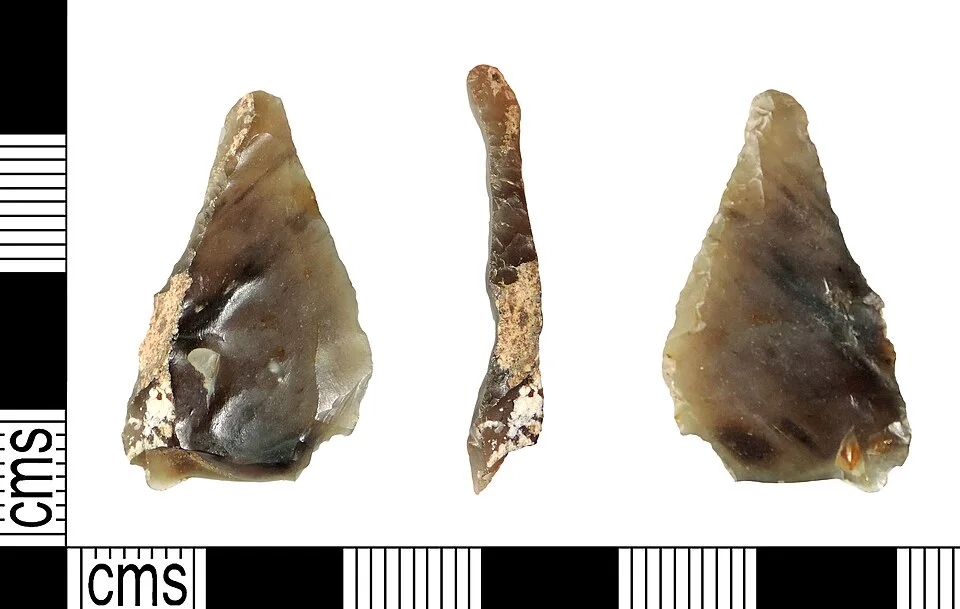
Flint implement catalogued as a microlith of possible Mesolithic date; comparative illustration, not Indian archaeological evidence.
Credit: York Museums Trust, Ellie Cox, 2014-07-18 11:47:50 · CC BY-SA 4.0 · sourceResized and converted to WebP; uncropped.
1. Meaning, chronology and environmental setting
The Mesolithic, literally the Middle Stone Age, is an archaeological category used for cultures generally placed between Palaeolithic and Neolithic traditions. It should not be understood as a brief, uniform bridge between hunting and farming. In the Indian subcontinent, communities using microlithic tools followed different regional histories, and hunting-gathering lifeways persisted alongside agricultural settlements for long periods.
Introductory accounts commonly place the beginning of the Indian Mesolithic around 10,000 BCE. This is a broad teaching convention rather than a fixed archaeological boundary. Microlithic technologies appeared in parts of South Asia much earlier, during the late Pleistocene. Their use also continued into Neolithic, Chalcolithic and later contexts. Consequently, neither a small stone tool nor a single date is sufficient to identify a Mesolithic culture.
The transition to the Holocene brought warmer conditions and changes in monsoon patterns, vegetation, rivers and animal habitats. These changes were regionally variable: grasslands, woodland edges, wetlands and river valleys offered different resources. Communities adapted through flexible mobility, exploitation of several ecological zones and, in suitable settings, repeated occupation of resource-rich places. Environmental change created opportunities, but it did not automatically produce agriculture.
- Chronology must be established through archaeological context, stratigraphy and dating, not tool size alone.
- Mesolithic is a cultural-archaeological term; Holocene is a geological time division.
2. Microlithic technology and everyday equipment
Microliths are the most recognisable technological feature of Mesolithic assemblages. They are small stone implements, commonly a few centimetres long, manufactured from carefully prepared cores. Raw materials included chert, chalcedony, jasper, agate and quartz, depending on local availability. Their manufacture required controlled flaking and frequently retouch, which shaped or blunted selected edges for particular functions.
Archaeologists distinguish geometric microliths, including triangles, trapezes and lunates, from forms such as backed blades, points and other non-geometric pieces. Backing means deliberately blunting an edge, often facilitating hafting. Different shapes may occur together, and their proportions vary between sites and periods. These categories help compare assemblages but do not themselves reveal a community's language or ethnic identity.
Many microliths functioned as components of composite implements. Several small inserts could be fixed into a wooden or bone shaft using binding and adhesive materials, producing cutting implements or projectile equipment. A damaged insert could be replaced without discarding the entire tool. Bows and arrows are inferred from some tool forms and artistic representations, though specific functions are best tested through use-wear, residue analysis and experiments.
Stone dominates the surviving record because it preserves well. Wood, fibres, baskets and other organic equipment usually survive poorly, while bone implements occur at some sites. Mesolithic technology should therefore not be reduced to miniature stone blades alone. Nor should every backed blade be called a harvesting tool: a functional interpretation requires evidence beyond appearance.
- Geometric forms: triangles, trapezes and lunates.
- Key technological concept: hafting small stone components into larger composite tools.
Reconstructing Mesolithic lifeways
- 1. Establish stratigraphy and date the archaeological context
- 2. Analyse stone tools, raw materials and manufacturing techniques
- 3. Identify animal and plant remains
- 4. Examine habitation features, burials and environmental evidence
- 5. Compare evidence to reconstruct subsistence, mobility and regional interactions
3. Subsistence, mobility and the transition towards food production
Hunting, gathering and fishing formed the principal subsistence base of Mesolithic communities. Animal remains indicate exploitation of species such as deer, antelope, wild cattle and wild pig, with substantial local variation. Fish, turtles, birds and molluscs contributed in favourable environments. Plant foods probably included fruits, roots, tubers, nuts and wild seeds, although preservation makes their contribution harder to reconstruct.
The term broad-spectrum subsistence describes the use of a wide range of foods rather than dependence on a narrow set of prey. It is useful for many Mesolithic settings but should not be applied mechanically to every site. Lakes, river margins and woodland-grassland boundaries could support seasonal aggregation or repeated occupation. Some settlements may have been relatively stable, while others served as short-duration hunting or processing camps.
Grinding stones can indicate plant processing but do not independently prove cultivation. Similarly, pottery is not a universal defining feature of the Mesolithic. Much of the material is aceramic, while pottery may occur in later phases or through interaction with neighbouring communities. Domestic animal remains reported from sites such as Bagor and Adamgarh must be assessed in relation to phase, species identification and stratigraphic security.
The emergence of food production was therefore a mosaic rather than a single revolution shared by all regions. Hunting-gathering communities could adopt particular animals, exchange forest products or tools with cultivators, and continue using microliths without immediately becoming full-time farmers. The distinction between Mesolithic and Neolithic rests on a wider economic and technological context, not simply on the presence of one artefact.
- Sedentism and agriculture are related possibilities, not identical concepts.
- Cultivation, domestication and consumption of wild plants require different kinds of archaeological evidence.
| Site | Present-day location | Key association |
|---|---|---|
| Bagor | Rajasthan; Kothari River | Microlithic settlement with later cultural phases |
| Langhnaj | Gujarat | Microliths, animal remains and human burials |
| Adamgarh | Madhya Pradesh; near Narmadapuram | Rock shelters and microlithic occupation |
| Bhimbetka | Madhya Pradesh; Raisen district | Multiperiod occupation and rock paintings |
| Sarai Nahar Rai, Mahadaha and Damdama | Uttar Pradesh; Ganga plain | Mesolithic occupation and human burials |
4. Regional distribution and major Indian sites
Indian Mesolithic sites occur in varied settings, including Rajasthan and Gujarat, the Vindhyan region, the middle Ganga plain and peninsular India. Open-air settlements and rock shelters provide different forms of evidence. River valleys offered water, stone and animal resources; shelters provided protected living surfaces and locations for painting. Distribution also reflects where archaeologists have surveyed and where deposits have survived.
Bagor, on the Kothari River in Rajasthan, is important for its microlithic occupation, habitation evidence and a sequence extending beyond the Mesolithic. Langhnaj in Gujarat has yielded microliths, animal remains and human burials. Adamgarh, near Narmadapuram in Madhya Pradesh, is associated with rock shelters and microlithic evidence. Bhimbetka, in Raisen district of Madhya Pradesh, preserves a much longer prehistoric sequence and extensive rock art.
Sarai Nahar Rai, Mahadaha and Damdama in Uttar Pradesh are especially important for Mesolithic burials and occupation in the Ganga plain. Their human skeletons, faunal remains and associated features permit investigation of diet, health, physical activity and mortuary treatment. These sites demonstrate that the Mesolithic record is not confined to painted shelters or isolated surface collections of tools.
- For map questions, distinguish western Indian sites from the Vindhyan shelters and Ganga plain burial sites.
- A multiperiod site must not be assigned exclusively to the Mesolithic.
5. Art, burials and interpreting Mesolithic society
Central Indian rock paintings depict animals, hunting and groups of human figures, among other subjects. Red and white are common colours. Such imagery offers clues to movement, hunting equipment and collective activities. However, rock-art complexes contain paintings from several periods. At Bhimbetka, not all paintings are Mesolithic, and assigning precise dates to individual images remains difficult.
Burials provide evidence of deliberate treatment of the dead and sometimes repeated use of particular places. Archaeologists examine body position, orientation, grave associations and spatial relationships to reconstruct mortuary practices. Skeletal analysis can reveal age, biological sex, injury and disease, although preservation and sample size constrain conclusions. Grave goods do not automatically demonstrate belief in an afterlife or a rigid social hierarchy.
For examination purposes, the strongest approach combines tools with settlement, subsistence, environmental and burial evidence. Avoid depicting Mesolithic people as technologically simple or culturally uniform. Their importance lies in flexible ecological adaptation, sophisticated composite tools and varied relationships with emerging food-producing societies. Claims about religion, political organisation or gender roles should remain proportionate to the surviving evidence.
- Common trap: all Bhimbetka paintings belong to one prehistoric period.
- Common trap: microliths necessarily indicate agriculture or a precisely dated Mesolithic occupation.
Microliths: Technology, Context and Mesolithic Interpretation
The supplied metadata identifies this implement as a possible Mesolithic flint tool and describes retouch, flake scars and surviving cortex. These terms explain manufacture: scars record earlier removals, retouch reshapes an edge, and cortex is the original outer surface of the stone. The description classifies it as a secondary flake because some cortex remains. This technological classification does not independently establish its age or function.
Microliths are small stone implements, often deliberately shaped or backed for use in composite equipment. Several could be mounted in a wooden or bone support, although hafting and specific functions require supporting evidence rather than assumption. In Indian Mesolithic studies, microlithic assemblages help investigate technological choices alongside animal remains, hearths, burials and settlement traces. This catalogue example provides a comparative technological reference, not evidence from an Indian site. Its proposed date must not be transferred to Indian sequences, which vary regionally.
- Prelims distinction: microliths are characteristic of Mesolithic assemblages but also occur outside them; their presence alone neither fixes chronology nor proves agriculture.
- Evidence limit: retouch indicates edge modification, not a demonstrated purpose. Use-wear, residues and archaeological context strengthen functional interpretations.
- Mains approach: compare sites such as Bagor, Langhnaj and Sarai Nahar Rai through multiple evidence categories rather than treating all microlith-using communities as socially or economically identical.
Real-world case studies
Bhimbetka: a layered prehistoric landscape
The Rock Shelters of Bhimbetka were inscribed on the UNESCO World Heritage List in 2003. Their archaeological deposits and paintings demonstrate repeated human use over long periods. Superimposed paintings help establish relative sequences, but neither UNESCO recognition nor a site's general prehistoric character dates every image. Bhimbetka illustrates why occupation deposits and painted surfaces require separate, contextual analysis.
Ganga plain burials: evidence beyond tools
Sarai Nahar Rai, Mahadaha and Damdama preserve important evidence of Mesolithic mortuary behaviour. Studying skeletons alongside burial arrangements, hearths and faunal remains enables questions about health, diet and repeated occupation. These assemblages show the value of combining biological and archaeological evidence rather than reconstructing society from tool typology alone.
Previous year questions
No source-linked PYQ is available here yet. Use the practice questions below.
Practice questions
Practice MCQ 1
With reference to microliths in the Indian subcontinent, consider the following statements: 1. They could be hafted as components of composite implements. 2. Their occurrence is restricted exclusively to Mesolithic contexts. 3. Triangles, trapezes and lunates are geometric microlithic forms. Which of the statements given above are correct?
- A. 1 and 2 only
- B. 1 and 3 only
- C. 2 and 3 only
- D. 1, 2 and 3
Practice MCQ 2
Which one of the following site-location pairs is incorrectly matched?
- A. Bagor — Rajasthan
- B. Langhnaj — Gujarat
- C. Mahadaha — Uttar Pradesh
- D. Adamgarh — Maharashtra
Practice MCQ 3
Which one of the following is the most defensible archaeological inference about Mesolithic cultures?
- A. Grinding stones alone conclusively establish cereal cultivation.
- B. All paintings at a rock-art site belong to its earliest occupation.
- C. Repeated occupation near wetlands may reflect reliable access to diverse food resources.
- D. Grave goods conclusively establish a hereditary ruling class.
Mains practice · Mesolithic cultures in India reveal diverse ecological adaptations rather than a uniform transition to agriculture. Discuss with archaeological examples. Answer in 150 words.
- Define the Mesolithic and qualify its regional chronology.
- Explain microlithic composite technology and flexible hunting-gathering-fishing economies.
- Use Bagor, Langhnaj and Ganga plain sites to illustrate regional variation.
- Distinguish repeated occupation or sedentism from agriculture.
- Explain selective adoption of domesticates and interaction with food producers.
- Conclude that multiple lines of contextual evidence are essential.
Further reading
- NCERT, Our Pasts–I: From Hunting–Gathering to Growing Food.
- Upinder Singh, A History of Ancient and Early Medieval India: From the Stone Age to the 12th Century.
- D. K. Bhattacharya, An Outline of Indian Prehistory.
- UNESCO World Heritage Centre: Rock Shelters of Bhimbetka.
- Archaeological Survey of India: Indian Archaeology—A Review, excavation and exploration reports.
- https://commons.wikimedia.org/wiki/File:Microlith_,_Mesolithic_(FindID_628327).jpg
Preparing for UPSC Civil Services? Get classroom teaching, answer-writing evaluation and mentorship at Pragnya IAS Academy, Ashok Nagar — see why aspirants choose us for IAS coaching in Hyderabad.