
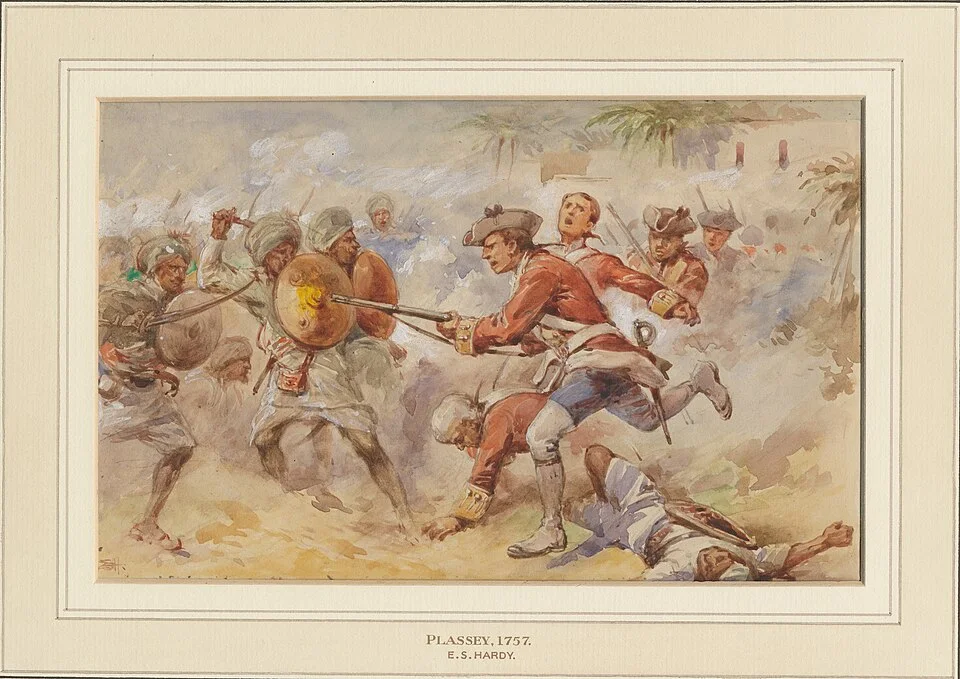
Illustration associated with the Battle of Plassey, 1757.
Credit: E. Stuart Hardy · Public domain · sourceResized and converted to WebP; uncropped.
1. Bengal and the Company before Plassey
In the mid-eighteenth century, Bengal was among the richest regions of the Indian subcontinent. Its fertile agricultural hinterland, textile production, inland waterways and overseas commerce attracted European trading companies. The Bengal nawab’s authority extended over Bengal, Bihar and Orissa, although control over particular territories varied. Murshidabad was the political centre, while Calcutta developed as the English East India Company’s principal settlement in Bengal.
Bengal’s nawabs exercised substantial autonomy while formally acknowledging Mughal sovereignty. Alivardi Khan, who ruled from 1740 to 1756, maintained close control over European companies and resisted their attempts to behave as independent political powers. His grandson and successor, Siraj-ud-Daulah, inherited both a prosperous province and a divided ruling establishment. Rival claimants, influential officials and banking interests complicated his position.
The Company’s privileges rested partly on Mughal emperor Farrukhsiyar’s farman of 1717. It permitted the Company’s Bengal trade to enjoy customs concessions against an annual payment of Rs 3,000. Dastaks, or passes certifying privileged consignments, became a major source of controversy. Their misuse, especially in the private trade of Company servants, reduced customs revenue and disadvantaged merchants without equivalent privileges. Commercial disputes therefore involved the larger issue of the nawab’s fiscal sovereignty.
- Distinguish the Company’s corporate trade from the private trade conducted by its employees.
- Bengal was not a politically empty space: the Company intervened in an existing state with established revenue, military and commercial institutions.
Timeline
1717
Farrukhsiyar’s farman confirmed important commercial privileges for the English East India Company.
April–June 1756
Siraj-ud-Daulah succeeded Alivardi Khan and subsequently captured Calcutta.
January–March 1757
The British recovered Calcutta, concluded the Treaty of Alinagar and captured Chandernagore.
23 June 1757
The Company defeated Siraj-ud-Daulah at Plassey; Mir Jafar subsequently became nawab.
1760–1763
Mir Qasim replaced Mir Jafar in 1760; Mir Jafar was restored in 1763.
1764–1765
The victory at Buxar was followed by the grant of Diwani to the Company.
2. From Commercial Dispute to Open Conflict
Siraj-ud-Daulah became nawab in April 1756. His confrontation with the English arose from several interconnected grievances: unauthorised strengthening of Calcutta’s fortifications, misuse of trading privileges, and the Company’s protection of persons who had incurred his displeasure. The English justified military preparations partly through the prospect of renewed conflict with the French. The nawab viewed independent fortification as a challenge to his authority over European settlements.
In June 1756, Siraj seized the Company’s establishment at Kasimbazar and then captured Calcutta, including Fort William. The episode subsequently called the Black Hole of Calcutta became prominent in British accounts. However, the casualty figures and details supplied by John Zephaniah Holwell remain disputed. It should not be presented as an uncontested explanation for Plassey or allowed to obscure the underlying commercial and political conflict.
A relief expedition from Madras, with Robert Clive commanding the land forces and Admiral Charles Watson directing naval operations, recovered Calcutta in January 1757. The Treaty of Alinagar, signed on 9 February 1757, restored the Company’s earlier privileges and accepted important Company demands concerning its settlement. This agreement was a temporary accommodation rather than a durable reconciliation.
The wider Anglo-French struggle intensified Bengal’s crisis. In March 1757, British forces captured the French settlement of Chandernagore. This weakened a potential counterweight to English influence and heightened the nawab’s insecurity. European warfare and Bengal court politics had thus become closely connected before the confrontation at Plassey.
- The immediate crisis concerned sovereignty, fortifications and trading privileges, not simply a personal quarrel between Clive and Siraj.
- The Seven Years’ War provided an international setting, but local alliances were decisive in Bengal.
How commercial conflict became political ascendancy
- 1. Disputes over customs privileges, fortifications and the nawab’s authority
- 2. Capture and British recovery of Calcutta
- 3. Temporary accommodation through the Treaty of Alinagar
- 4. Secret alliance with opponents of Siraj-ud-Daulah
- 5. Company victory at Plassey
- 6. Installation of Mir Jafar and extraction of financial and territorial concessions
3. The Conspiracy and the Battle
Clive and Company representatives negotiated secretly with opponents of Siraj-ud-Daulah. Mir Jafar, a senior military commander, was promised the nawabship in return for supporting the Company and meeting substantial financial demands. The conspiracy drew upon influential court and commercial interests, including the Jagat Seth banking house. Rai Durlabh and Yar Lutuf Khan were also associated with the opposition to Siraj.
Omichand, a merchant involved in the negotiations, sought a financial reward for his cooperation. Clive used a deceptive parallel agreement to make him believe that his demand had been accepted. The episode illustrates the methods employed in arranging the political settlement, although its detailed documentary history should not distract from the central fact: the Company secured collaborators within the nawab’s establishment before battle.
The armies met at Plassey on 23 June 1757. Clive commanded approximately 3,000 troops, including European soldiers and Indian sepoys. The nawab’s army was much larger, commonly estimated at around 50,000, with cavalry and substantial artillery; estimates differ among accounts. The Company occupied a mango grove that provided a useful defensive position. A small French artillery contingent supported the nawab.
Despite the numerical imbalance, much of Siraj’s army remained inactive. Mir Madan and Mohanlal were among those who actively resisted the Company. Mir Madan’s death weakened the nawab’s position, while advice from unreliable commanders aggravated confusion. Rain and ammunition protection influenced the fighting, but betrayal, divided command and the failure to commit superior forces were more fundamental than any single weather-related incident.
- Plassey was a real military engagement, but its outcome depended heavily on a pre-arranged political conspiracy.
- Avoid describing every contingent in Siraj’s army as disloyal: important commanders and troops fought the Company.
| Event | Key actors | Principal significance |
|---|---|---|
| Plassey, 1757 | Robert Clive; Siraj-ud-Daulah; Mir Jafar | Company-backed replacement of the nawab and major financial gains. |
| Buxar, 1764 | Hector Munro; Mir Qasim; Shuja-ud-Daulah; Shah Alam II | Military defeat of a coalition challenging Company power. |
| Diwani grant, 1765 | Shah Alam II; East India Company | Formal grant of revenue-collection rights in Bengal, Bihar and Orissa. |
4. Immediate Settlement and Economic Consequences
Siraj-ud-Daulah fled after the defeat, was subsequently captured, and was killed on the orders of Miran, Mir Jafar’s son. Mir Jafar became nawab with Company support. The new arrangement preserved the outward framework of the nawabi government while making the Company an influential arbiter of succession and policy. Nevertheless, the Company did not yet possess the formal Diwani rights acquired in 1765.
The settlement brought large payments to the Company, compensation to affected inhabitants of Calcutta, and substantial personal rewards for Company officials. The Company also received zamindari rights over the Twenty-four Parganas. These gains strengthened its Bengal base and demonstrated that intervention in succession disputes could generate political influence and immediate financial returns.
The financial demands imposed on Mir Jafar soon strained his resources and relations with the Company. He was replaced by Mir Qasim in 1760 and restored in 1763 after the Company’s conflict with Mir Qasim escalated. These changes show that the nawab’s dependence was not a stable constitutional arrangement. Plassey initiated a cycle in which commercial privileges, military costs, succession politics and revenue demands reinforced one another.
- The post-Plassey enrichment of Company servants should be distinguished from the later systematic use of Bengal’s revenue under Diwani.
- Company influence expanded through control over rulers before it developed into more direct control over administration.
5. Historical Significance and Examination Distinctions
Plassey is conventionally treated as a turning point in the establishment of British power in India. It gave a trading corporation unprecedented leverage over a wealthy Indian province and access to resources that supported further military and political expansion. Yet it did not establish British supremacy throughout India, nor did it abolish the Bengal nawabship immediately. Its significance lies in opening a sustained route from commerce to territorial power.
Buxar, fought on 22 October 1764, provided a broader military confirmation of Company ascendancy. Hector Munro defeated the combined forces of Mir Qasim, Shuja-ud-Daulah of Awadh and Mughal emperor Shah Alam II. In 1765, Shah Alam II granted the Company the Diwani of Bengal, Bihar and Orissa. This created a formal basis for revenue collection distinct from the political leverage secured at Plassey.
For historical interpretation, Plassey demonstrates both the Company’s opportunism and the fragmentation of Bengal’s ruling coalition. Superior European weapons alone do not adequately explain the result. Nor should collaboration by particular elites be equated with the support of Bengal’s population. The battle is best understood through the interaction of corporate ambition, commercial disputes, court factionalism, military organisation and international rivalry.
- Prelims sequence: Plassey → Buxar → Diwani.
- Robert Clive commanded at Plassey; Hector Munro commanded at Buxar.
- Dual Government in Bengal is associated with the arrangements introduced after the Diwani grant in 1765, not with 1757.
Plassey: Political Conspiracy and Company Expansion
The Battle of Plassey marked a decisive expansion of the English East India Company’s political influence in Bengal. On 23 June 1757, Robert Clive’s forces defeated Siraj-ud-Daulah near Palashi. The outcome cannot be explained by military superiority alone: a conspiracy involving Mir Jafar and influential interests within Bengal undermined the nawab’s position. The non-participation of substantial sections of his army helped turn internal political divisions into a Company victory.
Mir Jafar’s installation as nawab allowed the Company to seek payments, commercial advantages and influence over Bengal’s government. This was a major step towards territorial power, but not an immediate transfer of formal revenue administration. Distinguishing political leverage from legally recognised fiscal authority is essential to understanding British expansion. The supplied metadata identifies the image with Plassey in 1757, but establishes neither its creator nor its date of production. It should therefore serve as an illustration of the topic, not independent evidence for battlefield arrangements, uniforms or participants’ appearances.
- Prelims distinction: Plassey occurred in 1757; the Company obtained the Diwani of Bengal, Bihar and Orissa in 1765.
- Causal distinction: Elite collaboration and command failures mattered alongside battlefield action; avoid reducing victory to European weapons alone.
- Mains approach: Link Plassey to commercial power, succession politics and financial extraction, while distinguishing it from Buxar and subsequent institutional changes.
Real-world case studies
The Jagat Seth banking house: finance and succession
The Jagat Seth banking house at Murshidabad occupied an influential position in Bengal’s credit and revenue networks. Its association with the conspiracy against Siraj shows how financial intermediaries could influence political succession. This was an alliance of particular interests, not evidence that Bengal’s entire merchant community endorsed Company rule.
Chandernagore: a local settlement in a global war
The British capture of French Chandernagore in March 1757 linked the Seven Years’ War to Bengal’s political crisis. Eliminating this French base strengthened the English position before Plassey. The case illustrates how European rivalry operated through Indian ports, regional diplomacy and local military partnerships.
Previous year questions
No source-linked PYQ is available here yet. Use the practice questions below.
Practice questions
Practice MCQ 1
With reference to the Battle of Plassey, consider the following statements: 1. It was fought near the Bhagirathi River. 2. Hector Munro commanded the Company’s forces. 3. Mir Jafar became nawab following the Company’s victory. Which of the statements given above are correct?
- A. 1 and 2 only
- B. 1 and 3 only
- C. 2 and 3 only
- D. 1, 2 and 3
Practice MCQ 2
Which one of the following was an outcome of the settlement following Plassey, rather than a development of 1765?
- A. Grant of the Diwani of Bengal, Bihar and Orissa
- B. Introduction of Dual Government in Bengal
- C. Acquisition of zamindari rights over the Twenty-four Parganas
- D. Shah Alam II’s formal grant of provincial revenue rights
Practice MCQ 3
Arrange the following events in chronological order: 1. Capture of Chandernagore by British forces 2. Treaty of Alinagar 3. Battle of Plassey 4. Capture of Calcutta by Siraj-ud-Daulah.
- A. 4–2–1–3
- B. 2–4–3–1
- C. 4–1–2–3
- D. 1–2–4–3
Mains practice · “Plassey was a political revolution facilitated by a military engagement.” Critically examine the statement with reference to the origins and consequences of the battle. Answer in 250 words.
- Introduce Plassey as the beginning of sustained Company political ascendancy in Bengal.
- Explain disputes over dastaks, fortifications and the nawab’s sovereignty.
- Discuss court factionalism, the Jagat Seth banking interests and the agreement with Mir Jafar.
- Recognise actual fighting and loyal resistance rather than reducing the event entirely to betrayal.
- Assess the succession change, financial transfers and acquisition of the Twenty-four Parganas.
- Qualify the statement: formal revenue authority came with Diwani in 1765, after Buxar.
Further reading
- NCERT, Our Pasts–III, chapter From Trade to Territory: The Company Establishes Power.
- Bipan Chandra, History of Modern India, sections on British conquest and Bengal.
- Sekhar Bandyopadhyay, From Plassey to Partition and After, discussion of the transition to colonial rule.
- West Bengal Tourism official website, information on Palashi and Murshidabad.
- https://commons.wikimedia.org/wiki/File:Plassey,_1757.jpg
Preparing for UPSC Civil Services? Get classroom teaching, answer-writing evaluation and mentorship at Pragnya IAS Academy, Ashok Nagar — see why aspirants choose us for IAS coaching in Hyderabad.