
Map study
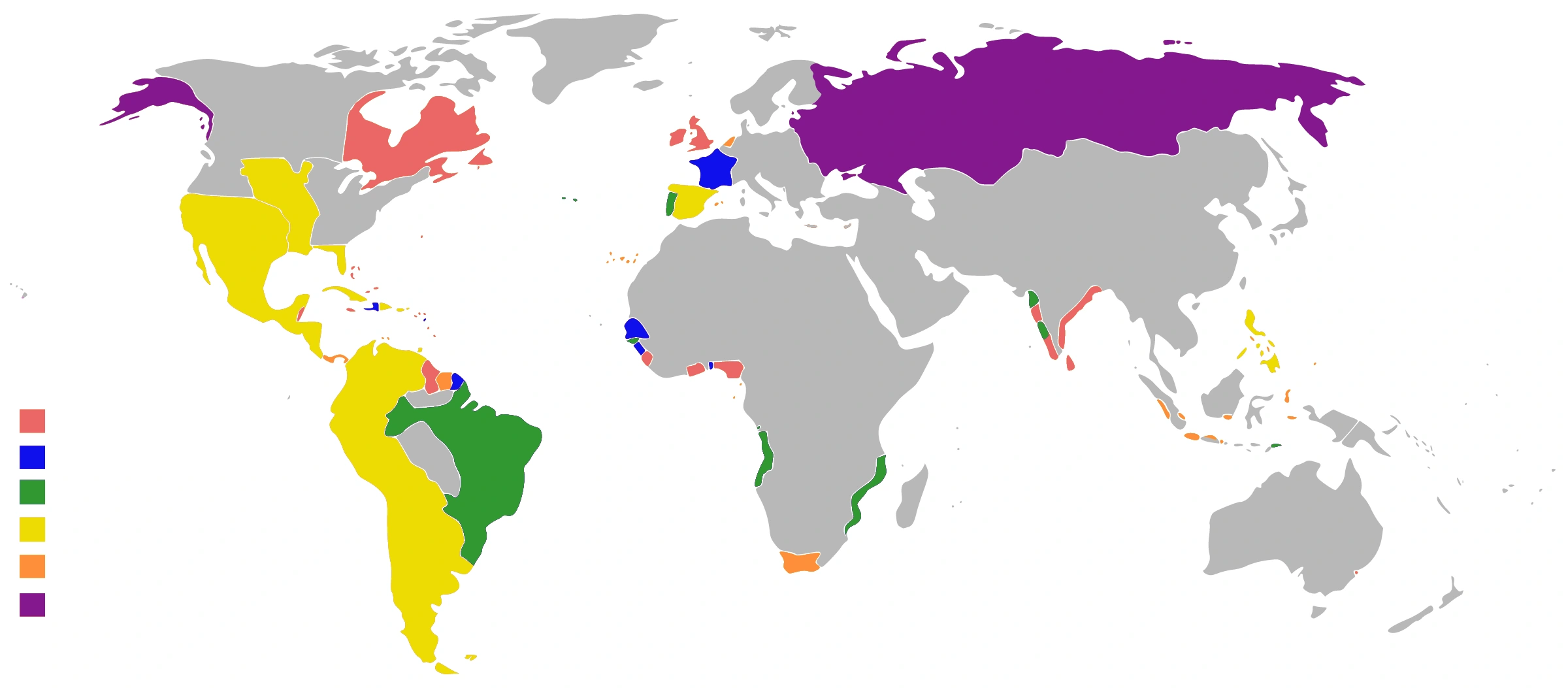
Colonial empires in 1800: global context for European expansion. A date-specific map, not the maximum territorial extent of every colonial power.
- Read the legend and reference date before interpreting regional patterns.
- Relate the map to the article’s topic; verify current administrative boundaries or data separately.
Credit: George Tsiagalakis · CC BY-SA 4.0 · sourceConverted to WebP on an opaque white background; proportionally resized without cropping. Original cartography and legend retained.
1. Origins and meaning of the monopoly
The East India Company originated as the Governor and Company of Merchants of London Trading into the East Indies. Queen Elizabeth I’s charter of 31 December 1600 granted it an initial fifteen-year exclusive privilege over English commerce in a broad eastern sphere, conventionally described as extending from the Cape of Good Hope eastward to the Straits of Magellan. The charter enabled merchants to combine capital and share the risks of long-distance voyages. James I renewed its privileges in 1609 without the original fixed expiry, subject to termination provisions.
This arrangement belonged to the mercantilist world of state-backed commercial rivalry. European governments used chartered companies to pursue overseas trade while limiting direct public expenditure. The Company sought spices initially and subsequently became deeply involved in Indian cotton textiles, silk, indigo and saltpetre. Chinese tea later became central to its commercial system.
Monopoly must be interpreted precisely. The English Crown could exclude unauthorised English competitors, but could not by charter alone prohibit Indian merchants or Dutch and Portuguese companies from trading. Access to Indian ports and markets depended on agreements, farmans and relations with local rulers. The Company’s royal charter and its privileges obtained from Indian authorities were therefore different legal foundations.
- A factory was primarily a trading establishment staffed by factors, not necessarily a manufacturing unit.
- Interlopers were traders who challenged or operated outside the Company’s exclusive privileges.
- Company trade must be distinguished from the private trade conducted by its servants.
Timeline
1600
Elizabeth I charters the East India Company with exclusive English trading privileges in the eastern sphere.
1698–1709
A rival English company emerges; the competing organisations subsequently unite.
1717
Farrukhsiyar’s farman strengthens the Company’s trading privileges in India.
1765
The Company receives Diwani rights in Bengal, Bihar and Orissa.
1813
General Indian-trade monopoly ends; tea and China-trade monopolies remain.
1833
Remaining commercial monopolies end and the Company is directed to cease trading.
1858
Government of British India passes from the Company to the Crown.
2. Competition, privileges and commercial power
The monopoly was repeatedly contested within England. Merchants excluded from eastern trade challenged the Company’s privileges, while the government used charter negotiations to obtain loans and other financial advantages. In 1698, a rival English company received statutory backing. The rival organisations eventually united in 1709 as the United Company of Merchants of England Trading to the East Indies. This episode shows that monopoly was a politically negotiated privilege rather than an uninterrupted commercial fact.
In India, the Mughal emperor Farrukhsiyar’s farman of 1717 strengthened Company privileges, including favourable customs arrangements in Bengal. Under these arrangements, Company goods could move under dastaks, or passes, with exemption from ordinary customs duties against a stipulated annual payment. The misuse of such privileges for private trade by Company servants disadvantaged Indian merchants and reduced the nawab’s customs revenue.
Customs disputes became an important element in the conflict with Mir Qasim. In 1763, he abolished internal duties to place Indian merchants on a more equal footing with the English. The Company resisted the loss of its privileged advantage. This conflict should not be reduced to the original English charter monopoly: it concerned the unequal operation of trading privileges within Bengal and the Company’s growing political power.
- Royal charter: exclusivity against unauthorised English or British competitors.
- Mughal farman and dastak: privileges affecting trade and customs within Indian territories.
- Private trade: transactions undertaken by Company servants for personal gain, sometimes through misuse of official privileges.
From privileged trader to colonial administrator
- 1. Royal charter grants exclusive English trading rights
- 2. Indian rulers grant local commercial privileges
- 3. Military victories establish territorial influence
- 4. Diwani revenues support export procurement
- 5. British commercial interests press for wider access
- 6. Acts of 1813 and 1833 progressively end Company commerce
3. Territorial revenues and commodity control
Plassey in 1757 and the grant of Diwani over Bengal, Bihar and Orissa in 1765 transformed the relationship between commerce and power. The Company could increasingly use Indian revenues to purchase Indian goods for export, reducing dependence on importing bullion from Europe. In Company terminology, investment often meant the procurement of export goods rather than modern capital investment in factories or infrastructure.
Political ascendancy also strengthened the Company’s bargaining position against producers. Gomasthas, or commercial agents, supervised procurement, advanced money and enforced delivery obligations. In Bengal’s textile districts, weavers often faced restrictions on selling to alternative buyers and pressure over prices and delivery. Such practices reveal how territorial authority could support monopsony-like conditions, in which a powerful buyer restricted the producer’s choices.
Commodity monopolies were another distinct institution. The Company’s Bengal opium system involved regulated cultivation, procurement and auctions; private merchants carried opium onward, including into China. Tea purchases and opium-related revenues formed parts of a wider Asian commercial network. Ending the Company’s general trading monopoly did not automatically abolish every colonial commodity monopoly or revenue arrangement. For examination purposes, separate charter-based exclusivity, control over producers and government monopolies over particular products.
- Monopoly concerns exclusive or dominant selling rights; monopsony concerns exclusive or dominant buying power.
- Territorial revenue helped finance export purchases and imperial expenditure.
- Commercial coercion and official customs privileges were related to, but not identical with, the British charter monopoly.
| Act | Commercial position | Examination distinction |
|---|---|---|
| Charter Act, 1793 | Company privileges renewed for twenty years | Did not open general Indian trade |
| Charter Act, 1813 | General Indian-trade monopoly abolished | Tea and China-trade monopolies retained |
| Charter Act, 1833 | Remaining commercial monopolies abolished | Company continued as an administrative agency |
4. Parliamentary regulation and the end of exclusivity
The Company’s territorial expansion, financial difficulties and administrative abuses prompted parliamentary intervention. The Regulating Act of 1773 and Pitt’s India Act of 1784 strengthened supervision without abolishing its commercial monopoly. Under Pitt’s India Act, the Board of Control supervised political affairs while the Court of Directors continued to manage the Company, including its commercial business. The Charter Act of 1793 renewed the Company’s privileges for another twenty years.
By the early nineteenth century, British manufacturers and merchants increasingly demanded access to Indian markets. Industrialisation expanded the influence of interests that regarded Company exclusivity as an obstacle. The Charter Act of 1813 ended the Company’s general monopoly over British trade with India and admitted other British traders, subject to licensing and regulatory arrangements. It nevertheless preserved the Company’s monopoly of trade with China and trade in tea.
The Charter Act of 1833 removed these remaining exceptions and directed the Company to wind up its commercial business. It continued as the agency administering British territories in India under parliamentary authority. Thus 1813 marks partial commercial liberalisation, 1833 the termination of the Company’s trading role, and 1858 the end of Company government. These are separate constitutional and economic transitions, not interchangeable dates.
- 1773 and 1784: stronger political supervision, not abolition of monopoly.
- 1813: Indian trade opened to other British traders; tea and China exceptions retained.
- 1833: remaining trading privileges ended; territorial administration continued.
5. Historical significance and examination approach
The decline of monopoly reflected a shift from chartered mercantilism towards a British imperial economy increasingly influenced by industrial manufacturers and private trading firms. India became more closely integrated into markets for British manufactures and supplies of agricultural commodities. However, changes in Indian handicrafts cannot be explained by the Charter Act of 1813 alone: machine production, tariff policies, political subordination and regional conditions also mattered.
Free trade in this context did not mean equal political power or unrestricted competition for everyone. British traders gained wider access within an expanding colonial order. A sound answer should therefore connect commercial liberalisation with continuing imperial control, while avoiding the claim that all Indian trade had previously belonged exclusively to the Company.
- Always identify the geographical scope, commodity and group of traders affected by a monopoly.
- Distinguish abolition of trading privileges from abolition of administrative authority.
- Use the sequence 1813–1833–1858 to eliminate misleading chronological options.
Real-world case studies
Mir Qasim and equal customs treatment
Mir Qasim’s abolition of internal duties in 1763 attempted to neutralise the advantage enjoyed through Company passes and their misuse. The ensuing confrontation illustrates how customs privileges became inseparable from struggles over sovereignty in Bengal.
Bengal opium and China trade
The Company controlled Bengal opium procurement and auctioned the product to private merchants. Its onward carriage demonstrates that Company monopoly and private enterprise could coexist within the same commercial network.
Previous year questions
No source-linked PYQ is available here yet. Use the practice questions below.
Practice questions
Practice MCQ 1
Which privileges remained with the East India Company immediately after the Charter Act of 1813?
- A. Monopoly of all Indian cotton-textile exports
- B. Monopoly of trade in tea and trade with China
- C. Monopoly of all European trade with India
- D. Exclusive authority to collect customs throughout Asia
Practice MCQ 2
Consider the following statements: 1. The charter of 1600 legally excluded every European nation from Asian trade. 2. The Diwani grant enabled the Company to use Indian revenues for export procurement. 3. The Charter Act of 1833 ended Company government in India. Which statement is correct?
- A. 1 only
- B. 2 only
- C. 2 and 3 only
- D. 1, 2 and 3
Practice MCQ 3
Which pair is correctly matched?
- A. Dastak — A pass associated with customs privileges
- B. Gomastha — A member of the British Board of Control
- C. Interloper — A Mughal provincial revenue officer
- D. Factory — Necessarily a mechanised textile mill
Mains practice · The abolition of the East India Company’s trade monopoly transformed the form rather than ended the substance of British economic dominance in India. Discuss. Write in 150 words.
- Introduce the chartered mercantilist monopoly.
- Connect territorial revenue and coercive procurement with commercial power.
- Distinguish the changes introduced in 1813 and 1833.
- Explain the growing influence of British manufacturers and private traders.
- Conclude that commercial opening coexisted with continuing colonial government.
Further reading
- NCERT, Our Pasts–III: From Trade to Territory; Ruling the Countryside; Weavers, Iron Smelters and Factory Owners.
- Bipan Chandra, History of Modern India, Orient BlackSwan.
- UK Parliament website: East India Company and parliamentary regulation.
- British Library, India Office Records: Company charters, trade and administration.
Preparing for UPSC Civil Services? Get classroom teaching, answer-writing evaluation and mentorship at Pragnya IAS Academy, Ashok Nagar — see why aspirants choose us for IAS coaching in Hyderabad.