

This is image of famous diu fort in Daman and Diu India . It was constructed by Portuguese when diu was there colony .
Credit: Sumit sharma · CC BY-SA 3.0 · source

This is a photo of HPIP monument number
Credit: iMahesh · CC BY-SA 4.0 · source
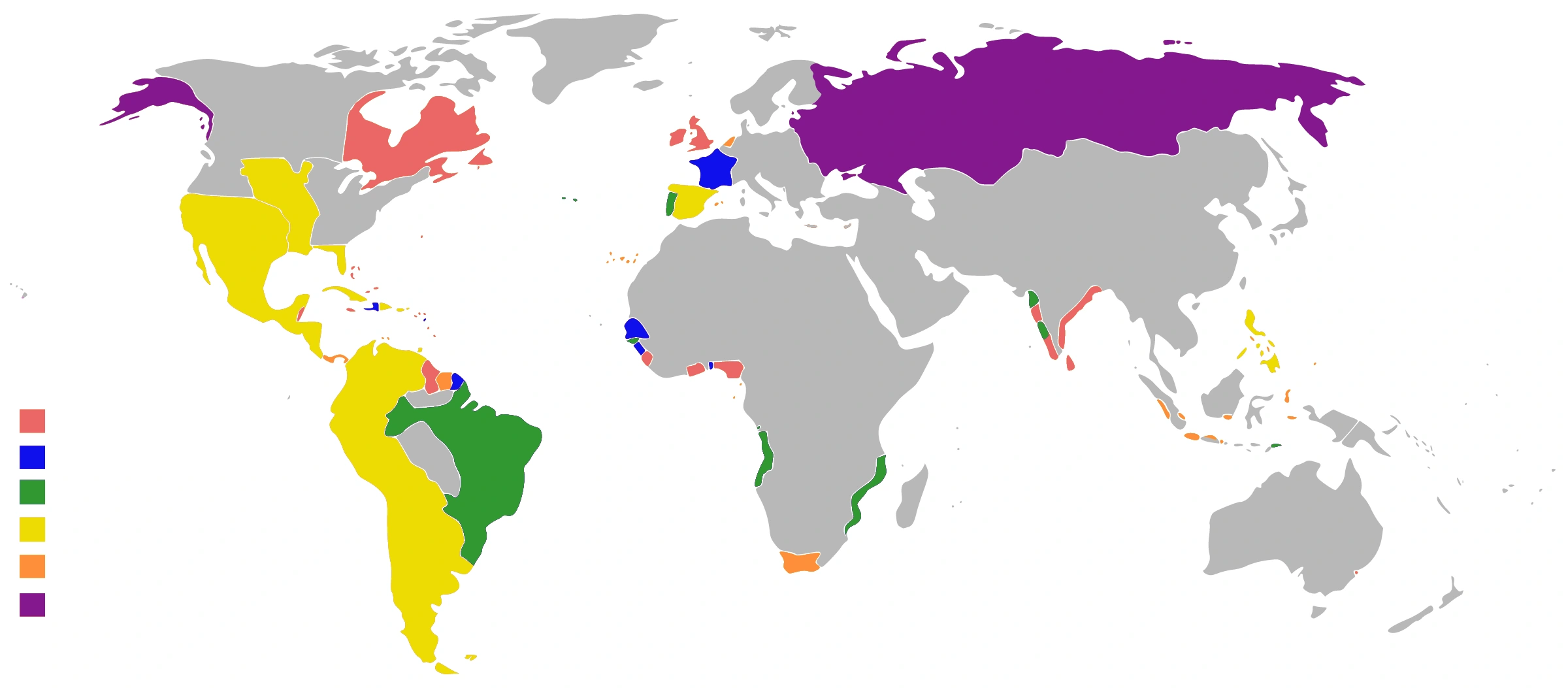
Map study
Colonial empires in 1800: global context for European expansion. A date-specific map, not the maximum territorial extent of every colonial power.
- Read the legend and reference date before interpreting regional patterns.
- Relate the map to the article’s topic; verify current administrative boundaries or data separately.
Credit: George Tsiagalakis · CC BY-SA 4.0 · sourceConverted to WebP on an opaque white background; proportionally resized without cropping. Original cartography and legend retained.
1. Background and the opening of the Cape route
Portuguese expansion grew out of European demand for pepper and other spices, royal competition, missionary ambitions and developments in oceanic navigation. Asian goods already reached Europe through interconnected Indian Ocean, Red Sea, Persian Gulf and Mediterranean networks. Portuguese rulers sought direct access to these trades and an advantage over established intermediaries. The Ottoman conquest of Constantinople in 1453 forms part of this background, but it did not completely close Europe’s eastern trade routes.
Portuguese voyages along Africa’s Atlantic coast gradually developed geographical knowledge and sailing experience. Bartolomeu Dias rounded the southern tip of Africa in 1488. Vasco da Gama subsequently sailed around the Cape of Good Hope and reached Calicut in May 1498. Calicut was a major commercial centre under the Zamorin, with an established community of merchants engaged in Indian Ocean trade.
Da Gama’s reception did not immediately produce commercial dominance. His gifts were unimpressive in a wealthy trading centre, and Portuguese demands generated tensions with local authorities and merchants. Pedro Álvares Cabral reached India in 1500; conflict at Calicut encouraged closer Portuguese relations with Cochin and Cannanore. On his second voyage in 1502, da Gama used naval coercion to press Portuguese claims. These developments transformed an exploratory venture into an armed commercial enterprise.
- The Portuguese opened a direct European oceanic route to India; they did not discover an India previously unknown to other societies.
- Indian Ocean trade was already extensive and involved Indian, Arab, Persian, East African and Southeast Asian merchants.
Timeline
1488–1498
Dias rounds southern Africa; da Gama subsequently reaches Calicut.
1505–1509
Almeida becomes viceroy; Portuguese forces win the Battle of Diu.
1510–1515
Albuquerque secures Goa, Malacca and Hormuz.
1530–1556
Goa becomes the capital; India’s first printing press is established there.
1580–1640
Portugal and Spain share a monarch during the Iberian Union.
December 1961
Operation Vijay ends Portuguese rule in Goa, Daman and Diu.
2. Almeida, Albuquerque and the Estado da Índia
The Estado da Índia was the Portuguese Crown’s administrative and military framework for its eastern possessions. It connected scattered ports, fortresses and trading stations rather than forming a continuous territorial empire. An early fort was constructed at Cochin in 1503. Francisco de Almeida, appointed the first viceroy in 1505, emphasised naval strength as the foundation of Portuguese influence. Textbooks commonly describe this emphasis as the Blue Water Policy.
After a Portuguese defeat at Chaul in 1508, Almeida won the Battle of Diu in 1509 against a coalition involving Mamluk Egyptian and Gujarat forces. The victory strengthened Portuguese naval predominance, although it neither eliminated Asian shipping nor created uncontested mastery of the entire ocean. Afonso de Albuquerque, governor from 1509 to 1515, complemented naval warfare with the capture of strategically located bases.
Albuquerque captured Goa from the Bijapur Sultanate in 1510, lost it temporarily, and recaptured it later that year. Goa offered a defensible harbour and access to western Indian commerce, including the horse trade. His capture of Malacca in 1511 and establishment of control at Hormuz in 1515 linked Portuguese bases to major commercial gateways. However, the failure to capture Aden limited Portuguese attempts to control access to the Red Sea.
- Almeida: first viceroy; naval emphasis; victory at Diu.
- Albuquerque: governor, not the first viceroy; Goa, Malacca and Hormuz.
- Goa became the administrative capital in 1530 under Nuno da Cunha.
Portuguese maritime expansion
- 1. Find the Cape route to Asian markets
- 2. Negotiate trading access and local alliances
- 3. Build or capture fortified ports
- 4. Use naval patrols and cartaz passes
- 5. Collect customs and pursue commercial monopolies
3. Trade, coercion and relations with Indian powers
Portuguese power depended on fortified settlements, artillery-equipped ships, diplomacy and selective monopolies. Pepper was especially important, but textiles, horses and other commodities also sustained their commercial network. Royal trade existed alongside private Portuguese enterprise and continuing Asian commerce. Their objective was often to tax, redirect or dominate existing trade rather than replace every merchant operating within it.
The cartaz was a naval pass that ships were required to obtain under Portuguese claims of maritime authority. It could prescribe routes, ports or cargo restrictions. Ships lacking an acceptable pass risked interception and seizure. Customs duties, patrols and compulsory calls at controlled ports supplemented this system. Its effectiveness varied geographically and over time; merchants evaded restrictions, negotiated exemptions or shifted routes.
Relations with Indian states combined alliances and conflict. Cochin became an important ally against Calicut, while the Zamorin resisted Portuguese commercial domination. Under Bahadur Shah of Gujarat, the Portuguese obtained Bassein in 1534 and permission to build a fort at Diu in 1535. Daman was acquired in 1559. Portuguese influence in Bengal developed differently: the settlement at Hugli was attacked by Shah Jahan’s forces in 1632 amid disputes involving piracy, slave-taking and Portuguese conduct.
- Distinguish Diu’s naval battle in 1509 from permission to construct its Portuguese fort in 1535.
- Portuguese expansion initially relied more on maritime strongpoints than on conquest of extensive inland territories.
| Centre | Relevant date | Importance |
|---|---|---|
| Cochin | 1503 | Early fortified base and ally on the Malabar coast |
| Goa | 1510 | Territorial base; later administrative capital |
| Malacca | 1511 | Gateway between the Indian Ocean and Southeast Asian seas |
| Hormuz | 1515 | Strategic position at the entrance to the Persian Gulf |
| Diu | 1535 | Fortified position near Gujarat’s commercial routes |
4. Religion, society and cultural exchange
Commerce and conquest were closely associated with Catholic missionary activity under Portuguese royal patronage. Francis Xavier arrived at Goa in 1542 and worked in several parts of Asia. Jesuits also visited Akbar’s court, beginning with the first mission in 1580, participating in religious discussions without converting the emperor. Missionary influence therefore extended beyond territories directly governed by Portugal.
Religious policy also involved coercion. The Goa Inquisition was established in 1560 and finally abolished in 1812, with a temporary suppression in between. Conversion pressures and restrictions affected sections of the local population, although experiences differed across regions and periods. Alongside conflict, Portuguese rule encouraged some intermarriage and produced Indo-Portuguese communities, architectural forms and linguistic exchanges.
India’s first printing press was established at Goa in 1556, initially serving missionary purposes. Churches and convents of Goa, including the Basilica of Bom Jesus, reflect this enduring cultural presence. Portuguese-connected exchange also helped introduce or disseminate American-origin crops such as chilli, cashew, tobacco and pineapple in India. Their adoption was gradual and involved local cultivators and wider trading networks, not simply a single act of introduction.
- For prelims, connect Goa with early printing, Catholic missions and Indo-Portuguese architecture.
- Do not confuse Portuguese-connected crop diffusion with the introduction of already established Indian crops such as black pepper.
5. Decline and historical significance
Portuguese commercial predominance weakened through the seventeenth century. Limited manpower and revenue, expensive dispersed fortifications, administrative weaknesses and resistance from Asian powers constrained their position. Dutch and English chartered companies brought stronger financial organisation and growing naval resources. Portugal’s dynastic union with Spain from 1580 to 1640 also exposed its possessions to Spain’s European enemies.
Losses occurred unevenly rather than in one decisive collapse. Hormuz fell to Persian forces supported by English ships in 1622, Malacca to the Dutch in 1641, and Cochin to the Dutch in 1663. Bombay, transferred to the English Crown through Catherine of Braganza’s marriage treaty with Charles II in 1661, was leased to the English East India Company in 1668. The Marathas captured Bassein in 1739.
Despite declining commercial leadership, Portugal retained several Indian enclaves long after British paramountcy emerged. Dadra and Nagar Haveli passed out of Portuguese control in 1954; Goa, Daman and Diu followed after Indian military action in December 1961. Historically, Portuguese expansion illustrates the early relationship between armed trade, strategic ports and overseas empire, while also demonstrating the resilience of Asian merchants and states.
Real-world case studies
Goa: from conquest to imperial capital
The capture of Goa in 1510 provided a territorial and administrative foundation beyond a simple trading factory. Its elevation to capital in 1530, printing press in 1556 and surviving churches demonstrate the interaction of commerce, government and missionary activity.
Resistance on the Malabar coast
The Zamorin’s naval commanders, known as the Kunjali Marakkars, challenged Portuguese shipping and coercive trade practices during the sixteenth century. Their resistance shows that Portuguese naval superiority was contested and did not eliminate indigenous maritime capacity.
Previous year questions
No source-linked PYQ is available here yet. Use the practice questions below.
Practice questions
Practice MCQ 1
Consider the following pairs: 1. Francisco de Almeida — First Portuguese viceroy in India; 2. Afonso de Albuquerque — Capture of Goa; 3. Nuno da Cunha — Arrival at Calicut in 1498. Which pairs are correctly matched?
- A. 1 and 2 only
- B. 2 and 3 only
- C. 1 and 3 only
- D. 1, 2 and 3
Practice MCQ 2
The Portuguese cartaz system was primarily associated with:
- A. Assessment of agricultural revenue in Goa
- B. Regulation of maritime movement through naval passes
- C. Recruitment of Indian soldiers for inland conquest
- D. Appointment of missionaries to Akbar’s court
Practice MCQ 3
Arrange the following events chronologically: 1. Establishment of a printing press at Goa; 2. Portuguese victory at the Battle of Diu; 3. Capture of Goa by Albuquerque; 4. Portuguese capture of Malacca.
- A. 3–2–4–1
- B. 2–4–3–1
- C. 2–3–4–1
- D. 1–2–3–4
Mains practice · Portuguese expansion in the Indian Ocean was an exercise in armed commerce rather than extensive territorial conquest. Discuss its instruments and limitations. Answer in 250 words.
- Introduce the Cape route and the pre-existing Asian trading system.
- Explain fortified ports, naval artillery, cartaz passes, customs and selective monopolies.
- Use Goa, Malacca and Hormuz to illustrate strategic positioning.
- Discuss local alliances, merchant adaptation and resistance by the Zamorin’s naval forces.
- Assess financial constraints and Dutch and English competition.
- Conclude that maritime coercion coexisted with territorial bases and enduring cultural influence.
Further reading
- Satish Chandra, History of Medieval India, sections on maritime trade and the Portuguese.
- Sanjay Subrahmanyam, The Portuguese Empire in Asia, 1500–1700.
- M. N. Pearson, The Portuguese in India.
- UNESCO World Heritage Centre: Churches and Convents of Goa.
- Government of Goa, Department of Information and Publicity: historical information on Goa and its liberation.
Preparing for UPSC Civil Services? Get classroom teaching, answer-writing evaluation and mentorship at Pragnya IAS Academy, Ashok Nagar — see why aspirants choose us for IAS coaching in Hyderabad.