
Map study
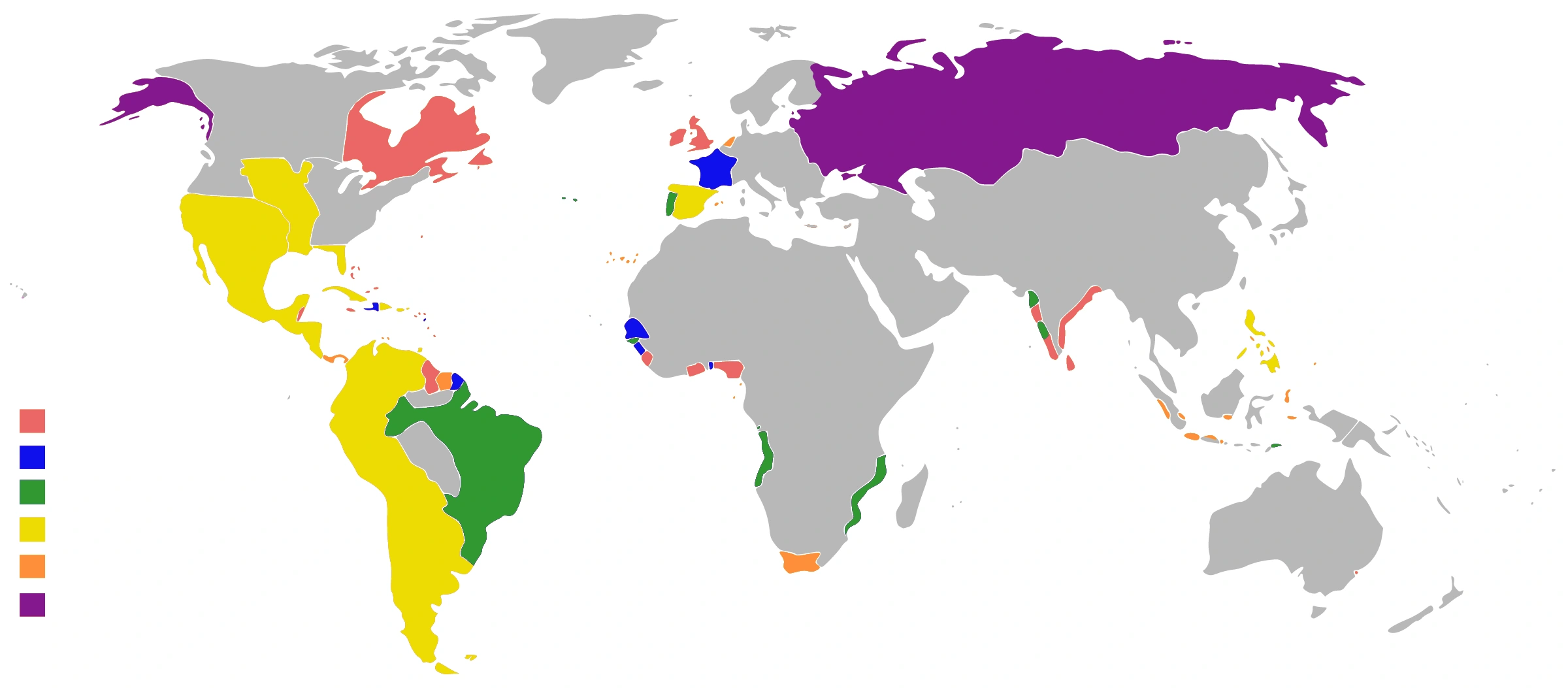
Colonial empires in 1800: global context for European expansion. A date-specific map, not the maximum territorial extent of every colonial power.
- Read the legend and reference date before interpreting regional patterns.
- Relate the map to the article’s topic; verify current administrative boundaries or data separately.
Credit: George Tsiagalakis · CC BY-SA 4.0 · sourceConverted to WebP on an opaque white background; proportionally resized without cropping. Original cartography and legend retained.
1. Origins and objectives of Dutch expansion
Dutch overseas expansion arose from the commercial strength of the Netherlands and its struggle against Spanish rule. After the Portuguese crown came under the Spanish monarchy in 1580, Dutch access to Iberian trading networks became increasingly insecure. Merchants therefore sought direct access to Asian commodities rather than relying on supplies passing through Lisbon. The voyage led by Cornelis de Houtman reached the Indonesian archipelago in 1596, helping initiate sustained Dutch commercial intervention in Asia.
In 1602, competing Dutch ventures were combined into the Verenigde Oostindische Compagnie, usually abbreviated as VOC. The States-General of the Netherlands granted it a monopoly over Dutch trade in a vast eastern overseas zone. The company could make treaties, construct forts, maintain armed forces and exercise administrative powers. It was thus both a commercial corporation and an instrument of armed expansion, rather than merely an association of private merchants.
The VOC's principal strategic interest lay in the spices of the Indonesian archipelago, especially cloves, nutmeg and mace. Batavia, established on Java in 1619, became its Asian headquarters. India nevertheless occupied an essential place in its operations because Indian manufactures could be sold or exchanged across Asian markets. For UPSC, the key distinction is between Dutch participation in Indian commerce and the company's more intensive territorial and monopoly-building activities in Southeast Asia.
- Dutch: associated with the Netherlands; not to be confused with the Danes of Denmark.
- VOC: a chartered company with commercial, diplomatic and military privileges.
- Batavia: present-day Jakarta, outside India.
Timeline
1602
Formation of the Dutch East India Company, or VOC.
1605
Dutch factory established at Masulipatnam.
1610–1613
Pulicat developed as a Dutch base; Fort Geldria built in 1613.
1658–1663
Dutch captured Nagapattinam in 1658 and Cochin in 1663 from the Portuguese.
1690
Headquarters of Dutch Coromandel shifted from Pulicat to Nagapattinam.
1741
Travancore defeated the Dutch at Colachel.
1759
English forces defeated the Dutch near Chinsurah at Bedara.
1799
VOC dissolved.
1824–1825
Anglo-Dutch treaty followed by transfer of Dutch establishments in India to Britain.
2. Dutch settlements and their geographical significance
The Dutch established a factory at Masulipatnam in 1605. Located on the Coromandel coast within the commercial world of the Golconda kingdom, the port provided access to textile-producing regions. In early modern usage, a factory meant a trading establishment staffed by company agents called factors; it did not necessarily mean a mechanised production unit. Factories included warehouses, offices and accommodation, sometimes protected by fortifications.
Pulicat, north of present-day Chennai, became an important Dutch base from 1610. Fort Geldria, built in 1613, strengthened its position as a fortified commercial centre. Pulicat served as the headquarters of Dutch Coromandel before that role shifted to Nagapattinam in 1690. Nagapattinam had been captured from the Portuguese in 1658. These centres connected textile-producing hinterlands with maritime routes to Ceylon, Batavia and other Asian ports.
The Dutch also established themselves at Surat on the western coast and at Chinsurah on the Hooghly in Bengal. Bengal offered cotton textiles, silk and access to saltpetre supplies from the wider eastern Indian trading network. On the Malabar coast, the Dutch displaced Portuguese influence at several locations, most notably Cochin in 1663. Commercial establishments also operated at places such as Bimlipatnam and Kasimbazar. Their distribution reveals a network organised around ports, river transport, commodity production and access to overseas markets rather than a continuous Indian territorial empire.
- Coromandel coast: Masulipatnam, Pulicat and Nagapattinam; especially important for textiles.
- Malabar coast: Cochin and associated settlements; particularly important for pepper.
- Bengal: Chinsurah and inland commercial connections; textiles, silk and saltpetre.
- Western India: Surat, linking the company with Gujarat's commerce.
Simplified Dutch intra-Asian trading circuit
- 1. Negotiate trading privileges and establish coastal factories in India.
- 2. Procure textiles through Indian merchants, brokers and producers.
- 3. Ship cloth to Southeast Asian markets.
- 4. Use sales proceeds and other funds to purchase spices and regional commodities.
- 5. Distribute commodities through Batavia to Asian and European markets.
3. Commodities, commercial methods and Indian connections
Indian cotton textiles were central to Dutch intra-Asian trade. Different Southeast Asian markets demanded particular colours, designs and cloth qualities. The VOC purchased suitable textiles in India and sold them in Asian markets, including regions supplying spices. This helped finance commodity purchases and reduced exclusive reliance on bullion shipped from Europe. India was consequently not a marginal stop on a Europe–Asia route but a major production centre within an interconnected Asian economy.
Other important commodities included Bengal silk, indigo, saltpetre, pepper and, in some circuits, opium and rice. Saltpetre was valued as an ingredient of gunpowder, while indigo supplied a durable dye. The significance of each commodity varied across regions and periods. Dutch ambitions to secure privileged or exclusive supplies often encountered competing European buyers, Indian merchants and the political authority of local rulers.
The company relied on Indian brokers, merchants, money changers, transporters and producers. Advances and supply contracts helped organise procurement, but the Dutch never controlled the entire Indian textile economy. Prices, harvest conditions, warfare and competition could disrupt deliveries. Their maritime commerce also included coercion and slave trading, including the export of enslaved people from the Coromandel coast. Dutch commercial expansion should therefore be understood through both market exchange and unequal relations of power, not as an exclusively peaceful trading enterprise.
- Intra-Asian trade means commerce between Asian regions, distinct from direct trade between Asia and Europe.
- Trading privileges depended on negotiations with Indian authorities and could be challenged or withdrawn.
- Fortified factories combined storage, commercial administration and military protection.
| Centre | Present-day location | Exam significance |
|---|---|---|
| Masulipatnam | Andhra Pradesh | Factory established in 1605; access to Coromandel textiles. |
| Pulicat | Tamil Nadu, near the Andhra Pradesh border | Fort Geldria; earlier headquarters of Dutch Coromandel. |
| Nagapattinam | Tamil Nadu | Captured in 1658; Coromandel headquarters from 1690. |
| Cochin | Kerala | Captured from Portugal in 1663; Malabar pepper trade. |
| Chinsurah | West Bengal | Bengal trading centre; associated with the nearby Battle of Bedara. |
| Surat | Gujarat | Access to western Indian commerce and textile supplies. |
4. Rivalries, resistance and military setbacks
The Dutch initially concentrated on breaking Portuguese dominance over Asian sea routes and commodity markets. Their capture of Portuguese possessions in Ceylon and on the Indian coast weakened the Portuguese Estado da Índia. Cochin's capture in 1663 was a major milestone, but replacing Portuguese influence did not automatically give the Dutch unrestricted control over Malabar pepper. Regional states and merchant networks retained considerable agency.
Relations with the English involved both commercial interaction and conflict. The Amboyna incident of 1623, in the Indonesian archipelago, intensified Anglo-Dutch hostility after English company personnel and others were executed by Dutch authorities. It was not an event on Indian soil, nor did it immediately eliminate English activity throughout Southeast Asia. Nevertheless, it illustrated the coercive struggle for commercial dominance in the spice-producing region.
In southern India, Marthanda Varma's Travancore defeated Dutch forces at Colachel in 1741. This checked Dutch intervention in regional politics and strengthened Travancore's position. In Bengal, an English force defeated a Dutch expedition near Chinsurah at Bedara, also called Biderra, in 1759. Coming after Plassey in 1757, this defeat helped secure the English company's ascendancy in Bengal against another European competitor. Neither battle should be treated as the immediate termination of all Dutch commerce in India.
- Colachel, 1741: Travancore versus the Dutch.
- Bedara, 1759: English versus Dutch forces in Bengal.
- Wandiwash, 1760: an Anglo-French battle, not a Dutch defeat.
5. Decline, withdrawal and historical assessment
Dutch decline in India resulted from interacting commercial, military and geopolitical pressures. The VOC's priorities remained concentrated in Southeast Asia, while the English increasingly combined Indian trade with territorial authority and revenue collection. Company indebtedness, administrative costs, wars and changing commercial conditions weakened Dutch operations. During the Fourth Anglo-Dutch War of 1780–1784, Britain captured Nagapattinam in 1781 and retained it under the subsequent peace settlement.
The VOC was dissolved at the end of 1799, and its possessions and obligations passed to the Dutch state. European revolutionary and Napoleonic conflicts caused further British occupations and subsequent rearrangements of Dutch overseas establishments. The Anglo-Dutch Treaty of 1824 ultimately provided for the cession of Dutch establishments in India to Britain, with the transfer implemented in 1825. The treaty also reorganised Anglo-Dutch interests around Malacca, Bencoolen and the wider Southeast Asian region.
The Dutch experience demonstrates that European expansion in India did not follow a single predetermined path towards territorial conquest. The VOC used armed force and exercised local authority, but it did not build an Indian empire comparable to that of the English East India Company. Its history links Indian artisanal production, Asian trading networks, chartered-company power and resistance by regional states. Surviving buildings and archives at Pulicat, Cochin and Chinsurah preserve evidence of these connections.
- Avoid explaining Dutch withdrawal through one battle alone.
- Distinguish the VOC's dissolution in 1799 from the transfer of Dutch Indian establishments in 1825.
- Study settlements through map locations, commodities and changing headquarters.
Real-world case studies
Colachel: regional resistance and military adaptation
Marthanda Varma's victory over the Dutch at Colachel in 1741 demonstrated the capacity of an Indian regional state to defeat a European company's forces. Eustachius De Lannoy, captured during the conflict, subsequently entered Travancore's service and contributed to military training and fortification. The episode illustrates both resistance to European intervention and selective adoption of European military expertise.
Mattancherry Palace: identifying layered heritage
Mattancherry Palace in Kochi is popularly called the Dutch Palace. It was originally built by the Portuguese in the sixteenth century and presented to the ruler of Cochin; the Dutch later renovated it. Its name therefore does not identify its original builders. The monument is useful for understanding successive Portuguese, Dutch and local royal associations on the Malabar coast.
Previous year questions
No source-linked PYQ is available here yet. Use the practice questions below.
Practice questions
Practice MCQ 1
Consider the following pairs: 1. Pulicat — Fort Geldria; 2. Cochin — Captured by the Dutch from the Portuguese in 1663; 3. Batavia — Dutch headquarters in Bengal. How many pairs are correctly matched?
- A. Only one
- B. Only two
- C. All three
- D. None
Practice MCQ 2
Which one of the following best explains the importance of Indian cotton textiles to the Dutch East India Company?
- A. Their use was restricted to uniforms for Dutch soldiers in India.
- B. They enabled the Dutch to discontinue all imports of precious metals into Asia.
- C. They were sold in Asian markets and helped finance purchases of spices and other commodities.
- D. They were produced exclusively in factories directly owned by the Dutch.
Practice MCQ 3
Arrange the following events in chronological order: 1. Battle of Bedara; 2. Formation of the VOC; 3. Battle of Colachel; 4. Anglo-Dutch Treaty providing for the transfer of Dutch establishments in India.
- A. 2–3–1–4
- B. 2–1–3–4
- C. 3–2–1–4
- D. 2–3–4–1
Mains practice · Indian commerce was integral to Dutch expansion in Asia, yet the Dutch did not establish a large territorial empire in India. Explain. (150 words)
- Introduce the VOC and its primary strategic interest in Southeast Asian spices.
- Explain the role of Indian textiles in intra-Asian trade and the importance of pepper, silk, indigo and saltpetre.
- Locate major factories across Coromandel, Malabar, Bengal and Gujarat.
- Discuss dependence on Indian merchants and negotiations with regional authorities.
- Assess regional resistance, English competition and the significance of Colachel and Bedara.
- Conclude by distinguishing armed commercial expansion from large-scale territorial consolidation.
Further reading
- NCERT, Our Pasts–III: From Trade to Territory.
- Bipan Chandra, History of Modern India: European trading companies and British expansion.
- Om Prakash, European Commercial Enterprise in Pre-Colonial India, The New Cambridge History of India.
- Nationaal Archief, Netherlands: Dutch East India Company archives and research guides.
- Archaeological Survey of India: Mattancherry Palace Museum.
- Kerala Tourism, Government of Kerala: Mattancherry Palace and Dutch heritage in Kochi.
Preparing for UPSC Civil Services? Get classroom teaching, answer-writing evaluation and mentorship at Pragnya IAS Academy, Ashok Nagar — see why aspirants choose us for IAS coaching in Hyderabad.