
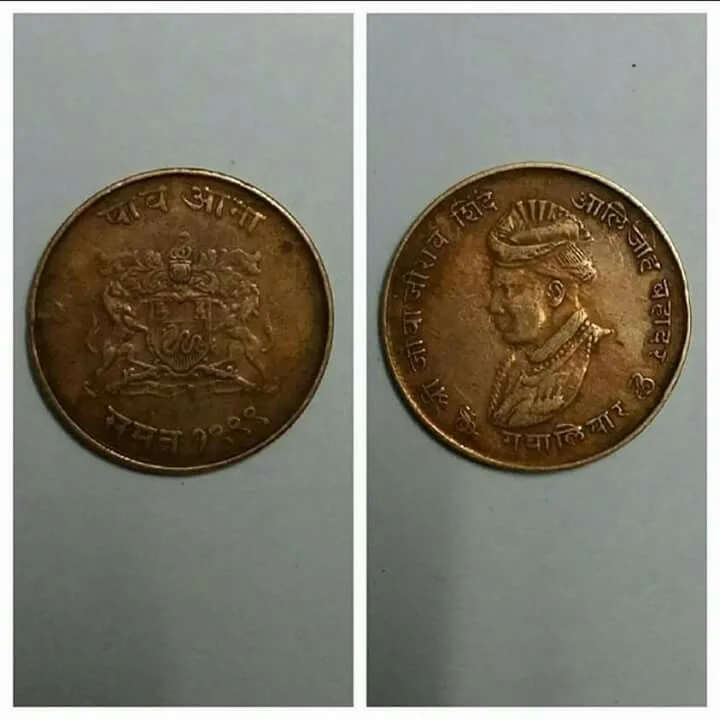
Coin attributed in the supplied metadata to Gwalior princely state and ruler Jivajirao Shinde.
Credit: SpeakingArch · CC BY-SA 4.0 · sourceResized and converted to WebP; uncropped.
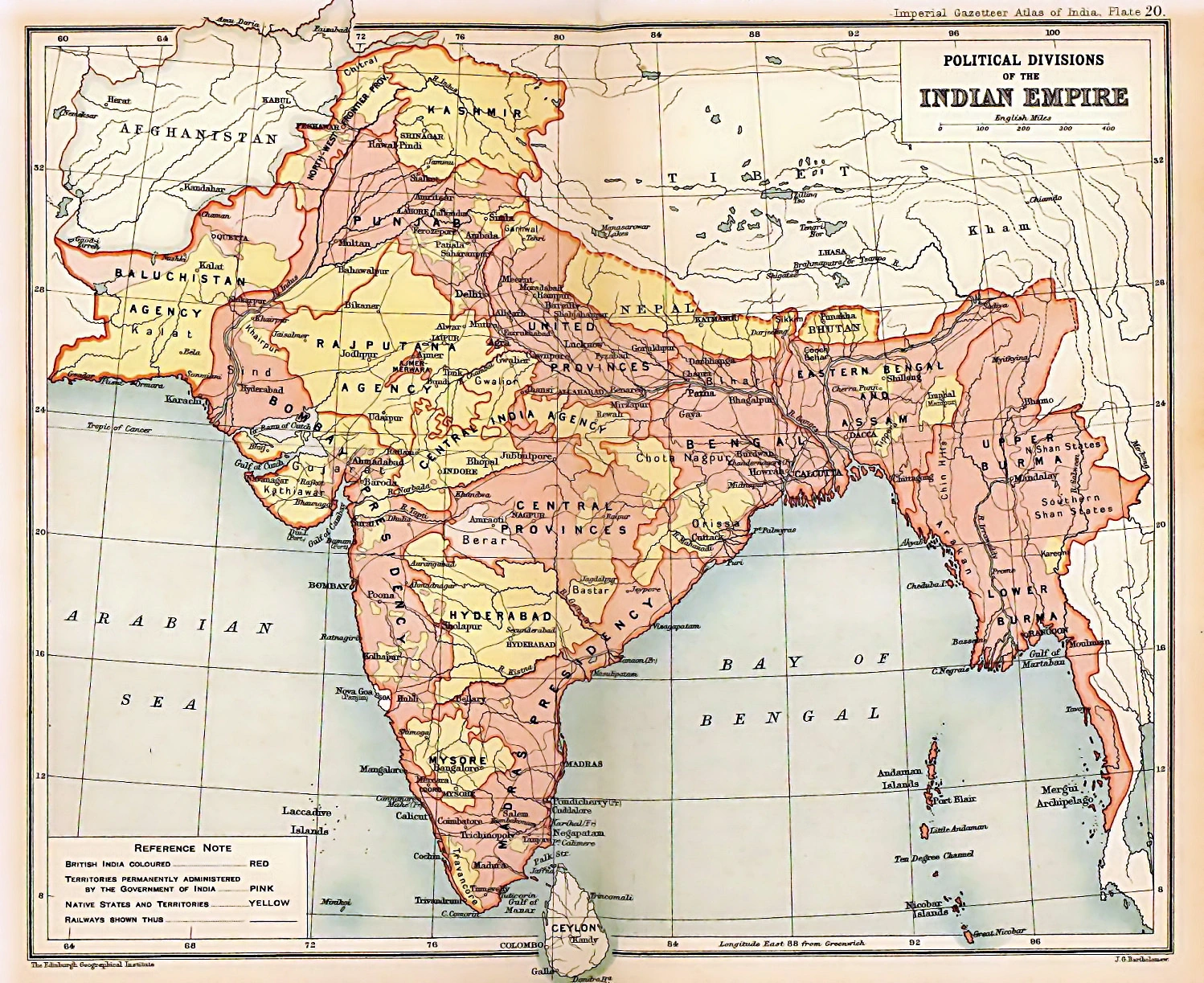
Map study
British Indian Empire in 1909: historical provinces and princely states, not contemporary Indian state boundaries.
- Read the source date and legend before interpreting territorial extent.
- Compare core regions, neighbouring powers and geographic barriers; historical borders and influence are approximate and changed over time.
Credit: Edinburgh Geographical Institute; J. G. Bartholomew and Sons · Public domain · sourceConverted to WebP on an opaque white background; proportionally resized without cropping. Original cartography and legend retained.
1. Meaning, origins and political geography
Princely states, also called Indian states or native states in colonial records, were territories under hereditary rulers who accepted British supremacy. Their rulers included maharajas, nawabs, nizams and other chiefs. Unlike British Indian provinces, these territories were normally administered through the ruler’s government rather than directly by the colonial bureaucracy. However, the extent of internal autonomy varied greatly, and British intervention limited the distinction between formal authority and effective independence.
Their origins were diverse. Some Rajput houses possessed longstanding regional authority; Hyderabad, Awadh and several other states emerged from the weakening Mughal Empire. Maratha states developed through eighteenth-century expansion, while Mysore became a major regional power. British victories and treaties converted many such powers into subordinate states. Thus, princely India was not simply a surviving remnant of an unchanging medieval order: colonial policy actively reshaped its boundaries, successions and institutions.
The states ranged from Hyderabad, Mysore and Jammu and Kashmir to tiny jurisdictions in Kathiawar and central India. Together, they covered approximately two-fifths of the subcontinent’s area and contained about one-quarter of its population, depending on the territorial frame and date used. Rajputana Agency and Central India Agency illustrate how the British grouped numerous states for political supervision without making them ordinary provinces.
- British India: direct colonial administration through provinces.
- Princely India: indirect rule through subordinate Indian rulers.
Timeline
1798
Hyderabad accepts Wellesley’s subsidiary arrangement.
1802
Treaty of Bassein places the Peshwa within the subsidiary system.
1848–1856
Dalhousie’s administration expands annexation through lapse and other grounds.
1858
Crown rule begins; Victoria’s Proclamation reassures princely dynasties.
1921–1927
Chamber of Princes established in 1921; All India States Peoples’ Conference founded in 1927.
1947
Paramountcy lapses; accession and integration reshape princely India.
2. Subsidiary alliances and expansion through treaties
The Company expanded through both conquest and agreements that reduced Indian rulers’ freedom of action. Under the policy commonly described as the ring fence, associated particularly with Warren Hastings, neighbouring powers could serve as buffers protecting Company territories. Later, subsidiary alliances brought states more directly within a British-controlled security system. Lord Wellesley, Governor-General from 1798 to 1805, developed this mechanism systematically, although arrangements involving Company troops predated him.
A ruler accepting a subsidiary alliance maintained or financed a British force, sometimes surrendering territory instead of paying a subsidy. The ruler could not independently conduct foreign relations or wage war, and restrictions were imposed on employing Europeans without British approval. A British Resident usually operated at court. In return, the Company promised protection. These arrangements weakened independent armed forces and transferred crucial decisions about security and diplomacy to the Company.
Hyderabad accepted Wellesley’s subsidiary arrangement in 1798, subsequently strengthened in 1800. Awadh ceded extensive territory in 1801 to meet defence arrangements. The Treaty of Bassein, signed with Peshwa Baji Rao II in 1802, brought the Peshwa under the subsidiary system and helped precipitate the Second Anglo-Maratha War. These examples show that expansion did not always require immediate annexation: financial dependence and military control could precede, substitute for, or facilitate territorial acquisition.
- The promise of non-interference did not prevent political pressure and intervention.
- Distinguish loss of external sovereignty under an alliance from complete annexation.
Typical subsidiary-alliance pathway
- 1. Ruler seeks or accepts British protection
- 2. Treaty provides for a subsidiary force and its financing
- 3. Independent diplomacy and military options are restricted
- 4. Resident supervises political relations
- 5. British influence expands while the dynasty formally survives
3. Annexation, succession and the Doctrine of Lapse
Lord Dalhousie, Governor-General from 1848 to 1856, pursued territorial consolidation through several methods. Under the Doctrine of Lapse, the Company annexed selected dependent states when a ruler died without a natural heir and it refused to recognise an adopted successor’s claim to rule. Adoption could remain valid for family or religious purposes while recognition of political succession was withheld. The doctrine therefore concerned the colonial assertion of authority over sovereignty, not a universal prohibition on adoption.
Important annexations associated with lapse included Satara in 1848, Sambalpur in 1849, and Jhansi and Nagpur in 1854. The policy threatened dynastic continuity and intensified distrust of British intentions. Jhansi’s disputed succession became especially significant during the Revolt of 1857, when Rani Lakshmibai emerged as a leading figure of resistance.
Not every annexation under Dalhousie resulted from lapse. Punjab was annexed in 1849 following the Second Anglo-Sikh War. Awadh was annexed in 1856 on the stated ground of misgovernment, despite its ruler having an heir. Berar was assigned to British administration in 1853 to finance the Hyderabad Contingent; this was not an ordinary Doctrine of Lapse annexation. Such distinctions are central to eliminating misleading options in Prelims questions.
- Lapse: refusal to recognise dynastic succession in selected dependent states.
- Other routes: conquest, treaty arrangements and allegations of misgovernment.
| Mechanism | Principal effect | Example |
|---|---|---|
| Subsidiary alliance | Military and diplomatic dependence without immediate annexation | Hyderabad, 1798 |
| Doctrine of Lapse | Annexation after refusal to recognise an adopted successor | Satara, 1848 |
| Conquest | Annexation following military defeat | Punjab, 1849 |
| Alleged misgovernment | Removal of ruling authority and annexation | Awadh, 1856 |
| Paramountcy intervention | Supervision or removal of a ruler without necessarily annexing the state | Baroda, 1875 |
4. Crown rule, paramountcy and princely administration
The Revolt of 1857 encouraged a change in British policy. The Government of India Act, 1858 transferred Company rule to the Crown. Queen Victoria’s Proclamation of 1 November 1858 promised respect for treaties and the rights, dignity and honour of Indian princes, while disclaiming a desire for territorial extension. Adoption sanads issued under Lord Canning reassured many ruling houses about succession. Preserving loyal princes became a means of stabilising empire rather than an obstacle to expansion.
British paramountcy nevertheless remained superior to princely authority. It lacked a single exhaustive constitutional definition and was exercised through treaties, political practice and claims of imperial responsibility. The British controlled external relations and could intervene over succession, disorder or alleged maladministration. Residents and political agents mediated relations, gathered information and exerted influence. Internal administration generally remained with rulers and their ministers, but even a ruler’s removal need not involve annexing the state.
Princely administration was highly uneven. Mysore, Baroda and Travancore became associated with notable educational, administrative or welfare initiatives, while many states retained restrictive political systems. The Chamber of Princes, established in 1921, provided a consultative forum rather than a sovereign legislature. The Government of India Act, 1935 proposed an all-India federation incorporating acceding states, but the federal scheme never commenced because the necessary participation was not secured.
- After 1858, dynastic preservation coexisted with interventionist paramountcy.
- A Resident represented British political authority; a diwan generally headed a state’s own administration.
5. Popular movements and the transition to independence
Nationalist mobilisation increasingly challenged the idea that a ruler alone represented a state’s people. Praja Mandals and related organisations demanded civil liberties, representative institutions, responsible government and relief from oppressive taxation or forced labour. The All India States Peoples’ Conference, founded in 1927, connected these struggles. Haripura Congress resolutions in 1938 supported responsible government in the states while emphasising locally rooted movements; Jawaharlal Nehru became president of the Conference in 1939.
The Indian Independence Act, 1947 ended British paramountcy and the treaty obligations linking the Crown to the states. Paramountcy did not automatically pass to India or Pakistan. Sardar Vallabhbhai Patel and V. P. Menon played leading roles in securing accessions to India. The standard Instrument of Accession initially covered defence, external affairs and communications, while standstill agreements sought continuity in existing administrative arrangements.
Accession and complete integration were separate processes. Later merger agreements, unions of states and constitutional changes consolidated territory and administration. Junagadh, Hyderabad and Jammu and Kashmir followed different, contested paths rather than a single uniform procedure. Privy purses and constitutional recognition of rulers survived independence but were abolished by the Constitution (Twenty-sixth Amendment) Act, 1971. The longer trajectory was therefore from regional sovereignty to colonial subordination and then integration into a democratic republic.
- For Prelims, keep paramountcy, accession, merger and constitutional integration conceptually separate.
Gwalior: Princely Authority under British Paramountcy
The supplied metadata identifies this object as a copper coin of Gwalior associated with Jivajirao Shinde. It provides a relevant entry point into princely states: territories where Indian dynasties retained rulership while acknowledging British paramountcy. Gwalior, ruled by the Scindia dynasty, illustrates how a regional power could survive within an imperial order without becoming an ordinary province of British India. Coinage could express dynastic identity and fiscal authority, but its existence did not establish complete political independence.
British expansion involved more than annexation. Treaties, military pressure and political supervision also subordinated rulers while preserving their thrones. Arrangements varied across states, but princely rulers generally lacked independent control over external relations, and British intervention could constrain internal government. After 1858, preserving subordinate dynasties became an important feature of imperial governance. This coin is therefore an illustrative object, not proof of Gwalior’s precise constitutional powers. The metadata’s denomination and attribution require corroboration through reliable numismatic catalogues; no conclusion about inscriptions, imagery or circulation can be drawn from the description alone.
- Prelims distinction: princely states were not directly administered British provinces; retained internal authority should not be confused with unrestricted sovereignty.
- Mains connection: indirect rule helped Britain extend control through Indian rulers, alongside the separate instruments of conquest and annexation.
- Integration distinction: the lapse of paramountcy in 1947 ended British suzerainty; accession and subsequent political integration were related but distinct processes.
Real-world case studies
Baroda: intervention without annexation
In 1875, the British deposed Malhar Rao Gaekwad on grounds of misgovernment amid allegations involving the Resident. Baroda was not annexed; Sayajirao III became ruler through adoption. The episode demonstrates that post-1858 protection of dynasties did not guarantee an individual ruler’s security.
Hyderabad: alliance and eventual integration
Hyderabad illustrates the difference between colonial dependence and postcolonial integration. A major subsidiary ally from 1798, it retained its dynasty under paramountcy. After independence, the Nizam sought to remain outside both dominions. Indian military action in September 1948, known as Operation Polo, ended this position and brought the state into the Indian Union.
Previous year questions
No source-linked PYQ is available here yet. Use the practice questions below.
Practice questions
Practice MCQ 1
Which territory was annexed on the stated ground of misgovernment rather than the Doctrine of Lapse?
- A. Satara
- B. Jhansi
- C. Awadh
- D. Nagpur
Practice MCQ 2
Consider the following statements: 1. Subsidiary alliances generally restricted independent foreign relations. 2. Queen Victoria’s Proclamation ended British intervention in princely affairs. 3. The Chamber of Princes was established in 1921. Which statements are correct?
- A. 1 and 2 only
- B. 1 and 3 only
- C. 2 and 3 only
- D. 1, 2 and 3
Practice MCQ 3
With reference to princely states in 1947, which statement is correct?
- A. British paramountcy automatically transferred to India.
- B. Accession necessarily abolished a state’s internal government immediately.
- C. The standard Instrument of Accession initially concerned defence, external affairs and communications.
- D. The federal provisions of the 1935 Act had already integrated all states.
Mains practice · British policy towards princely states shifted from territorial absorption to dynastic preservation without abandoning imperial control. Discuss. (250 words)
- Explain indirect rule and subsidiary alliances.
- Distinguish lapse, conquest and misgovernment-based annexation.
- Connect the 1857 revolt with the reassurances of 1858.
- Show how Residents and paramountcy sustained intervention.
- Use Baroda to distinguish deposition from annexation.
- Conclude with popular demands for responsible government.
Further reading
- NCERT, Our Pasts III: From Trade to Territory.
- NCERT, Politics in India Since Independence: Challenges of Nation Building.
- Bipan Chandra, History of Modern India.
- V. P. Menon, The Story of the Integration of the Indian States.
- Indian Independence Act, 1947, Section 7, legislation.gov.uk.
- Constitution (Twenty-sixth Amendment) Act, 1971, Legislative Department, Government of India.
- https://commons.wikimedia.org/wiki/File:Copper_Coin,_Indian_Princely_States_Denomination,_5_Annas_State_Gwalior_Ruler,_Jivajirao_Shinde_Alija_Bahadur.jpg
Preparing for UPSC Civil Services? Get classroom teaching, answer-writing evaluation and mentorship at Pragnya IAS Academy, Ashok Nagar — see why aspirants choose us for IAS coaching in Hyderabad.