

Inside the Rani Laxmibai's Jhansi Fort in Jhansi, Uttar Pradesh
Credit: Pinakpani · CC BY-SA 4.0 · source

Accoding to Alain R. Truong in 2014, this is one of only a few surviving paintings of royal princesses in Lucknow by George Duncan Beechey, and is dated circa 1840. Beechey was the official court pain
Credit: George Duncan Beechey, 1798–1852 · Public domain · source
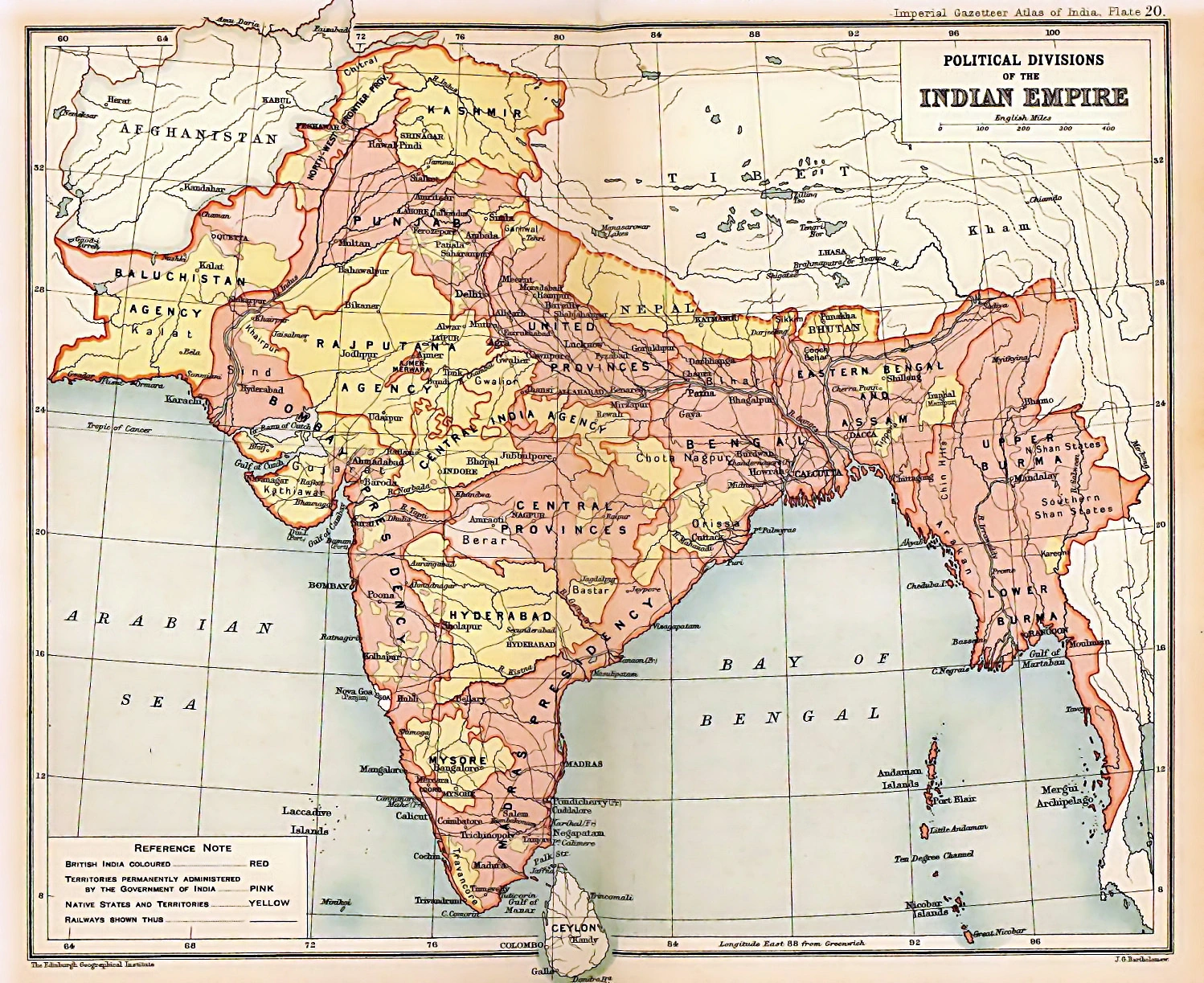
Map study
British Indian Empire in 1909: historical provinces and princely states, not contemporary Indian state boundaries.
- Read the source date and legend before interpreting territorial extent.
- Compare core regions, neighbouring powers and geographic barriers; historical borders and influence are approximate and changed over time.
Credit: Edinburgh Geographical Institute; J. G. Bartholomew and Sons · Public domain · sourceConverted to WebP on an opaque white background; proportionally resized without cropping. Original cartography and legend retained.
1. The framework of British expansion
The East India Company's transformation from a trading corporation into a territorial power was neither uniform nor governed by a single annexation policy. Military victories, revenue claims, treaty obligations and interventions in succession progressively enlarged its authority. The grant of the Diwani of Bengal, Bihar and Orissa in 1765 established revenue-collection rights; it should not be confused with an ordinary annexation that immediately abolished every existing institution.
British expansion operated through both direct and indirect rule. Under direct rule, Company officials administered acquired territories and collected revenue. Under indirect rule, an Indian ruler remained formally in place but lost substantial freedom over diplomacy, defence or succession. Consequently, the presence of a British Resident or a subsidiary force did not necessarily mean that a state had already been annexed.
Treaties frequently followed military defeat or were negotiated under severe pressure. They could require territorial cessions, payment of subsidies or acceptance of British supervision. The emerging claim of British paramountcy placed the Company above Indian states in practical political relations. However, the precise rights asserted varied across treaties and periods; paramountcy was not a single, consistently defined constitutional code.
- Conquest: territory acquired following war.
- Cession: territory surrendered through a treaty or agreement.
- Lapse: refusal to recognise succession to rulership in specified circumstances.
- Misgovernment: alleged administrative failure used to justify intervention or annexation.
Timeline
1798
Hyderabad entered a major subsidiary arrangement under Wellesley.
1801–1802
Awadh ceded territories in 1801; the Peshwa signed the Treaty of Bassein in 1802.
1843
Sind was annexed following British military victories.
1848–1849
Satara was annexed through lapse in 1848; Punjab through conquest and Sambalpur through lapse in 1849.
1854
Jhansi and Nagpur were annexed under the Doctrine of Lapse.
1856
Awadh was annexed on grounds of alleged misgovernment.
1858
The Crown's proclamation signalled a policy of preserving subordinate princely dynasties.
2. Subsidiary Alliance: dependence before annexation
Lord Wellesley's Subsidiary Alliance sought to establish British strategic supremacy while excluding rival European influence, particularly French influence, from Indian courts. Earlier arrangements had contained similar features, but Wellesley developed the system into a major instrument of expansion. Hyderabad's agreement of 1798 is a standard landmark in its application.
A ruler accepting the system maintained a British-controlled subsidiary force within or near the state and paid for its upkeep. Payment could take the form of an annual subsidy or the cession of revenue-yielding territory. The ruler accepted restrictions on independent diplomacy and warfare and generally could not employ Europeans without British approval. A British Resident usually became an influential presence at court.
In return, the Company promised protection against external enemies and, in relevant arrangements, internal challenges. Although treaties could profess non-interference in internal administration, military dependence and the Resident's influence substantially weakened autonomy. The cost of the subsidiary force could burden state finances, while the ruler's dependence on British protection reduced accountability to local political groups.
Awadh's treaty of 1801 illustrates territorial expansion through this mechanism: Nawab Saadat Ali Khan ceded extensive territories to support the Company's military establishment. The Treaty of Bassein in 1802 brought Peshwa Baji Rao II into a subsidiary arrangement and helped precipitate the Second Anglo-Maratha War. Neither agreement should be labelled an application of the Doctrine of Lapse.
- Key distinction: a subsidiary ally could retain its dynasty and internal administration.
- Territorial cession could accompany an alliance without producing immediate annexation of the entire state.
Typical logic of a lapse annexation
- 1. A ruler died without a recognised natural successor.
- 2. The Company asserted authority over succession in the dependent state.
- 3. An adopted heir's political claim was rejected or succession was otherwise denied.
- 4. The state was declared to have lapsed to the paramount power.
- 5. Company administration replaced dynastic government.
3. Doctrine of Lapse: succession as an expansionist instrument
The Doctrine of Lapse rested on the Company's claim that sovereignty over certain dependent states could revert to the paramount power when a ruler died without a recognised natural heir. Dalhousie used this claim aggressively to incorporate territories. His reasoning distinguished between states regarded as independent and those considered dependent or created by British authority, although these classifications themselves could be contested.
Adoption was a recognised institution in Hindu law and dynastic practice. The crucial British intervention was not a blanket prohibition on adopting a son. Rather, the Company asserted that an adopted son's right to inherit private property did not automatically confer a right to succeed to political rulership. Recognition of succession was thus made dependent on British sanction.
Major annexations associated with the doctrine included Satara in 1848, Jaitpur and Sambalpur in 1849, and Jhansi and Nagpur in 1854. In Jhansi, Raja Gangadhar Rao adopted a son before his death in 1853, but the Company refused to recognise the boy's succession to the state. Nagpur's ruler, Raghuji III, died in 1853; annexation followed in 1854.
For examination purposes, distinguish territorial annexation from the denial of titles or pensions. Nana Sahib's grievance arose from the Company's refusal to continue the pension of his adoptive father, the former Peshwa Baji Rao II, after the latter's death in 1851. This was related to British succession policy but was not the annexation of a ruling state called Nana Sahib's kingdom.
- Dalhousie was the doctrine's most prominent expansionist practitioner, not the originator of adoption disputes in Indian politics.
- Jhansi's annexation date is 1854; its ruler's death and adoption dispute began in 1853.
| Instrument | Basis | Example | Outcome |
|---|---|---|---|
| Subsidiary Alliance | Treaty-based military dependence | Hyderabad, 1798 | Ruler retained; external autonomy restricted |
| Territorial cession | Treaty surrender of territory | Awadh, 1801 | Specified territories transferred |
| Doctrine of Lapse | Non-recognition of succession to rulership | Satara, 1848 | State absorbed into Company territory |
| Misgovernment | Alleged administrative failure | Awadh, 1856 | Ruler deposed and kingdom annexed |
| Conquest | Military defeat | Punjab, 1849 | Kingdom extinguished and territory annexed |
4. Misgovernment, conquest and other routes
Awadh demonstrates why every annexation under Dalhousie cannot be attributed to lapse. Its ruling dynasty had heirs, and succession was not the stated issue. In 1856, the Company deposed Wajid Ali Shah and annexed the kingdom on grounds of alleged misgovernment. The British presented intervention as an administrative and moral obligation, although Awadh also possessed major strategic and revenue significance.
Military conquest remained another decisive route. Sind was annexed in 1843 after campaigns led by Charles Napier during Lord Ellenborough's governor-generalship. Punjab was annexed in 1849 following the Second Anglo-Sikh War, during Dalhousie's tenure. The First Anglo-Sikh War had already produced territorial losses and increased British control, but it had not immediately extinguished the Lahore kingdom.
Administrative takeover also requires careful terminology. In 1853, the Nizam assigned Berar to British administration to support the Hyderabad Contingent. This was not an application of lapse or straightforward extinction of the Nizam's sovereignty over his entire state. Prelims questions often exploit such differences between annexation, assignment, occupation and treaty-based dependence.
- Same Governor-General does not imply the same annexation mechanism.
- Identify the stated ground, immediate event and legal-political outcome separately.
5. Consequences and the post-1857 settlement
Annexations displaced rulers, court officials, soldiers, artisans and groups dependent on royal patronage. New revenue arrangements and administrative institutions could disturb established rights and local balances of power. Their effects differed across regions: annexation did not create identical grievances everywhere, nor did every affected group join resistance.
In Awadh, the deposition of the king and the initial treatment of many taluqdars intensified political and landed discontent. The region also supplied large numbers of soldiers to the Bengal Army, connecting changes at home with sepoy concerns. In Jhansi, the succession dispute became central to Rani Lakshmibai's conflict with British authority. These developments contributed to the Revolt of 1857 alongside military, economic and religious anxieties.
The revolt exposed the risks of relentless territorial absorption. Queen Victoria's Proclamation of 1 November 1858 promised respect for treaties and the rights, dignity and honour of Indian princes, while declaring no desire to extend British territorial possessions. Under Lord Canning, adoption sanads subsequently gave many rulers assurances concerning dynastic succession.
This change did not restore equal sovereignty. Princes remained subordinate to British paramountcy, and intervention or deposition remained possible. Nevertheless, preserving loyal princely states became a major pillar of imperial governance. The Doctrine of Lapse was abandoned as a systematic expansionist policy, while indirect rule became an enduring feature of British India.
- 1858 marked a change in imperial strategy, not the end of British supremacy.
- Annexation policies belong to both the history of territorial expansion and the background of the Revolt of 1857.
Real-world case studies
Jhansi: adoption versus political succession
Gangadhar Rao's adoption of Damodar Rao did not secure British recognition of the child's right to rule. Annexation in 1854 illustrates the distinction the Company imposed between private inheritance and sovereignty. The resulting grievance helped shape Rani Lakshmibai's role in the resistance of 1857–1858.
Awadh: two stages of expansion
Awadh lost extensive territory through the treaty of 1801 but retained its dynasty. In 1856, alleged misgovernment supplied the justification for complete annexation. The same state therefore illustrates both treaty-based territorial cession and a later annexation on a different ground.
Previous year questions
No source-linked PYQ is available here yet. Use the practice questions below.
Practice questions
Practice MCQ 1
Which of the following states were annexed under the Doctrine of Lapse? 1. Satara 2. Awadh 3. Jhansi 4. Punjab
- A. 1 and 3 only
- B. 1, 2 and 3 only
- C. 2 and 4 only
- D. 1, 3 and 4 only
Practice MCQ 2
Consider the following statements about the Subsidiary Alliance: 1. It necessarily abolished the allied ruler's dynasty. 2. The subsidiary force could be supported through territorial cession. 3. It restricted the ruler's independent foreign relations. Which statements are correct?
- A. 1 and 2 only
- B. 2 and 3 only
- C. 1 and 3 only
- D. 1, 2 and 3
Practice MCQ 3
Which statement best explains the succession principle used in the Doctrine of Lapse?
- A. Adoption was prohibited throughout British India.
- B. Every princely state was required to elect its ruler.
- C. An adopted son's inheritance rights did not automatically establish a British-recognised right to rule.
- D. Every ruler with a natural son was exempt from British intervention.
Mains practice · British expansion in India relied as much on political dependence and legal claims as on military conquest. Discuss with reference to annexation policies. Answer in 250 words.
- Distinguish direct annexation from indirect control.
- Explain the Subsidiary Alliance, subsidies and territorial cessions.
- Analyse lapse through Satara and Jhansi.
- Contrast Awadh's annexation with the conquest of Punjab and Sind.
- Connect dispossession with grievances contributing to 1857.
- Conclude with the post-1858 preservation of princes under paramountcy.
Further reading
- NCERT, Our Pasts–III, chapter From Trade to Territory: The Company Establishes Power.
- NCERT, Themes in Indian History, Part III, chapter Rebels and the Raj.
- Bipan Chandra, History of Modern India.
- Queen Victoria's Proclamation, 1 November 1858, text available through the British Library and historical document collections.
Preparing for UPSC Civil Services? Get classroom teaching, answer-writing evaluation and mentorship at Pragnya IAS Academy, Ashok Nagar — see why aspirants choose us for IAS coaching in Hyderabad.