
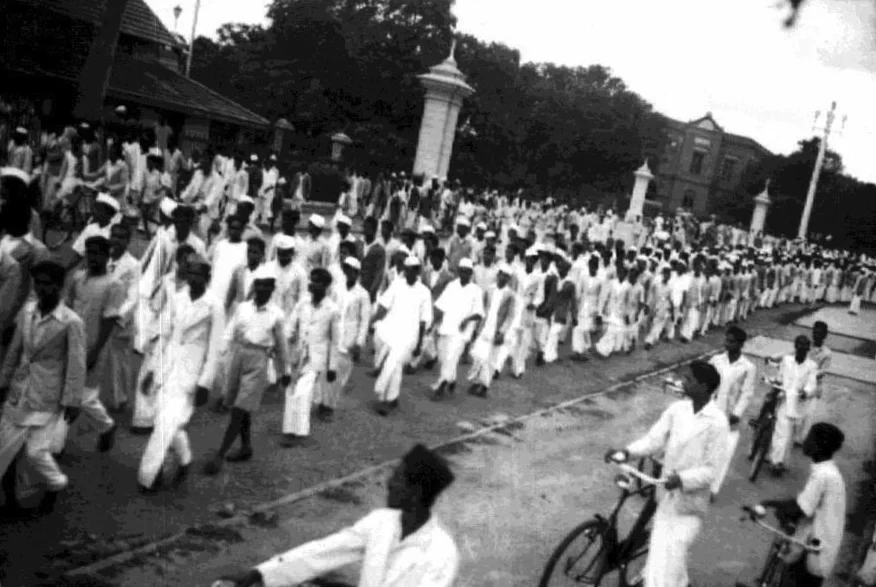
Procession in Bangalore during the Quit India Movement, as identified in the supplied metadata.
Credit: No machine-readable author provided. Dore chakravarty~commonswiki assumed (based on copyright claims). · CC BY-SA 2.5 · sourceResized and converted to WebP; uncropped.
Wartime background and immediate causes
Quit India arose from the contradiction between Britain’s declared war for freedom and its continued denial of Indian self-government. In September 1939, Viceroy Linlithgow announced India’s participation in the Second World War without consulting Indian political representatives. Congress ministries subsequently resigned. The August Offer of 1940 and the limited Individual Satyagraha launched that year did not resolve the constitutional deadlock.
Japan’s advance into Southeast Asia transformed the strategic situation. Singapore fell in February 1942, and Japanese forces occupied Burma, bringing the war close to India. British military reverses weakened the image of imperial invincibility. Wartime inflation, shortages and disruption also intensified popular hardship. The retreat from Burma and discriminatory treatment experienced by Indian evacuees added to resentment.
The immediate political trigger was the failure of the Cripps Mission in March–April 1942. Its proposals offered dominion status after the war, a constitution-making body and provision for provinces unwilling to accept the new constitution to remain outside it. Effective control over wartime defence remained British. Congress objected to the absence of immediate responsible government and the possibility of territorial fragmentation.
Gandhi argued that British withdrawal would enable Indians to organise their own defence and remove the principal obstacle to national unity. Quit India was therefore neither support for Japan nor acceptance of fascism. It sought independence amid a global war, although Congress leaders differed over the timing and risks of launching a mass struggle.
- Background cause: unilateral British involvement of India in the war.
- Immediate trigger: failure of the Cripps Mission.
- Wider setting: Japanese military advances and wartime economic distress.
Timeline
March–April 1942
Cripps Mission fails to secure agreement.
14 July 1942
Congress Working Committee adopts the Quit India proposal at Wardha.
8 August 1942
AICC endorses the resolution in Bombay; Gandhi gives the “Do or Die” call.
9 August 1942
Major Congress leaders are arrested; widespread protests follow.
December 1942
Tamralipta Jatiya Sarkar is established.
1943–1946
Satara’s Prati Sarkar sustains regional resistance.
May 1944
Gandhi is released from detention.
Resolution, leadership and the August arrests
On 14 July 1942, the Congress Working Committee at Wardha adopted a resolution demanding an end to British rule. The All India Congress Committee endorsed it on 8 August at Gowalia Tank Maidan in Bombay, now Mumbai’s August Kranti Maidan. Jawaharlal Nehru moved the AICC resolution and Vallabhbhai Patel seconded it. Maulana Abul Kalam Azad was Congress president.
The resolution authorised a mass struggle on non-violent lines under Gandhi’s leadership. It linked Indian freedom with the wider struggle against fascism and envisaged a provisional government after British withdrawal. In his address, Gandhi gave the call “Do or Die”: Indians were to achieve freedom or sacrifice themselves in the attempt, rather than continue to accept subjection.
Before an organised nationwide programme could develop, the colonial government arrested Gandhi and other leading Congress figures early on 9 August. Gandhi was detained at the Aga Khan Palace in Poona, while several Working Committee members were imprisoned at Ahmednagar Fort. Congress organisations were declared unlawful, meetings restricted and the press subjected to stringent controls.
The sudden removal of central leadership shaped the movement’s character. Local activists and ordinary participants improvised their responses rather than following a continuously directed national campaign. Aruna Asaf Ali hoisted the Congress flag at Gowalia Tank on 9 August and became an enduring symbol of defiance.
- Distinguish 8 August, the adoption and speech, from 9 August, the arrests and outbreak of widespread protests.
- The official commitment was non-violence; actual events included both peaceful protest and violent resistance.
From wartime deadlock to mass resistance
- 1. War without Indian consent and mounting economic distress
- 2. Cripps Mission fails
- 3. Wardha proposal and Bombay AICC resolution
- 4. Leadership arrested on 9 August
- 5. Mass protests and local disruption of colonial authority
- 6. Underground networks and parallel governments sustain resistance
Forms of resistance and underground organisation
The initial wave included hartals, demonstrations, student strikes and interruptions of work in some industrial centres. Police firing and arrests frequently intensified public anger. Resistance then spread into rural areas, particularly in parts of Bihar, eastern United Provinces, Bengal, Maharashtra and Odisha. Its intensity varied considerably across regions.
Crowds attacked symbols of colonial authority such as police stations, courts and revenue offices. Railway tracks, telegraph lines and other communication facilities were damaged to disrupt government functioning. These actions distinguish the movement’s actual course from an exclusively non-violent satyagraha. They should not, however, be treated as proof that Congress formally adopted armed insurrection.
Underground networks helped maintain communication after open political activity became dangerous. Congress Socialist leaders, including Jayaprakash Narayan, Ram Manohar Lohia and Achyut Patwardhan, played important roles. Jayaprakash Narayan escaped from Hazaribagh jail in November 1942 and continued clandestine activity. Activists circulated bulletins, organised secret contacts and attempted to coordinate resistance.
Usha Mehta and her associates operated the clandestine Congress Radio in Bombay from August to November 1942. Its broadcasts challenged official censorship by transmitting movement news and nationalist messages. Women participated as organisers, couriers and demonstrators, while students frequently supplied the organisational energy lost through senior leaders’ arrests.
- Matangini Hazra was killed while leading a procession at Tamluk in September 1942.
- Kanaklata Barua was killed during a flag procession at Gohpur in Assam in September 1942.
- The broad sequence was open protest, widening local resistance, and more sustained underground activity; these forms often overlapped.
| Person | Association | Location |
|---|---|---|
| Aruna Asaf Ali | Flag-hoisting on 9 August 1942 | Gowalia Tank, Bombay |
| Usha Mehta | Clandestine Congress Radio | Bombay |
| Jayaprakash Narayan | Jail escape and underground resistance | Hazaribagh and Bihar |
| Chittu Pandey | Short-lived parallel authority | Ballia |
| Nana Patil | Prati Sarkar | Satara |
Parallel governments and regional participation
In some areas, weakening colonial control enabled activists to create parallel administrations. These were local experiments rather than one nationally coordinated alternative government. Their duration and capacity differed: some briefly displaced district authority, while others developed arbitration, relief and protective arrangements over longer periods.
At Ballia in eastern United Provinces, Chittu Pandey became associated with a short-lived parallel authority in August 1942. Colonial control was rapidly restored. In the Tamluk subdivision of Midnapore district, Bengal, the Tamralipta Jatiya Sarkar emerged in December 1942 and continued until 1944. It organised relief, arbitration and volunteer activities in an area affected by cyclone devastation and wartime hardship.
In Satara district of Maharashtra, the Prati Sarkar developed from 1943 under leaders including Nana Patil. It remained active into 1946 and became associated with local justice, resistance to oppressive practices and the Toofan Sena. Its longevity demonstrates that organised resistance survived beyond the suppression of the first wave of August demonstrations.
Participation was broad but not universal. Many students, peasants, women and sections of workers joined, while industrial labour participation was uneven. The Muslim League opposed the movement. The Communist Party of India, following the Soviet Union’s entry into the Allied war in 1941, supported the anti-fascist war effort and opposed Quit India. B. R. Ambedkar also criticised the campaign. Such organisational positions must not be confused with the conduct of every individual belonging to a community.
- Ballia: Chittu Pandey; brief assertion of local authority.
- Tamluk: Tamralipta Jatiya Sarkar; Bengal; relief and administration.
- Satara: Nana Patil; Prati Sarkar; sustained rural resistance.
Repression, consequences and historical significance
The government deployed police and military forces, imposed collective fines, conducted mass arrests and used firing and severe punitive measures. Tens of thousands were imprisoned. Most open resistance was suppressed within months, although underground work and some regional organisations continued. With the leadership detained and communications disrupted, the movement could not compel an immediate British withdrawal.
Gandhi undertook a twenty-one-day fast in detention in February–March 1943. Mahadev Desai died at the Aga Khan Palace in August 1942, and Kasturba Gandhi died there in February 1944. Gandhi was released on health grounds in May 1944. These events kept the treatment of detained nationalist leaders in public attention.
Quit India demonstrated the depth of anti-colonial sentiment and the capacity for mobilisation without continuous central direction. It strengthened the conviction that British rule could not indefinitely survive against widespread Indian opposition. Yet independence in 1947 cannot be attributed to this movement alone: Britain’s post-war weakness, subsequent political negotiations, the INA issue and other post-war unrest also mattered.
For comparison, Non-Cooperation centred on boycotts and withdrawal from colonial institutions, while Civil Disobedience began with the Salt March and deliberate breach of unjust laws. Quit India demanded immediate British departure in wartime conditions and developed under a near-total leadership vacuum. Unlike the earlier movements, it produced no immediate negotiated settlement with Congress.
- Immediate outcome: repression rather than transfer of power.
- Long-term importance: a decisive assertion that complete independence could no longer be deferred.
- Exam caution: avoid describing either participation or non-violence as uniform across India.
Quit India: Regional Mobilisation and Decentralised Resistance
The supplied metadata identifies this photograph as a Congress procession in Bangalore during the Quit India Movement. It provides a regional illustration of a campaign often remembered mainly through Gandhi’s leadership and events in Bombay. The All India Congress Committee adopted the Quit India resolution in Bombay on 8 August 1942, and Gandhi issued his call to “Do or Die”. The movement followed the failure of the Cripps Mission amid wartime pressures and demanded an immediate end to British rule.
The arrest of prominent Congress leaders deprived the campaign of central direction, but did not prevent resistance. Processions, strikes, underground communication and, in some regions, attacks on communications infrastructure reflected diverse local responses. Gandhi’s commitment to non-violence should therefore be distinguished from the full range of actions undertaken during the uprising. For studying Bangalore’s participation, this photograph’s metadata offers a specific association, not proof of the procession’s exact date, participants, scale or consequences. Those questions require corroboration from contemporary newspapers, administrative records and other historical sources.
- Prelims chronology: distinguish the resolution’s adoption on 8 August from the major leadership arrests beginning on 9 August 1942.
- Regional comparison: Bangalore’s procession should not be conflated with parallel governments associated with Ballia, Tamluk and Satara; these represented different forms of resistance.
- Mains interpretation: Quit India demonstrated the depth of anti-colonial mobilisation, but neither secured immediate independence nor operated as a uniformly coordinated, exclusively non-violent campaign.
Real-world case studies
Congress Radio: resisting censorship
Usha Mehta’s clandestine broadcasting initiative operated in Bombay for a brief period in 1942, shifting locations to evade detection. Its eventual discovery illustrates both the ingenuity of underground communication and its vulnerability to colonial surveillance.
Tamralipta: protest becomes administration
The Tamralipta Jatiya Sarkar combined resistance with cyclone relief, arbitration and volunteer organisation. Associated with leaders such as Satish Chandra Samanta, it illustrates how local legitimacy could grow through public service as well as opposition to colonial rule.
Previous year questions
UPSC Prelims 2013
The Quit India Movement was launched in response to which of the following?
- A. Cabinet Mission Plan
- B. Cripps Proposals
- C. Simon Commission Report
- D. Wavell Plan
UPSC Mains 2024 · GS-I
What events led to the Quit India Movement? Point out its results.
- Explain wartime exclusion of Indian opinion, constitutional deadlock and the failure of the Cripps Mission.
- Discuss Japanese advances and economic hardship.
- Describe arrests, decentralised resistance, underground activity and parallel governments.
- Distinguish immediate suppression from long-term political significance.
Practice questions
Practice MCQ 1
Consider the following events: 1. AICC endorsement of the Quit India resolution 2. Congress Working Committee resolution at Wardha 3. Arrest of major Congress leaders 4. Failure of the Cripps Mission. What is their correct chronological order?
- A. 4–2–1–3
- B. 2–4–3–1
- C. 4–1–2–3
- D. 2–1–4–3
Practice MCQ 2
Which of the following pairs is incorrectly matched?
- A. Usha Mehta — Congress Radio
- B. Chittu Pandey — Ballia
- C. Nana Patil — Tamralipta Jatiya Sarkar
- D. Aruna Asaf Ali — Gowalia Tank flag-hoisting
Practice MCQ 3
With reference to Quit India, consider these statements: 1. Congress authorised a struggle on non-violent lines. 2. The Communist Party of India officially supported the movement. 3. Some parallel administrations continued beyond 1942. Which statements are correct?
- A. 1 and 2 only
- B. 2 and 3 only
- C. 1 and 3 only
- D. 1, 2 and 3
Mains practice · The Quit India Movement combined an organised political call with decentralised popular resistance. Discuss its character and significance. Answer in 250 words.
- Introduce the wartime context and August 1942 resolution.
- Explain how pre-emptive arrests disrupted central direction.
- Examine peaceful demonstrations, sabotage and underground networks.
- Use Ballia, Tamluk and Satara to illustrate regional variation.
- Assess uneven participation and the distinction between Congress policy and local action.
- Conclude by balancing immediate suppression against the movement’s long-term challenge to colonial legitimacy.
Further reading
- NCERT, Themes in Indian History, Part III: Mahatma Gandhi and the Nationalist Movement.
- Bipan Chandra and others, India’s Struggle for Independence: chapter on Quit India.
- Sumit Sarkar, Modern India 1885–1947.
- Gandhi Heritage Portal: Collected Works of Mahatma Gandhi, speeches and writings from August 1942.
- UPSC official website: Civil Services Examination previous question papers.
- https://commons.wikimedia.org/wiki/File:Procession_at_Bangalore_during_Quit_India_movement,_by_Indian_National_Congress.jpg
Preparing for UPSC Civil Services? Get classroom teaching, answer-writing evaluation and mentorship at Pragnya IAS Academy, Ashok Nagar — see why aspirants choose us for IAS coaching in Hyderabad.