
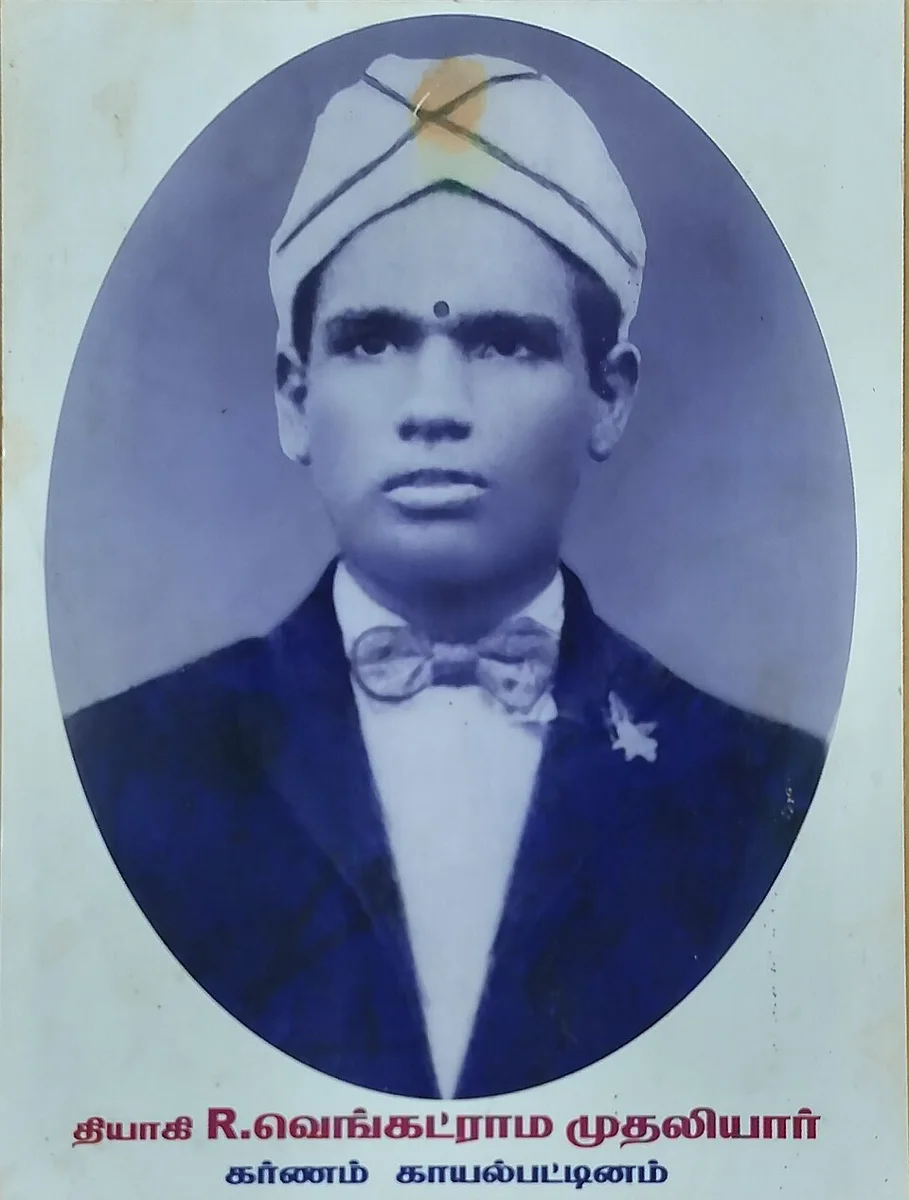
R. Venkatrama Mudaliar, identified in the supplied metadata as a participant in Individual Satyagraha in 1941.
Credit: Gowtham Rajan M R · CC BY-SA 4.0 · sourceResized and converted to WebP; uncropped.
1. Wartime background and the August Offer
The Second World War began in Europe in September 1939. Viceroy Lord Linlithgow declared India to be at war with Germany without consulting Indian elected representatives. Congress objected both to this unilateral decision and to the contradiction between Britain’s claim to defend democracy abroad and its maintenance of colonial rule in India. Congress ministries in the provinces resigned during October–November 1939, withdrawing the cooperation that had developed under provincial autonomy established by the Government of India Act, 1935.
Congress was not ideologically sympathetic to fascism. Jawaharlal Nehru, in particular, had strongly opposed fascist aggression. The central dispute concerned who could commit India to war and whether Britain would recognise Indian freedom. Congress sought a clear declaration of war aims applicable to India and meaningful responsibility for Indians at the centre. British unwillingness to transfer effective power prevented an agreed wartime settlement.
On 8 August 1940, Linlithgow announced the August Offer. It promised expansion of the Viceroy’s Executive Council, a War Advisory Council and a post-war body to frame a new constitution. Dominion status remained the stated objective. However, the offer postponed substantive constitutional reconstruction until after the war and emphasised that power would not be transferred to a system rejected by important elements of Indian national life. Congress rejected it as inadequate. Individual Satyagraha emerged from this political impasse.
- Distinguish the August Offer of 1940 from the Cripps proposals of March 1942.
- The resignations of Congress provincial ministries preceded Individual Satyagraha; they were not a consequence of it.
Timeline
September 1939
India was declared a participant in the Second World War without consultation with elected Indian representatives.
October–November 1939
Congress provincial ministries resigned.
8 August 1940
Linlithgow announced the August Offer.
17 October 1940
Vinoba Bhave began Individual Satyagraha at Paunar.
21 October 1940
Vinoba Bhave was arrested.
31 October 1940
Nehru, the second selected satyagrahi, was arrested.
Late 1941
The campaign wound down; many Congress political prisoners were released in early December.
March 1942
The Cripps Mission attempted a new wartime constitutional settlement.
2. Objectives and Gandhi’s choice of individual action
Gandhi designed the campaign around a deliberately narrow immediate demand: the right of Indians to express opposition to the war and to the use of Indian resources in it without their consent. Its political message was that colonial control could not manufacture genuine Indian support for Britain’s war effort. It challenged the assumption that the absence of a mass uprising meant acceptance of British wartime policy.
At the same time, Gandhi did not want to exploit Britain’s military difficulties through an uncontrolled confrontation. He doubted whether conditions were suitable for disciplined mass civil disobedience and feared that a wider campaign might produce violence. The movement therefore balanced resistance to imperialism with restraint in the methods of resistance. It was not intended as military assistance to Germany, Italy or Japan.
The Congress leadership authorised Gandhi to guide civil disobedience in September 1940. He selected individual volunteers rather than inviting immediate participation by the entire population. Selection stressed commitment to non-violence and the capacity to follow instructions. In this arrangement, ‘individual’ described the method of initiating protest, not an absence of national organisation or collective political purpose.
The campaign also served a preparatory function. It maintained Congress activity after the provincial resignations, tested cadres under repression and preserved the moral vocabulary of satyagraha. Its scale was intentionally limited at the outset: Gandhi sought a clear assertion of civil liberty without immediately launching a struggle to bring the entire colonial administration to a halt.
- Immediate objective: freedom of anti-war expression.
- Underlying principle: a subject people could not freely consent to participation in war.
- Method: selected volunteers, public dissent, strict non-violence and willing acceptance of punishment.
How Individual Satyagraha operated
- 1. Gandhi approved a volunteer committed to non-violence.
- 2. The volunteer generally notified the local authorities.
- 3. The satyagrahi publicly expressed the authorised anti-war message.
- 4. If arrested, the satyagrahi accepted punishment without violent resistance.
- 5. If not arrested, the volunteer continued propaganda while proceeding towards Delhi.
- 6. Further approved volunteers sustained the campaign.
3. Launch, volunteers and methods
Vinoba Bhave, a Gandhian worker associated with constructive work and ashram life, became the first satyagrahi. He opened the campaign at Paunar near Wardha on 17 October 1940 and was arrested on 21 October. Gandhi’s choice highlighted personal discipline and ethical commitment rather than simply the political prominence of the protester. Vinoba subsequently became nationally known for the Bhoodan movement, launched in 1951; that later campaign should not be confused with his wartime satyagraha.
Jawaharlal Nehru was selected as the second satyagrahi. He was arrested on 31 October 1940 before he could undertake his intended satyagraha and received a four-year prison sentence. His participation demonstrated that the limited campaign included major Congress leaders, despite differences within the nationalist leadership over pacifism, international affairs and the appropriate response to the war.
The authorised anti-war message stated, in substance, that helping the British war effort with men or money was wrong and that resistance should be non-violent. Volunteers generally informed the district authorities of their intended protest, delivered the statement publicly and accepted arrest. The openness of this procedure distinguished satyagraha from clandestine sabotage: its purpose was to expose and challenge an unjust restriction through publicly assumed responsibility.
If a volunteer was not arrested, the protest could be repeated in other places while the satyagrahi moved towards Delhi. This gave rise to the association with ‘Delhi Chalo’. Participation widened beyond the first prominent volunteers to other approved Congress workers. The movement thus became a succession of individual acts of civil disobedience rather than a single demonstration.
- Paunar, not Dandi, was the starting location of this campaign.
- Vinoba Bhave was first; Nehru was second in the order of selection.
- The central protest concerned anti-war speech, not a renewed nationwide breaking of the salt law.
| Feature | Civil Disobedience, 1930 | Individual Satyagraha, 1940–1941 | Quit India, 1942 |
|---|---|---|---|
| Immediate focus | Salt law and wider colonial authority | Right to express anti-war dissent | Immediate end of British rule |
| Initial method | Dandi March followed by mass civil disobedience | Successive protests by selected volunteers | Call for a mass struggle |
| Prominent opening association | Gandhi and Dandi | Vinoba Bhave and Paunar | Bombay and the August resolution |
| Political context | Purna Swaraj declaration and rejection of nationalist demands | Second World War and failure of the August Offer | Failure of the Cripps Mission and wartime crisis |
4. Repression, expansion and winding down
Wartime emergency powers provided the colonial state with extensive means of controlling political activity. The Defence of India Act, 1939 and the rules framed under it enabled restrictions on expression, organisation and other activities regarded as prejudicial to the war effort. Arrests and imprisonment converted the campaign’s abstract demand for freedom of speech into a concrete confrontation over the state’s coercive authority.
During 1941, successive groups of selected volunteers continued the campaign and thousands faced imprisonment. However, its planned limitations prevented the kind of broad popular mobilisation seen during the Salt Satyagraha. The absence of a simultaneous mass call was part of its design, although it also restricted the pressure that Congress could exert on the government.
The campaign wound down towards the end of 1941. The government released many Congress political prisoners in early December, including Nehru. Japan’s entry into the war in December and its subsequent advance in Southeast Asia transformed the strategic setting. British concern about India’s cooperation contributed to renewed constitutional negotiations through the Cripps Mission in March 1942. After that mission failed, Congress adopted the Quit India resolution in August 1942. These later developments should not be treated as phases of Individual Satyagraha.
5. Historical significance and examination perspective
Individual Satyagraha preserved nationalist opposition during a period when Congress neither accepted colonial wartime policy nor considered an immediate mass struggle appropriate. It linked the national question to civil liberties: freedom included the right to dissent from decisions imposed by an unrepresentative government. The campaign also demonstrated Gandhi’s tactical flexibility, since satyagraha could take the form of carefully controlled individual action as well as mass mobilisation.
Its limitations were substantial. It did not secure immediate independence or a decisive transfer of power, and its restricted participation limited its direct disruptive force. Nevertheless, judging it solely by the absence of immediate constitutional concessions overlooks its intended role in sustaining organisation, discipline and political visibility. For examinations, place it between the August Offer and the Cripps Mission, distinguish it from Quit India, and connect its method with Gandhi’s concern for non-violence and freedom of expression.
- Avoid describing it as a movement supporting fascism or as a rejection of anti-fascism.
- Do not equate ‘individual’ with spontaneous, uncoordinated action.
- Separate its immediate civil-liberties demand from the wider nationalist objective of independence.
Individual Satyagraha: Selected Protest and Local Participation
The supplied metadata identifies R. Venkatrama Mudaliar as a participant in Individual Satyagraha in 1941, making this portrait relevant to the campaign’s reach beyond its best-known leaders. It also records his participation in Civil Disobedience and Quit India. These associations illustrate how an activist could participate in successive phases of the national movement, although the movements differed substantially in their immediate objectives, methods and scale.
Launched under Gandhi’s leadership in October 1940 after the August Offer failed to satisfy nationalist demands, Individual Satyagraha asserted the right to express opposition to India’s compulsory involvement in the Second World War. Its carefully selected participants publicly voiced anti-war statements and accepted arrest rather than initiating a mass confrontation. Vinoba Bhave was the first satyagrahi and Jawaharlal Nehru the second. The campaign combined opposition to colonial coercion with Gandhi’s insistence on disciplined non-violence. Mudaliar’s attributed participation provides an individual connection to this wider strategy; however, the image metadata alone cannot establish his precise protest statement, place of action, arrest circumstances or organisational responsibilities.
- Prelims distinction: Individual Satyagraha began in 1940; a participant’s involvement in 1941 does not change the campaign’s launch year.
- Mains interpretation: Its limited scale was a deliberate strategic choice, preserving principled dissent without immediately launching mass civil disobedience.
- Evidence caution: A portrait and its description support identification and attributed participation, not reconstruction of a specific protest episode.
Real-world case studies
Vinoba Bhave at Paunar
The selection of Vinoba Bhave as the first satyagrahi brought a constructive worker to the forefront of national politics. His protest on 17 October 1940 and arrest four days later embodied the campaign’s model: a public moral challenge, restrained language and acceptance of imprisonment. The episode illustrates how Gandhi used personal credibility as a political resource.
Nehru’s arrest before his intended protest
Nehru’s arrest on 31 October 1940 showed that the authorities could act before the planned act of satyagraha. His four-year sentence also illustrated the severity of wartime repression. His participation brought a prominent anti-fascist nationalist into a campaign opposing colonial control over India’s war commitments.
Previous year questions
No source-linked PYQ is available here yet. Use the practice questions below.
Practice questions
Practice MCQ 1
With reference to Individual Satyagraha, consider the following statements: 1. Vinoba Bhave was the first selected satyagrahi. 2. Its immediate objective included asserting the right to express opposition to the war. 3. It was launched after the failure of the Cripps Mission. Which of the statements given above are correct?
- A. 1 and 2 only
- B. 2 and 3 only
- C. 1 and 3 only
- D. 1, 2 and 3
Practice MCQ 2
Which one of the following best explains Gandhi’s adoption of Individual Satyagraha in 1940?
- A. He sought to provide military support to the Axis powers.
- B. He wanted disciplined resistance without immediately launching a potentially uncontrolled mass movement.
- C. Congress had accepted the August Offer as a complete transfer of power.
- D. He intended to replace non-violence with underground sabotage.
Practice MCQ 3
Arrange the following in chronological order: 1. Beginning of Individual Satyagraha 2. Resignation of Congress provincial ministries 3. Cripps Mission 4. August Offer.
- A. 2–1–4–3
- B. 4–2–1–3
- C. 2–4–1–3
- D. 1–2–3–4
Mains practice · Individual Satyagraha represented a deliberate balance between resistance and restraint. Explain its objectives, methods and significance in the wartime national movement. Answer in 150 words.
- Introduce the unilateral involvement of India in the war and the failure of the August Offer.
- Explain the immediate demand for freedom of anti-war expression.
- Discuss selected volunteers, Gandhi’s supervision, non-violence and acceptance of arrest.
- Mention Vinoba Bhave and Nehru.
- Assess the maintenance of nationalist activity alongside limited mass pressure.
- Conclude by distinguishing the campaign from the later Quit India Movement.
Further reading
- Bipan Chandra and others, India’s Struggle for Independence: chapters on the national movement during the Second World War.
- NCERT, Themes in Indian History, Part III: Mahatma Gandhi and the Nationalist Movement.
- The Collected Works of Mahatma Gandhi: writings and correspondence from 1940–1941, available through the Gandhi Heritage Portal.
- Sumit Sarkar, Modern India, 1885–1947: discussion of wartime politics and the national movement.
- https://commons.wikimedia.org/wiki/File:Freedom_Fighter_R_Venkatrama_Mudaliar.jpg
Preparing for UPSC Civil Services? Get classroom teaching, answer-writing evaluation and mentorship at Pragnya IAS Academy, Ashok Nagar — see why aspirants choose us for IAS coaching in Hyderabad.