

Royapuram Railway Station
Credit: Manuvardhan62406 · CC BY-SA 4.0 · source

Location map of the Bhor Ghat Railway in India. Index in Germand
Credit: Open Street Map Data: OpenStreetMap and contributors Rendering: Pechristener · CC BY-SA 3.0 · source
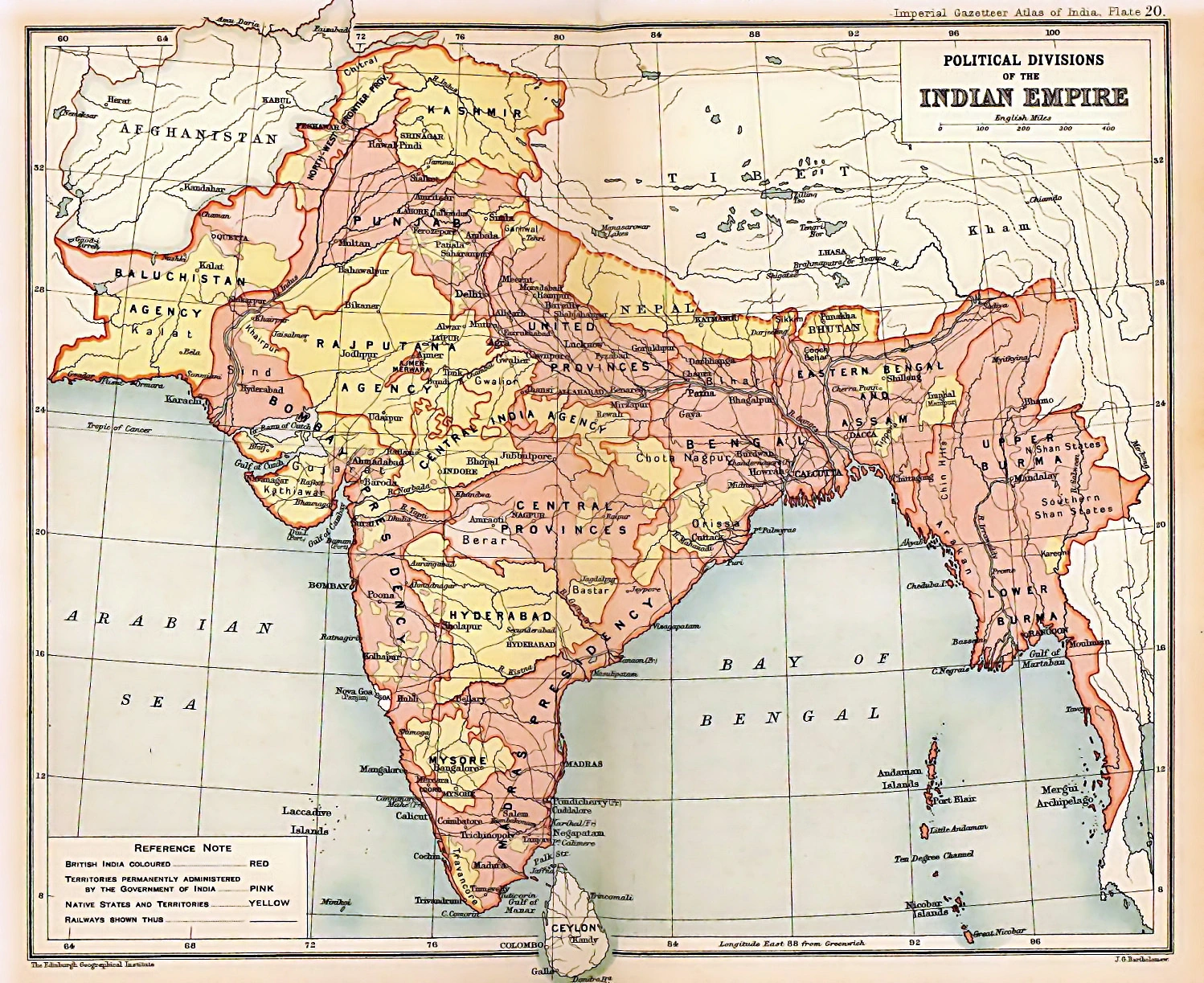
Map study
British Indian Empire in 1909: historical provinces and princely states, not contemporary Indian state boundaries.
- Read the source date and legend before interpreting territorial extent.
- Compare core regions, neighbouring powers and geographic barriers; historical borders and influence are approximate and changed over time.
Credit: Edinburgh Geographical Institute; J. G. Bartholomew and Sons · Public domain · sourceConverted to WebP on an opaque white background; proportionally resized without cropping. Original cartography and legend retained.
1. Origins and expansion
Railway development followed earlier experiments with short industrial lines, including the Red Hill Railway near Madras in the 1830s. These must be distinguished from the first passenger service, operated by the Great Indian Peninsula Railway between Bombay and Thane on 16 April 1853. The East Indian Railway opened passenger services between Howrah and Hooghly in 1854. In southern India, the Royapuram–Wallajah Road service began in 1856.
Governor-General Lord Dalhousie gave railway development an explicit policy framework through his Railway Minute of 1853. He supported trunk routes linking major ports, administrative centres and the interior. Railways accompanied the electric telegraph and improved postal services as instruments of more rapid communication and imperial consolidation. The Revolt of 1857 further demonstrated to British officials the value of moving troops quickly over long distances.
The network expanded from approximately 9,000 route-miles in 1880 to about 35,000 by 1914. Such totals generally refer to British-era India, whose boundaries differed from those of the present Republic. Expansion was uneven: commercially valuable and strategically important corridors often received priority over local transport needs. Bombay, Calcutta and Madras emerged as major railway gateways linking their hinterlands with overseas trade.
- Important early companies included the Great Indian Peninsula Railway, East Indian Railway and Madras Railway.
- Exam distinction: the first passenger train in 1853 was not the first use of railway technology anywhere in India.
Timeline
1853
Bombay–Thane passenger service begins; Dalhousie issues his Railway Minute.
1854–1856
Passenger services open between Howrah and Hooghly, and between Royapuram and Wallajah Road.
Late 1860s onward
Direct state railway construction expands alongside evolving company arrangements.
1905
Railway Board is established.
1920–1924
Acworth Committee examines railway administration; separate railway finances follow in 1924.
2. Finance, ownership and administration
Under the early guarantee system, private British companies raised capital, principally in London. The colonial government supplied land without charge and generally guaranteed a 5% annual return on approved capital. If operating earnings were insufficient, the shortfall was met from Indian revenues. Contracts also provided for government supervision, profit-sharing arrangements and eventual purchase. Private ownership therefore did not mean that investors bore the full commercial risk.
Critics argued that guaranteed returns weakened incentives to control construction costs. Expensive works, imported equipment and payments to British personnel increased the burden. Indian taxpayers underwrote risks, while investors enjoyed protected returns. Nationalist economists consequently examined railways not simply as transport infrastructure but as part of the distribution of colonial costs and benefits.
From the late 1860s, direct state construction expanded, partly because the original guarantee arrangements had proved expensive. Later decades combined state-owned lines, company management and revised guarantees. Many lines were progressively purchased by the government, although their operation sometimes remained with companies. Colonial railway administration was therefore a changing mixture of public and private arrangements, not a single unchanging model.
The Railway Board, created in 1905, strengthened central coordination. The Acworth Committee of 1920–21 recommended reforms in railway administration and finance. Separation of railway finances from general finances followed in 1924, giving the system a distinct budgetary framework. Broad, metre and narrow gauges coexisted, lowering construction costs on some routes but creating transshipment problems at breaks of gauge.
- A guaranteed return was a financial arrangement; it did not guarantee cheap fares or universal access.
- State ownership and state operation were distinct: a government-owned railway could still be company-operated.
How the early guarantee system worked
- 1. British companies raised capital.
- 2. Government provided land and guaranteed returns.
- 3. Companies constructed and operated lines under contracts.
- 4. Earnings below the guarantee required support from Indian revenues.
- 5. High costs encouraged revised contracts and greater state participation.
3. Colonial economic purposes and consequences
Railways helped connect cotton, wheat, jute, coal and other producing regions with ports and industrial centres. They carried raw materials and export crops outward and distributed imported manufactured goods inland. This supported India’s incorporation into a world economy shaped by British industrial and commercial interests. However, the system also handled substantial passenger traffic and internal trade; it was not exclusively an export conveyor.
Lower freight costs and shorter journey times widened markets, encouraged regional specialisation and reduced price differences between connected markets. Cultivators gained access to distant buyers, but greater commercialisation also exposed them to volatile international prices. Its effects depended on local credit relations, land revenue demands and bargaining power. Railway access alone did not ensure higher peasant incomes or freedom from debt.
Procurement initially favoured British rails, locomotives and machinery, limiting the domestic industrial stimulus that railway construction might otherwise have generated. Nevertheless, railway workshops, Indian coal mining and, later, domestic iron and steel production benefited from railway demand. Railways also supported industrial centres such as Bombay and the Bengal coal belt. Their contribution to Indian industry was therefore real but constrained by colonial procurement and investment patterns.
Dadabhai Naoroji and R. C. Dutt criticised the fiscal burden and unequal distribution of benefits. Interest remittances, overseas procurement and salaries or pensions paid abroad formed part of the wider debate on the drain of wealth. For analytical accuracy, not every railway payment abroad should be treated as an identical category of drain: the nationalist argument concerned the unequal structure and opportunity costs of colonial development.
- Railways facilitated the penetration of machine-made imports, but deindustrialisation had multiple causes and cannot be attributed to railways alone.
| Dimension | Colonial priority | Wider consequence |
|---|---|---|
| Trade | Connect producing regions with ports | Expansion of internal markets and commercial agriculture |
| Security | Rapid deployment of troops | Greater civilian and political mobility |
| Finance | Attract British capital through guarantees | Risk borne partly by Indian revenues |
| Industry | Demand for British railway equipment | Growth of Indian workshops, coal mining and later steel supplies |
| Environment | Secure timber and transport corridors | Forest pressure and local drainage disruption |
4. Society, famine and nationalism
Railways increased movement for employment, pilgrimage, education and trade. Railway towns, workshops and junctions generated new occupational communities. Shared travel sometimes challenged customary social boundaries, but caste practices, class distinctions and racial discrimination persisted. Most Indian passengers travelled in overcrowded third-class accommodation, contrasting sharply with the better facilities available to wealthier travellers.
Rail transport made it possible to transfer food rapidly into scarcity-hit regions. Nevertheless, major famines continued, including those of 1876–78 and 1896–97. Food availability and access were different problems: grain could circulate while impoverished people lacked purchasing power. Revenue pressures, inadequate relief and administrative choices shaped mortality. Railways could assist relief, but could not by themselves prevent famine.
The same network that strengthened colonial troop movement also helped nationalist leaders, newspapers and political ideas circulate. Congress delegates, public speakers and campaigners travelled across provincial boundaries, contributing to an all-India political sphere. Railway workers developed collective organisation; the All India Railwaymen’s Federation was established in 1924. Railways thus served imperial control while also creating connections useful to anti-colonial mobilisation.
- Avoid technological determinism: railways aided national integration but did not automatically create nationalism or eliminate social hierarchy.
5. Environmental effects and historical assessment
Construction required land, earthworks, bridges and large quantities of timber for sleepers. Railway demand intensified pressure on forests and contributed to the colonial drive to regulate timber supplies. Forest legislation and reservation also pursued wider revenue and administrative objectives, so railway expansion should be treated as one important cause rather than the sole explanation.
Railway embankments could obstruct drainage where adequate openings were absent, while coal consumption and mining produced additional environmental costs. A balanced historical assessment separates three questions: why railways were built, who financed and controlled them, and what consequences followed. Colonial commercial and military priorities shaped the system, but Indians also used it for enterprise, mobility and political organisation. Modernising effects therefore coexisted with extractive institutions.
- UPSC approach: distinguish technological progress from equitable development, and imperial intentions from unintended outcomes.
Real-world case studies
Bombay cotton hinterland during the American Civil War
The American Civil War of 1861–65 disrupted cotton supplies to British mills and increased demand for Indian cotton. Expanding railway connections helped channel western Indian cotton towards Bombay. The subsequent price reversal illustrated how improved transport could increase both commercial opportunities and exposure to global market shocks.
The famine of 1876–78
Severe famine affected parts of Madras, Bombay, Mysore and Hyderabad despite an expanding railway network. Rail transport could move grain, but destitution and inadequate relief restricted access. The episode demonstrates why transport capacity must be distinguished from effective famine protection.
Previous year questions
No source-linked PYQ is available here yet. Use the practice questions below.
Practice questions
Practice MCQ 1
Regarding the early railway guarantee system in colonial India, consider: 1. British investors generally received a guaranteed return. 2. Indian revenues could meet shortfalls in earnings. 3. All guaranteed railways were directly operated by the government. Which statements are correct?
- A. 1 and 2 only
- B. 2 and 3 only
- C. 1 and 3 only
- D. 1, 2 and 3
Practice MCQ 2
Which is the correct chronological order? 1. Establishment of the Railway Board 2. Bombay–Thane passenger service 3. Separation of railway finances 4. Howrah–Hooghly passenger service
- A. 2–4–1–3
- B. 4–2–1–3
- C. 2–1–4–3
- D. 2–4–3–1
Practice MCQ 3
Railways did not automatically prevent famines in colonial India primarily because:
- A. Railway lines could not transport grain
- B. All railway routes were reserved for military traffic
- C. Food movement did not ensure purchasing power or adequate relief
- D. Railways completely eliminated local food markets
Mains practice · Railways in colonial India were instruments of imperial control but also agents of economic and political integration. Discuss. (250 words)
- Introduce the 1853 passenger service and colonial policy context.
- Explain port-oriented trade, military mobility and guaranteed finance.
- Assess market integration, industrial demand and unequal benefits.
- Discuss passenger mobility, nationalism and railway labour.
- Use famine experience to distinguish connectivity from welfare.
- Conclude by separating colonial objectives from wider outcomes.
Further reading
- NCERT, Our Pasts–III: Ruling the Countryside; Weavers, Iron Smelters and Factory Owners.
- Bipan Chandra, History of Modern India.
- R. C. Dutt, The Economic History of India in the Victorian Age.
- Indian Railways and National Rail Museum official websites: railway history and heritage.
- Report of the Indian Railway Committee, 1920–21, chaired by William Acworth.
Preparing for UPSC Civil Services? Get classroom teaching, answer-writing evaluation and mentorship at Pragnya IAS Academy, Ashok Nagar — see why aspirants choose us for IAS coaching in Hyderabad.