

Cotton Green station of suburban railway in Mumbai, India
Credit: A.Savin · FAL · source
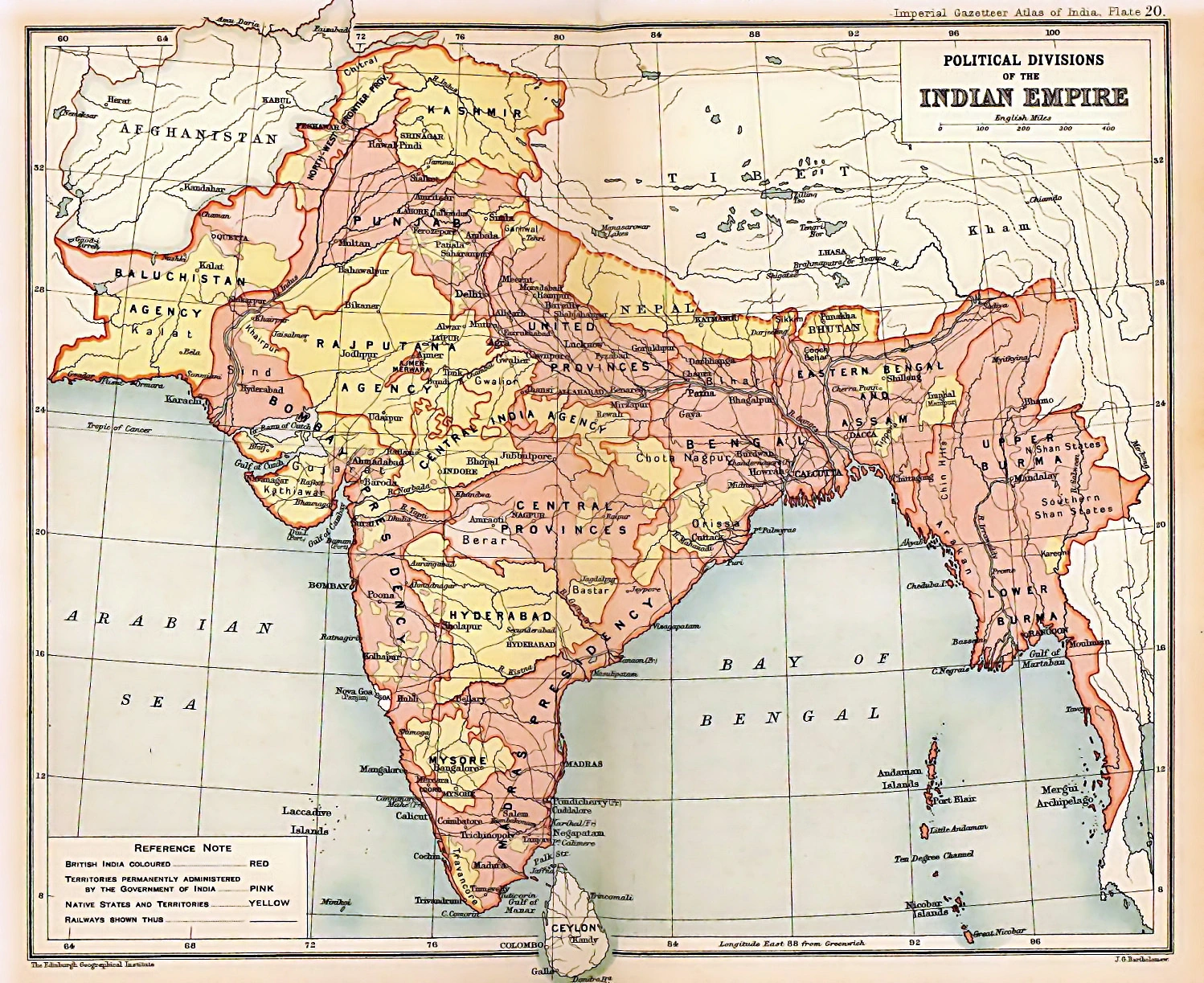
Map study
British Indian Empire in 1909: historical provinces and princely states, not contemporary Indian state boundaries.
- Read the source date and legend before interpreting territorial extent.
- Compare core regions, neighbouring powers and geographic barriers; historical borders and influence are approximate and changed over time.
Credit: Edinburgh Geographical Institute; J. G. Bartholomew and Sons · Public domain · sourceConverted to WebP on an opaque white background; proportionally resized without cropping. Original cartography and legend retained.
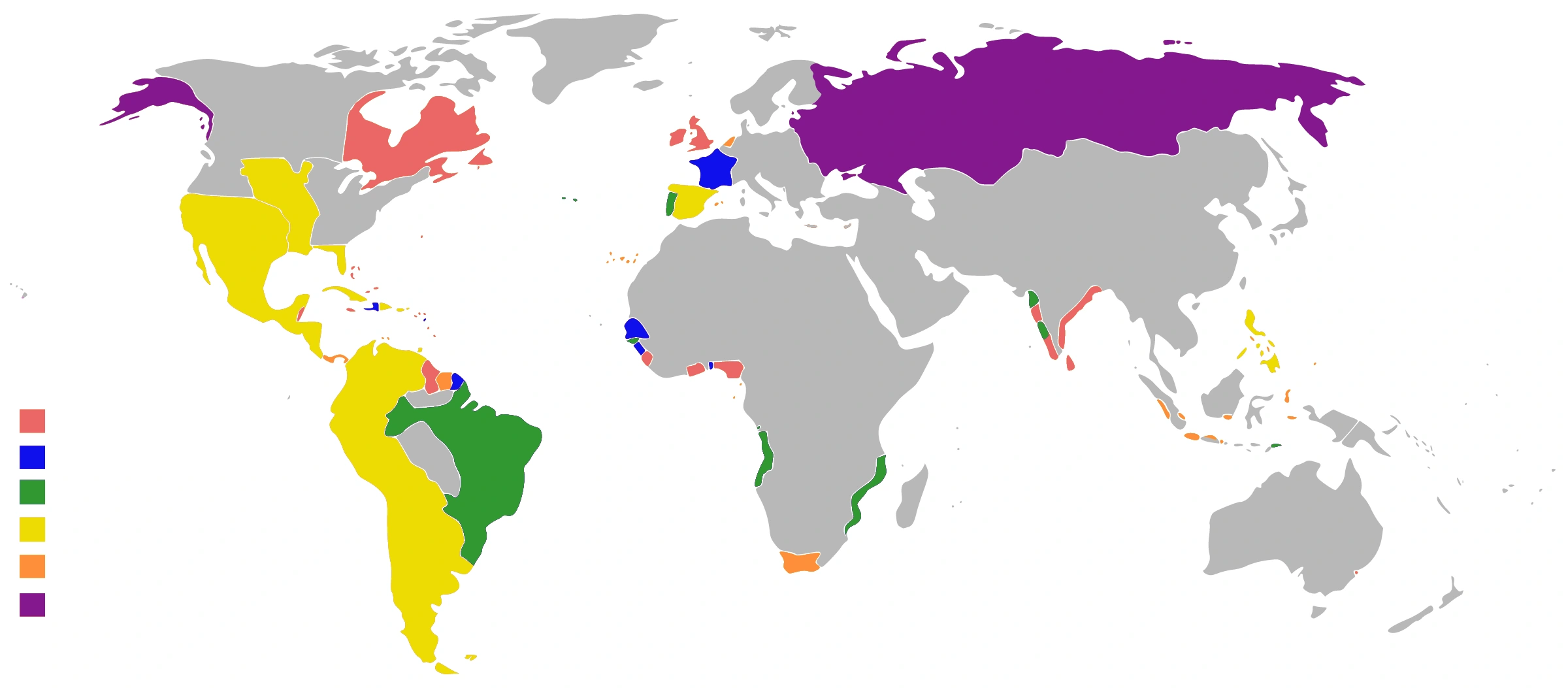
Map study
Colonial empires in 1800: global context for European expansion. A date-specific map, not the maximum territorial extent of every colonial power.
- Read the legend and reference date before interpreting regional patterns.
- Relate the map to the article’s topic; verify current administrative boundaries or data separately.
Credit: George Tsiagalakis · CC BY-SA 4.0 · sourceConverted to WebP on an opaque white background; proportionally resized without cropping. Original cartography and legend retained.
1. From commercial company to territorial power
Before British political dominance, India participated in extensive Indian Ocean and overland trading networks. Gujarat, Bengal and the Coromandel Coast supplied cotton textiles, while other exports included silk, indigo, saltpetre and spices. Indian merchants, bankers, shipowners and brokers were important intermediaries. European companies entered these existing networks rather than creating Indian overseas trade. Because European demand for Indian goods exceeded Indian demand for European merchandise, the early Company often paid for purchases with imported silver and gold.
The Company’s commercial position increasingly depended on privileges obtained from Indian rulers. Farrukhsiyar’s farman of 1717 provided important concessions, particularly in Bengal. Dastaks were passes associated with privileged trade. Company servants misused these privileges for private trading, weakening the nawab’s customs revenue and disadvantaging merchants who had to pay duties. The dispute intensified under Mir Qasim, who abolished internal duties to remove this unequal advantage.
The Battle of Plassey in 1757 and the Battle of Buxar in 1764 changed the balance of power. In 1765, Shah Alam II granted the Company Diwani rights over Bengal, Bihar and Orissa. Revenue collection and export procurement now came under the same authority. Instead of relying principally on bullion imports, the Company could use Indian tax revenues to purchase Indian goods for sale overseas. Political conquest thus altered the financing and distribution of gains from trade.
- Distinguish Company trade from the private trade of its servants; both mattered, but their legal privileges were not identical.
- Diwani meant the right to collect revenue, not merely a customs concession.
Timeline
1600
The English East India Company receives its royal charter.
1717
Farrukhsiyar’s farman confirms important Company trading privileges.
1765
The Company receives Diwani rights over Bengal, Bihar and Orissa.
1813
Company monopoly over Indian trade ends, with tea and China-trade exceptions.
1833
The Company’s remaining commercial functions end.
1869
The Suez Canal opens, shortening the maritime connection between India and Europe.
2. Monopoly, free trade and the changing commodity pattern
Colonial trade is commonly studied through three overlapping phases: mercantilist monopoly, industrial-capitalist free trade, and finance-capital expansion. These are analytical categories rather than rigid, universally applicable periods. During the earlier phase, the Company sought exclusive privileges, controlled procurement and exported Indian manufactures. Its agents, or gomastas, supervised purchases and advances to weavers. Backed by political power, this system could restrict artisans’ choice of buyers and impose unfavourable prices and delivery conditions.
British industrialisation increased manufacturers’ demand for access to Indian consumers and raw materials. The Charter Act of 1813 opened trade with India to other British traders, while retaining the Company’s tea and China-trade monopolies. The Charter Act of 1833 ended those remaining commercial functions. The Company continued as a governing agency until the transfer of rule to the British Crown in 1858. Thus, 1813 and 1833 concern commercial monopoly, whereas 1858 concerns sovereignty and administration.
Over the nineteenth century, India increasingly exported raw cotton, jute, wheat, rice, oilseeds, hides, tea and other primary products, while importing machine-made cotton textiles and manufactured goods. Opium also became a major export to China. This shift was substantial but not absolute: artisan production continued, and Indian cotton and jute mills later entered export markets. Bombay developed as a cotton-exporting and industrial centre, Calcutta as a major eastern trading and jute-processing centre, and Madras remained an important southern port.
- Free trade meant the removal of Company monopoly, not equal bargaining power or complete Indian control over commercial policy.
- Avoid describing colonial India as exporting only raw materials: manufactured exports survived and modern industries emerged.
How territorial revenue financed early colonial exports
- 1. The Company acquires territorial revenue rights.
- 2. Taxes are collected from Indian producers and landholders.
- 3. Part of these revenues finances purchases of Indian export goods.
- 4. Goods are sold in overseas markets.
- 5. Sale proceeds support Company finances and transfers abroad.
3. Tariffs, deindustrialisation and transport
The rise of British machine production reduced the cost of manufactured textiles. However, colonial competition was not conducted on neutral terms. Earlier British restrictions on Asian cotton goods, including the Calico Acts of 1700 and 1721, protected domestic producers and restricted consumption of specified textiles. Later, British manufactures gained expanding access to India under policies shaped heavily by imperial interests. Tariff arrangements changed over time; they should not be reduced to a single unchanging rate.
A revealing late nineteenth-century example was the excise imposed on Indian mill-produced cotton goods alongside import duties, following pressure from Lancashire interests. This reduced the protective effect of the import duty. Such policies, combined with technological competition, weakened many craft producers. Deindustrialisation refers to the decline of traditional industry and artisanal livelihoods, often associated with movement towards agriculture. Its timing and severity differed between regions and occupations; it did not mean the complete disappearance of handlooms.
Railways, steamships, telegraphs and the opening of the Suez Canal in 1869 lowered transport and information costs and strengthened links with overseas markets. Railway routes connected producing interiors with ports, facilitating both exports and the distribution of imported manufactures. These networks also encouraged domestic market integration and Indian enterprise. Their economic effects were therefore wider than extraction alone, although their construction and financing reflected colonial commercial and strategic priorities.
- Causes of artisanal decline included machine competition, coercive procurement in some periods, changing patronage and unequal commercial policy.
- Modern industrial growth in Bombay and Ahmedabad coexisted with distress among numerous traditional producers.
| Commodity | Important producing region | Trade significance |
|---|---|---|
| Cotton textiles | Bengal, Gujarat and Coromandel Coast | Major early exports; later faced competition from British machine-made cloth. |
| Raw cotton | Western India and the Deccan | Supplied overseas mills; exports surged during the American Civil War. |
| Jute | Bengal delta | Supported raw-fibre exports and the growth of mills around Calcutta. |
| Opium | Bihar, eastern United Provinces and Malwa | Generated revenue and linked Indian exports with the China trade. |
| Tea | Assam and Darjeeling | Plantation export associated with colonial capital and restrictive labour systems. |
4. Commercial agriculture and Asian trade circuits
Overseas demand encouraged cultivation of cotton, indigo, jute, tea, opium and other commercial crops. High cash-revenue requirements, advances from traders and dependence on moneylenders often pushed cultivators towards market production. Commercialisation could offer profits, but also exposed households to international price fluctuations, indebtedness and coercive contracts. Export production did not automatically cause famine; its consequences depended on purchasing power, food access, local cropping patterns and the state’s relief response.
Opium linked Indian production, Chinese demand and British purchases of tea. In Bengal and Bihar, the colonial government organised opium production and procurement through a tightly controlled system, selling it at auctions for export by private traders. Malwa opium operated under a different arrangement involving transit taxation. The trade helped finance Britain’s Asian commerce and generated substantial colonial revenue. Chinese resistance to illegal opium imports formed an important background to the First Opium War of 1839–1842.
The American Civil War of 1861–1865 interrupted supplies of American cotton to British mills and stimulated a boom in western Indian cotton exports. Rising prices benefited some merchants and cultivators but also encouraged speculative borrowing. The post-war reversal exposed producers to debt and falling returns. Such episodes demonstrate how colonial integration transmitted distant events into Indian agricultural incomes and credit relations.
- Commercialisation means production increasingly for sale; it is not synonymous with agricultural modernisation.
- Tea plantations in Assam and Bengal’s indigo districts illustrate the importance of labour control and unequal contracts.
5. Export surplus, the drain of wealth and nationalist criticism
India frequently recorded a merchandise export surplus under colonial rule. Nationalist economists argued that part of this surplus represented a transfer without an equivalent economic return to India. Dadabhai Naoroji developed the drain theory, while R. C. Dutt analysed the effects of revenue policy, trade and public expenditure. Their central distinction was between ordinary mutually compensated commerce and payments arising from foreign political domination.
Home Charges included expenditure payable in Britain, such as pensions, interest on certain debt, India Office expenses and purchases of stores. Private remittances and profits formed additional channels of outward transfer. Council Bills helped settle these transactions: purchasers in London paid sterling to the Secretary of State and received claims payable in rupees in India. This mechanism supported imperial remittances without requiring each payment to be physically shipped as bullion.
The merchandise surplus alone cannot measure the drain precisely. Freight, insurance, interest, capital movements and bullion flows must also be considered. Nevertheless, the nationalist argument exposed a fundamental issue: India’s external earnings were partly committed to obligations determined outside representative Indian control. Swadeshi and demands for fiscal autonomy consequently connected political self-government with domestic industrial development, protective policy and greater control over national resources.
- For Prelims, distinguish the balance of merchandise trade from the broader balance of payments.
- For analytical answers, connect trade policy with revenue extraction, production structures and political power.
Real-world case studies
Bengal Indigo Revolt, 1859–1860
Bengal cultivators resisted European planters’ efforts to enforce indigo cultivation through advances and coercive contracts. Their refusal to sow indigo received support from sections of the intelligentsia and press. The Indigo Commission of 1860 investigated abuses. The episode illustrates how export demand could operate through unequal agrarian relations rather than voluntary market exchange.
Cotton boom and rural indebtedness in western India
The American Civil War raised demand for Indian cotton, producing a boom in exports through Bombay. After the war, renewed American supplies contributed to falling prices. Together with revenue pressures and exploitative credit relations, indebtedness formed part of the background to the Deccan Riots of 1875. The episode should not be explained by the cotton-price reversal alone.
Previous year questions
No source-linked PYQ is available here yet. Use the practice questions below.
Practice questions
Practice MCQ 1
With reference to the East India Company’s commercial monopoly, consider the following statements: 1. The Charter Act of 1813 retained its monopoly over tea and trade with China. 2. The Charter Act of 1833 ended its remaining commercial activities. 3. The Charter Act of 1833 transferred the government of India to the British Crown. Which statements are correct?
- A. 1 and 2 only
- B. 2 and 3 only
- C. 1 and 3 only
- D. 1, 2 and 3
Practice MCQ 2
Why did the acquisition of Diwani rights in 1765 represent a turning point in Company trade?
- A. It eliminated all private European trade in Asia.
- B. It enabled the Company to finance export purchases using Indian revenues.
- C. It immediately ended Indian textile exports.
- D. It abolished land revenue throughout Bengal.
Practice MCQ 3
Which statement best explains why a colonial merchandise export surplus did not necessarily indicate an equivalent gain of wealth for India?
- A. Merchandise exports were excluded from international accounts.
- B. All export earnings were compulsorily invested in Indian factories.
- C. Export earnings could finance Home Charges and other payments abroad.
- D. Imports and exports always had identical monetary values.
Mains practice · Colonial trade integrated India into the world economy on unequal terms. Examine with reference to commercial policy, agricultural production and the drain of wealth. Answer in 250 words.
- Contrast early bullion-financed commerce with revenue-financed procurement after 1765.
- Explain the Charter Acts of 1813 and 1833 and the shift towards British industrial interests.
- Discuss textile competition, tariff policy and regionally uneven deindustrialisation.
- Use cotton, indigo or opium to illustrate commercialisation and external dependence.
- Explain Home Charges and distinguish merchandise surplus from national enrichment.
- Acknowledge domestic market integration and Indian industrial enterprise while assessing unequal political control.
Further reading
- NCERT, Our Pasts III: Ruling the Countryside; Weavers, Iron Smelters and Factory Owners.
- NCERT, Themes in Indian History, Part III: Colonialism and the Countryside.
- Bipan Chandra, History of Modern India.
- Dadabhai Naoroji, Poverty and Un-British Rule in India.
- R. C. Dutt, The Economic History of India.
Preparing for UPSC Civil Services? Get classroom teaching, answer-writing evaluation and mentorship at Pragnya IAS Academy, Ashok Nagar — see why aspirants choose us for IAS coaching in Hyderabad.