

Inside the Rani Laxmibai's Jhansi Fort in Jhansi, Uttar Pradesh
Credit: Pinakpani · CC BY-SA 4.0 · source

This is the ruins of a roofless Imambara (a place of religious significance in Muslim religion) inside the Residency in Lucknow, Uttar Pradesh. The Imambara is adjacent to the Begum Kothi and was buil
Credit: Dey.sandip · CC BY-SA 4.0 · source
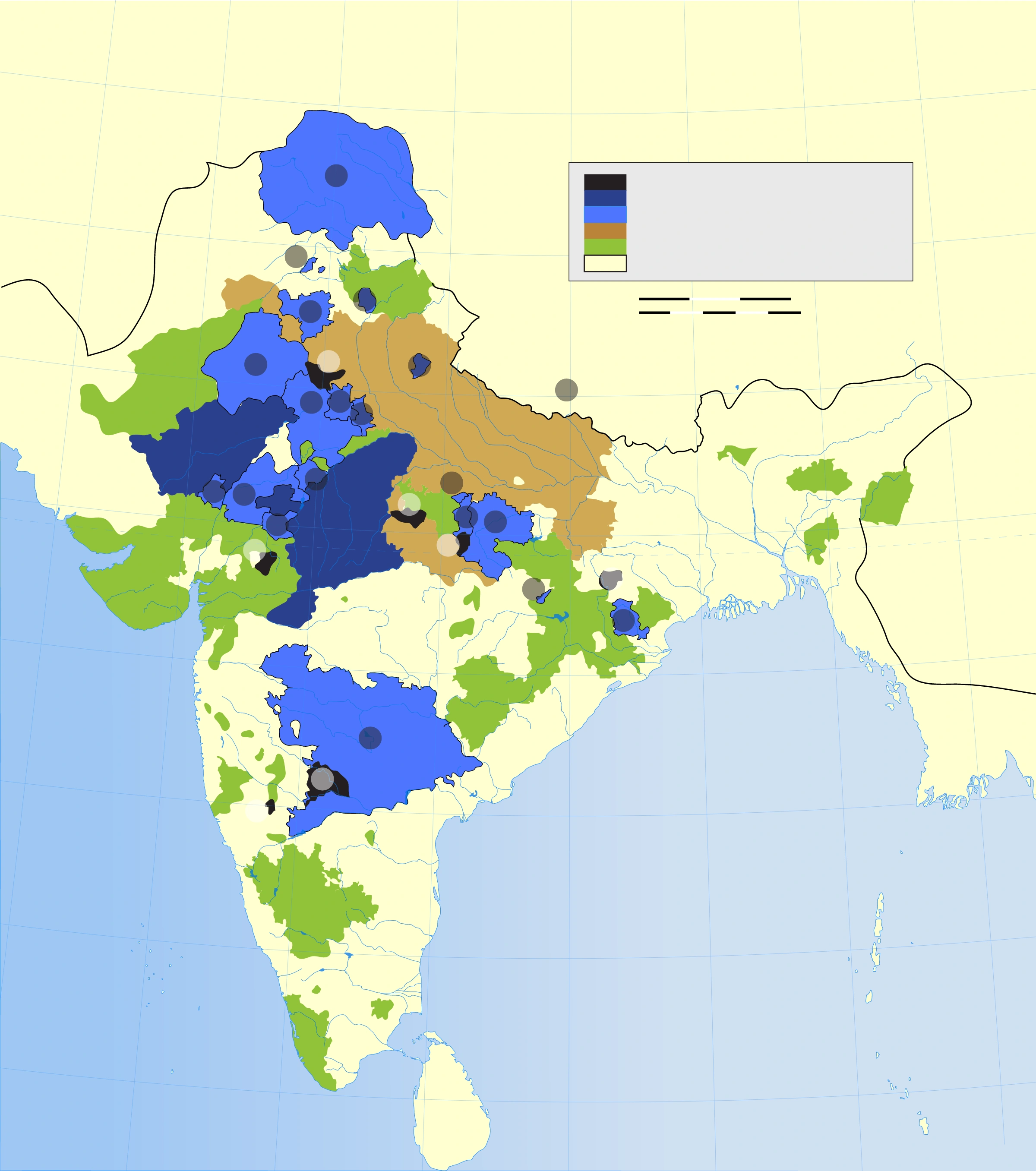
Map study
Princely state alignments during the 1857 uprising: compare regional participation through the legend. Not every battle or uprising centre is shown, and local participation was not uniform.
- Read the legend and reference date before interpreting regional patterns.
- Relate the map to the article’s topic; verify current administrative boundaries or data separately.
Credit: Planemad · CC BY-SA 3.0 · sourceConverted to WebP on an opaque white background; proportionally resized without cropping. Original cartography and legend retained.
Background and structural causes
The revolt emerged from accumulated resentment against Company expansion and the disruption of established political and social relationships. Under Lord Dalhousie, the Doctrine of Lapse enabled annexation where the British refused to recognise an adopted heir's succession to sovereignty. Satara, Jhansi and Nagpur were among the affected states. Awadh, however, was annexed in 1856 on the separate ground of alleged misgovernment, an important distinction for Prelims.
Annexation displaced ruling families, courtiers, soldiers and dependants. Nana Sahib's grievance arose from the Company's refusal to continue the pension of his adoptive father, the former Peshwa Baji Rao II. Rani Lakshmibai opposed the annexation of Jhansi and rejection of her adopted son's succession. British decisions concerning the future status of the Mughal dynasty also threatened its remaining prestige.
Economic grievances varied across regions. Heavy land-revenue demands, debt and changes in proprietary rights generated rural insecurity. In Awadh, the post-annexation revenue settlement displaced many taluqdars, weakening existing networks of authority and patronage. Artisans and service groups suffered from the decline of princely courts and changing commercial conditions, although their experiences were not identical throughout India.
- Political grievances: annexation, loss of pensions, displacement of elites and erosion of dynastic authority.
- Rural grievances: revenue pressure, dispossession and disruption of landlord-peasant relationships.
- Religious anxieties: missionary activity and fears that colonial measures were intended to undermine caste and religion.
Timeline
1856
Annexation of Awadh and passage of the General Service Enlistment Act.
29 March 1857
Mangal Pandey's action at Barrackpore.
10–11 May 1857
Uprising at Meerut followed by rebel arrival in Delhi.
September 1857
British forces recapture Delhi.
March–June 1858
British recovery of Lucknow and Jhansi; Lakshmibai dies near Gwalior.
2 August–1 November 1858
Government of India Act receives royal assent; Queen Victoria's Proclamation follows.
April 1859
Tantia Tope is captured and executed.
Military discontent and the immediate outbreak
Indian sepoys faced racial discrimination, limited promotion and disputes over pay and allowances. The Bengal Army recruited heavily from the upper Gangetic plain, including Awadh, so developments affecting rural households also influenced soldiers. The General Service Enlistment Act of 1856 required new Bengal Army recruits to accept overseas service if ordered, provoking anxiety about crossing the sea and losing caste status.
The immediate controversy concerned cartridges for the newly introduced Enfield rifle, whose ends were ordinarily bitten before loading. Reports that the grease contained cow and pig fat offended Hindu and Muslim religious sentiments respectively. British explanations failed to dispel distrust because the rumours fitted wider fears of forced religious change.
On 29 March 1857, Mangal Pandey attacked British officers at Barrackpore; he was executed on 8 April. At Meerut, 85 cavalrymen were publicly punished on 9 May for refusing cartridges. The following evening, soldiers rebelled, released imprisoned comrades and marched towards Delhi. On 11 May, the rebels secured the symbolic leadership of Bahadur Shah Zafar. Delhi thus supplied an imperial rallying point, though not an effective unified command.
- Barrackpore was an important precursor; Meerut marked the outbreak of the main uprising.
- The cartridge issue connected military grievances with fears concerning religion.
- Bahadur Shah Zafar's leadership was primarily symbolic; rebel military and political authority remained fragmented.
From accumulated grievances to imperial restructuring
- 1. Annexation, rural distress and military discrimination generate resentment
- 2. Cartridge controversy intensifies religious fears
- 3. Meerut rebellion spreads to Delhi
- 4. Regional leaders and civilian groups join unevenly
- 5. British forces suppress fragmented resistance
- 6. Crown rule and military reorganisation follow
Centres, leaders and patterns of participation
Delhi, Awadh, Kanpur, Bundelkhand, Rohilkhand and parts of Bihar formed the principal theatre of rebellion. At Delhi, Bakht Khan, arriving from Bareilly, became a prominent military leader. At Kanpur, Nana Sahib assumed leadership, assisted by figures including Tantia Tope. In Awadh, Begum Hazrat Mahal organised resistance in the name of her son Birjis Qadr; Maulvi Ahmadullah Shah was another influential leader.
Rani Lakshmibai became the leading figure at Jhansi and later fought alongside Tantia Tope. Kunwar Singh of Jagdishpur led resistance in Bihar, while Khan Bahadur Khan emerged at Bareilly. These associations are frequently useful in map-based and matching questions. Local objectives ranged from restoration of dynastic authority to recovery of land and resistance to revenue demands.
Participation extended beyond sepoys to peasants, taluqdars, artisans and townspeople in several areas, particularly Awadh. Nevertheless, support was neither uniform nor universal. Much of southern India and large parts of eastern and western India remained outside the main uprising. The Madras and Bombay armies largely remained loyal, although there were scattered disturbances. Several princes supported the British or stayed aloof; the British also drew on Sikh, Punjabi and Gurkha troops.
- Do not equate the conduct of a ruler with that of all subjects or soldiers: the Scindia ruler supported the British, while sections of his forces joined the rebellion.
- Hindu-Muslim cooperation was visible in many centres, but the revolt did not erase local divisions or competing interests.
| Centre | Leader or leaders | Recall point |
|---|---|---|
| Delhi | Bahadur Shah Zafar; Bakht Khan | Mughal legitimacy and military leadership |
| Kanpur | Nana Sahib; Tantia Tope | Peshwa pension grievance |
| Lucknow and Awadh | Begum Hazrat Mahal; Birjis Qadr | Resistance to annexation |
| Jhansi | Rani Lakshmibai | Doctrine of Lapse |
| Jagdishpur, Bihar | Kunwar Singh | Regional landed leadership |
| Bareilly | Khan Bahadur Khan | Rohilkhand centre |
Suppression, limitations and historical interpretations
British forces recaptured Delhi in September 1857. Lucknow was finally recovered in March 1858, after earlier relief operations at the Residency. Hugh Rose captured Jhansi in April; Lakshmibai died fighting near Gwalior in June 1858. Tantia Tope continued guerrilla resistance before his capture and execution in April 1859. Bahadur Shah Zafar was tried and exiled to Rangoon, where he died in 1862.
The rebels lacked a common strategy, reliable supply arrangements and coordinated leadership. Their arms and financial resources were generally inferior to those available to the British. Control of ports, overseas reinforcements, telegraph communications and cooperation from Indian allies strengthened the colonial response. Rebel aspirations could also conflict: restoring older political orders did not provide a single programme acceptable to every participating group.
Interpretations reflect the revolt's complexity. Colonial accounts commonly described it as a sepoy mutiny, understating civilian participation. V.D. Savarkar presented it as the First War of Indian Independence. R.C. Majumdar questioned its character as a national war, while S.N. Sen recognised its development beyond a purely military revolt in important regions. For examination purposes, it is best understood as a broad but uneven anti-colonial uprising with military, popular and restorative dimensions, rather than a fully organised modern national movement.
- Limited geographical spread did not mean an absence of civilian resistance.
- Brutal violence occurred during the rebellion and its suppression; punitive colonial reprisals deeply affected civilian populations.
Consequences and institutional changes
The Government of India Act, 1858 abolished Company rule and transferred government to the Crown. A Secretary of State for India, assisted by a Council of India, replaced the earlier Company-related governing machinery in Britain. The Governor-General also functioned as the Crown's representative, commonly called the Viceroy; Lord Canning was the first to hold that designation.
Queen Victoria's Proclamation, issued on 1 November 1858 and publicly announced at Allahabad, promised respect for treaties with princes, non-interference in religious belief and impartial protection under law. It disclaimed a desire for further territorial expansion and promised eligibility for public employment based on qualifications. These declarations did not eliminate racial inequality or colonial exploitation.
The army was reorganised to reduce the risk of another coordinated uprising. The European proportion increased, most artillery remained under European control, and recruitment shifted towards communities the British classified as martial races. Princes and major landlords increasingly became pillars of imperial stability. Policies of social and religious caution accompanied more deliberate management of divisions within Indian society.
- Distinguish the 1858 Act's institutional changes from the Proclamation's policy assurances.
- The Doctrine of Lapse was abandoned, while British paramountcy over princely states continued.
- The revolt's memory later became an important resource for nationalist mobilisation and commemoration.
Real-world case studies
Awadh: soldiers and rural society
Awadh illustrates why 1857 cannot be reduced to a barracks mutiny. Annexation affected the court and its dependants, while revenue changes alienated many taluqdars. Because numerous Bengal Army sepoys came from the region, military and village grievances reinforced one another. Resistance continued beyond the fall of Lucknow.
Jhansi: succession and colonial sovereignty
Jhansi was annexed under the Doctrine of Lapse in 1854 despite the adoption of an heir by its ruler before his death. Lakshmibai's subsequent resistance connected a dynastic dispute with the wider rebellion. Her campaign and death near Gwalior became enduring symbols of anti-colonial courage.
Previous year questions
UPSC Prelims 2018
Which proclamation reflected the British decision to change their policy towards Indian states: the Charter Act of 1853, Government of India Act of 1858, Queen's Proclamation of 1858, or Indian Councils Act of 1861?
- A. Charter Act of 1853
- B. Government of India Act of 1858
- C. Queen's Proclamation of 1858
- D. Indian Councils Act of 1861
Practice questions
Practice MCQ 1
Consider the following statements: 1. Awadh was annexed under the Doctrine of Lapse. 2. Jhansi was annexed after the British refused to recognise an adopted heir's succession to sovereignty. 3. Nana Sahib's grievance included the refusal to continue Baji Rao II's pension. Which statements are correct?
- A. 1 and 2 only
- B. 2 and 3 only
- C. 1 and 3 only
- D. 1, 2 and 3
Practice MCQ 2
Which one of the following pairs is incorrectly matched?
- A. Kunwar Singh — Jagdishpur
- B. Khan Bahadur Khan — Bareilly
- C. Begum Hazrat Mahal — Lucknow
- D. Bakht Khan — Jhansi
Practice MCQ 3
Which development followed the Revolt of 1857?
- A. Transfer of Indian administration to the British Crown
- B. Abolition of British paramountcy over princely states
- C. Transfer of most artillery to Indian soldiers
- D. Introduction of the Doctrine of Lapse
Mains practice · The Revolt of 1857 was more than a military mutiny but less than a unified national movement. Discuss. (250 words)
- Identify military grievances and the cartridge controversy.
- Explain political dispossession and civilian participation, especially in Awadh.
- Use regional examples such as Jhansi, Jagdishpur and Delhi.
- Assess geographical limits, divergent objectives and fragmented leadership.
- Distinguish anti-colonial resistance from modern organised nationalism.
- Conclude with its significance for Crown rule and later nationalist memory.
Further reading
- NCERT, Our Pasts III: When People Rebel, 1857 and After.
- NCERT, Themes in Indian History, Part III: Rebels and the Raj.
- Bipan Chandra and others, India's Struggle for Independence.
- S.N. Sen, Eighteen Fifty-Seven.
- National Archives of India: records and exhibitions on the Revolt of 1857.
Preparing for UPSC Civil Services? Get classroom teaching, answer-writing evaluation and mentorship at Pragnya IAS Academy, Ashok Nagar — see why aspirants choose us for IAS coaching in Hyderabad.