

This is the ruins of a roofless Imambara (a place of religious significance in Muslim religion) inside the Residency in Lucknow, Uttar Pradesh. The Imambara is adjacent to the Begum Kothi and was buil
Credit: Dey.sandip · CC BY-SA 4.0 · source
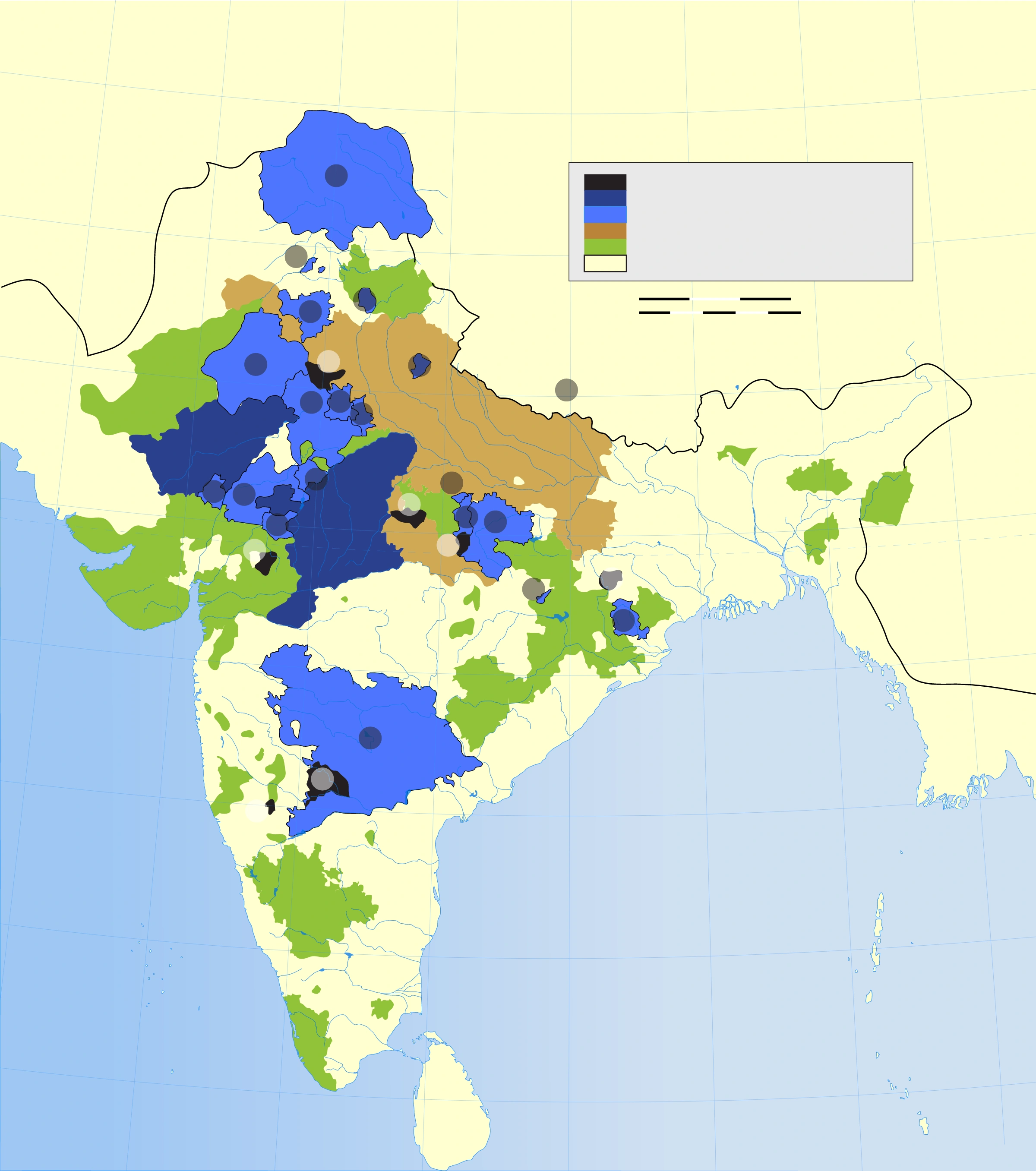
Map study
Princely state alignments during the 1857 uprising: compare regional participation through the legend. Not every battle or uprising centre is shown, and local participation was not uniform.
- Read the legend and reference date before interpreting regional patterns.
- Relate the map to the article’s topic; verify current administrative boundaries or data separately.
Credit: Planemad · CC BY-SA 3.0 · sourceConverted to WebP on an opaque white background; proportionally resized without cropping. Original cartography and legend retained.
1. Understanding the causes: a cumulative crisis
The uprising of 1857 was not simply a spontaneous reaction to one military innovation. Company expansion had progressively disturbed relationships among rulers, soldiers, landholders, cultivators and urban dependants. These changes did not affect everyone equally, but they created overlapping constituencies of resentment. A military incident could therefore mobilise grievances extending far beyond the cantonment.
For examination purposes, distinguish structural causes, accelerating developments and the immediate trigger. Colonial extraction and the erosion of indigenous authority formed the structural background. Annexations, changes in military recruitment and measures interpreted as religious interference sharpened insecurity. The Enfield cartridge controversy then converted accumulated suspicion into open defiance.
The character of participation varied geographically. In Awadh, the revolt acquired a particularly broad rural base; elsewhere, dispossessed dynasties or rebellious military units were central. Bengal and the Bombay and Madras presidencies did not witness comparable general uprisings. This unevenness cautions against treating 1857 either as a purely military mutiny or as a fully organised modern national movement.
Timeline
1848–1854
Annexations associated with the Doctrine of Lapse heightened dynastic insecurity.
1856
Annexation of Awadh and the General Service Enlistment Act intensified political and military grievances.
29 March 1857
Mangal Pandey attacked British officers at Barrackpore.
9–10 May 1857
Punishment of 85 cavalrymen was followed by the Meerut uprising.
11 May 1857
Meerut rebels reached Delhi and sought Bahadur Shah Zafar’s leadership.
2. Political causes: annexation and dispossession
The Company’s territorial expansion weakened confidence that Indian rulers could preserve their states through treaties or cooperation. Under Lord Dalhousie, the Doctrine of Lapse allowed the Company to refuse recognition of an adopted heir’s succession to sovereignty in certain dependent states. Satara in 1848, Jhansi in 1854 and Nagpur in 1854 were prominent annexations associated with this policy. It challenged dynastic interests and expectations concerning adoption and inheritance.
Awadh’s annexation in February 1856 was especially consequential. The British removed Nawab Wajid Ali Shah on the stated ground of misgovernment, despite the dynasty’s longstanding subordination and cooperation. Annexation displaced court officials, soldiers, retainers and service providers. It demonstrated that loyalty to the Company did not necessarily guarantee a ruler’s survival.
Other measures deepened elite resentment. Nana Sahib, the adopted son of the former Peshwa Baji Rao II, was denied continuation of the latter’s pension after his death in 1851. British decisions restricting the future status of the Mughal dynasty further weakened an important symbol of legitimate authority. Dispossessed leaders subsequently supplied political direction and rallying points, although there was no single common programme.
How accumulated grievances produced rebellion
- 1. Company expansion and colonial economic changes
- 2. Dispossession of rulers, landed groups and dependants
- 3. Rural grievances transmitted through sepoy households
- 4. Military discrimination and religious distrust
- 5. Cartridge controversy and punitive discipline
- 6. Meerut rebellion and assertion of Mughal authority at Delhi
3. Economic and agrarian causes
Company revenue demands, enforced collection and changes in property relations generated rural insecurity. In several regions, arrears and indebtedness exposed cultivators and landholders to dispossession. Moneylenders and purchasers of auctioned estates could become local targets because rebels associated them with the new legal and fiscal order. However, agrarian conditions differed across provinces; no single revenue system explains the entire revolt.
Awadh illustrates the connection between annexation and agrarian conflict. The post-annexation summary revenue settlement displaced many taluqdars from estates or reduced their recognised control, often by dealing directly with village-level proprietors. British expectations that this would uniformly benefit cultivators were misplaced. Revenue pressures persisted, while the removal of older intermediaries disrupted local relationships of authority, protection and dependence.
Urban society also experienced disruption. The decline of princely courts reduced patronage for artisans, musicians, scholars and other occupational groups. Imported manufactures and colonial commercial policies placed pressure on sections of handicraft production. These developments contributed to resentment, but economic hardship alone did not automatically produce rebellion.
Resumption proceedings against revenue-free grants threatened religious establishments and landed beneficiaries. Such measures linked material loss to anxiety about the survival of traditional institutions. Economic and religious grievances therefore frequently reinforced one another rather than operating as separate causes.
| Issue | Correct association | Common error |
|---|---|---|
| Awadh annexation | 1856; alleged misgovernment | Attributing it to the Doctrine of Lapse |
| Jhansi annexation | 1854; Doctrine of Lapse | Confusing it with Awadh’s annexation |
| Nana Sahib | Denial of continuation of Baji Rao II’s pension | Treating his grievance as identical to Jhansi’s |
| General Service Enlistment Act | 1856; overseas-service obligation for new recruits | Assuming retrospective application to all sepoys |
| Enfield cartridges | Immediate trigger amid religious fears | Treating them as the sole cause |
4. Religious anxieties and military grievances
Missionary activity and the increasing visibility of Western education encouraged fears that colonial rule ultimately aimed at conversion. The Caste Disabilities Removal Act, 1850 protected inheritance rights against forfeiture arising from conversion or loss of caste. Although its legal purpose was protective, critics interpreted it as encouragement to abandon inherited religion. The Hindu Widows’ Remarriage Act, 1856 similarly became part of a wider atmosphere of suspicion among conservative groups.
These reactions should not be confused with an objective assessment of social reform. Measures could address genuine injustice yet still be perceived as coercive interference when introduced by an alien power. Rumours about contamination of food or deliberate destruction of caste gained credibility because trust in Company intentions had already weakened.
Indian soldiers faced racial discrimination, restricted promotion and resentment over pay and allowances, including batta. Service conditions and deployment beyond familiar regions could threaten caste practices. The General Service Enlistment Act, 1856 required new Bengal Army recruits to accept overseas service when ordered. Existing soldiers were not universally subjected to it retrospectively, but many feared that traditional exemptions were being eroded.
Many Bengal Army sepoys came from the agrarian society of Awadh and neighbouring areas, with substantial recruitment among high-caste Brahmins and Rajputs. They maintained close connections with village households. Consequently, annexation, revenue disputes and family insecurity entered the barracks alongside specifically military complaints.
5. The cartridge controversy and the outbreak
The introduction of the Pattern 1853 Enfield rifle brought the cartridge issue to a head. Soldiers were expected to bite open paper cartridges during loading. Reports that the grease contained cow and pig fat threatened Hindu and Muslim religious sensibilities respectively. The crucial causal fact was the widespread belief that the cartridges endangered religion, rather than an assumption that every cartridge issued everywhere had identical ingredients.
Official reassurances and changes in handling arrangements could not readily overcome accumulated distrust. Earlier incidents at Berhampore and Barrackpore revealed the spreading crisis. On 29 March 1857, Mangal Pandey attacked British officers at Barrackpore; he was executed on 8 April. These events preceded, but should not be confused with, the major outbreak at Meerut.
At Meerut, 85 cavalrymen were publicly punished on 9 May for refusing the cartridges. On 10 May, soldiers rebelled, freed imprisoned comrades and moved towards Delhi. Their arrival on 11 May and invocation of Bahadur Shah Zafar’s authority transformed a cantonment revolt into a broader political challenge. Thus, the cartridges supplied the spark, while political dispossession, rural distress and military insecurity supplied the combustible conditions.
Real-world case studies
Awadh: the village–barracks connection
Annexation affected the royal court, former soldiers, taluqdars and cultivators simultaneously. Because many Bengal Army sepoys originated in this region, discontent in their home villages reinforced resentment within military units. Awadh demonstrates why the military and civilian dimensions of 1857 cannot be separated.
Jhansi: dynastic grievance
After Raja Gangadhar Rao’s death in 1853, the Company refused to recognise the adopted heir’s succession to sovereignty and annexed Jhansi in 1854. Rani Lakshmibai initially pursued her claim through petitions. Her later leadership illustrates how a specific succession dispute could become part of wider resistance.
Previous year questions
No source-linked PYQ is available here yet. Use the practice questions below.
Practice questions
Practice MCQ 1
Which state was annexed by the East India Company in 1856 on the ground of alleged misgovernment?
- A. Satara
- B. Jhansi
- C. Awadh
- D. Nagpur
Practice MCQ 2
Consider the following statements: 1. The General Service Enlistment Act, 1856 imposed an overseas-service obligation on new recruits. 2. It retrospectively imposed that obligation on every serving Bengal Army sepoy. Which is correct?
- A. 1 only
- B. 2 only
- C. Both 1 and 2
- D. Neither 1 nor 2
Practice MCQ 3
Which best explains the connection between agrarian discontent and the Bengal Army before 1857?
- A. Sepoys were recruited exclusively from dispossessed princely families.
- B. Many sepoys maintained household ties with villages in Awadh and neighbouring regions.
- C. Every sepoy owned a large revenue-free estate.
- D. The Bengal Army administered all rural revenue settlements directly.
Mains practice · The cartridge controversy was the immediate trigger, not a sufficient explanation, of the Revolt of 1857. Discuss. (150 words)
- Distinguish structural causes from the immediate trigger.
- Explain annexations, dynastic insecurity and Awadh’s special significance.
- Connect agrarian grievances with sepoy recruitment networks.
- Discuss racial discrimination, service conditions and religious anxieties.
- Conclude with regional variation and the absence of a uniform programme.
Further reading
- NCERT, Themes in Indian History, Part III: Rebels and the Raj.
- NCERT, Our Pasts III: When People Rebel, 1857 and After.
- Bipan Chandra and others, India’s Struggle for Independence.
- S. N. Sen, Eighteen Fifty-Seven, Publications Division, Government of India.
Preparing for UPSC Civil Services? Get classroom teaching, answer-writing evaluation and mentorship at Pragnya IAS Academy, Ashok Nagar — see why aspirants choose us for IAS coaching in Hyderabad.