
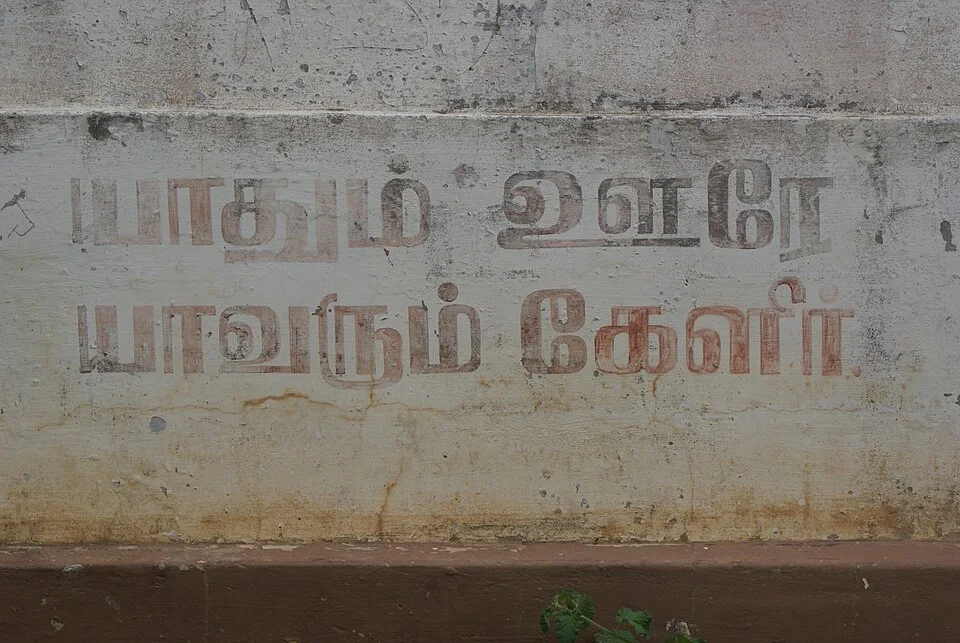
Modern memorial in Jaffna, Sri Lanka, quoting Purananuru 192; an illustration of Sangam literature’s later reception.
Credit: Jbuchholz · CC BY-SA 4.0 · sourceResized and converted to WebP; uncropped.
1. Chronology, geography and the nature of evidence
Sangam is the conventional name given to the earliest surviving body of classical Tamil poetry and the society reflected in it. For examination purposes, the Sangam age is commonly placed around the third century BCE to the third century CE. These are approximate boundaries: individual poems belong to different layers, while compilation and transmission continued later. Archaeological dates from a settlement cannot automatically establish the date of a particular poem.
Tamilakam contained contrasting ecological zones, including the Western Ghats, river valleys, coastal plains and dry interiors. This diversity supported different livelihoods and interconnected regional economies. Unlike the Gangetic plain under the Mauryas, the far south was not incorporated into a comparable centrally administered imperial structure. Ashokan inscriptions nevertheless demonstrate that southern political communities were known by the third century BCE.
Reconstruction requires several sources. Tamil poetry describes rulers, warfare, occupations and customs; Tamil-Brahmi cave inscriptions record donations, often associated with Jain ascetics. Excavations reveal settlements, industries and exchange networks. The Periplus of the Erythraean Sea, Pliny and Ptolemy offer external perspectives on ports and trade. Each source has limitations: praise poems exaggerate royal achievements, and imported objects alone do not establish foreign political control.
Timeline
Third century BCE
Ashokan inscriptions identify southern ruling communities outside directly administered Mauryan territory.
Last centuries BCE to early centuries CE
Early Tamil poetry, Tamil-Brahmi inscriptions and expanding settlements illuminate the early historic society of Tamilakam.
First century CE
The Periplus of the Erythraean Sea describes maritime commerce and ports including Muziris.
Second century CE
Ptolemy’s Geography records places and trading centres in southern India.
Subsequent centuries
Compilation, commentary and later literary traditions preserve and reinterpret the early Tamil heritage.
2. Literature and the five landscapes
Later Tamil tradition describes three literary academies, or sangams, patronised by Pandya rulers. The elaborate account of their duration and membership is not independently established history. The surviving early poetic corpus centres on Ettuttokai and Pattuppattu. Important anthologies include Akananuru, Purananuru, Kuruntokai and Natrinai. Patirruppattu principally celebrates Chera rulers, while works such as Pattinappalai and Maduraikkanchi describe urban life and royal centres.
Tolkappiyam is an early Tamil work on grammar and poetics, also valuable for understanding literary conventions and social ideas. Its dating and textual layers remain debated. Akam and puram are thematic categories rather than simple labels for fiction and history. Akam generally explores love and separation through conventional situations; puram celebrates warfare, public conduct, patronage and fame.
Tinai linked poetic situations to landscapes, seasons, occupations and deities. Kurinji represented hills and union; mullai, pastoral woodland and patient waiting; marutam, cultivated plains and domestic tensions; neital, the coast and anxious longing; and palai, aridity, separation and dangerous journeys. These were literary-ecological classifications, not administrative provinces. Tirukkural belongs to the didactic Eighteen Minor Works collection. Silappadikaram and Manimekalai are generally treated as later epics, not as members of the two principal Sangam poetic collections.
A simplified economic connection between the interior and overseas markets
- 1. Agrarian, pastoral and forest zones produce specialised goods
- 2. Craft centres process textiles, beads, metals and other products
- 3. Internal routes connect producers with markets and ports
- 4. Merchants move goods through monsoon-based maritime networks
- 5. Exchange generates imports, commercial wealth and opportunities for political patronage
3. Political organisation and warfare
The muventar dominated the political imagination of Sangam poetry, but numerous lesser chiefs, often called Velir, also exercised authority. The Cheras were associated with the western region and routes connecting the interior with the Malabar coast. The Cholas were strongly linked to the Kaveri valley, Uraiyur and Kaveripattinam, also called Puhar. The Pandyas were associated with Madurai and the pearl-fishing centre of Korkai. Identifications of some ancient centres, especially Chera Vanchi, remain debated.
Rulers gained prestige through military success, feasts and gifts to poets and followers. Political authority rested on varying combinations of control over productive land, tribute, booty and trade revenues. Courts supported bards who preserved reputations through praise and criticism. These polities should not be mechanically described using the fully developed bureaucratic institutions of the later imperial Cholas.
Raiding, cattle seizure, battles and the defence of settlements recur in the poems. Fallen warriors could be commemorated through memorial stones, known as nadukal, revealing the importance of martial honour. Karikala is a celebrated Chola ruler associated with victory at Venni and, in later tradition, works connected with the Kaveri. Senguttuvan is remembered in Chera traditions and Silappadikaram, but literary narratives should not be treated as securely dated political chronicles.
| Tinai | Landscape | Characteristic livelihoods | Akam association |
|---|---|---|---|
| Kurinji | Hills | Hunting, gathering and hill cultivation | Union |
| Mullai | Pastoral woodland | Cattle herding | Patient waiting |
| Marutam | Cultivated riverine plains | Agriculture, especially paddy cultivation | Domestic tensions or quarrels |
| Neital | Coast | Fishing, salt production and maritime activities | Anxious longing |
| Palai | Arid tracts, including seasonally parched landscapes | Travel, raiding and mobile livelihoods | Separation and perilous journeys |
4. Economy, settlements and overseas trade
Agriculture was particularly important in the riverine plains, where paddy cultivation supported larger settlements and political centres. Pastoralism, fishing, hunting and gathering remained significant elsewhere. Craft activities included ironworking, weaving, pottery production, bead-making and shell working. Salt and other regional products circulated through internal exchange. The literary contrast between landscapes therefore also reflects economic interdependence.
Ports linked Tamilakam with the Mediterranean through the Red Sea, and with Sri Lanka and other Indian Ocean regions. Important names include Muziris on the western coast, Korkai in the south and Puhar on the eastern coast. Exports included pepper, pearls, ivory, textiles and precious or semi-precious stones. Wine, metal goods and gold entered through overseas commerce. Monsoon navigation helped sustain these networks, especially during the early centuries CE.
Roman coins, amphora fragments and other imported ceramics provide material evidence of exchange, but require contextual interpretation. Coins could serve as bullion or prestige objects rather than everyday currency. Arikamedu, near Puducherry, illustrates an Indian settlement participating in overseas trade, not simply a Roman colony. Likewise, rouletted ware should not automatically be labelled Roman: much of it belongs to South Asian production and distribution networks. The term yavana broadly designated western foreigners in relevant literary contexts.
5. Society, religion and historical significance
Sangam society was differentiated by occupation, wealth, lineage and access to power. Rulers, chiefs, cultivators, pastoralists, merchants, artisans, bards and performers appear in the texts. Brahmanas and Vedic rituals were known, but the social world cannot be reduced to a uniformly applied fourfold varna model. Local hierarchies and institutions coexisted with expanding influences from other parts of the subcontinent.
Women appear as poets, lovers, workers and members of ruling households. Avvaiyar is an important name in the early poetic tradition, although later authors also bore that name. Female literary participation demonstrates a recognised cultural presence, not universal gender equality. Poems also reveal patriarchal expectations, hardship associated with widowhood and unequal social conditions. References to particular customs should not be generalised into universal practices.
Religious life included Seyon or Murugan, Mayon, Korravai, hero commemoration and local cults, alongside Vedic, Jain and Buddhist traditions. Conventional landscape associations include Murugan with kurinji, Mayon with mullai, Ventan with marutam and Varunan with neital; Korravai is associated with war and the arid landscape tradition. Early Tamilakam is historically significant for its vernacular literary culture, developing political institutions and participation in Indian Ocean commerce. Its trajectory shows regional state formation without Mauryan annexation.
Purananuru: Sangam Poetry and Its Modern Reception
The supplied metadata identifies a quotation from Purananuru 192 on a modern memorial in Jaffna, Sri Lanka. Its opening, commonly translated as “Every town is our town; everyone is our kin,” is attributed to the poet Kaniyan Pungundranar. Purananuru belongs to the Ettuttokai, the Eight Anthologies of early Tamil poetry. It is associated with puram themes, including warfare, generosity, kingship, public life and ethical reflection. The quotation therefore offers a specific entry point into Sangam literature rather than evidence about the memorial’s ancient origins.
For ancient Indian history, the poem illustrates the intellectual range of early Tamil writing: Sangam poetry cannot be reduced to royal praise or descriptions of battle. However, an ethical statement expressing universal kinship does not establish that Sangam society lacked hierarchy, conflict or exclusion. Poems must be interpreted through their genre and context, and compared with inscriptions and archaeological evidence. This Sri Lankan memorial documents modern commemoration and the continuing cultural significance of a Tamil text; it is neither an ancient inscription nor independent archaeological evidence for Sangam-age Tamilakam.
- Prelims distinction: Purananuru is part of the Ettuttokai; do not confuse it with the later Tamil epics.
- Conceptual distinction: Akam concerns interior, especially love-related experience; puram concerns public life, but includes ethical reflection.
- Evidence limit: Separate the ancient poem’s historical interpretation from its modern quotation, location and commemorative purpose.
Real-world case studies
Arikamedu: interpreting an Indo-Mediterranean trading site
Excavations at Arikamedu near Puducherry, including Mortimer Wheeler’s work in 1945 and later investigations, revealed amphorae, imported fine pottery and evidence of bead production. The assemblage demonstrates overseas connections alongside local manufacturing. Its examination value lies in separating evidence of commerce from unsupported assumptions about a Roman colony or foreign sovereignty.
Pattanam and the search for Muziris
Excavations at Pattanam in Kerala have recovered imported ceramics, beads and other evidence of Indian Ocean exchange. The site has been proposed as associated with ancient Muziris, but the identification is not conclusively settled. It illustrates how archaeology and Greco-Roman texts can be compared while keeping a proposed identification distinct from an established fact.
Previous year questions
No source-linked PYQ is available here yet. Use the practice questions below.
Practice questions
Practice MCQ 1
With reference to early Tamil literature, consider the following statements: 1. Ettuttokai comprises eight anthologies. 2. Patirruppattu principally praises Chera rulers. 3. Silappadikaram forms part of Pattuppattu. Which of the statements given above are correct?
- A. 1 and 2 only
- B. 2 and 3 only
- C. 1 and 3 only
- D. 1, 2 and 3
Practice MCQ 2
Which one of the following pairs is incorrectly matched?
- A. Kurinji — Hill landscape
- B. Mullai — Pastoral woodland
- C. Marutam — Cultivated plains
- D. Neital — Arid interior
Practice MCQ 3
With reference to the overseas commerce of early historic Tamilakam, consider the following statements: 1. Amphora fragments may indicate connections with Mediterranean trading networks. 2. Roman coin finds necessarily prove that Roman currency was used for all local transactions. 3. Monsoon navigation facilitated maritime exchange. Which of the statements given above are correct?
- A. 1 only
- B. 1 and 3 only
- C. 2 and 3 only
- D. 1, 2 and 3
Mains practice · Sangam literature reveals a society shaped by ecological diversity and long-distance exchange. Discuss, highlighting the limitations of literary evidence. Answer in 250 words.
- Introduce early historic Tamilakam and the approximate chronology of the poetic corpus.
- Explain the five tinai and their relationship to livelihoods and poetic conventions.
- Connect agricultural production, pastoralism and craft specialisation with internal exchange.
- Discuss ports, pepper and pearl exports, Mediterranean imports and monsoon navigation.
- Link wealth and warfare to the muventar, lesser chiefs and bardic patronage.
- Address literary idealisation, uncertain dates and later compilation; corroborate with inscriptions and archaeology.
Further reading
- NCERT, Our Pasts–I: chapters on early kingdoms, trade and southern India.
- Tamil Nadu State Council of Educational Research and Training, Class XI History: Early Tamil Society and Culture.
- Upinder Singh, A History of Ancient and Early Medieval India: From the Stone Age to the 12th Century.
- K. A. Nilakanta Sastri, A History of South India.
- Iravatham Mahadevan, Early Tamil Epigraphy: From the Earliest Times to the Sixth Century A.D.
- Archaeological Survey of India: Indian Archaeology—A Review and excavation publications.
- https://commons.wikimedia.org/wiki/File:Jaffna_Tamil_Conference_memorial_detail.JPG
Preparing for UPSC Civil Services? Get classroom teaching, answer-writing evaluation and mentorship at Pragnya IAS Academy, Ashok Nagar — see why aspirants choose us for IAS coaching in Hyderabad.