
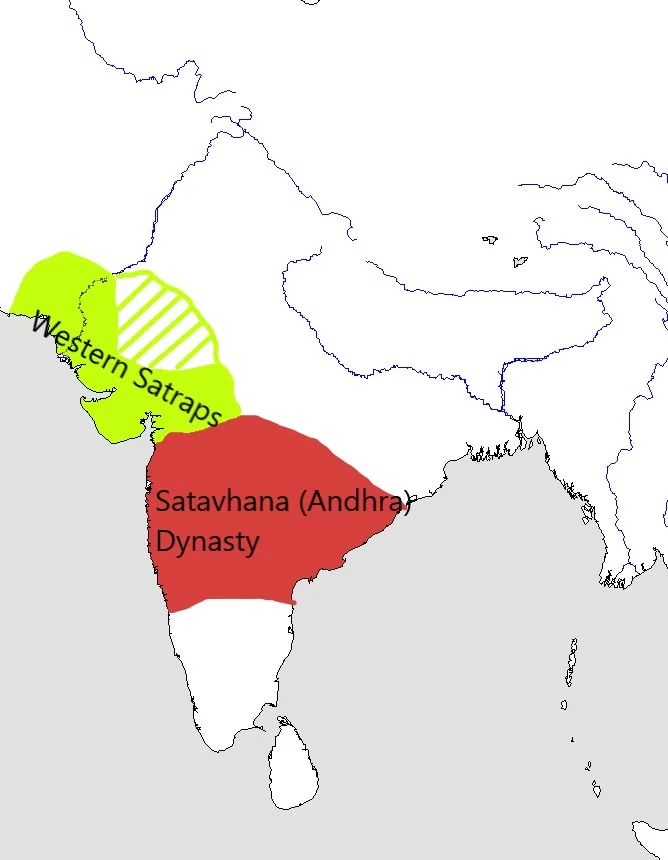
Illustrative map of Satavahana–Saka territorial rivalry; boundaries varied across phases of conflict.
Credit: Pls I dank memer · CC BY-SA 4.0 · sourceResized and converted to WebP; uncropped.
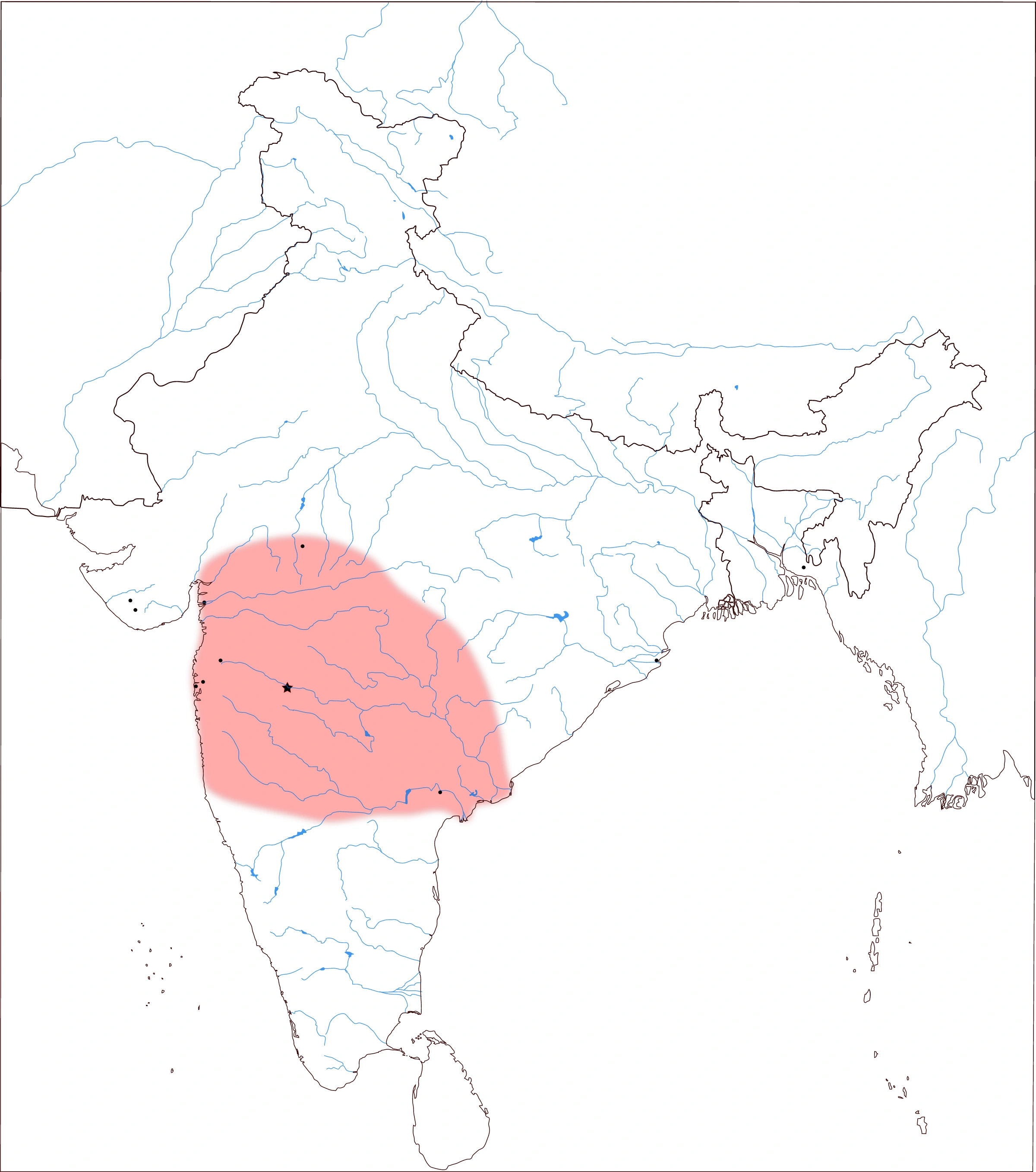
Map study
Satavahana territorial reconstruction: compare the Deccan core with northern and coastal trading connections; control changed over time.
- Read the source date and legend; distinguish territory, influence and geographic location.
- Historical boundaries and reference memberships are not live political or operational data.
Credit: Chetanv · CC BY-SA 3.0 · sourceConverted to WebP on an opaque white background; proportionally resized without cropping. Original cartography and legend retained.
1. Sources, chronology and territorial setting
The Satavahanas emerged as a major Deccan power during the political reorganisation following Mauryan decline. Their kingdom was not territorially uniform throughout its history: its reach shifted across parts of present-day Maharashtra, Telangana, Andhra Pradesh and neighbouring regions. Pratishthana, modern Paithan on the Godavari, was an important royal centre. The Godavari and Krishna river systems connected agricultural settlements, craft centres and routes leading towards both coasts.
Their early chronology is uncertain. Older reconstructions sometimes place their beginnings in the third century BCE, while securely contextualised inscriptions and coins provide a firmer basis for the later first century BCE onward. The Puranas refer to Andhra rulers, but their dynastic lists differ in names, succession and regnal totals. Consequently, neither a precise foundation date nor an exclusively western or eastern Deccan origin should be presented as settled fact.
Evidence comes chiefly from inscriptions, coins, archaeology and literary traditions. Important inscriptional sites include Naneghat, Nashik and Kanheri. Coins reveal rulers, circulation zones and changing political control. The Periplus of the Erythraean Sea, a first-century CE account of Indian Ocean commerce, helps reconstruct the trading environment. The Gatha Saptashati, traditionally associated with King Hala, illuminates Prakrit literary culture, although its surviving form contains material accumulated over time.
- Distinguish the Puranic designation Andhra from a simple identification with the boundaries of modern Andhra Pradesh.
- Royal eulogies express political claims; their lists of conquered territories require comparison with other evidence.
Timeline
Early chronology disputed
Simuka and early successors establish the dynasty; proposed foundation dates vary considerably.
Around the first century BCE
Naganika’s Naneghat inscription documents royal genealogy, sacrifices and donations.
Early second century CE
Gautamiputra Satakarni defeats Nahapana and expands Satavahana authority.
Around 150 CE
Rudradaman’s Junagadh inscription records victories over a Satakarni.
Late second century CE
Yajna Sri Satakarni emerges as an important later ruler.
Early third century CE
Satavahana authority fragments and regional successor powers emerge.
2. Rulers and the struggle with the Western Kshatrapas
Simuka is generally identified as the founder, followed in conventional reconstructions by Kanha or Krishna. An early Satakarni, usually called Satakarni I, is associated with Queen Naganika’s inscription at Naneghat. It records royal sacrifices, including Ashvamedha and Rajasuya, and substantial gifts. The inscription demonstrates how Vedic ritual helped legitimise kingship. Naneghat’s location on a pass connecting the western coast with the Deccan interior also highlights the overlap between royal power and strategic commercial routes.
Gautamiputra Satakarni, usually placed in the early second century CE, restored and expanded Satavahana power. The Nashik eulogy issued by his mother Gautami Balashri presents him as a victorious ruler who defeated Shakas, Yavanas and Pahlavas. His success against the Kshaharata ruler Nahapana is supported by Nahapana’s silver coins overstruck with Gautamiputra’s types. These provide stronger material corroboration of political change than praise inscriptions alone.
Vasisthiputra Pulumavi succeeded Gautamiputra and is associated with continued Satavahana authority, including in the eastern Deccan. Relations with the Western Kshatrapas involved both marriage and warfare. Rudradaman I’s Junagadh inscription, dated around 150 CE, states that he twice defeated a Satakarni but spared him because of their close relationship. Identifying that Satakarni precisely remains debated. Yajna Sri Satakarni was a significant later ruler; after the early third century CE, Satavahana power fragmented and regional dynasties, including the Ikshvakus in the eastern Deccan, rose.
- Do not confuse the Kshaharata ruler Nahapana with Rudradaman I of the Kardamaka line.
- Satakarni was used by several rulers; it is not the name of a single king.
Trade and religious patronage in the Deccan
- 1. Agricultural and craft production generates exchangeable goods
- 2. Inland centres connect with coastal ports through river valleys and passes
- 3. Merchants and artisans participate in regional and overseas commerce
- 4. Donors provide gifts and endowments to religious establishments
- 5. Monuments and inscriptions preserve evidence of commercial and social networks
3. Administration, social structure and royal women
Satavahana kingship combined royal authority with substantial roles for local elites. Inscriptions mention officials such as amatyas and territorial divisions called aharas. Titles including maharathi and mahabhoja point to influential regional families, some connected to the dynasty through marriage. These arrangements suggest negotiated authority rather than a uniformly centralised administrative system comparable to the idealised Mauryan model.
Agriculture formed the economic foundation, and land revenue supported the state. Donations of villages or fields to religious beneficiaries are recorded, sometimes with exemptions or restrictions on official interference. Such grants are important for studying the gradual development of privileged landed rights. However, individual grants should not be treated as proof that a fully developed feudal order existed throughout the Satavahana kingdom.
Royal names frequently incorporated matronymics: Gautamiputra means son of Gautami, while Vasisthiputra refers to maternal lineage associated with Vasishtha. These names, and the records of Naganika and Gautami Balashri, demonstrate the visibility of royal women in genealogy, patronage and political commemoration. They do not prove matrilineal succession. Royal ideology upheld Brahmanical social order, while inscriptions and material evidence reveal a diverse society of merchants, artisans, monks, donors and groups of foreign origin.
- Gautami Balashri was Gautamiputra Satakarni’s mother; Naganika was associated with an earlier Satakarni.
- Distinguish women’s public patronage from claims about the inheritance system of the entire society.
| Evidence | Main association | Historical significance |
|---|---|---|
| Naneghat inscription | Naganika and an early Satakarni | Vedic sacrifices, royal genealogy and gifts |
| Gautami Balashri’s Nashik eulogy | Gautamiputra Satakarni | Royal achievements and maternal commemoration |
| Overstruck Nahapana coins | Gautamiputra Satakarni | Material evidence of victory over Kshaharata power |
| Junagadh inscription | Rudradaman I | Western Kshatrapa victories over a related Satakarni |
| Ship-bearing coins | Yajna Sri Satakarni | Maritime associations, not proof of overseas empire |
| Gatha Saptashati | Traditionally attributed to Hala | Maharashtri Prakrit poetry and everyday social settings |
4. Agriculture, trade, towns and coinage
The Satavahana economy rested on cultivation, craft production and exchange. River valleys supported settlements, while routes across the Western Ghats linked the plateau with ports such as Kalyan and Sopara. Inland centres including Pratishthana and Tagara, commonly identified with Ter in Maharashtra, participated in textile and other commerce. Barygaza, modern Bharuch, was important to western Indian trade, but political control over ports and their hinterlands changed during Satavahana–Kshatrapa conflict.
Indian Ocean commerce connected the Deccan with the Roman world and other regions. Archaeological finds, including Roman coins and Mediterranean objects, demonstrate commercial contacts, though their distribution does not precisely map a kingdom’s boundaries. Merchant and artisan donations to Buddhist establishments show that religious institutions were embedded in commercial society. Guilds could receive endowments and provide income for religious purposes, but not every western Deccan guild inscription belongs to a Satavahana ruler.
Satavahana coinage is especially notable for extensive use of lead, alongside copper, copper-based alloys and some silver. Coins carry symbols such as elephants, lions, chaityas and the four-orbed Ujjain symbol. Most legends are Prakrit in Brahmi; some portrait silver issues also carry legends interpreted as an early southern language. Ship-bearing coins associated with Yajna Sri Satakarni are valuable evidence of maritime connections, but do not by themselves establish naval supremacy or overseas conquest.
- Overstriking means placing a new ruler’s design over an existing coin, often following a political takeover.
- Lead coinage is a strong identification clue, but the Satavahanas did not issue only lead coins.
5. Religion, architecture and literary culture
Satavahana rulers supported Brahmanical ritual while Buddhist institutions also received patronage from royal relatives, officials, merchants, artisans and women. Naganika’s sacrificial record and donations to Buddhist establishments demonstrate overlapping forms of patronage rather than an exclusive state religion. Donor inscriptions are particularly valuable because they reveal participants in cultural life beyond the royal court.
Western Deccan rock-cut architecture developed substantially in this period. Nashik, Karle and Kanheri preserve chaitya halls and viharas associated with wider networks of patronage. A chaitya hall was primarily a congregational worship space, commonly organised around a stupa; a vihara provided monastic accommodation. Attribution requires care: individual caves and donations may belong to Satavahana, Kshatrapa or later phases. Karle’s celebrated great chaitya cannot be explained solely as a Satavahana royal commission.
In the eastern Deccan, Amaravati on the Krishna became a major Buddhist centre. Its stupa underwent several phases before, during and after Satavahana rule. Limestone reliefs depict narrative episodes, worship and richly ornamented figures; later phases increasingly include anthropomorphic Buddha images. Prakrit was central to inscriptional and literary expression. Hala’s Gatha Saptashati, a collection of approximately seven hundred verses in Maharashtri Prakrit, is traditionally linked with the dynasty and deals largely with love, rural settings and everyday experience.
- Period of construction, political control and identity of the actual donor are separate questions.
- Amaravati art was not confined to a single reign or exclusively to Satavahana patronage.
Satavahanas and the Western Kshatrapas
The supplied metadata identifies this map as an illustration of the Saka–Andhra wars, making it directly relevant to Satavahana political history. Here, “Andhra” refers to the Satavahanas in historical usage, not to the boundaries of the modern state of Andhra Pradesh. Their principal Saka rivals were the Western Kshatrapas. Competition over the western Deccan and adjoining regions involved access to agricultural resources, inland routes and connections with Arabian Sea ports. A territorial map can orient this discussion, but should not be read as a snapshot of permanent or uniformly administered frontiers.
Gautamiputra Satakarni’s conflict with Nahapana is especially important. His overstrikes on Nahapana’s coins provide material evidence of political ascendancy and the reuse of existing currency. The Nashik inscription of Gautami Balashri, Gautamiputra’s mother, celebrates his achievements, but its royal praise requires critical reading. Later, Rudradaman’s Junagadh inscription claims that he defeated a Satakarni twice while sparing him because of their close relationship. Together, these sources reveal changing fortunes rather than a single decisive conquest. The metadata does not establish which chronological phase or evidentiary reconstruction the map represents.
- Prelims distinction: Western Kshatrapas were Saka rulers; do not confuse them with the Kushanas or treat all Saka groups as one political unit.
- Evidence limit: Coin overstrikes and inscriptions support reconstructions of rivalry, but do not independently establish every boundary drawn on a modern map.
- Mains linkage: Explain warfare alongside trade routes, revenue and dynastic relationships; neither commercial competition nor royal conquest claims alone provide a complete explanation.
Real-world case studies
Jogalthembi coin hoard: testing a royal victory claim
The Jogalthembi hoard near Nashik contained large numbers of Nahapana’s silver coins, many overstruck by Gautamiputra Satakarni. Read alongside the Nashik eulogy, these coins corroborate a shift in political authority. The case illustrates how numismatics can test and strengthen conclusions drawn from royal inscriptions.
Ushavadata’s Nashik endowment: guilds and monastic finance
An inscription of Ushavadata, Nahapana’s son-in-law, records money deposited with weavers’ guilds at Govardhana, with returns assigned to monastic needs. This is Kshatrapa-period evidence, not a Satavahana royal grant. It nevertheless illuminates the commercial and religious institutions of the western Deccan in the environment within which the Satavahanas operated.
Previous year questions
No source-linked PYQ is available here yet. Use the practice questions below.
Practice questions
Practice MCQ 1
With reference to the Satavahanas, consider the following statements: 1. Most of their inscriptions were composed in Prakrit using Brahmi script. 2. Matronymic royal names conclusively establish matrilineal succession. 3. Lead was extensively used in their coinage. Which of the statements given above are correct?
- A. 1 and 2 only
- B. 1 and 3 only
- C. 2 and 3 only
- D. 1, 2 and 3
Practice MCQ 2
Which one of the following provides direct numismatic support for Gautamiputra Satakarni’s victory over Nahapana?
- A. Roman gold coins found in peninsular India
- B. Ship-bearing coins of Yajna Sri Satakarni
- C. Nahapana’s coins overstruck with Gautamiputra’s types
- D. Punch-marked coins bearing no royal names
Practice MCQ 3
Consider the following pairs: 1. Naganika — Naneghat inscription 2. Hala — Gatha Saptashati 3. Gautamiputra Satakarni — Issuer of Rudradaman’s Junagadh inscription. How many of the above pairs are correctly matched?
- A. Only one
- B. Only two
- C. All three
- D. None
Mains practice · The Satavahana period illustrates the interaction of political authority, commerce and religious patronage in the Deccan. Discuss with reference to inscriptional and numismatic evidence. Answer in 250 words.
- Introduce the dynasty’s Deccan setting and the uncertainty surrounding its early chronology.
- Use Naneghat to connect royal legitimacy, Vedic sacrifice and a strategic commercial pass.
- Explain Satavahana–Kshatrapa competition through Nashik inscriptions and overstruck coins.
- Discuss inland centres, coastal connections, guilds and merchant donations without assuming stable territorial control.
- Show the coexistence of Brahmanical ritual and Buddhist patronage, including the roles of women and non-royal donors.
- Conclude by distinguishing royal claims, material corroboration and the limits of historical inference.
Further reading
- R. S. Sharma, Ancient India, old NCERT: chapters on the post-Mauryan period and the Satavahanas.
- Upinder Singh, A History of Ancient and Early Medieval India: From the Stone Age to the 12th Century.
- D. C. Sircar, Select Inscriptions Bearing on Indian History and Civilization, Volume I.
- Archaeological Survey of India: official material on Nashik, Karle, Kanheri and Amaravati.
- NCERT, Themes in Indian History, Part I: Kings, Farmers and Towns; Thinkers, Beliefs and Buildings.
- https://commons.wikimedia.org/wiki/File:Saka-satavahana_wars.jpg
Preparing for UPSC Civil Services? Get classroom teaching, answer-writing evaluation and mentorship at Pragnya IAS Academy, Ashok Nagar — see why aspirants choose us for IAS coaching in Hyderabad.