
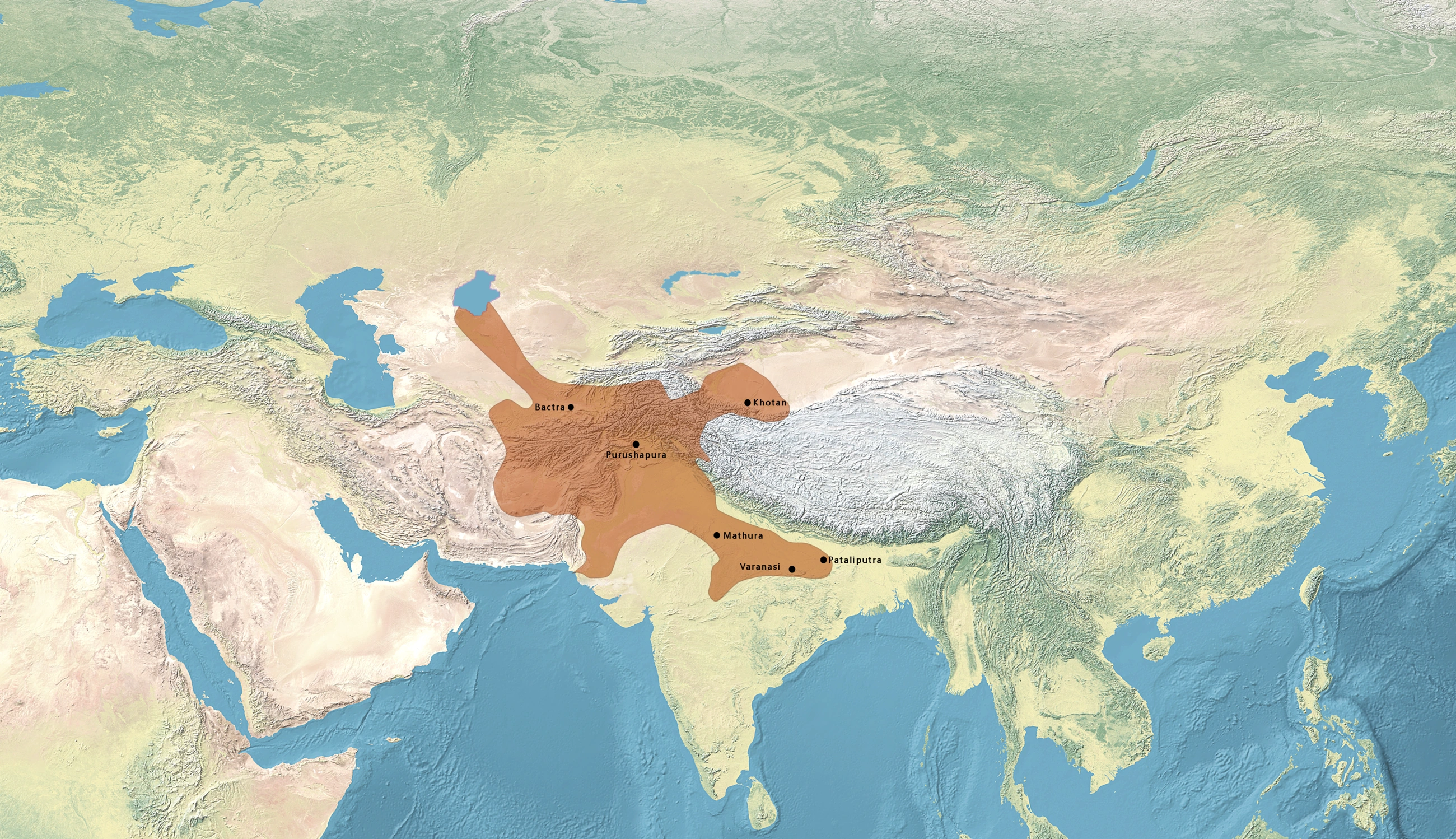
Map study
Kushan-era reconstruction: locate Central Asian–northwestern Indian routes. This is not the territorial extent of earlier Indo-Greek or Shaka kingdoms.
- Read the source date and legend; distinguish territory, influence and geographic location.
- Historical boundaries and reference memberships are not live political or operational data.
Credit: Natural Earth base map; source contributors credited on linked file page · CC BY-SA 4.0 · sourceConverted to WebP on an opaque white background; proportionally resized without cropping. Original cartography and legend retained.
1. Origins, migration and political setting
The Shakas belonged to the broader Saka or Scythian world of Central Asian mobile pastoral communities. They were not a single Indian dynasty with an uninterrupted line of succession. Different groups entered the subcontinent and founded regional ruling houses. Their movements formed part of the wider displacement of peoples across Central Asia during the second and first centuries BCE, involving the Xiongnu, Yuezhi and Saka populations.
Pressure from these movements pushed some Saka groups towards Bactria, the Iranian borderlands and eventually the northwestern subcontinent. Their arrival coincided with the weakening of Indo-Greek kingdoms and the political fragmentation that followed the Mauryan Empire. Entry occurred through multiple routes and phases rather than through one clearly dated invasion. Gandhara, the lower Indus region and adjoining territories became important centres of their activity.
Maues, known as Moga in an inscription, emerged as an important Shaka ruler in the northwest during the first century BCE. Azes was another prominent name associated with Indo-Scythian power. Coins and inscriptions help reconstruct their history, but precise reign dates and the identification of some rulers remain disputed. Shaka authority overlapped with, and was eventually displaced by, Indo-Parthian and Kushana expansion in parts of the northwest.
- Treat Shakas, Indo-Parthians and Kushanas as distinct historical groups, despite overlapping territories and cultural influences.
- The sequence Indo-Greeks–Shakas–Indo-Parthians–Kushanas is a useful broad framework, not a uniform succession across every region.
Timeline
Second–first centuries BCE
Central Asian migrations bring Saka groups towards the northwestern subcontinent.
First century BCE
Maues and other Indo-Scythian rulers establish power in the northwest.
Late first–early second centuries CE
Nahapana’s authority expands in western India before his defeat by Gautamiputra Satakarni.
150 CE
Rudradaman’s Junagadh inscription records restoration of the Sudarshana lake.
Around the beginning of the fifth century CE
Chandragupta II’s conquests terminate Western Kshatrapa rule.
2. Regional centres and the Western Kshatrapas
Shaka-linked political formations developed in the northwest, at Mathura and in western India. At Mathura, rulers such as Rajuvula and Sodasa used satrapal titles. The Mathura lion capital inscription is an important source for the ruling family and Buddhist patronage. The most durable Shaka state, however, was that of the Western Kshatrapas, whose changing territories included Gujarat, Saurashtra, Malwa and parts of northern Maharashtra.
Kshatrapa derived from an Iranian term conventionally translated as satrap. Mahakshatrapa meant great satrap. These titles suggest ranked authority, but they should not automatically be interpreted as proof of dependence on a foreign emperor. Their meaning varied with political circumstances, and Western Kshatrapa rulers often exercised substantial independent power.
The two principal ruling houses were the Kshaharatas and the Kardamakas. Nahapana was the best-known Kshaharata ruler. Inscriptions of his son-in-law Ushavadata at western Deccan sites record religious gifts and charitable works. Chashtana established the Kardamaka line, and his grandson Rudradaman I became its most celebrated ruler. Ujjayini and the Gujarat–Saurashtra region were important centres of Western Kshatrapa power.
Control over western India was contested with the Satavahanas. Gautamiputra Satakarni defeated Nahapana, and his restriking of Nahapana’s silver coins provides material evidence of this reversal. The Nashik inscription of Gautami Balashri praises Gautamiputra’s destruction of the Kshaharata line. Later Kardamaka expansion shows that this victory did not permanently eliminate Shaka power.
- Major evidence includes coins, cave-donation inscriptions, royal genealogies and the Junagadh inscription.
- Royal victory claims should be assessed alongside numismatic and archaeological evidence.
Broad pattern of Shaka state formation
- 1. Central Asian population movements
- 2. Entry into the northwestern subcontinent
- 3. Establishment of regional satrapal authorities
- 4. Competition for inland routes and western ports
- 5. Integration through marriage, patronage, language and coinage
3. Rudradaman I and the Junagadh inscription
Rudradaman I’s inscription at Junagadh, near Girnar in Gujarat, is generally dated to 150 CE, corresponding to year 72 of the Shaka era. It is among the earliest substantial royal inscriptions in polished Sanskrit prose. Earlier inscriptions had occasionally used Sanskrit, so describing it as the first Sanskrit inscription without qualification is misleading. Its importance lies in the scale and sophistication of its political and literary expression.
The inscription records the repair of the Sudarshana lake after a severe storm damaged its embankment. It traces the reservoir’s origin to Pushyagupta, a governor under Chandragupta Maurya, and mentions works associated with Tushaspha under Ashoka. Rudradaman’s restoration was supervised by Suvishakha, his governor of Anarta and Surashtra. The same locality thus preserves evidence connecting Mauryan infrastructure with later regional administration.
The text states that the repair was financed without imposing additional taxes or forced labour on the population. As a royal eulogy, this is a claim requiring critical interpretation, but it reveals the ideals through which the ruler sought legitimacy: public welfare, financial capacity and protection of productive resources. Irrigation supported agriculture and therefore the revenue base of the state.
Rudradaman also claims to have defeated a Satakarni, lord of the Deccan, twice but spared him because of close kinship. The exact identification of this Satavahana ruler is debated. The statement demonstrates that warfare and marriage alliances could coexist. His praise of Sanskrit learning and royal accomplishments also shows how a dynasty of Central Asian origin adopted established South Asian expressions of kingship.
- Junagadh is important for Sanskrit epigraphy, irrigation history, provincial administration and Shaka–Satavahana relations.
- The Girnar inscriptional complex also includes Ashokan edicts and a later inscription of Skandagupta.
| Ruler | Political association | Remember for |
|---|---|---|
| Maues | Northwestern Indo-Scythians | Early prominent Shaka ruler; also called Moga |
| Nahapana | Kshaharata house | Defeat by Gautamiputra Satakarni |
| Chashtana | Kardamaka house | Founder of the ruling line associated with Rudradaman |
| Rudradaman I | Kardamaka house | Junagadh Sanskrit inscription and Sudarshana lake repair |
| Chandragupta II | Gupta dynasty | Conquest of the Western Kshatrapa kingdom |
4. Economy, coinage and cultural integration
Western Kshatrapa territories connected inland production centres with Arabian Sea ports. Bharukachchha, identified with modern Bharuch and called Barygaza in Greco-Roman accounts, was a major commercial centre. Routes linked it with Malwa and the Deccan. The Periplus of the Erythraean Sea describes western Indian ports and trading conditions, providing a useful external perspective on commerce involving textiles, luxury goods and imported products.
Silver coinage is especially valuable for studying the Western Kshatrapas. Many issues display a ruler’s profile bust on the obverse and a conventional hill or chaitya-like symbol with celestial motifs on the reverse. Legends give royal names, titles and often patronymics; many later issues also provide dates. Such details help establish succession and chronology more securely than literary tradition alone.
Their cultural integration was neither immediate nor uniform. Coin designs retained Hellenistic and Iranian elements, while inscriptions increasingly employed local scripts and Indian languages. Religious patronage crossed boundaries: inscriptions associated with Nahapana’s family record support for Buddhist establishments and gifts to Brahmanas. Donations at caves such as Nashik and Karle connect political elites, merchants and religious institutions.
This evidence cautions against treating foreign origin as a permanent cultural identity. Shaka ruling families entered marriage networks, adopted Sanskritic royal ideals and participated in regional religious life. Their rule contributed to the formation of a cosmopolitan western Indian society rather than simply replacing one cultural system with another.
5. Decline, the Shaka era and examination distinctions
Western Kshatrapa rule continued through several generations after Rudradaman. Around the beginning of the fifth century CE, Chandragupta II’s expansion into western India brought it to an end. Gupta silver coins adapted features of Western Kshatrapa currency, demonstrating continuity in regional monetary practices after political conquest. The acquisition of Gujarat and Malwa strengthened Gupta access to western commercial routes.
The Shaka era begins in 78 CE and must be distinguished from the arrival of Shaka groups, which occurred much earlier. Older accounts frequently associated its foundation with Kanishka, but that identification is disputed; much modern scholarship places his accession around 127 CE. Nor does later Western Kshatrapa use of the era establish who originally founded it. India’s national calendar, adopted in 1957, uses the Shaka era.
- Separate political communities, dynasties and chronological eras: they are not interchangeable categories.
- Remember the key pairing: Gautamiputra Satakarni defeated Nahapana; Chandragupta II ended the later Western Kshatrapa kingdom.
Real-world case studies
Jogalthembi coin hoard: evidence of conquest
The Jogalthembi hoard near Nashik contained numerous silver coins of Nahapana restruck by Gautamiputra Satakarni. Overstriking corroborates political defeat while showing the reuse of an existing monetary stock. It does not by itself fix every territorial boundary or the exact date of conquest.
Sudarshana lake: infrastructure across dynasties
The reservoir’s inscriptional history links Mauryan construction, Rudradaman’s restoration and repairs under Skandagupta. It illustrates how successive regimes inherited productive infrastructure and used its maintenance to demonstrate legitimate, welfare-oriented kingship.
Previous year questions
No source-linked PYQ is available here yet. Use the practice questions below.
Practice questions
Practice MCQ 1
Consider the following statements about Rudradaman I’s Junagadh inscription: 1. It is composed in substantial Sanskrit prose. 2. It records the original construction of the Sudarshana lake by Rudradaman. 3. It mentions his victories over a Satakarni. Which statements are correct?
- A. 1 and 2 only
- B. 1 and 3 only
- C. 2 and 3 only
- D. 1, 2 and 3
Practice MCQ 2
Which of the following pairs is incorrectly matched?
- A. Nahapana — Kshaharata house
- B. Chashtana — Kardamaka house
- C. Gautamiputra Satakarni — Restriking of Nahapana’s coins
- D. Chandragupta Maurya — Termination of Western Kshatrapa rule
Practice MCQ 3
With reference to the Shaka era, consider the following statements: 1. Its epoch is 78 CE. 2. Its foundation by Kanishka is an undisputed historical fact. 3. India’s national calendar uses this era. Which statements are correct?
- A. 1 only
- B. 2 and 3 only
- C. 1 and 3 only
- D. 1, 2 and 3
Mains practice · How do inscriptions and coins illuminate the political power and cultural integration of the Shakas in ancient India? Discuss in 250 words.
- Introduce regional Shaka formations, especially the Western Kshatrapas.
- Use Junagadh for kingship, Sanskrit, irrigation and administration.
- Discuss cave donations and diverse religious patronage.
- Use coin legends, dates and patronymics for political chronology.
- Explain Nahapana’s overstruck coins as evidence of conquest and monetary continuity.
- Conclude with cultural interaction while acknowledging eulogistic bias and chronological uncertainties.
Further reading
- R. S. Sharma, Ancient India, old NCERT: chapters on Central Asian contacts and the Satavahanas.
- Upinder Singh, A History of Ancient and Early Medieval India: From the Stone Age to the 12th Century.
- D. C. Sircar, Select Inscriptions Bearing on Indian History and Civilization, Volume I.
- Archaeological Survey of India: Epigraphia Indica and resources on Junagadh inscriptions.
- India Meteorological Department, Positional Astronomy Centre: Rashtriya Panchang and the Indian national calendar.
Preparing for UPSC Civil Services? Get classroom teaching, answer-writing evaluation and mentorship at Pragnya IAS Academy, Ashok Nagar — see why aspirants choose us for IAS coaching in Hyderabad.