

Heliodorus Pillar ("Garuda Pillar"), Besnagar c.1908-09
Credit: Unknown authorUnknown author · Public domain · source

Menander I, tetradrachm
Credit: CNG Coins · CC BY-SA 3.0 · source
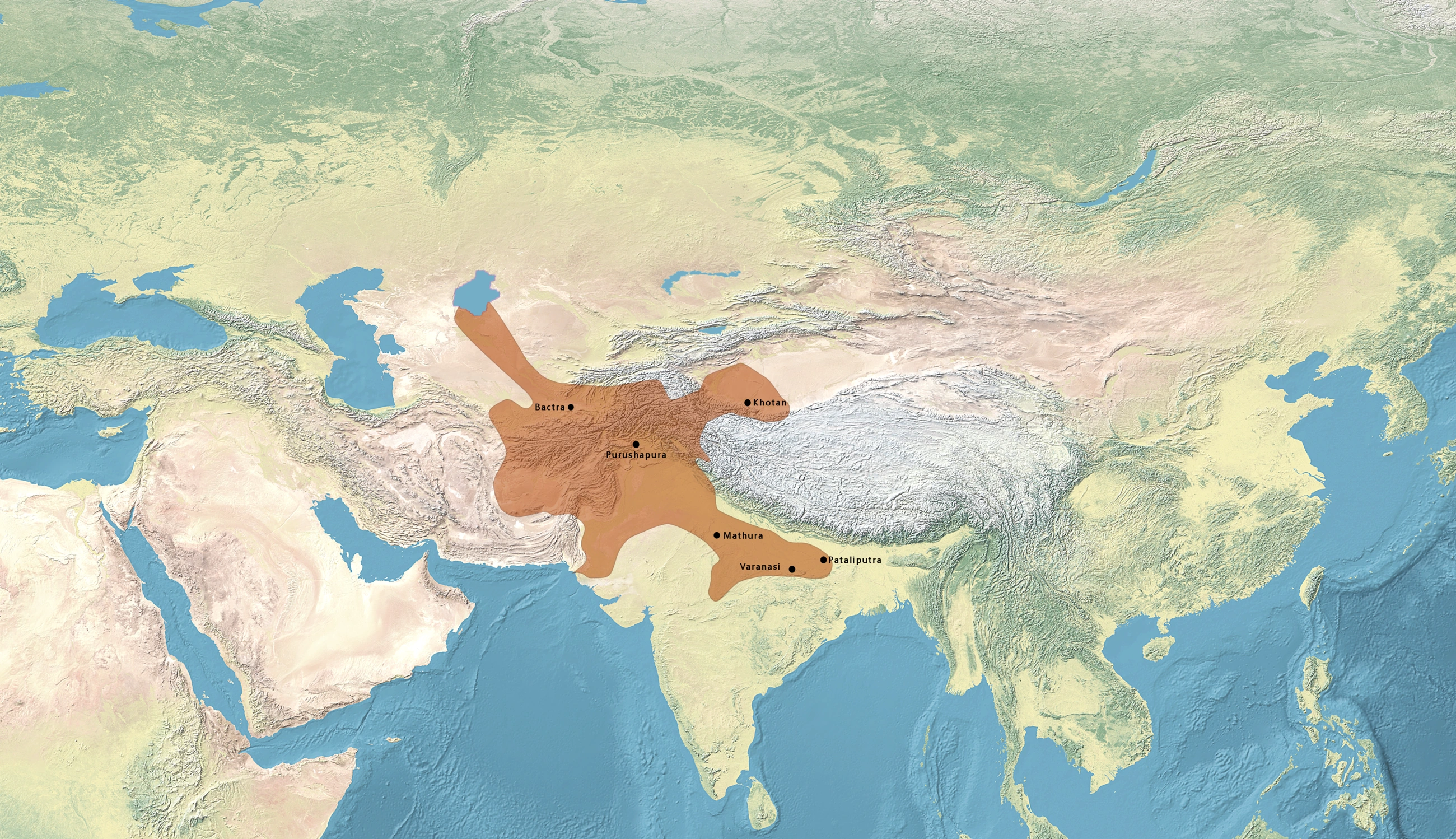
Map study
Kushan-era reconstruction: locate Central Asian–northwestern Indian routes. This is not the territorial extent of earlier Indo-Greek or Shaka kingdoms.
- Read the source date and legend; distinguish territory, influence and geographic location.
- Historical boundaries and reference memberships are not live political or operational data.
Credit: Natural Earth base map; source contributors credited on linked file page · CC BY-SA 4.0 · sourceConverted to WebP on an opaque white background; proportionally resized without cropping. Original cartography and legend retained.
1. Origins and geographical setting
The Indo-Greeks belonged to the Hellenistic political world created after Alexander's conquests. Alexander entered the north-western subcontinent in 327–326 BCE, but the later Indo-Greek kingdoms were not simply the uninterrupted continuation of his Indian possessions. Seleucus I subsequently controlled parts of Alexander's Asian empire. Around 305–303 BCE, his conflict and settlement with Chandragupta Maurya altered the frontier and brought territories in the north-west within the Mauryan sphere.
Bactria, centred around modern Balkh in northern Afghanistan, became the base of a separate Greek kingdom when Diodotus broke from Seleucid authority around the middle of the third century BCE. These Greco-Bactrian rulers controlled a prosperous region connected to Iran, Central Asia and the Indian subcontinent. Demetrius I is conventionally associated with expansion across the Hindu Kush around 200–180 BCE, broadly coinciding with the weakening and eventual collapse of Mauryan power.
The distinction between Greco-Bactrian and Indo-Greek is primarily geographical and historical, not an absolute cultural boundary. Indo-Greek rule developed in areas including the Kabul valley, Gandhara and Punjab, with changing frontiers and rival dynasties. Taxila was a major urban and commercial centre within this wider frontier world. Ancient references to Yavanas often denote Greeks in this period, but the term acquired broader meanings later and should not always be translated mechanically as Indo-Greek.
Timeline
327–326 BCE
Alexander campaigns in the north-western subcontinent, creating an earlier context for Hellenistic interaction.
Around 250 BCE
Diodotus establishes an independent Greco-Bactrian kingdom.
Around 200–180 BCE
Expansion associated with Demetrius I helps establish Greek rule south of the Hindu Kush.
Approximately 165/155–130 BCE
Menander I rules a major Indo-Greek kingdom.
Late second century BCE
Heliodorus erects the Vasudeva-related pillar at Besnagar.
Around the beginning of the Common Era
The last Indo-Greek principalities in Punjab disappear amid expanding Indo-Scythian power.
2. Political expansion, Menander and decline
Indo-Greek political history is reconstructed largely from coins, supplemented by inscriptions, archaeology and Indian and classical literary sources. Numerous rulers are known, but their reigns, relationships and territories are often uncertain. Demetrius, Apollodotus and Menander were important names, while conflicts involving the Greco-Bactrian ruler Eucratides contributed to the fragmentation of Greek power. Several kings could rule simultaneously in different regions.
Menander I was among the most successful Indo-Greek rulers. His reign is usually placed in the middle and later second century BCE, approximately 165/155–130 BCE. Sakala, generally identified with modern Sialkot in Pakistan, is associated with him. Classical accounts suggest substantial Greek expansion into India, while Patanjali's Mahabhashya refers to Yavana attacks on Saketa and Madhyamika. The Yuga Purana also preserves accounts of Yavana incursions. Such references require careful interpretation: raids or temporary advances do not establish durable Indo-Greek administration over the entire Gangetic plain.
Indo-Greek power declined unevenly rather than ending in one decisive event. Pressure from the Sakas, movements of Central Asian peoples and internal rivalries reduced their territories. Some eastern Indo-Greek lines survived in Punjab until around the beginning of the Common Era; Strato II is commonly counted among the last rulers. Indo-Scythian, Indo-Parthian and eventually Kushana power reshaped the region, but these transitions overlapped geographically and chronologically rather than forming a neat sequence everywhere.
Reading an Indo-Greek coin as historical evidence
- 1. Identify the metal, weight and imagery
- 2. Read the ruler's name, title, language and script
- 3. Compare associated types, overstrikes and hoards
- 4. Check archaeological context and other sources
- 5. Infer chronology and circulation without assuming territorial control
3. Coinage, economy and historical evidence
Coinage is the most distinctive surviving evidence of Indo-Greek rule. Gold, silver and copper-alloy issues are known, although metals, denominations and circulation differed between rulers and regions. Royal portraits, diadems, Greek gods and goddesses, Indian symbols and detailed royal legends provide information about sovereignty and political communication. Titles such as Basileus, meaning king, and Soter, meaning saviour, occur on coins. Portraiture can help distinguish rulers, but artistic resemblance alone is insufficient to establish family relationships.
Many coins intended for South Asian circulation carried Greek on one side and Prakrit in Kharoshthi on the other. Kharoshthi was normally written from right to left and was widely used in the north-west. Brahmi appears on some early issues, notably those of Agathocles. Bilingual coinage indicates adaptation to different users and administrative environments; it does not mean that all inhabitants spoke both languages. Greek-only coin types also continued, particularly in areas linked to Bactrian monetary traditions.
The kingdoms occupied routes linking Central Asia and Afghanistan with the Indus basin and northern India. Cities such as Taxila participated in exchange involving merchants, craftspeople and religious communities. Coin finds illuminate monetisation and commercial connections, but a coin's presence outside a kingdom does not automatically prove territorial control. Hoards, excavation contexts, overstrikes and die studies must be combined to reconstruct circulation and relative chronology. Greeks did not introduce coinage into India: punch-marked coins and other indigenous monetary traditions predated them.
| Source | Key information | Caution |
|---|---|---|
| Indo-Greek coins | Names, titles, portraits, scripts and relative succession | Circulation need not equal political control |
| Milindapanha | Milinda–Nagasena dialogue and Buddhist philosophy | Not a verbatim contemporary biography |
| Heliodorus pillar | Antialcidas, diplomatic exchange and Vasudeva devotion | One individual's devotion does not establish universal royal religion |
| Mahabhashya and Yuga Purana | Literary references to Yavana incursions | Chronology and the extent of occupation require corroboration |
4. Religious interaction and artistic significance
The Milindapanha, or Questions of Milinda, presents philosophical dialogues between King Milinda, usually identified with Menander, and the Buddhist monk Nagasena. It explores difficult Buddhist ideas, including personal identity and the doctrine of non-self, using accessible analogies such as the chariot. The work developed through textual transmission and should not be treated as a verbatim contemporary court record. Buddhist tradition associates Menander with acceptance of Buddhism, but it does not establish that every Indo-Greek ruler was Buddhist.
The Heliodorus pillar at Besnagar near Vidisha in Madhya Pradesh provides inscriptional evidence of another religious connection. Usually dated to the late second century BCE, it identifies Heliodorus as a man from Taxila and an ambassador of the Greek king Antialcidas to King Bhagabhadra. Heliodorus describes himself as a Bhagavata, a devotee of Vasudeva. The Garuda-standard thus documents both diplomacy and participation by a person of Greek background in an Indian devotional tradition.
Indo-Greek coins also retained Greek deities such as Zeus and Athena, showing that interaction did not eliminate older traditions. Hellenistic artistic practices contributed to the wider cultural environment from which Gandhara art developed. However, mature Gandharan Buddhist sculpture flourished principally in the early centuries CE, especially under Kushana patronage, and incorporated multiple influences. It is therefore inaccurate to equate the Indo-Greek period directly with the full flowering of Gandhara art or to attribute all Buddha images to Greek initiative.
5. UPSC approach: distinctions and common traps
For Prelims, organise the topic around ruler, source, place and inference. Menander connects with Milinda, Nagasena and Sakala; Antialcidas connects with Heliodorus and Besnagar; bilingual coinage connects Greek with Prakrit, usually written in Kharoshthi. Distinguish language from script: Prakrit is a language category, whereas Kharoshthi and Brahmi are scripts. Keep Sakala, Taxila and Besnagar geographically separate.
The larger significance lies in frontier interaction rather than a simple story of foreign conquest. Indo-Greek kingdoms adapted Hellenistic political symbols to South Asian settings and participated in networks of trade, diplomacy and religious exchange. Nevertheless, evidence must be matched to its limits: a religious text is not a precise chronology, a devotional inscription does not demonstrate mass conversion, and the discovery of coins does not by itself establish a province.
Real-world case studies
Besnagar: diplomacy and devotion
The Heliodorus pillar near Vidisha links a Greek ambassador from Taxila with the court of Bhagabhadra and worship of Vasudeva. It demonstrates cross-cultural participation through a specific inscription rather than a general claim about Greek conversion.
Agathocles: Indian imagery on royal coinage
Certain coins of Agathocles depict figures generally identified as Balarama-Samkarshana and Vasudeva-Krishna and carry Greek and Brahmi legends. They provide early numismatic evidence of these cult figures, although royal imagery alone cannot establish the ruler's personal beliefs.
Previous year questions
No source-linked PYQ is available here yet. Use the practice questions below.
Practice questions
Practice MCQ 1
Consider the following statements: 1. Indo-Greek coins frequently combine Greek legends with Prakrit written in Kharoshthi. 2. Kharoshthi was normally written from left to right. 3. Coinage existed in India before Indo-Greek rule. Which statements are correct?
- A. 1 and 2 only
- B. 1 and 3 only
- C. 2 and 3 only
- D. 1, 2 and 3
Practice MCQ 2
The Heliodorus pillar is particularly important as evidence of:
- A. Menander's embassy to Ashoka
- B. The first Buddhist council in Gandhara
- C. A Greek ambassador's devotion to Vasudeva
- D. The establishment of Kushana rule at Sialkot
Practice MCQ 3
Which statement about Indo-Greek history is most accurate?
- A. All Indo-Greek rulers governed a single unified empire.
- B. The Milindapanha is a contemporary administrative chronicle.
- C. Mature Gandhara sculpture belongs exclusively to Menander's reign.
- D. Coins are central to reconstructing a frequently uncertain political chronology.
Mains practice · Assess the significance of the Indo-Greeks in the cultural history of ancient India. What limitations arise from the sources available for studying them? Answer in 250 words.
- Locate their kingdoms within post-Mauryan frontier politics.
- Discuss bilingual coinage, portraiture and adaptation to regional monetary traditions.
- Use Menander and the Milindapanha for Buddhist interaction.
- Use Heliodorus and Agathocles for engagement with Indian devotional traditions.
- Distinguish Hellenistic contributions from the later flowering of Gandhara art.
- Explain the limitations of coin distribution, literary traditions and isolated inscriptions.
Further reading
- R. S. Sharma, Ancient India, old NCERT Class XI.
- Upinder Singh, A History of Ancient and Early Medieval India.
- Archaeological Survey of India: information on the Heliodorus pillar at Besnagar.
- British Museum collection database: Indo-Greek coins of Menander, Agathocles and Antialcidas.
Preparing for UPSC Civil Services? Get classroom teaching, answer-writing evaluation and mentorship at Pragnya IAS Academy, Ashok Nagar — see why aspirants choose us for IAS coaching in Hyderabad.