
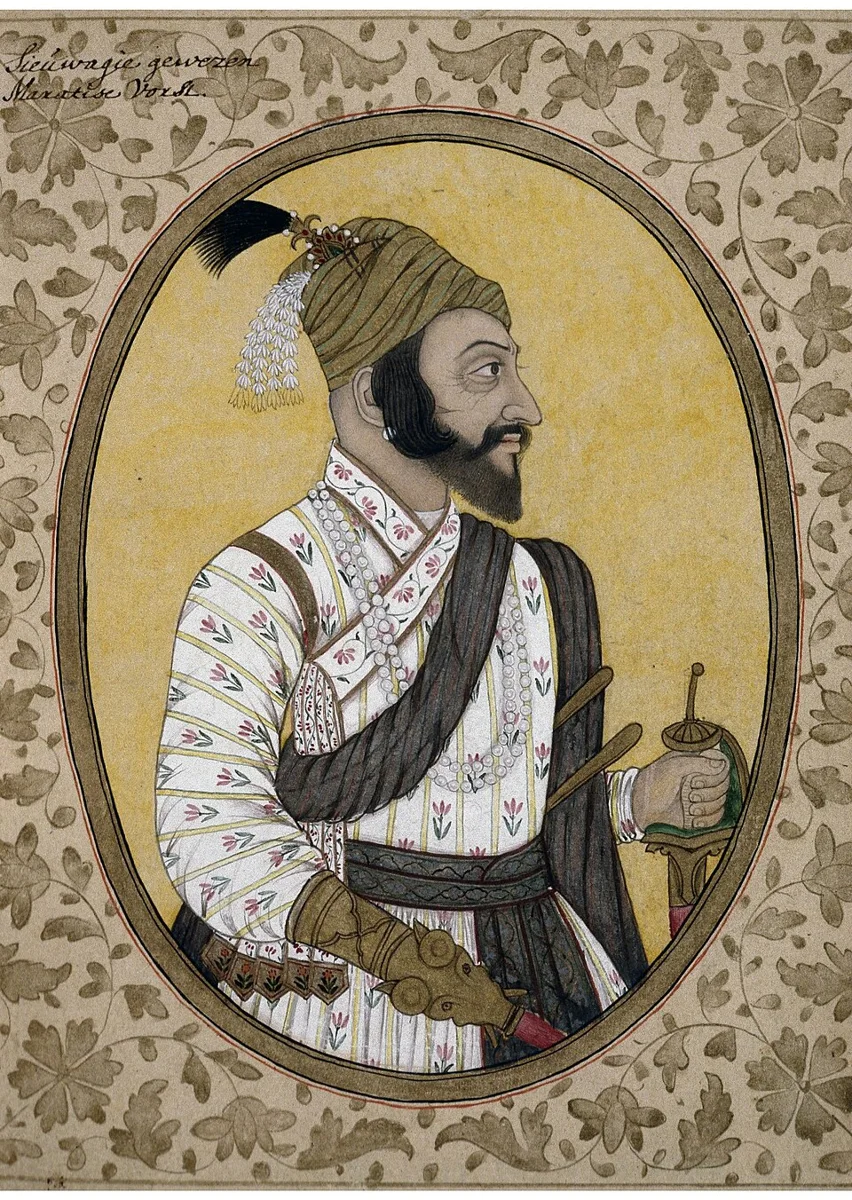
Portrait identified as Shivaji; the supplied metadata associates it with the British Museum, London.
Credit: Unknown authorUnknown author · Public domain · sourceResized and converted to WebP; uncropped.
1. Historical setting and the rise of Shivaji
Shivaji emerged in the seventeenth-century western Deccan, where Mughal expansion intersected with the weakening power of Ahmadnagar and continuing competition involving Bijapur and Golconda. The region contained hereditary rural intermediaries, especially deshmukhs, who controlled local resources and armed followers. Its combination of cultivated plateaus, rugged Sahyadri hills and the narrow Konkan coast made political authority geographically fragmented. Forts and mountain passes were consequently as important as large cities.
His father, Shahji Bhonsle, served different Deccan powers, including Ahmadnagar and Bijapur, and held important military and landed assignments. Shivaji developed his power around the family's Pune holdings. Jijabai was an important influence in his upbringing, while Dadoji Konddev managed the Pune estate during his youth. Explanations that attribute Shivaji's entire state-building programme to any single mentor, however, go beyond what the evidence securely establishes.
The acquisition of Torna in 1646 is conventionally treated as an early milestone. Rajgad became an important political centre, and Shivaji gradually secured neighbouring forts and territories. His conquest of Javli from the More chiefs in 1656 improved access between the uplands and Konkan and strengthened his strategic position. Recruitment among the Maval region's inhabitants supplied soldiers familiar with difficult terrain. Maratha state formation thus rested on local alliances and resources, not merely on individual battlefield victories.
- Swarajya meant self-rule or one's own political dominion in this context; it should not be equated uncritically with modern democratic nationalism.
- Useful sources include Marathi chronicles called bakhars, Persian histories, official correspondence and European commercial records. Their dates, purposes and biases require comparison.
Timeline
1630
Born at Shivneri.
1646–1656
Early expansion through Torna and neighbouring forts; conquest of Javli in 1656.
1659
Afzal Khan encounter and Maratha victory near Pratapgad.
1663–1664
Attack on Shaista Khan at Pune, followed by the first raid on Surat.
1665–1666
Treaty of Purandar; visit to Aurangzeb's court and escape from restraint at Agra.
1674
Coronation at Raigad.
1676–1680
Southern campaign in 1676–1678; death at Raigad in 1680.
2. Conflict, diplomacy and sovereign kingship
In 1659, Bijapur sent Afzal Khan against Shivaji. Afzal Khan was killed during their encounter near Pratapgad, and Shivaji's forces defeated the accompanying Bijapuri army. Accounts differ on details of the meeting, so the secure historical point is the decisive improvement in Shivaji's position. In 1660, pressure around Panhala led to his escape towards Vishalgad; the associated rearguard action is remembered through Baji Prabhu Deshpande and Pavan Khind.
The Mughals then became a major adversary. Shivaji attacked Shaista Khan's quarters at Pune in 1663 and raided the wealthy Mughal port city of Surat in 1664. Mirza Raja Jai Singh's campaign forced negotiations. Under the Treaty of Purandar in 1665, Shivaji agreed to surrender 23 forts and retain 12, while his son Sambhaji was to enter Mughal service. The settlement also involved cooperation against Bijapur, illustrating that military confrontation could coexist with negotiated accommodation.
Shivaji attended Aurangzeb's court at Agra in 1666, was placed under restraint after a dispute over his treatment, and subsequently escaped. Popular narratives describe the escape in considerable detail, but the precise method is disputed. Renewed warfare from 1670 enabled him to recover several lost forts and raid Surat again. His coronation at Raigad in 1674, performed with the involvement of the scholar Gaga Bhatt, asserted independent, ritually sanctioned kingship. His southern campaign of 1676–1678 extended Maratha influence into parts of present-day Karnataka and Tamil Nadu, including the strategically important fort of Gingee.
- Rajgad and Raigad are different forts: the former was an earlier political centre; the latter was the coronation capital.
- Shivaji's principal opponents included both Muslim-ruled states and local Maratha chiefs; contemporary conflicts cannot be reduced to a simple religious binary.
Interacting foundations of Maratha state formation
- 1. Mobilisation of Pune-area resources and local supporters
- 2. Acquisition of hill forts and strategic passes
- 3. Expansion through mobile warfare and negotiation
- 4. Organisation of revenue and royal administration
- 5. Assertion of sovereignty through coronation
- 6. Extension towards coastal and southern territories
3. Administration and the agrarian economy
Shivaji sought to strengthen royal control without completely eliminating inherited local institutions. The Ashtapradhan comprised the Peshwa, concerned with general coordination; Amatya, with finance; Sachiv, with official correspondence; Mantri, with records and intelligence; Sumant or Dabir, with diplomatic affairs; Senapati, with military command; Nyayadhish, with justice; and Panditrao, with religious affairs and charitable grants. These officers assisted the ruler rather than constituting a collectively responsible cabinet. Several also performed military duties.
Territorial government linked provincial and district officials to village institutions. Patils and kulkarnis continued to perform important local functions, while the crown attempted to restrain the independent power and arbitrary exactions of hereditary intermediaries. Land measurement and assessment were associated especially with Annaji Datto. Revenue demand is commonly described as reaching about two-fifths of the assessed produce, although rates and collection practices varied. It is therefore misleading to present one figure as a perfectly uniform tax across all territories and years.
Chauth and sardeshmukhi require careful distinction from ordinary land revenue within the kingdom. Chauth was a levy nominally amounting to one-fourth of assessed revenue, demanded from territories exposed to Maratha military pressure, often in return for protection from raids. Sardeshmukhi was an additional one-tenth claim justified through superior hereditary rights. Their systematic extension and imperial recognition belong especially to the later Maratha period. The Mughal grants obtained in 1719 should not be attributed to Shivaji.
- The Peshwa's later predominance under Shahu and his successors must not be projected backwards onto Shivaji's reign.
- Revenue claims did not necessarily produce regular receipts: warfare, local bargaining and administrative reach affected actual collection.
| Term | Meaning under or associated with Shivaji | Examination caution |
|---|---|---|
| Ashtapradhan | Eight principal officers assisting the ruler | Not a modern cabinet or a body superior to the king |
| Chauth | Levy nominally equal to 25% of assessed revenue | Distinct from ordinary land revenue |
| Sardeshmukhi | Additional 10% claim based on superior hereditary rights | Its later imperial recognition postdated Shivaji |
| Bargir | Cavalryman supplied with a horse and equipment by the state | Contrast with the self-equipped shiledar |
| Rajgad and Raigad | Earlier political centre and later coronation capital respectively | They are separate forts |
4. Forts, mobile warfare and maritime policy
Shivaji combined positional defence with highly mobile operations. Hill forts protected stores, treasuries and garrisons, while also controlling passes and providing refuges during superior enemy advances. His forces used intelligence, surprise attacks, rapid marches and disruption of communications. These methods are commonly described as ganimi kava. Nevertheless, he also employed sieges, conventional engagements and diplomacy; calling his entire military system guerrilla warfare overlooks its institutional and territorial foundations.
His cavalry included bargirs, whose horses and equipment were supplied by the state, and shiledars, who generally provided their own mounts and equipment. Infantry remained important in hill fighting and fort defence. Fort administration distributed responsibilities among officers to reduce dependence on a single commander. Mobility worked effectively because it was supported by defensible bases and access to countryside resources.
On the coast, Shivaji developed naval forces and fortified maritime positions. Sindhudurg and Vijaydurg are closely associated with this policy. The aims included protecting the Konkan coastline, challenging the Siddis of Janjira and managing competition with European maritime powers. His naval programme should not be confused with the later achievements of Kanhoji Angre. Nor should it be described as India's first navy: earlier Indian states had substantial naval traditions.
- Geographical linkage for Prelims: Sahyadri or Western Ghats, Maval uplands, Konkan coast and the Arabian Sea.
- Janjira remained a major Siddi stronghold and was not permanently conquered by Shivaji.
5. Society, religious policy and historical significance
Shivaji drew support from cultivators, local landed groups, soldiers, administrators and commercial interests. Marathi gained greater importance in political administration, alongside inherited Persianate practices and Sanskrit expressions of royal legitimacy. His coronation involved debates over Kshatriya status, demonstrating the importance of caste, genealogy and Brahmanical sanction in early modern kingship.
Although Shivaji consciously asserted Hindu royal identity and patronised religious institutions, his government and armed forces also employed Muslims. Evidence records injunctions to protect mosques, the Quran and women during military operations. These should be understood as elements of royal policy rather than proof that every campaign was free from violence or plunder. Equally, describing his rule through modern concepts of either a secular nation-state or an exclusively religious movement obscures its historical setting.
His lasting achievement was a durable regional state capable of resisting larger powers through an integrated combination of forts, military organisation, fiscal claims and political legitimacy. After his death in 1680, Sambhaji succeeded him. Continued Mughal–Maratha warfare transformed this inheritance, while eighteenth-century Maratha expansion produced institutions and territorial arrangements that differed significantly from Shivaji's original kingdom.
- For examination answers, connect leadership with structural factors: terrain, agrarian resources, local intermediaries, Deccan political competition and maritime commerce.
Shivaji: Sovereignty and Regional State Formation
Shivaji’s significance lies not merely in successful resistance to larger powers but in creating a durable framework of regional kingship. Operating within the contested western Deccan, he combined control of hill forts, mobile forces and negotiation with revenue administration. His coronation at Raigad in 1674 publicly asserted sovereign status and strengthened claims to legitimate rule. His career is therefore best studied as a process of state formation, rather than reduced to a sequence of battles or an exclusively religious confrontation.
The portrait provides an illustrative link to Shivaji as a historical ruler, but its evidentiary value requires caution. The supplied metadata identifies the subject and associates the work with the British Museum; it does not establish the artist, production date, patronage or whether the likeness was made during Shivaji’s lifetime. Museum association alone cannot authenticate a contemporary likeness. For historical interpretation, portraits should be read alongside critically assessed administrative records, correspondence, chronicles and material evidence from forts.
- Administration: The Ashtapradhan comprised eight principal ministerial offices assisting the ruler; it was not a modern cabinet based on collective responsibility.
- Revenue: Distinguish ordinary land revenue from chauth and sardeshmukhi, claims associated with Maratha power beyond directly administered territory; their reach varied over time.
- Military strategy: Fort networks, mobility and coastal defence complemented one another. Calling Shivaji only a guerrilla leader obscures his administrative and sovereign ambitions.
Real-world case studies
Purandar, 1665: negotiation as statecraft
Jai Singh's campaign compelled Shivaji to surrender substantial territory rather than risk the destruction of his emerging state. The settlement preserved a territorial base and opened a channel of accommodation with the Mughals. Shivaji's subsequent recovery demonstrates that treaties were contingent instruments of survival and expansion, not necessarily permanent alignments.
Sindhudurg: adapting defence to the coast
Constructed under Shivaji near Malvan in present-day Maharashtra, Sindhudurg illustrates the maritime dimension of his strategy. Its island setting complemented inland hill forts and supported the defence of the Konkan. It shows that his military geography included sea routes and coastal strongholds, not just mountain warfare.
Previous year questions
No source-linked PYQ is available here yet. Use the practice questions below.
Practice questions
Practice MCQ 1
Consider the following pairs concerning Shivaji's administration: 1. Amatya — Finance 2. Sumant — Diplomatic affairs 3. Panditrao — Cavalry command. Which of the pairs given above are correctly matched?
- A. 1 and 2 only
- B. 2 and 3 only
- C. 1 and 3 only
- D. 1, 2 and 3
Practice MCQ 2
Arrange the following events in chronological order: 1. Coronation at Raigad 2. Treaty of Purandar 3. Encounter with Afzal Khan 4. Visit to Aurangzeb's court at Agra.
- A. 3–4–2–1
- B. 2–3–4–1
- C. 3–2–4–1
- D. 2–4–1–3
Practice MCQ 3
With reference to Shivaji's military organisation, consider the following statements: 1. Bargirs received horses and equipment from the state. 2. Janjira was permanently incorporated into his kingdom. 3. Forts supported mobile warfare by securing stores and communications. Which of the statements given above are correct?
- A. 1 only
- B. 2 and 3 only
- C. 1 and 2 only
- D. 1 and 3 only
Mains practice · Shivaji's success lay in integrating military innovation with administrative consolidation and political legitimacy. Discuss. (250 words)
- Introduce the competitive political environment of the seventeenth-century Deccan.
- Explain how forts, intelligence, mobile forces and coastal defence complemented one another.
- Discuss revenue assessment, management of intermediaries and the Ashtapradhan.
- Use Purandar to illustrate pragmatic diplomacy and preservation of a territorial base.
- Connect the 1674 coronation with sovereignty, genealogy and ritual legitimacy.
- Conclude by distinguishing Shivaji's kingdom from later Peshwa-led Maratha expansion.
Further reading
- Satish Chandra, Medieval India, NCERT old syllabus textbook.
- Satish Chandra, History of Medieval India, Orient BlackSwan.
- Stewart Gordon, The Marathas 1600–1818, The New Cambridge History of India.
- Maharashtra State Gazetteers, official Gazetteers Department website.
- Archaeological Survey of India: information on Maratha forts and protected monuments.
- https://commons.wikimedia.org/wiki/File:Shivaji_British_Museum.jpg
Preparing for UPSC Civil Services? Get classroom teaching, answer-writing evaluation and mentorship at Pragnya IAS Academy, Ashok Nagar — see why aspirants choose us for IAS coaching in Hyderabad.