

Statue of Shivaji Maharaj at Raigad fort, Maharashtra
Credit: User:Cj.samson · GFDL 1.2 · source
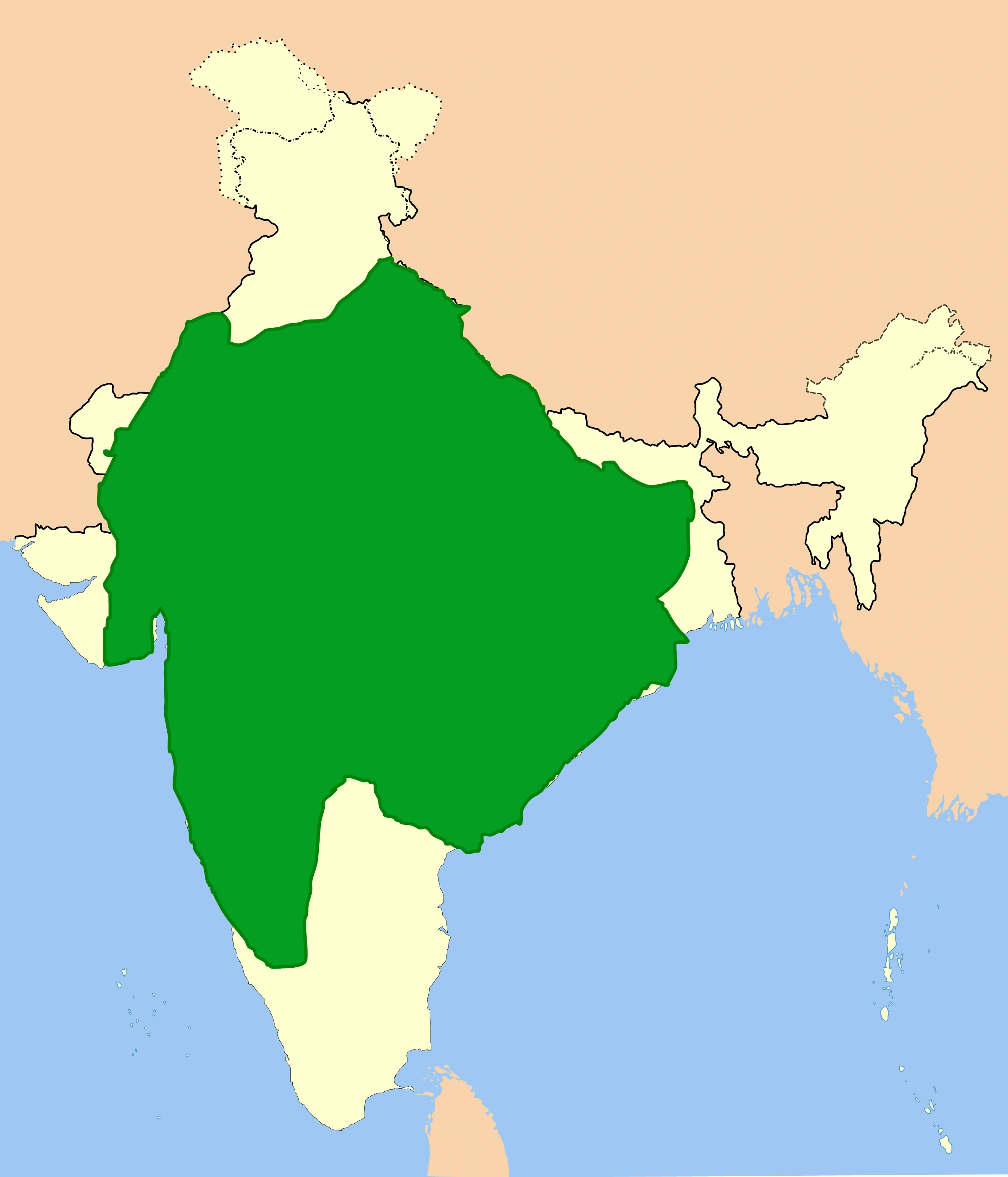
Map study
Maratha power around 1760: confederate influence was not identical to uniform central administration.
- Read the source date and legend before interpreting territorial extent.
- Compare core regions, neighbouring powers and geographic barriers; historical borders and influence are approximate and changed over time.
Credit: Ayunipear · CC0 · sourceConverted to WebP on an opaque white background; proportionally resized without cropping. Original cartography and legend retained.
1. Regional setting and the rise of Shivaji
Maratha power developed in the western Deccan, particularly the Maharashtra plateau, the Sahyadri or Western Ghats, and the Konkan coast. Hill forts, narrow passes and difficult terrain favoured mobile warfare and provided defensible centres of authority. The region also possessed established village institutions, revenue intermediaries and military-service networks. Maratha chiefs had served the Deccan sultanates well before an independent kingdom emerged.
Shivaji, born at Shivneri in 1630, was the son of Shahji Bhonsle and Jijabai. Shahji served the Deccan sultanates, while Shivaji built his own territorial base around Pune. The acquisition of Torna in 1646 is conventionally treated as an early milestone. Shivaji recruited local soldiers, including men from the Maval region, and combined negotiation, fort acquisition and warfare against Bijapur and Mughal authority.
His defeat of Bijapur’s general Afzal Khan near Pratapgad in 1659 strengthened his position. The attack on Shaista Khan at Pune in 1663 and the raid on Surat in 1664 demonstrated his capacity to strike powerful opponents. Under the Treaty of Purandar in 1665, negotiated with Jai Singh, Shivaji agreed to surrender 23 forts and retain 12.
Shivaji visited Aurangzeb’s court at Agra in 1666, was placed under restraint and escaped. He subsequently recovered much of his position and was crowned at Raigad in 1674. The coronation asserted independent sovereignty and elevated his standing among competing chiefs. He died in 1680.
Timeline
1674
Shivaji’s coronation at Raigad.
1689–1707
Resistance continued after Sambhaji’s execution through Rajaram, Tarabai and dispersed Maratha commanders.
1713–1719
Balaji Vishwanath became Peshwa; Mughal grants subsequently recognised important Maratha claims.
1761
Defeat at the Third Battle of Panipat.
1802
Treaty of Bassein between Baji Rao II and the East India Company.
1818
End of the Third Anglo-Maratha War and abolition of the Peshwa’s office.
2. Shivaji’s administration, revenue and armed forces
The king was the centre of Shivaji’s administration. An eight-member council, the Ashta Pradhan, assisted him, but it was not a modern cabinet with collective responsibility. Its offices were Peshwa, Amatya, Sachiv, Mantri, Sumant or Dabir, Senapati, Nyayadhish and Panditrao. Their principal functions concerned general administration, finance, correspondence, records and intelligence, diplomacy, military command, justice, and religious matters respectively.
Shivaji sought to control hereditary intermediaries and strengthen direct supervision of revenue and military administration. Land measurement and assessment were important; the state’s demand is commonly described as approximately two-fifths of assessed produce under his revised arrangements, although actual practice varied. Cash payment of officials and soldiers was encouraged where feasible, rather than unrestricted dependence on transferable territorial assignments.
Chauth and sardeshmukhi must be distinguished from ordinary land revenue within directly governed territory. Chauth was a claim to one-fourth of assessed revenue, often linked to protection or exemption from Maratha raids. Sardeshmukhi was an additional one-tenth claim justified through an asserted superior hereditary right. Their collection later became central to Maratha expansion, but collection rights did not necessarily imply complete territorial sovereignty.
Forts functioned as military bases, stores and administrative centres. Swift cavalry movements, surprise attacks and avoidance of disadvantageous pitched battles characterised Maratha warfare, often called ganimi kava. Bargirs rode horses supplied by the state, while silahdars supplied their own horses and equipment. Shivaji also developed coastal forts and naval forces to protect the Konkan against maritime rivals, including the Siddis and European powers.
Broad transformation of Maratha power
- 1. Deccan military-service and agrarian networks
- 2. Shivaji’s independent territorial kingdom
- 3. Decentralised resistance to Mughal conquest
- 4. Peshwa-led expansion and revenue claims
- 5. Increasing autonomy of regional houses
- 6. British intervention and loss of political independence
3. Society, religion and the social base of power
Maratha state formation drew upon cultivators, village headmen or patils, record-keepers or kulkarnis, hereditary deshmukhs, military retainers and landed families. Military service offered opportunities for mobility, but caste, lineage and control over agrarian resources remained influential. The term Maratha could carry regional, military and social meanings; it should not be treated as an unchanging, homogeneous category.
Maharashtra’s devotional traditions helped create a broad Marathi-speaking cultural sphere. Jnaneshwar, Namdev, Eknath and Tukaram were associated with traditions of devotion, vernacular expression and criticism of ritual exclusiveness. The Varkari tradition centred on Vitthal at Pandharpur. However, treating the Bhakti movement as the single cause of Maratha political success ignores military institutions, agrarian resources and Deccan political conditions.
Shivaji used Hindu kingship and coronation rituals to legitimise sovereignty, while his administration also employed Muslims and operated within the wider Indo-Persian political environment. His conflicts cannot be reduced to a simple Hindu–Muslim confrontation: alliances and hostilities crossed religious boundaries. Under the Peshwas, Pune became an important political and cultural centre, and Brahman administrative influence increased. Women such as Tarabai and Ahilyabai Holkar exercised notable authority despite a generally patriarchal social order.
| Authority or house | Principal centre | Important association |
|---|---|---|
| Peshwa | Pune | Leading executive authority under the Chhatrapati |
| Sindhia | Gwalior | Malwa and northern Indian politics |
| Holkar | Indore; Maheshwar under Ahilyabai | Malwa |
| Gaekwad | Baroda | Gujarat |
| Bhonsle | Nagpur | Berar and expansion towards Odisha |
4. From the Chhatrapati to the Peshwas and regional houses
After Shivaji, Sambhaji continued resistance to Mughal expansion but was captured and executed in 1689. Rajaram sustained resistance from Jinji and later western India. Following his death in 1700, Tarabai directed the struggle as regent for her son. Aurangzeb’s prolonged Deccan campaigns failed to eliminate Maratha resistance and placed severe pressure on Mughal resources.
Shahu, Sambhaji’s son, was released from Mughal captivity in 1707. His contest with Tarabai contributed to rival centres at Satara and Kolhapur. Under Shahu, Balaji Vishwanath strengthened the Peshwa’s office. In 1719, Mughal grants recognised Shahu’s claims to swarajya and rights to collect chauth and sardeshmukhi in the six Deccan subahs, subject to obligations.
Baji Rao I expanded Maratha influence into Malwa, Gujarat and Bundelkhand. His victory over the Nizam at Palkhed in 1728 demonstrated the effectiveness of rapid cavalry manoeuvre. Under Balaji Baji Rao, also called Nana Saheb, Maratha intervention extended deep into northern India. After Shahu’s death in 1749, effective leadership increasingly centred on the Peshwa at Pune.
The resulting order is commonly described as a confederacy, although it was not a federation with a fixed constitution. The Sindhias of Gwalior, Holkars of Indore, Gaekwads of Baroda and Bhonsles of Nagpur developed substantial autonomy. Their overlapping ambitions and uneven cooperation became major features of eighteenth-century politics.
5. Panipat, recovery and conflict with the British
At the Third Battle of Panipat in 1761, the Maratha army led by Sadashivrao Bhau suffered a devastating defeat against Ahmad Shah Durrani and his allies. Long supply lines, shortages and inadequate regional alliances weakened the Marathas. The defeat checked northern expansion but did not immediately end Maratha power.
Peshwa Madhav Rao I restored much of the state’s strength. Mahadji Sindhia subsequently became influential in northern India and helped restore Shah Alam II to Delhi in 1772. Nevertheless, succession disputes and rivalries among leading houses created opportunities for British intervention.
The First Anglo-Maratha War, 1775–1782, ended with the Treaty of Salbai. The Treaty of Bassein in 1802 placed Peshwa Baji Rao II under a British subsidiary alliance and helped trigger the Second Anglo-Maratha War, 1803–1805. Following the Third Anglo-Maratha War, 1817–1818, the Peshwa’s office was abolished. Several Maratha dynasties survived as princely states under British paramountcy.
Real-world case studies
Palkhed, 1728: mobility over territorial occupation
Baji Rao I manoeuvred against the Nizam’s communications and supplies rather than relying on a costly frontal assault. The resulting settlement strengthened Shahu’s position. Palkhed illustrates why logistical control and cavalry mobility were crucial to early eighteenth-century warfare.
Ahilyabai Holkar: governance and patronage
Ahilyabai governed the Holkar territories from 1767 to 1795, with Maheshwar as her principal seat. Her administration and patronage of temples, ghats, wells and rest houses across India demonstrate the regional houses’ roles beyond warfare. Her reconstruction of the Kashi Vishwanath temple at Varanasi is a prominent surviving example.
Previous year questions
No source-linked PYQ is available here yet. Use the practice questions below.
Practice questions
Practice MCQ 1
With reference to Maratha revenue claims, consider the following statements: 1. Chauth conventionally represented one-fourth of assessed revenue. 2. Sardeshmukhi was an additional one-tenth claim. 3. The right to collect these levies invariably meant complete sovereignty over the territory. Which statements are correct?
- A. 1 and 2 only
- B. 2 and 3 only
- C. 1 and 3 only
- D. 1, 2 and 3
Practice MCQ 2
Which one of the following pairs is incorrectly matched?
- A. Panditrao — Religious matters
- B. Sumant — Foreign affairs
- C. Amatya — Finance
- D. Sachiv — Commander-in-chief
Practice MCQ 3
Arrange the following in chronological order: 1. Treaty of Bassein 2. Battle of Palkhed 3. Treaty of Salbai 4. Third Battle of Panipat.
- A. 2–4–3–1
- B. 4–2–1–3
- C. 2–3–4–1
- D. 3–2–4–1
Mains practice · How did the transition from Shivaji’s kingdom to the eighteenth-century Maratha confederacy influence both Maratha expansion and political vulnerability? Discuss in 250 words.
- Explain Shivaji’s royal authority, forts, revenue supervision and military organisation.
- Discuss prolonged Mughal warfare and the growing importance of autonomous commanders.
- Connect Peshwa leadership and revenue-collection rights with geographical expansion.
- Show how regional houses mobilised resources while pursuing separate interests.
- Distinguish Panipat’s immediate losses from the subsequent Maratha recovery.
- Assess succession disputes, the Treaty of Bassein and British military-diplomatic intervention.
Further reading
- NCERT, Our Pasts–II, chapter on Eighteenth-Century Political Formations.
- Satish Chandra, Medieval India: From Sultanat to the Mughals, Part II.
- Stewart Gordon, The Marathas 1600–1818, The New Cambridge History of India.
- Maharashtra State Gazetteers, official Gazetteers Department publications and website.
Preparing for UPSC Civil Services? Get classroom teaching, answer-writing evaluation and mentorship at Pragnya IAS Academy, Ashok Nagar — see why aspirants choose us for IAS coaching in Hyderabad.