

Sir Thomas Lawrence (1769-1830) - Richard Colley Wellesley, Marquess Wellesley (1760-1842) - RCIN 400643 - Royal Collection
Credit: Thomas Lawrence · Public domain · source

British Residency of Hyderabad
Credit: Rangan Datta Wiki · CC BY-SA 4.0 · source
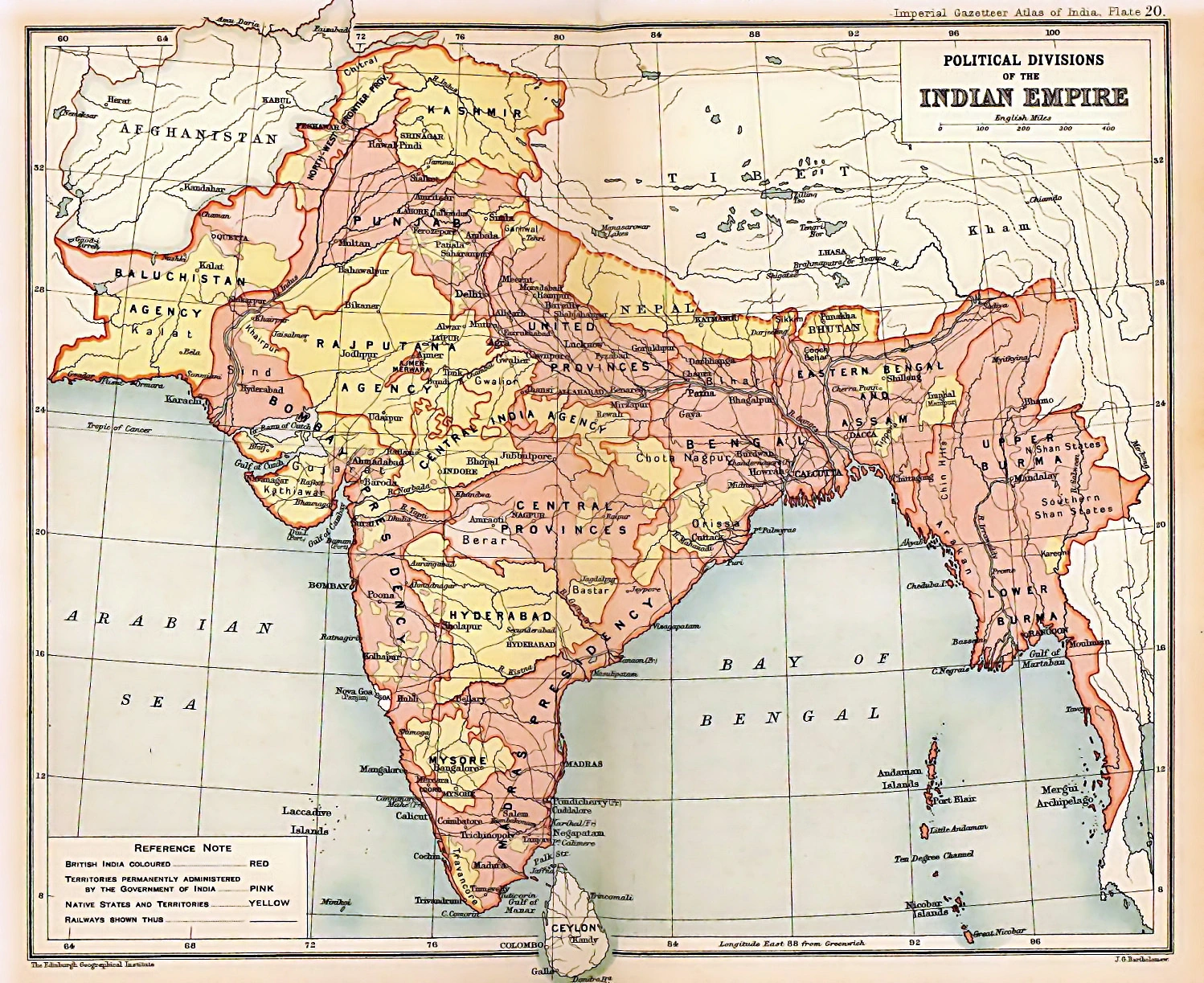
Map study
British Indian Empire in 1909: historical provinces and princely states, not contemporary Indian state boundaries.
- Read the source date and legend before interpreting territorial extent.
- Compare core regions, neighbouring powers and geographic barriers; historical borders and influence are approximate and changed over time.
Credit: Edinburgh Geographical Institute; J. G. Bartholomew and Sons · Public domain · sourceConverted to WebP on an opaque white background; proportionally resized without cropping. Original cartography and legend retained.
Origins and the context of British expansion
The Subsidiary Alliance emerged from eighteenth-century practices of hiring European troops and exchanging military assistance for payments or political concessions. French and British companies had intervened in Indian succession disputes during the Carnatic Wars. Before Wellesley, the East India Company had also concluded military and financial arrangements with Indian rulers. His contribution was to consolidate these precedents into an extensive system of political subordination backed by a permanent British military presence.
Wellesley arrived in India in 1798, when the Company faced powerful regional states and feared French intervention. Napoleon’s expedition to Egypt that year heightened British anxieties about the security of India. French officers serving in Indian armies, particularly the force maintained by the Nizam of Hyderabad, appeared to offer a channel for rival European influence. Removing such officers became an important immediate objective.
The wider setting was the fragmentation of Mughal authority and intense competition among Mysore, Hyderabad, the Maratha chiefs and other regional powers. Rulers sought protection against external enemies, rival claimants and internal instability. Wellesley exploited these insecurities, combining diplomatic promises with military pressure. The alliance therefore needs to be understood as both a security arrangement for threatened rulers and an instrument of Company imperialism.
- Central objective: replace a balance among Indian powers with Company predominance.
- Immediate strategic concern: exclude French military and political influence.
- Structural advantage: obtain strategic positions and military finance without assuming all the costs of direct administration.
Timeline
1798
Wellesley becomes Governor-General; Hyderabad accepts a subsidiary alliance and removes its French-trained corps.
1799
Following Tipu Sultan’s defeat, the restored Wodeyar kingdom of Mysore is brought under a subsidiary arrangement.
1800
A further Hyderabad treaty assigns territory to support the subsidiary force.
1801
Awadh cedes extensive territory under a new treaty with the Company.
31 December 1802
Baji Rao II signs the Treaty of Bassein.
1803–1805
The Second Anglo-Maratha War follows the political crisis intensified by Bassein.
Principal provisions and how the system operated
Under the characteristic arrangement, an Indian ruler accepted a British-commanded subsidiary force stationed within or near the state for its protection. The ruler paid a subsidy for its maintenance or ceded territory whose revenues supported the force. The troops served Company strategic interests as well as the stated purpose of defending the ally. Territorial cession was particularly valuable because it gave the Company a more secure revenue base than payments from a financially troubled court.
The ruler surrendered independent diplomatic action. Treaties with other powers, negotiations and decisions concerning war were subject to Company approval or mediation. Employment of Europeans outside Company control, especially French officers, was prohibited or restricted. A British Resident generally supervised relations with the court and became an influential intermediary between the ruler and the Company.
In return, the Company promised protection against external attack and, in some treaties, assistance against internal threats. Agreements commonly professed non-interference in internal administration. In practice, dependence on British troops and finance enabled Residents and Company officials to influence appointments, succession disputes and governmental decisions. The extent and wording of obligations differed between treaties; the system should not be treated as a single identical document imposed everywhere.
- Military dependence: a British-commanded force reduced the ruler’s strategic autonomy.
- Financial obligation: maintenance through cash payments, territorial revenue or cession.
- Diplomatic dependence: no independent alliance-making or war policy.
- Court supervision: a Resident monitored compliance and transmitted Company demands.
- Important qualification: rulers often retained some troops; complete abolition of every allied army was not a universal provision.
Typical pathway to dependent rule
- 1. Regional insecurity or Company pressure creates demand for protection.
- 2. The ruler accepts a subsidiary treaty.
- 3. A British-commanded force is supported by subsidy or territorial revenue.
- 4. Independent diplomacy and foreign military employment are restricted.
- 5. The Resident and military dependence expand Company influence.
Major applications under Wellesley
Hyderabad was the first major Indian state to accept Wellesley’s developed system in 1798. The Nizam dismissed the French-trained corps and accepted a British subsidiary force. A further agreement in 1800 transferred territories to support the enlarged force. Hyderabad’s search for security against regional rivals thus produced deeper military and diplomatic dependence on the Company.
After Tipu Sultan’s defeat and death in the Fourth Anglo-Mysore War in 1799, the victors partitioned Mysore. A reduced kingdom was placed under the restored Wodeyar dynasty and tied to the Company through a subsidiary arrangement. This illustrates how military conquest and indirect rule could operate together: some territory was acquired directly, while the remaining state survived under British supervision.
Awadh had earlier military arrangements with the Company, so 1801 should not be described as the beginning of all Anglo-Awadh dependence. Under the treaty of 1801, Nawab Saadat Ali Khan ceded roughly half his dominions in return for relief from the existing subsidy burden and expanded British responsibility for defence. The ceded areas included Rohilkhand and substantial territory in the Ganga-Yamuna Doab.
The Treaty of Bassein followed Baji Rao II’s defeat by Jaswant Rao Holkar near Poona in 1802. The Peshwa accepted a subsidiary force and assigned revenue-bearing territory for its maintenance in exchange for British support and restoration. Other major Maratha chiefs regarded the treaty as an intrusion into Maratha affairs. It helped precipitate the Second Anglo-Maratha War of 1803–1805.
- Remember the sequence: Hyderabad, Mysore, Awadh, Bassein.
- Do not assume that every Maratha chief accepted identical terms or submitted simultaneously.
| Instrument | Principal mechanism | Illustration |
|---|---|---|
| Subsidiary Alliance | Military protection in exchange for finance and strategic subordination | Hyderabad, 1798 |
| Conquest and settlement | Military defeat followed by partition, annexation or dependent restoration | Mysore, 1799 |
| Doctrine of Lapse | Annexation following refusal to recognise an adopted successor to sovereignty | Satara, 1848 |
| Annexation for alleged misgovernment | Direct takeover justified by claims of administrative failure | Awadh, 1856 |
Political, military and economic consequences
For the Company, subsidiary alliances created forward military positions inside allied territories. Indian revenues financed much of this deployment, allowing British forces to operate farther from the Company’s directly administered provinces. Restrictions on diplomacy also obstructed cooperation among Indian powers. Each dependent ruler increasingly dealt with the Company rather than negotiating freely with neighbouring states.
For allied rulers, protection came at the cost of effective sovereignty. A dynasty might retain its palace, court and administrative machinery while losing control over the essential sovereign functions of defence and foreign relations. Residents gradually became centres of political influence. The system helped lay the foundations of British paramountcy, although paramountcy developed over time and cannot be reduced to one treaty formula.
Subsidy demands placed pressure on state finances. Where payments exceeded available resources, rulers could raise revenue demands, accumulate arrears or surrender territory. Reductions in indigenous military establishments disrupted the livelihoods of soldiers and associated service groups. British protection could also weaken a ruler’s dependence on domestic political support. Nevertheless, fiscal and administrative effects varied across states, and claims of uniformly inevitable decline oversimplify the historical record.
- Company gains: strategic depth, revenue, exclusion of rivals and reduced diplomatic opposition.
- Ruler’s losses: military independence, diplomatic freedom and sometimes territory.
- Analytical theme: formal dynastic survival could coexist with substantive political subordination.
Distinctions and examination approach
Distinguish the Subsidiary Alliance from Dalhousie’s Doctrine of Lapse. The former primarily secured dependence through treaties, troops and financial obligations; the latter justified annexation of certain dependent states when a ruler died without a recognised natural heir and the Company refused to recognise an adopted successor for sovereignty. One could preserve a ruling dynasty under supervision, while the other extinguished the state’s separate political existence.
Also distinguish alliance from annexation on grounds of alleged misgovernment. Awadh’s treaty of 1801 deepened its dependence, whereas its annexation in 1856 occurred under Dalhousie on the stated ground of misgovernment, not the Doctrine of Lapse. In Prelims, scrutinise absolute statements: Wellesley did not originate all subsidiary practices, every alliance did not immediately annex a state, and all allied rulers did not lose every internal administrative function.
- For Mains, organise an answer around context, treaty provisions, examples and consequences.
- Use Bassein to show how an alliance with one ruler could alter the wider regional balance of power.
Real-world case studies
Hyderabad: protection with strategic dependence
The Nizam’s agreements of 1798 and 1800 excluded French military influence and secured British protection. Territorial assignments helped finance the subsidiary force. Hyderabad nevertheless retained its dynasty and separate administration, demonstrating that indirect imperial control did not require immediate annexation.
Bassein: a ruler’s restoration, a confederacy’s crisis
Baji Rao II obtained British assistance to recover his position through the 1802 treaty. Yet his acceptance of Company protection challenged the autonomy of the wider Maratha political order. The resulting conflict shows that an ostensibly bilateral defensive arrangement could become an instrument of regional expansion.
Previous year questions
No source-linked PYQ is available here yet. Use the practice questions below.
Practice questions
Practice MCQ 1
Consider the following statements about the Subsidiary Alliance: 1. An allied ruler’s independent diplomatic activity was restricted. 2. Maintenance of the subsidiary force could be financed through territorial cession. 3. Every alliance immediately abolished the allied dynasty. Which statements are correct?
- A. 1 and 2 only
- B. 2 and 3 only
- C. 1 and 3 only
- D. 1, 2 and 3
Practice MCQ 2
Arrange the following in chronological order: 1. Treaty of Bassein 2. Hyderabad’s subsidiary alliance under Wellesley 3. Awadh’s major territorial cession of 1801.
- A. 1–2–3
- B. 2–3–1
- C. 3–2–1
- D. 2–1–3
Practice MCQ 3
Which statement best explains the distinction between Awadh’s treaty of 1801 and its annexation in 1856?
- A. Both were applications of the Doctrine of Lapse.
- B. The 1801 treaty ended Company influence, which resumed in 1856.
- C. The 1801 treaty deepened military dependence and transferred territory; annexation in 1856 was justified by alleged misgovernment.
- D. The 1801 treaty abolished the dynasty, while the 1856 annexation restored it.
Mains practice · The Subsidiary Alliance preserved the outward forms of Indian rulership while undermining effective sovereignty. Discuss with examples. Answer in 250 words.
- Introduce Wellesley’s systematisation of earlier military-subsidy practices.
- Explain British control over defence, diplomacy and foreign military employment.
- Connect subsidy demands and territorial cessions with financial dependence.
- Use Hyderabad, Mysore, Awadh and Bassein as differentiated examples.
- Discuss Residents, dynastic continuity and the expansion of indirect rule.
- Conclude that the system advanced Company predominance without requiring universal immediate annexation.
Further reading
- NCERT, Our Pasts–III, From Trade to Territory: The Company Establishes Power.
- Bipan Chandra, History of Modern India, discussion of British expansion and consolidation.
- Sekhar Bandyopadhyay, From Plassey to Partition and After, discussion of colonial state formation.
- C. U. Aitchison, A Collection of Treaties, Engagements and Sanads Relating to India and Neighbouring Countries, relevant treaty texts.
Preparing for UPSC Civil Services? Get classroom teaching, answer-writing evaluation and mentorship at Pragnya IAS Academy, Ashok Nagar — see why aspirants choose us for IAS coaching in Hyderabad.