

Inside the Rani Laxmibai's Jhansi Fort in Jhansi, Uttar Pradesh
Credit: Pinakpani · CC BY-SA 4.0 · source
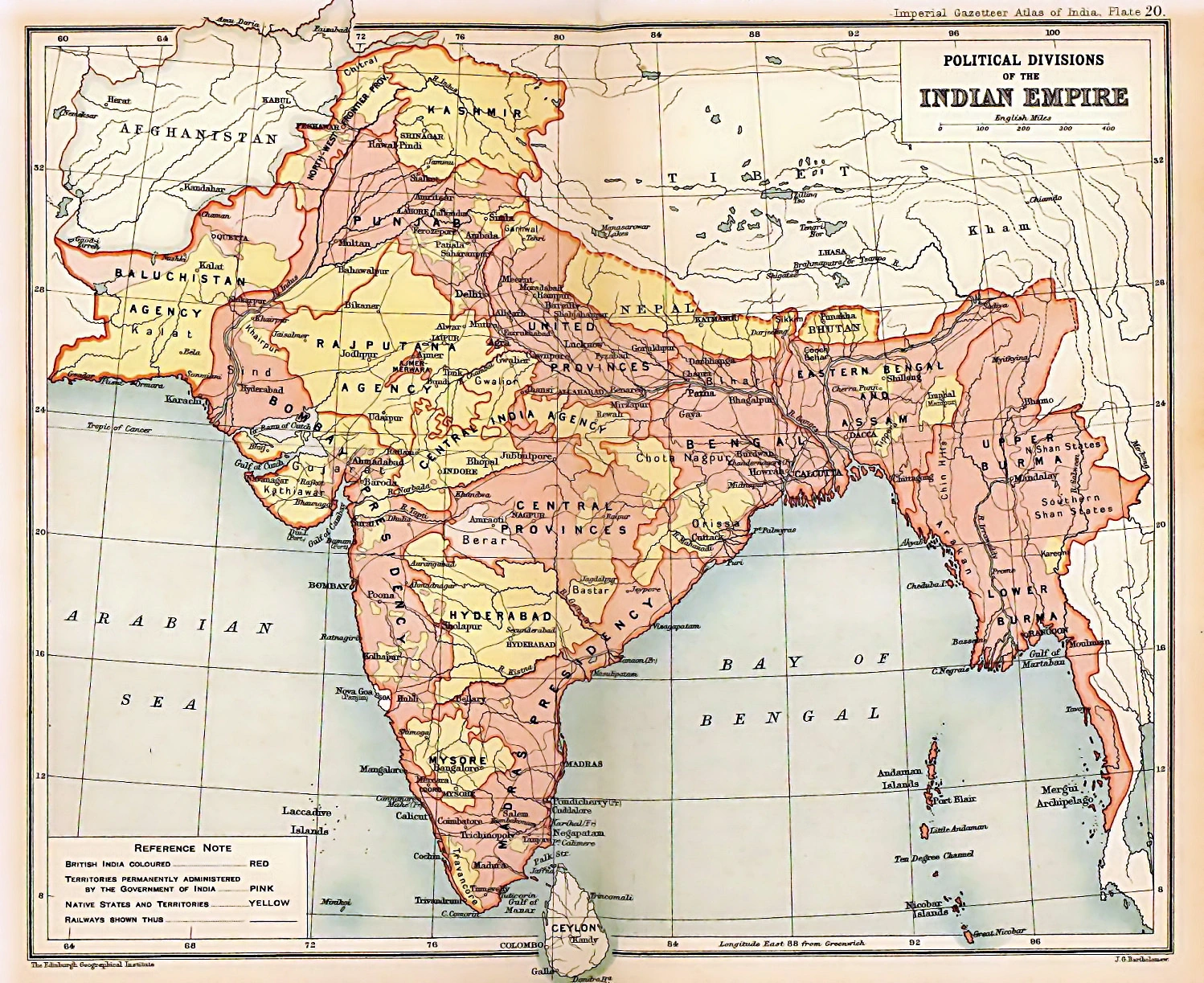
Map study
British Indian Empire in 1909: historical provinces and princely states, not contemporary Indian state boundaries.
- Read the source date and legend before interpreting territorial extent.
- Compare core regions, neighbouring powers and geographic barriers; historical borders and influence are approximate and changed over time.
Credit: Edinburgh Geographical Institute; J. G. Bartholomew and Sons · Public domain · sourceConverted to WebP on an opaque white background; proportionally resized without cropping. Original cartography and legend retained.
1. Meaning and political background
The Doctrine of Lapse was a succession-based justification for annexing Indian princely states into the East India Company’s territories. If the ruler of a state regarded as dependent on the Company died without a natural male heir, the British could decline to recognise an adopted successor and declare that sovereignty had lapsed to the paramount power. The state then ceased to exist as a separately governed principality and came under direct British administration.
The doctrine developed within the unequal political order created by British military victories, treaties and subsidiary alliances. Indian rulers retained varying degrees of internal authority, but the Company increasingly claimed the power to determine their external relations and adjudicate disputed successions. Paramountcy referred to this claimed superior political authority; it was not a single, uniformly defined rule accepted on equal terms by all Indian states.
Earlier British governments had already intervened in successions and sometimes refused recognition to adopted heirs. Dalhousie therefore did not invent the principle. His importance lies in making annexation through lapse a prominent and systematic policy during 1848–1856. It formed part of a wider expansionist programme that also employed conquest, allegations of misgovernment and treaty-based arrangements.
Timeline
1848
Dalhousie becomes Governor-General; Satara is annexed under lapse.
1849
Sambalpur is annexed following a succession failure.
1853–1854
The deaths of the rulers of Nagpur and Jhansi are followed by annexations in 1854.
1856
Awadh is annexed for alleged misgovernment; Dalhousie’s tenure ends.
1857–1858
Rebellion challenges British authority; Crown rule replaces Company government.
After 1858
Adoption sanads under Canning strengthen assurances of dynastic continuity.
2. Adoption, sovereignty and British interpretation
Adoption had an established place in Hindu family and religious practice. An adopted son could continue the family line, perform religious obligations and inherit property according to applicable law and custom. For ruling houses, adoption also provided a means of maintaining dynastic continuity when there was no natural male successor. Nevertheless, succession to a throne could involve political recognition as well as family law.
The Company exploited this distinction. It argued that recognition of an adopted son for private inheritance did not automatically establish his right to exercise sovereign power. In states it treated as subordinate or dependent, adoption for succession required the paramount power’s approval. Refusing that approval allowed the British to absorb the territory while presenting annexation as the consequence of an interrupted ruling succession.
Dalhousie distinguished between different classes of states according to their relationship with British power, including states created or restored by the Company. Such distinctions were neither politically neutral nor consistently applied. The British themselves interpreted the treaties, classified the state and decided whether recognition should be granted. The doctrine was therefore an instrument of imperial discretion rather than an automatic, universally applicable inheritance law.
For examination purposes, avoid the statement that the British simply prohibited adoption throughout India. The central issue was the denial of an adopted heir’s political right to succeed in particular princely states, not a general abolition of adoption as a social or religious institution.
Typical operation of the doctrine
- 1. Ruler dies without a natural male heir
- 2. Company examines succession and the state’s political status
- 3. No successor is recognised, including rejection of an adopted heir where applicable
- 4. British declare sovereignty to have lapsed to the paramount power
- 5. Territory is incorporated into direct Company administration
3. Principal annexations and important exclusions
Satara was annexed in 1848 after the death of its ruler, Shahji, also known as Appa Sahib. The British refused to recognise his adopted successor. Satara carried considerable symbolic importance because the principality had been established under a descendant of Shivaji after the defeat of the Peshwa in 1818. Its annexation demonstrated how even a dynasty restored under British auspices could lose its territory through British interpretation of succession rights.
Sambalpur was annexed in 1849 following the death of its ruler without a recognised successor. Nagpur was annexed in 1854 after Raghuji III died in December 1853 without a natural male heir or an adopted successor recognised by the British. Jhansi was annexed in 1854 after Gangadhar Rao’s death in November 1853, despite his adoption of Damodar Rao shortly before his death. These cases show that absence of a recognised heir, rather than one identical adoption dispute, lay behind different applications of lapse.
Not every annexation during Dalhousie’s tenure resulted from this doctrine. Punjab was annexed in 1849 after the Second Anglo-Sikh War. Lower Burma was annexed in 1852 following the Second Anglo-Burmese War. Berar was assigned to British administration in 1853 under an arrangement with the Nizam of Hyderabad. Awadh was annexed in 1856 on the allegation of misgovernment.
Similarly, the refusal to continue Baji Rao II’s pension to his adopted son Nana Sahib after the former Peshwa’s death in 1851 was not a territorial annexation under lapse. It was a related dispute over inherited status and financial privileges.
| Territory | Year | Basis of acquisition |
|---|---|---|
| Satara | 1848 | Doctrine of Lapse; adopted successor rejected |
| Punjab | 1849 | Conquest after the Second Anglo-Sikh War |
| Jhansi | 1854 | Doctrine of Lapse; Damodar Rao denied recognition as ruler |
| Nagpur | 1854 | Doctrine of Lapse following Raghuji III’s death |
| Awadh | 1856 | Annexation on the stated ground of misgovernment |
4. Objectives, effects and the Revolt of 1857
The doctrine helped the Company enlarge its revenue base, consolidate territory and reduce the number of intervening princely jurisdictions. British officials also justified annexation through claims of administrative improvement. These claims reflected colonial assumptions about the superiority of British government; they did not establish that annexation was legitimate or welcomed by the affected population.
The consequences extended beyond the ruling family. Courts supported soldiers, officials, artisans, religious establishments and service groups. Their displacement or reduced patronage could spread discontent across local society. Incorporation into Company territory also brought changes in administration, judicial arrangements and revenue management, although their precise effects varied between annexed regions.
The doctrine contributed to the insecurity of princely houses and formed part of the political background to the Revolt of 1857. Jhansi became its most powerful symbol through Rani Lakshmibai’s resistance. However, the revolt cannot be explained by lapse alone: military grievances, agrarian pressures, fears of religious interference and other annexations were also important. Awadh’s annexation was especially significant despite having a different official justification.
5. Policy reversal and historical significance
The rebellion demonstrated the dangers of alienating Indian rulers and landed elites. The Government of India Act, 1858 transferred government from the East India Company to the British Crown. Queen Victoria’s Proclamation of 1 November 1858 disclaimed a desire for further territorial extension and promised respect for the rights, dignity and honour of Indian princes, while preserving British supremacy.
Under Lord Canning, adoption sanads issued to numerous princes recognised rights of adoption and succession subject to British paramountcy. The annexationist application of lapse was thus abandoned, but this did not restore equal sovereignty or automatically return annexed states to their former dynasties.
The doctrine marks the high point of Company-era territorial consolidation through intervention in succession. Its abandonment illustrates the post-1857 shift towards using princely states as subordinate allies and supports of imperial rule rather than treating them primarily as territories available for annexation.
Real-world case studies
Jhansi: adoption denied political recognition
Gangadhar Rao adopted Damodar Rao shortly before his death in 1853. Rani Lakshmibai sought recognition of the child’s succession, but the British annexed Jhansi in 1854. Her subsequent role in the 1857–1858 resistance made Jhansi an enduring example of the connection between dynastic dispossession and anti-colonial struggle.
Awadh: a contrasting route to annexation
The British deposed Wajid Ali Shah and annexed Awadh in 1856, alleging misgovernment. Unlike Jhansi, the case did not concern failure of succession. Comparing the two prevents a common Prelims error: treating all annexations under Dalhousie as applications of lapse.
Previous year questions
No source-linked PYQ is available here yet. Use the practice questions below.
Practice questions
Practice MCQ 1
Which statement most accurately describes the Doctrine of Lapse?
- A. It prohibited adoption by all Hindu families.
- B. It enabled annexation of certain dependent states when the British recognised no successor.
- C. It required every Indian ruler to maintain British troops.
- D. It transferred all princely states to the Crown in 1858.
Practice MCQ 2
Consider the following pairs: 1. Satara — Doctrine of Lapse; 2. Punjab — Misgovernment; 3. Awadh — Doctrine of Lapse. Which pairs are correctly matched?
- A. 1 only
- B. 1 and 2 only
- C. 2 and 3 only
- D. 1, 2 and 3
Practice MCQ 3
With reference to British policy towards princely states, consider the statements: 1. Dalhousie originated every form of British intervention in succession. 2. Post-1857 policy increasingly favoured preserving princely dynasties under British paramountcy. Which is correct?
- A. 1 only
- B. 2 only
- C. Both 1 and 2
- D. Neither 1 nor 2
Mains practice · The Doctrine of Lapse was an assertion of British paramountcy rather than merely a rule of succession. Discuss its operation and political consequences. Answer in 250 words.
- Define lapse and distinguish private adoption from recognition of sovereign succession.
- Explain British discretion in classifying states and interpreting treaties.
- Use Satara, Jhansi and Nagpur as examples.
- Differentiate Awadh’s annexation and Nana Sahib’s pension dispute.
- Assess dynastic insecurity, loss of court patronage and links with 1857.
- Conclude with post-1858 assurances and adoption sanads under continuing paramountcy.
Further reading
- NCERT, Our Pasts–III, chapter From Trade to Territory: The Company Establishes Power.
- NCERT, Themes in Indian History, Part III, chapter Rebels and the Raj.
- Bipan Chandra, History of Modern India.
- Queen Victoria’s Proclamation, 1 November 1858.
Preparing for UPSC Civil Services? Get classroom teaching, answer-writing evaluation and mentorship at Pragnya IAS Academy, Ashok Nagar — see why aspirants choose us for IAS coaching in Hyderabad.