
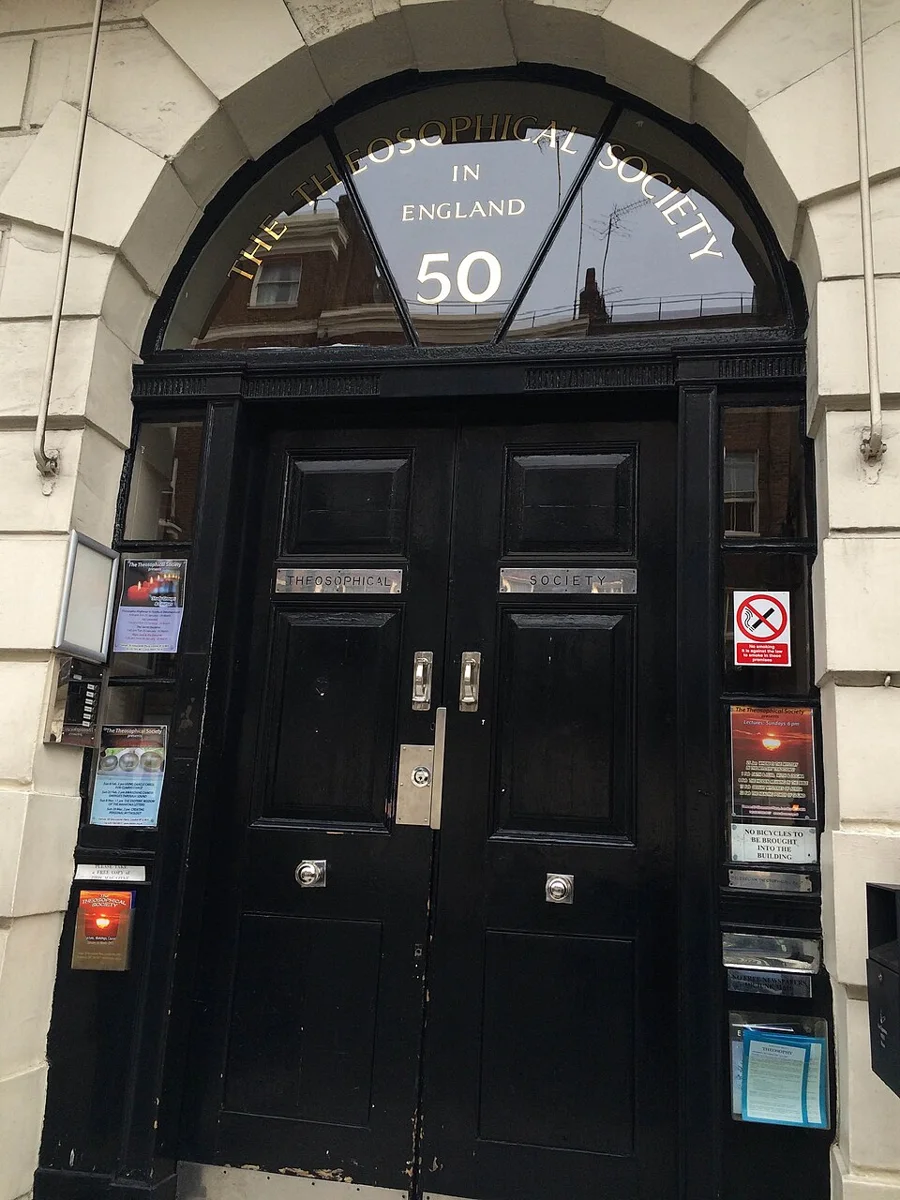
Entrance to the Theosophical Society in London: an international institutional example, not its Indian headquarters.
Credit: Secretlondon · CC BY-SA 4.0 · sourceResized and converted to WebP; uncropped.
1. Origins, terminology and institutional development
The Theosophical Society arose in the nineteenth-century environment of religious questioning, interest in Asian philosophies and dissatisfaction with rigid religious dogma. It was founded in New York in 1875 by a group whose leading figures included the Russian-born Helena Petrovna Blavatsky, the American Henry Steel Olcott and William Quan Judge. The word theosophy derives from Greek terms commonly rendered as divine wisdom. Its founders sought a deeper wisdom believed to underlie different religious traditions rather than establishing another exclusive religious denomination.
Blavatsky and Olcott reached India in 1879 and initially worked from Bombay. In 1882, the Society established its international headquarters at Adyar, then on the outskirts of Madras, now Chennai. This relocation made India central to its activities and distinguished it from reform associations that remained confined to a particular Indian region or community. Olcott served as its first president until his death in 1907; Annie Besant then became president.
The movement later developed organisational divisions, particularly around the 1895 separation associated with Judge’s American following. Consequently, references to the Theosophical Society in modern Indian history generally mean the Adyar-based organisation. For examination purposes, New York must be remembered as the founding location and Adyar as the later international headquarters.
- Founders and later leaders are not interchangeable: Annie Besant was its most prominent leader in India, not its original founder.
- The Society was international in origin, although India became its principal institutional and intellectual centre.
Timeline
1875
The Theosophical Society is founded in New York.
1879
Blavatsky and Olcott arrive in India.
1882
The international headquarters moves to Adyar, Madras.
1889–1893
Annie Besant joins the Society in 1889 and arrives in India in 1893.
1898
Besant and associates establish the Central Hindu College at Benares.
1907
Besant succeeds Olcott as president.
1916–1917
Besant establishes her Home Rule League in 1916 and presides over the Congress in 1917.
2. Objectives, beliefs and approach to religion
The Society’s three recognised objects were to form a nucleus of the universal brotherhood of humanity without distinctions such as race, creed, sex, caste or colour; encourage the comparative study of religion, philosophy and science; and investigate unexplained laws of nature and powers latent in human beings. Universal brotherhood was therefore broader than solidarity within any one religion or nation. Membership did not formally require conversion to a new faith or acceptance of every teaching associated with prominent theosophists.
Theosophical literature emphasised the possibility of an underlying unity among religions. Its leading writers drew extensively upon Hindu and Buddhist ideas, including karma, rebirth and spiritual evolution. They interpreted these through a wider esoteric framework that also incorporated Western occult traditions. Blavatsky’s Isis Unveiled, published in 1877, and The Secret Doctrine, published in 1888, became influential texts within the movement. These writings represent theosophical interpretations, not authoritative statements of all Hindu or Buddhist traditions.
Theosophy should not be equated with scientific rationalism. Although comparative inquiry and science appeared among its objects, claims about hidden spiritual knowledge, extraordinary powers and spiritual masters attracted criticism and remain matters of belief rather than established scientific findings. Nor was it simply a Hindu revival organisation: Hindu traditions were especially important in its Indian work, but its declared outlook was universal and comparative.
- Core vocabulary: universal brotherhood, comparative religion, karma, reincarnation, spiritual evolution and esotericism.
- Exam distinction: studying several religions is different from insisting on the exclusive authority of one scripture.
How theosophical activity contributed to India’s public life
- 1. International interest in Asian religious traditions
- 2. Establishment of headquarters at Adyar
- 3. Lectures, publications and comparative religious study
- 4. Cultural confidence and educational initiatives
- 5. Participation of leaders such as Besant in nationalist politics
3. Place in India’s social and religious reform movement
The Society entered India when colonial claims of Western superiority and missionary criticism had encouraged intense debate over Indian civilisation. Public appreciation of Indian philosophy by European and American theosophists helped some educated Indians challenge the assumption that their traditions were inherently inferior. Its contribution lay especially in cultural confidence, religious discussion, publication and education. It helped circulate Indian religious ideas internationally while encouraging Indian readers to reconsider their intellectual inheritance.
Its approach differed from that of several Indian reform movements. The Brahmo Samaj emphasised monotheism and criticised image worship; the Arya Samaj proclaimed the authority of the Vedas and rejected many later religious practices. The Theosophical Society instead pursued comparative and esoteric interpretations across traditions. It did not make rejection of image worship or exclusive adherence to the Vedas a general condition of membership. Unlike the Ramakrishna Mission, it was not primarily organised as a monastic institution combining Vedantic teaching with service.
Its significance nevertheless requires qualification. Intellectual enthusiasm for ancient wisdom did not necessarily produce a systematic challenge to every inherited social hierarchy. The universal brotherhood ideal could question caste prejudice, but individual theosophists differed in their interpretations of caste and social organisation. The movement’s reach was particularly strong among educated circles rather than the entire population. It is therefore more accurate to identify it with cultural-religious renewal and selected educational initiatives than with a uniform programme of radical social reconstruction.
- Its Indian role combined revivalist appreciation of ancient traditions with a universalist religious outlook.
- Avoid attributing identical views on social reform to every member or presenting the movement as a mass anti-caste organisation.
| Organisation | Origin | Distinctive emphasis |
|---|---|---|
| Brahmo Samaj | Rammohan Roy; Calcutta, 1828 | Monotheism, criticism of image worship and social reform |
| Arya Samaj | Dayanand Saraswati; Bombay, 1875 | Authority of the Vedas and reform through a return to Vedic principles |
| Theosophical Society | Blavatsky, Olcott and others; New York, 1875 | Universal brotherhood, comparative religion and esoteric inquiry |
| Ramakrishna Mission | Swami Vivekananda; Calcutta, 1897 | Practical Vedanta, religious harmony and organised service |
4. Annie Besant: education and nationalism
Annie Besant had been active in British secularist, socialist and reform circles before joining the Theosophical Society in 1889. She arrived in India in 1893 and became a major advocate of Indian religious and cultural traditions. Her educational programme aimed to combine modern learning with moral and religious instruction. In 1898, she and her associates established the Central Hindu College at Benares, now Varanasi. The institution subsequently became an important foundation for Banaras Hindu University, established in 1916 under Madan Mohan Malaviya’s leadership.
Besant also moved into Indian nationalist politics. Through publications such as New India and Commonweal, she advocated political reform and self-government. In 1916, she established a Home Rule League, while Bal Gangadhar Tilak organised a separate league. Their campaigns popularised the demand for self-government within the British Empire. Her internment in 1917 generated widespread protest and strengthened public attention to the Home Rule movement.
In December 1917, Besant presided over the Calcutta session of the Indian National Congress, becoming its first woman president. This is distinct from Sarojini Naidu’s position as the first Indian woman Congress president in 1925. Besant’s political career was closely connected with networks and public standing developed through theosophy, but Home Rule was not one of the Society’s three objects. The institution’s religious-philosophical identity must therefore be separated from the nationalist activities of its members.
- Remember the sequence: joined the Society in 1889, arrived in India in 1893, became president in 1907.
- Central Hindu College: Benares, 1898; Besant’s Home Rule League: 1916; Congress presidency: 1917.
5. Wider legacy and historical assessment
The Society’s impact extended beyond India. Olcott supported Buddhist revival and education in Ceylon, now Sri Lanka, after his visit with Blavatsky in 1880. His Buddhist Catechism, first published in 1881, became a notable educational text. Such activity illustrates how theosophical networks connected religious renewal across colonial societies rather than functioning solely within Indian nationalism.
At Adyar, the Adyar Library and Research Centre, established in 1886, supported the preservation and study of manuscripts and classical learning. The Society also fostered lectures, journals and educational institutions that brought Asian traditions into international discussion. Its legacy is thus strongest in transnational religious exchange, cultural self-confidence and education. A balanced assessment recognises these contributions while acknowledging its limited mass reach, contested occult claims and tendency to interpret diverse Asian traditions through a single framework of ancient wisdom.
- For Prelims, prioritise founders, places, dates, institutional associations and the distinction between organisational objectives and individual political work.
- For analytical answers, connect the movement with colonial cultural encounters, religious revival, education and emerging nationalism.
Theosophy: International Networks and Indian Reform
The supplied metadata identifies an entrance to the Theosophical Society in London. This is directly relevant as an example of the movement’s international institutional presence, but it is not evidence of its headquarters at Adyar or of particular activities in India. Founded in New York in 1875, the Society established its headquarters at Adyar, Madras, in 1882. Its objectives combined universal brotherhood, comparative study of religion, philosophy and science, and inquiry into unexplained natural laws and latent human capacities.
In colonial India, Theosophy encouraged interest in Hindu and Buddhist traditions and challenged assumptions of Western cultural superiority. Its educational work and affirmation of Indian intellectual traditions contributed to cultural self-confidence, although these contributions should not be equated with uniformly progressive social reform. Annie Besant became a prominent bridge between Theosophical circles, education and nationalism. Her Home Rule advocacy, however, must be distinguished from the Society’s institutional purposes. The London example helps frame this movement as a transnational exchange rather than an exclusively Indian religious organisation.
- Prelims distinction: the Society’s founding location was New York; Adyar became its headquarters later. London represents another institutional setting, not either founding location or Indian headquarters.
- Conceptual distinction: studying multiple religious traditions did not make Theosophy identical to the Brahmo Samaj or Arya Samaj; compare their objectives, authority claims and reform methods separately.
- Evidence limit: doorway metadata establishes an institutional association, not membership strength, popular reach or political influence. Assess Indian impact through educational records, publications and documented activities.
Real-world case studies
Central Hindu College and the making of BHU
The Central Hindu College, founded at Benares in 1898 by Besant and associates, sought to combine modern education with religious and moral instruction. Its later incorporation into the institutional development of Banaras Hindu University demonstrates the connection between cultural renewal and national education. Besant’s contribution should be recognised without displacing Madan Mohan Malaviya’s central role in founding BHU.
Olcott and Buddhist education in Sri Lanka
Following his 1880 visit to Ceylon, Olcott supported Buddhist educational organisation and helped promote Buddhist schools. His Buddhist Catechism appeared in 1881. This involvement illustrates the Society’s transnational influence and shows why its history cannot be reduced to Hindu revivalism alone.
Previous year questions
No source-linked PYQ is available here yet. Use the practice questions below.
Practice questions
Practice MCQ 1
With reference to the Theosophical Society, consider the following statements: 1. It was founded in New York. 2. Its international headquarters was established at Adyar in 1882. 3. Annie Besant was its first president. Which of the statements given above are correct?
- A. 1 and 2 only
- B. 2 and 3 only
- C. 1 and 3 only
- D. 1, 2 and 3
Practice MCQ 2
Which of the following was not one of the recognised objects of the Theosophical Society?
- A. Formation of a nucleus of universal human brotherhood
- B. Comparative study of religion, philosophy and science
- C. Establishment of the exclusive authority of the Vedas
- D. Investigation of unexplained laws of nature and powers latent in human beings
Practice MCQ 3
Consider the following events associated with Annie Besant: 1. Establishment of the Central Hindu College 2. Presidency of the Indian National Congress 3. Joining the Theosophical Society 4. Establishment of her Home Rule League. What is their correct chronological order?
- A. 3–1–4–2
- B. 1–3–2–4
- C. 3–4–1–2
- D. 1–4–3–2
Mains practice · Assess the contribution of the Theosophical Society to cultural renewal and education in colonial India. How should its role be distinguished from Annie Besant’s nationalist activities? Answer in 250 words.
- Introduce its international origins in 1875 and Adyar headquarters from 1882.
- Explain universal brotherhood, comparative religion and appreciation of Indian philosophical traditions.
- Discuss cultural confidence in the context of colonial and missionary criticism.
- Use the Central Hindu College and Adyar Library as educational examples.
- Distinguish the Society’s objects from Besant’s Home Rule League and Congress presidency.
- Balance achievements against limited mass reach and contested esoteric claims.
Further reading
- NCERT, Themes in Indian History, Part III, for the wider colonial and nationalist context.
- Bipan Chandra and others, India’s Struggle for Independence, for Home Rule and Annie Besant.
- Sumit Sarkar, Modern India 1885–1947, for reform, revivalism and nationalism.
- The Theosophical Society, Adyar: official history and Three Objects, ts-adyar.org.
- Banaras Hindu University: official institutional history, bhu.ac.in.
- Adyar Library and Research Centre: official institutional history and collections.
- https://commons.wikimedia.org/wiki/File:Theosophical_Society_England.jpg
Preparing for UPSC Civil Services? Get classroom teaching, answer-writing evaluation and mentorship at Pragnya IAS Academy, Ashok Nagar — see why aspirants choose us for IAS coaching in Hyderabad.