
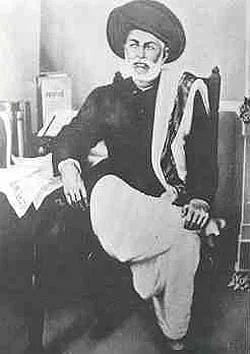
Jyotirao Phule, founder of the Satyashodhak Samaj; biographical illustration.
Credit: Unknown authorUnknown author · Public domain · sourceResized and converted to WebP; uncropped.
1. Historical context and foundation
The Satyashodhak Samaj emerged in nineteenth-century western India, where caste governed access to education, religious authority, occupations and social respect. Although Peshwa rule ended in 1818, inherited inequalities continued under British administration. Colonial schools, missionary activity, print culture and new urban occupations created opportunities to question established authority. These changes were uneven: literacy and access to administrative employment remained strongly shaped by caste and class.
Jyotirao Govindrao Phule, born in 1827 into a Mali family associated with gardening and cultivation, experienced the disabilities attached to non-Brahman status. His encounter with modern education helped him challenge claims that social rank was divinely ordained. He interpreted the degradation of lower castes not as a natural condition but as the outcome of historical domination, monopolisation of knowledge and religious practices that legitimised inequality.
On 24 September 1873, Phule founded the Satyashodhak Samaj in Pune. Its name expressed a commitment to seeking truth rather than accepting inherited religious authority. The organisation sought to enable oppressed communities to understand and resist their subordination. Unlike an association confined to elite theological debate, it connected religious reform with education, everyday dignity and the material interests of working people.
- Shudra and Atishudra were historically situated terms in Phule’s vocabulary; they should not be treated as exact equivalents of present-day constitutional categories.
- The Samaj originated before the Indian National Congress, founded in 1885.
Timeline
1848
Jyotirao and Savitribai Phule begin a girls’ school at Bhide Wada, Pune.
1873
Gulamgiri is published; the Satyashodhak Samaj is founded on 24 September.
1877
Krishnarao Bhalekar starts Dinbandhu.
1882
Phule submits his views on education to the Hunter Commission.
1890–1891
Phule dies in 1890; Sarvajanik Satya Dharma Pustak is published posthumously in 1891.
1902
Shahu Maharaj introduces reservation in Kolhapur state employment for backward classes, reflecting the wider movement towards social representation.
2. Ideology: caste, religion and social equality
Phule’s principal target was Brahmanical domination: a social and ideological order that justified hereditary caste privilege and reserved religious interpretation for a privileged group. He rejected the proposition that birth determined spiritual worth or entitled any caste to rule over others. His criticism addressed structures of power, although his polemical writing also sharply attacked those who sustained them. Social equality required challenging the religious foundations invoked to defend hierarchy.
The Samaj affirmed a universal creator, commonly described in Phule’s thought as Nirmik. It argued that human beings did not need hereditary priestly intermediaries to approach the creator. Religious life should rest on truth, moral conduct and human fellowship rather than ritual status. Its programme was therefore not simply atheism or a campaign for conversion; it sought to reconstruct ethical and religious life on an egalitarian basis.
Phule did not advocate a return to the Vedas as an authoritative solution to social problems. Instead, he questioned scriptural narratives and the authority claimed through them. His interpretations of mythology and the figure of Baliraja offered counter-narratives in which cultivators and oppressed people could recover dignity. These interpretations are important as political and intellectual interventions, not as settled accounts of ancient history.
Gulamgiri, published in 1873, linked caste oppression with the wider problem of human bondage. Phule dedicated it to those in the United States who had worked against slavery. His later Sarvajanik Satya Dharma Pustak, published posthumously in 1891, developed an ethical vision centred on truth and equality. Together, these writings reveal an attempt to make universal human dignity the basis of social organisation.
- Core distinction: rejection of caste hierarchy, not merely charitable assistance within the existing caste order.
- Exam contrast: the Arya Samaj invoked Vedic authority, whereas Phule challenged the use of scriptural authority to legitimise inequality.
Logic of Satyashodhak reform
- 1. Identify caste-based exclusion and monopolisation of knowledge
- 2. Question inherited religious authority
- 3. Expand education and critical awareness
- 4. Organise oppressed communities
- 5. Introduce egalitarian social practices
- 6. Seek dignity, representation and material improvement
3. Education, women and practical reform
Education was central to Phule’s understanding of emancipation. Denial of learning enabled dependence on dominant castes and reduced the ability of oppressed people to question exploitation. Jyotirao and Savitribai Phule began a school for girls at Bhide Wada in Pune in 1848 and subsequently expanded their educational work. These initiatives preceded the Samaj and must not be incorrectly dated to its foundation in 1873.
Savitribai Phule was an educator, writer and organiser in her own right, not merely an assistant to her husband. The Phules’ wider programme addressed the vulnerability of widows, the consequences of enforced sexual morality and exclusion from public resources. They supported widow remarriage and opposed child marriage. Their shelter initiative for pregnant widows and their opening of a household water source to excluded communities illustrated the practical character of their reform.
Satyashodhak marriage ceremonies reduced dependence on Brahman priests and emphasised simplicity, mutual obligations and public affirmation. They challenged both ritual hierarchy and expenses that burdened poorer households. Such ceremonies translated abstract equality into a visible change in family and community life. However, their social use should not be confused with automatic recognition under every marriage law.
Meetings, vernacular writing and accessible public communication helped spread the movement’s message beyond English-educated circles. Dinbandhu, started by Krishnarao Bhalekar in 1877, became an important platform for Satyashodhak concerns. The movement’s effectiveness depended on its ability to connect arguments about truth and justice with familiar experiences of schooling, marriage, agricultural work and social humiliation.
- Education and social reform were mutually reinforcing: knowledge enabled resistance, while changes in social practice widened access to knowledge.
- Distinguish the Phules’ lifelong reform activities from initiatives formally undertaken after the Samaj’s establishment.
| Organisation | Foundation | Prominent orientation |
|---|---|---|
| Brahmo Sabha, later Brahmo Samaj | 1828, Calcutta; Rammohan Roy | Monotheism, criticism of idolatry and social reform |
| Prarthana Samaj | 1867, Bombay; Atmaram Pandurang | Theistic reform, women’s uplift and opposition to caste restrictions |
| Satyashodhak Samaj | 1873, Pune; Jyotirao Phule | Anti-caste mobilisation, education and rejection of hereditary priestly mediation |
| Arya Samaj | 1875, Bombay; Dayanand Saraswati | Vedic authority, religious reform and educational activity |
4. Agrarian concerns and relationship with colonial rule
The Samaj’s social criticism extended beyond ritual discrimination. Phule viewed cultivators as vulnerable to intersecting forms of exploitation involving revenue demands, indebtedness, administrative intermediaries and ceremonial expenditure. Shetkaryacha Asud, generally dated to 1883, examined the hardships of the peasantry and criticised those who profited from agricultural labour without adequately protecting cultivators’ interests.
In his 1882 submission to the Indian Education Commission, commonly called the Hunter Commission, Phule pressed for wider primary education and questioned the concentration of public benefits among already advantaged groups. His approach connected education with the distribution of state resources: public expenditure should serve the productive majority rather than simply reproduce elite access to higher learning and employment.
Phule’s attitude towards British rule was qualified rather than uniformly supportive or oppositional. He sometimes regarded colonial authority as a possible counterweight to entrenched caste power and appealed to it for protective measures. At the same time, he criticised policies and administrative arrangements that harmed cultivators. This differs from the priorities of later mass anti-colonial nationalism. Describing him solely as either pro-British or nationalist obscures the social question at the centre of his politics.
- Analytical theme: caste, gender and agrarian inequality were interconnected rather than separate reform problems.
5. Expansion, significance and limitations
After Phule’s death in 1890, Satyashodhak ideas continued through activists, publications and local organisations. Savitribai sustained the wider reform work until her death in 1897. During the early twentieth century, the movement influenced a broader non-Brahman mobilisation in Maharashtra. Shahu Maharaj of Kolhapur supported education and representation for disadvantaged communities and became an important patron of this wider egalitarian current.
The Samaj’s historical significance lies in shifting reform from the benevolence of privileged groups towards the agency of subordinated communities. It connected dignity with institutional access, exposed the relationship between knowledge and power, and treated women’s education as integral to social transformation. B. R. Ambedkar later acknowledged Phule as an important intellectual predecessor, although Ambedkar’s constitutional, political and religious programme was distinct.
Its limitations included uneven geographical reach, restricted resources and differing interests within the broad non-Brahman constituency. Later non-Brahman politics did not always preserve Phule’s radical commitment to the most oppressed. For examination purposes, distinguish the original Samaj from subsequent political formations: influence and continuity do not mean identical organisations, membership or objectives.
- Overall assessment: a pioneering anti-caste association that joined religious criticism, education and practical social reform.
Phule and the Satyashodhak Challenge to Social Hierarchy
The supplied metadata identifies Jyotirao Phule, making this image directly relevant as a biographical illustration of the Satyashodhak Samaj’s founder. Established in Pune in 1873, the organisation connected criticism of caste hierarchy with practical social reform. Phule questioned the claim that birth conferred religious authority or social superiority. The Samaj sought to enable Shudras and Ati-Shudras to understand and assert their dignity without dependence on hereditary priestly mediation. Its significance therefore extends beyond religious reform to questions of power, knowledge and social equality.
Education was central to this emancipatory vision. Jyotirao and Savitribai Phule’s educational work preceded the Samaj and formed an important background to its programme; their earlier initiatives should not all be attributed to the organisation itself. Satyashodhak marriage practices also challenged priestly control by promoting ceremonies without Brahman priests. In western India, the movement helped shape subsequent non-Brahman mobilisation, although later organisations and leaders should not be treated as identical with Phule’s original association. The image metadata supports identification of the reformer, not conclusions about a particular meeting, ceremony or the Samaj’s membership.
- Prelims distinction: Satyashodhak Samaj was founded by Jyotirao Phule; do not confuse it with the Brahmo, Prarthana or Arya Samaj.
- Conceptual distinction: Challenging hereditary priestly authority did not simply mean rejecting every form of religious belief or ethical community.
- Mains linkage: Analyse education, gender reform and caste critique together, while distinguishing Phule’s individual initiatives from the Samaj’s institutional activities.
Real-world case studies
Bhide Wada: education before organisation
The girls’ school begun by the Phules at Bhide Wada in Pune in 1848 illustrates their early commitment to widening educational access. It preceded the Samaj by twenty-five years, demonstrating that the organisation consolidated a reform programme already underway.
Kolhapur: social equality and public employment
In 1902, Shahu Maharaj reserved 50 per cent of vacancies in Kolhapur state service for backward classes as defined by the state. This was not a policy enacted by the Samaj itself, but it illustrates how the broader non-Brahman reform environment connected education with access to public employment.
Previous year questions
No source-linked PYQ is available here yet. Use the practice questions below.
Practice questions
Practice MCQ 1
Consider the following statements about the Satyashodhak Samaj: 1. It was founded in Pune in 1873. 2. It regarded hereditary priestly mediation as essential to religious life. 3. It supported education for women and oppressed castes. Which statements are correct?
- A. 1 and 2 only
- B. 1 and 3 only
- C. 2 and 3 only
- D. 1, 2 and 3
Practice MCQ 2
Which of the following pairs is incorrectly matched?
- A. Gulamgiri — Critique of oppression through the language of slavery
- B. Shetkaryacha Asud — Concerns of cultivators
- C. Dinbandhu — Founded by Dayanand Saraswati
- D. Sarvajanik Satya Dharma Pustak — Phule’s ethical-religious thought
Practice MCQ 3
Which event occurred before the foundation of the Satyashodhak Samaj?
- A. Phule’s submission to the Hunter Commission
- B. Establishment of the Indian National Congress
- C. Publication of Dinbandhu
- D. Opening of the Phules’ girls’ school at Bhide Wada
Mains practice · The Satyashodhak Samaj linked religious criticism with the democratisation of social life. Discuss with reference to caste, education and gender. Answer in 250 words.
- Introduce Phule and the foundation of the Samaj in 1873.
- Explain the rejection of hereditary caste privilege and priestly mediation.
- Connect educational exclusion with the reproduction of power.
- Discuss Savitribai’s contribution and distinguish pre-1873 initiatives.
- Use simplified marriage ceremonies and agrarian criticism as examples.
- Assess its influence on non-Brahman mobilisation while noting uneven reach.
Further reading
- NCERT, Our Pasts III, chapter Women, Caste and Reform.
- NCERT, Themes in Indian History, Part III, for the wider colonial context.
- Jyotirao Phule, Gulamgiri, in a reliable annotated translation.
- Jyotirao Phule, Selected Writings, edited by G. P. Deshpande.
- Maharashtra State Gazetteers, official historical accounts of Pune and Kolhapur.
- https://commons.wikimedia.org/wiki/File:Mphule.jpg
Preparing for UPSC Civil Services? Get classroom teaching, answer-writing evaluation and mentorship at Pragnya IAS Academy, Ashok Nagar — see why aspirants choose us for IAS coaching in Hyderabad.