
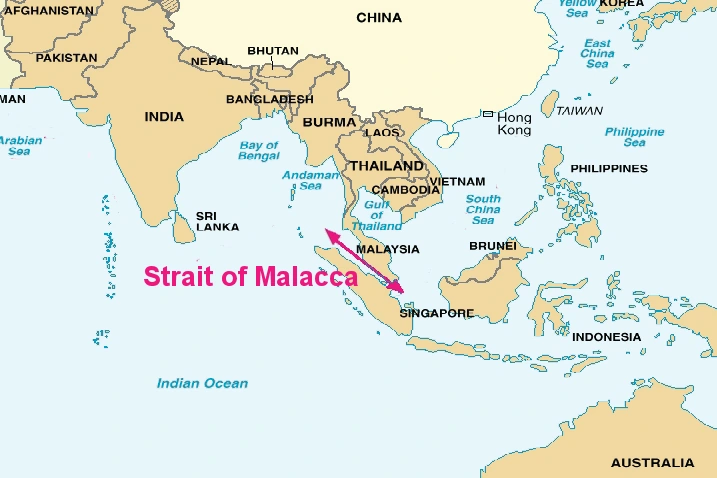
Map study
Strait of Malacca between the Malay Peninsula and Sumatra: trace the Indian Ocean–South China Sea shipping connection and its trade significance.
- Read the source legend and reference date before interpreting the map.
- Use spatial patterns to support topic revision; verify current official boundaries, designations and warnings separately.
Credit: US Department of Defense · Public domain · sourceConverted to WebP on an opaque white background; proportionally resized without cropping. Original cartography and legend retained.
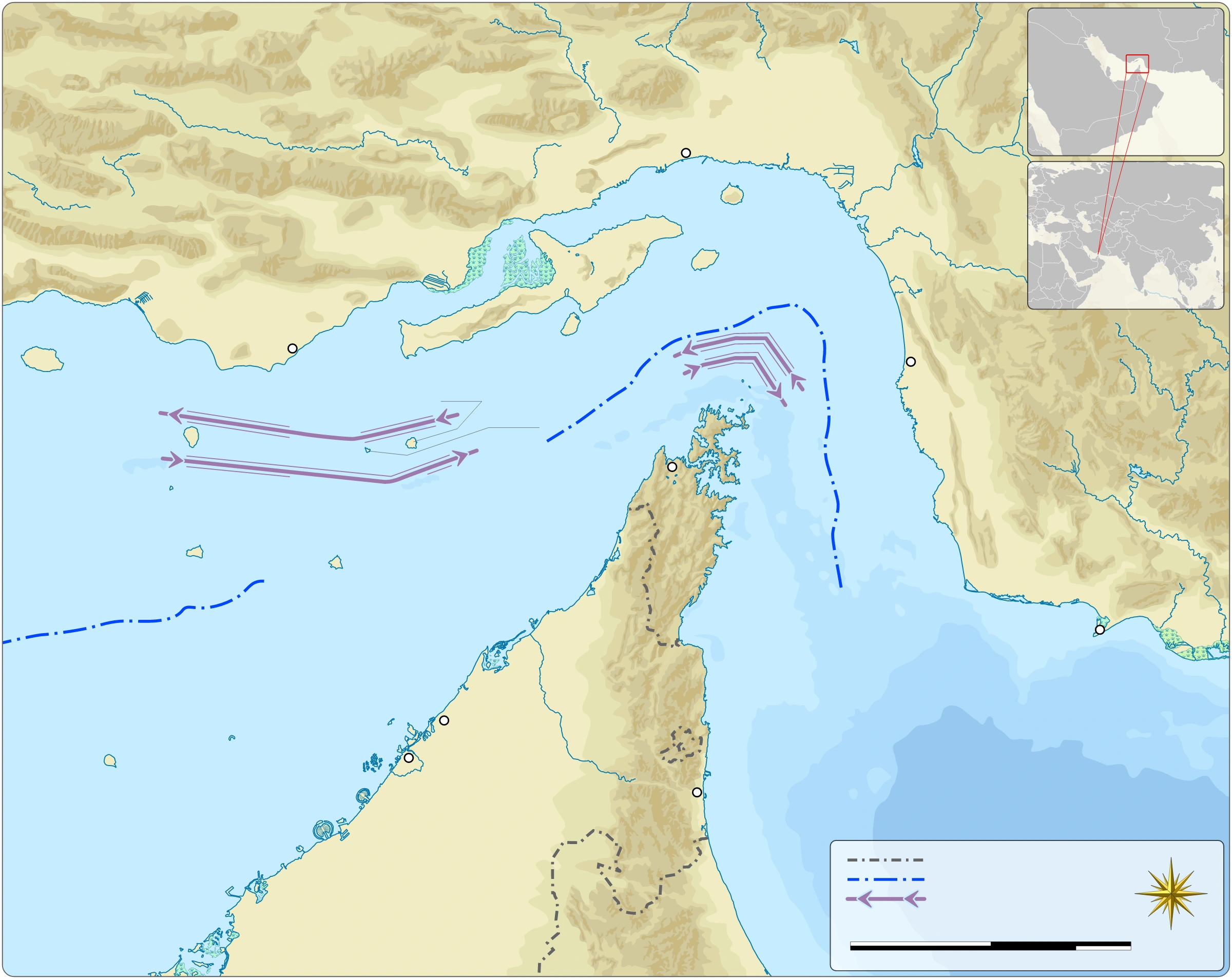
Map study
Strait of Hormuz: locate Iran, Oman and the Persian Gulf–Gulf of Oman connection. Geographic context for energy trade, not a current disruption map.
- Read the source legend and reference date before interpreting the map.
- Use spatial patterns to support topic revision; verify current official boundaries, designations and warnings separately.
Credit: Goran tek-en · CC BY-SA 4.0 · sourceConverted to WebP on an opaque white background; proportionally resized without cropping. Original cartography and legend retained.
The stakes: trade, energy and the Indian Ocean
India sits astride the world's busiest energy and trade routes. The Strait of Hormuz, Bab el-Mandeb and the Malacca Strait are chokepoints on which Indian imports and exports depend; disruption in any — as the 2023-24 Houthi attacks in the Red Sea showed — raises freight and insurance costs and threatens energy security. Offshore installations (Bombay High produces a significant share of domestic crude), submarine cables carrying the internet, and a growing offshore wind and deep-sea mining ambition widen the asset base to be protected.
The Indian Ocean is also increasingly contested. China's naval presence — anti-piracy task forces that never leave, a base at Djibouti, survey vessels mapping the ocean floor, and port stakes across the littoral — has normalised a extra-regional naval presence in what India considers its primary area of interest. Maritime security is thus simultaneously an economic, a military and a diplomatic project.
- Hormuz, Bab el-Mandeb and Malacca are India's critical chokepoints.
- Red Sea crisis (2023-24) forced rerouting and naval escort deployments.
- Offshore energy, undersea cables and deep-sea resources expand the protected estate.
- China's Indian Ocean presence is the central strategic challenge.
Timeline
2001
Andaman and Nicobar Command established.
2008
Anti-piracy patrols begin in the Gulf of Aden; IONS launched.
2015
SAGAR doctrine articulated.
2018
IFC-IOR commissioned at Gurugram.
2022
INS Vikrant commissioned; Maritime Anti-Piracy Act enacted.
2023-24
Major anti-piracy and escort operations in the Arabian Sea and Red Sea crisis.
Naval capability and posture
The Indian Navy's modernisation centres on carrier battle groups (INS Vikrant commissioned 2022, alongside INS Vikramaditya), nuclear submarines (INS Arihant class for deterrence patrol), P-8I maritime patrol aircraft, and Mission Based Deployments — continuous presence of warships across the Indian Ocean's key sea lanes, ready to respond to piracy, disaster or crisis. The Navy's 2023-24 anti-piracy surge in the Arabian Sea, rescuing hijacked vessels like MV Ruen, demonstrated this reach.
The Andaman and Nicobar Command gives India a forward tri-services presence near the Malacca Strait. The Coast Guard, with over 150 vessels, handles law enforcement in the EEZ. Gaps remain: submarine numbers are ageing, mine countermeasures are thin, and the share of the defence budget for the Navy lags the maritime ambition. Indigenisation — Vikrant, destroyers, and the planned next-generation submarines under Project 75I — is the long-term answer.
- Mission Based Deployments keep warships on station across the IOR.
- INS Vikrant (2022) made India one of few nations to build its own carrier.
- P-8I aircraft provide long-range maritime surveillance.
- Submarine strength and mine warfare are capability gaps.
India's maritime security logic
- 1. Protect trade and energy sea lanes
- 2. Maintain domain awareness (IFC-IOR, P-8I, satellites)
- 3. Deploy forward (MBD, ANC)
- 4. Cooperate regionally (SAGAR, IONS, Quad)
- 5. Grow the Blue Economy to sustain the effort
Cooperation as strategy: SAGAR and the network
India's maritime strategy is cooperative by design. SAGAR (2015) commits India to the security and prosperity of the whole region; the IFC-IOR shares white-shipping data with partners; India runs coordinated patrols with Indonesia, Thailand, Myanmar and Bangladesh; and the Indian Ocean Naval Symposium (IONS, 2008) builds navy-to-navy trust. The Colombo Security Conclave adds a security-specific grouping with Sri Lanka, Maldives and Mauritius.
Quad maritime cooperation — the Indo-Pacific Maritime Domain Awareness initiative and the Maritime Initiative for Training in the Indo-Pacific — extends the network. India is also the Indian Ocean's first responder for humanitarian assistance and disaster relief: the 2004 tsunami, cyclone relief in Mozambique, and vaccine and food aid during crises build the soft-power capital that underwrites its security role.
- IONS (2008) links Indian Ocean navies; India is a founding chair.
- Coordinated patrols with Indonesia, Thailand, Myanmar, Bangladesh.
- Quad's IPMDA shares maritime domain awareness with the region.
- HADR operations build India's first-responder reputation.
| Instrument | Purpose |
|---|---|
| Mission Based Deployments | Continuous naval presence on key sea lanes |
| IFC-IOR | White-shipping information sharing with partners |
| Andaman & Nicobar Command | Tri-services presence near Malacca Strait |
| Coordinated patrols | Joint EEZ surveillance with neighbours |
| SAGAR/IONS | Regional cooperation and navy-to-navy trust |
Blue Economy and the security-development link
The Blue Economy — fisheries, ports, shipping, offshore energy, marine biotechnology, tourism and deep-sea exploration — is both a growth strategy and a security argument: a prosperous maritime economy justifies and funds maritime security. Sagarmala modernises ports and coastal logistics; the Deep Ocean Mission explores polymetallic nodules; the Maritime India Vision 2030 targets port-led development.
Security enables the Blue Economy and is enabled by it: ports are dual-use infrastructure, merchant shipping and fishing fleets are surveillance multipliers, and island development (Lakshadweep, Andaman and Nicobar) extends India's maritime reach. The Holistic Development of Islands programme and the Lakshadweep infrastructure push reflect this integration. The strategic logic is circular: wealth from the sea funds the fleets that keep the sea safe for wealth.
- Sagarmala: port-led development and coastal logistics.
- Deep Ocean Mission: polymetallic nodules and marine research.
- Island development extends surveillance and presence.
- Ports and shipping are dual-use security assets.
Real-world case studies
Rescue of MV Ruen (2024)
When the bulk carrier MV Ruen, hijacked by Somali pirates, was used as a mother ship, the Indian Navy deployed INS Kolkata, a submarine, drones and marine commandos in a 40-hour operation 1,400 nautical miles from the coast, freeing 17 crew and capturing 35 pirates — a demonstration of blue-water reach and the 2022 anti-piracy law's first major use.
Red Sea crisis response (2023-24)
Houthi attacks on shipping forced India to deploy over a dozen warships for escort and reassurance in the Arabian Sea and Gulf of Aden, inspect hundreds of vessels and respond to drone attacks on India-bound merchant ships — underlining that distant chokepoints are domestic economic concerns.
Previous year questions
No source-linked PYQ is available here yet. Use the practice questions below.
Practice questions
Practice MCQ 1
The IFC-IOR, which shares maritime traffic information with partner countries, is located at:
- A. Port Blair
- B. Mumbai
- C. Gurugram
- D. Kochi
Practice MCQ 2
India's only tri-services theatre command is:
- A. Western Naval Command
- B. Andaman and Nicobar Command
- C. Southern Command
- D. Strategic Forces Command
Mains practice · 'For India, maritime security is economic security.' Discuss with reference to sea lanes, chokepoints and the Blue Economy.
- 90% of trade by volume by sea; energy imports via Hormuz.
- Chokepoint vulnerability: Red Sea crisis as case study.
- Blue Economy: ports, offshore energy, deep-sea mission.
- Naval modernisation and MBD as enablers.
Mains practice · Examine India's strategy to manage China's growing presence in the Indian Ocean.
- String of Pearls: Gwadar, Hambantota, Djibouti; survey vessels.
- Indian counters: SAGAR, IFC-IOR, ANC, Quad, HADR leadership.
- Capability gaps: submarines, budget share.
- Cooperation-competition balance; avoiding escalation.
Further reading
- Indian Maritime Doctrine, Indian Navy
- SAGAR vision statement (2015)
- Maritime India Vision 2030
Preparing for UPSC Civil Services? Get classroom teaching, answer-writing evaluation and mentorship at Pragnya IAS Academy, Ashok Nagar — see why aspirants choose us for IAS coaching in Hyderabad.