
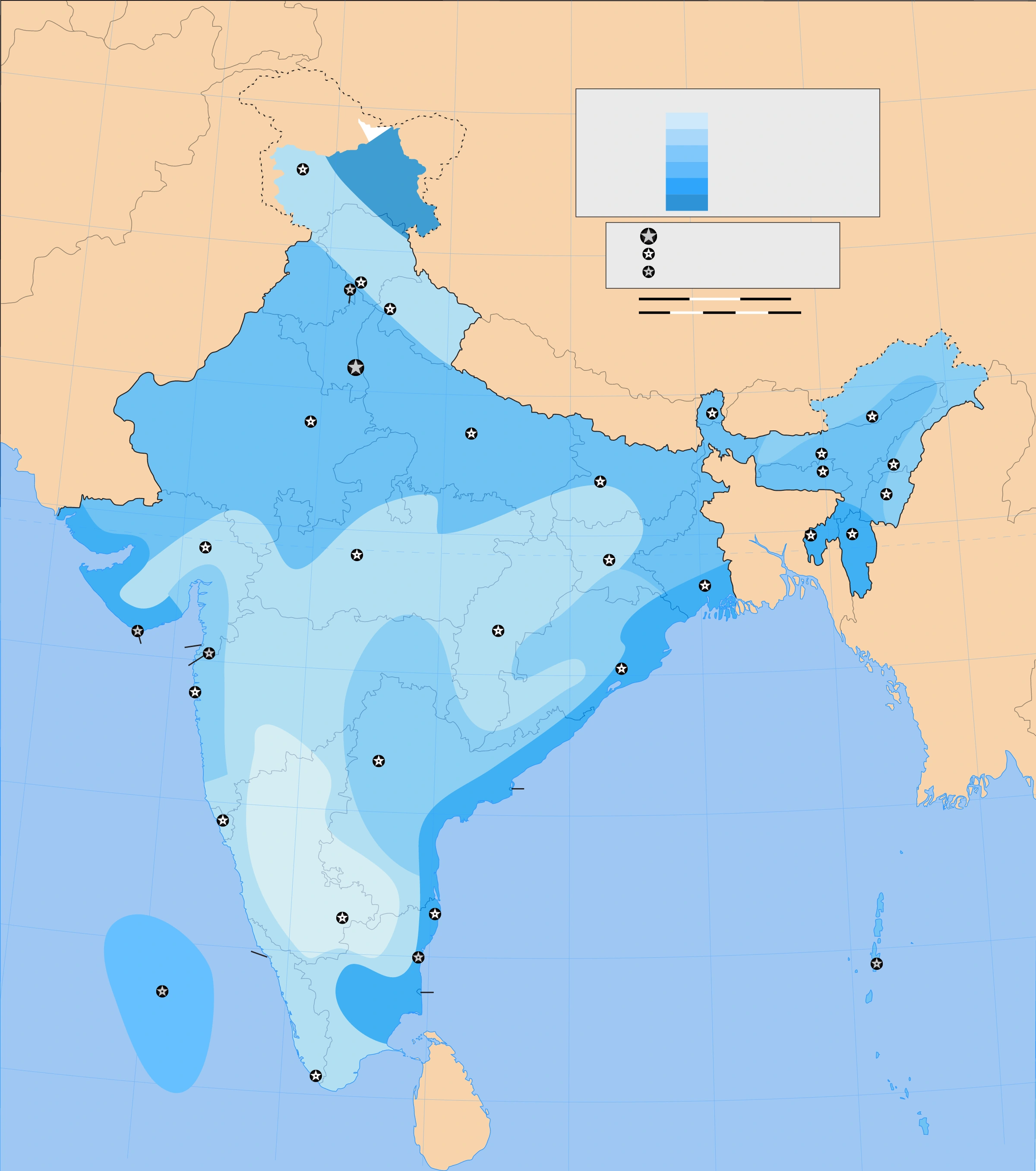
Map study
Wind and cyclone-risk reference zones: compare east coast, west coast and inland areas. Current official forecasts must guide operational decisions.
- Read the source legend and reference date before interpreting the map.
- Use spatial patterns to support topic revision; verify current official boundaries, designations and warnings separately.
Credit: Planemad · CC BY-SA 3.0 · sourceConverted to WebP on an opaque white background; proportionally resized without cropping. Original cartography and legend retained.
Why the coast matters: threat profile
The sea was historically India's open flank. The 1993 Mumbai blasts used coastal landing points to smuggle RDX; 26/11 proved that a determined enemy could sail hundreds of kilometres and land in India's financial capital. Beyond terrorism, the coast faces smuggling of gold, drugs (the Arabian Sea route from Afghanistan via Pakistan), arms and contraband; illegal fishing; human trafficking; and piracy in the Arabian Sea. Island territories and the 1,197 islands, many uninhabited, offer hideouts and landing points.
The economic stakes amplify the security imperative: over 90% of India's trade by volume moves by sea; major ports, refineries, LNG terminals, offshore oil installations (Bombay High) and nuclear plants (Tarapur, Kudankulam, Kalpakkam) sit on the coast. A successful attack on any of these would be a national economic event, not just a security incident.
- 26/11 and 1993 blasts both exploited the sea route.
- Drug smuggling via the Arabian Sea is a growing narco-terror channel.
- Ports, refineries, offshore rigs and nuclear plants are high-value coastal targets.
- Uninhabited islands and fishing fleets are surveillance blind spots.
Timeline
1993
Mumbai blasts explosives landed via the coast.
2005
Coastal Security Scheme Phase I creates marine police.
2008
26/11 seaborne attack; coastal security overhaul ordered.
2014
IMAC commissioned at Gurugram under NMDA project.
2022
National Maritime Security Coordinator appointed; Maritime Anti-Piracy Act enacted.
The post-26/11 architecture
The 26/11 attacks triggered a comprehensive overhaul. Operational responsibility was clarified: the Navy was made responsible for overall maritime security including coastal and offshore security; the Coast Guard for territorial waters; and State Marine Police — a new force created under the Coastal Security Scheme — for the shoreline belt. Joint Operations Centres were established at Mumbai, Visakhapatnam, Kochi and Port Blair, and coastal security coordination committees at national, state and district levels.
Surveillance was the second pillar. A chain of coastal radar stations (46 in phase one, expanded later with 38 more including island territories) covers the coastline; the NC3I network links naval and coast guard nodes; and the IMAC at Gurugram, the nerve centre of the National Maritime Domain Awareness (NMDA) project, fuses data from radars, AIS transponders, satellite tracking and intelligence to build a recognised maritime picture. The National Maritime Security Coordinator (2022) now provides apex coordination.
- Navy: overall maritime security; Coast Guard: territorial waters; Marine Police: shoreline.
- Joint Operations Centres at Mumbai, Visakhapatnam, Kochi, Port Blair.
- Coastal radar chain + NC3I + IMAC = maritime domain awareness.
- National Maritime Security Coordinator appointed in 2022.
How a suspicious vessel is tracked
- 1. Radar/AIS/satellite detection
- 2. IMAC fuses data and flags anomaly
- 3. Joint Operations Centre assigns interceptor
- 4. Coast Guard or Marine Police boards and inspects
- 5. Intelligence follow-up on crew and cargo
State Marine Police and the community layer
State Marine Police are the weakest and most critical link. Created under the Coastal Security Scheme (2005 onwards), they operate over 200 coastal police stations with interceptor boats, but suffer from manpower shortages, poor training in maritime operations, boat maintenance issues and unclear jurisdiction. The 2021 expansion approved more stations, boats and manpower, and the Sagarmala programme has funded coastal infrastructure.
Fishermen are the eyes and ears of coastal security: over 2 lakh fishing boats operate along the coast. Measures include biometric ID cards for fishermen, colour-coding and registration of boats, AIS transponders on larger vessels, and community awareness programmes. Sagar Kavach exercises test the whole system — from radar detection to marine police interception — and have repeatedly exposed and fixed gaps.
- Coastal Security Scheme funds marine police stations, boats and jetties.
- Fishermen ID cards, boat registration and AIS transponders aid identification.
- Sagar Kavach exercises test inter-agency coastal response.
- Marine police capacity remains the weakest link.
| Layer | Agency | Zone |
|---|---|---|
| Outer | Indian Navy | Overall maritime security, EEZ and beyond |
| Middle | Indian Coast Guard | Territorial waters (up to 12 nm) and EEZ enforcement |
| Inner | State Marine Police | Shoreline belt and coastal waters |
| Shore | District police, fisheries, customs, port security | Landing points, ports, coastal communities |
Challenges and the way forward
Persistent challenges include the sheer scale of legitimate sea traffic that hides threats (dhows, fishing boats, merchant traffic), the slow modernisation of marine police, coordination frictions among a dozen agencies, and new vectors: sea drones, semi-submersibles for drug runs, and the use of mother ships to transfer contraband to small boats beyond radar coverage. The 2021-24 seizures of multi-hundred-kg drug consignments off Gujarat and Kerala show the scale of the maritime drug trade.
The way forward combines technology (satellite-based tracking of small vessels, AI-enabled anomaly detection at IMAC), capacity (marine police professionalisation, more interceptor craft), legal tools (the Maritime Anti-Piracy Act 2022 filled a long-standing gap) and regional cooperation through the Indian Ocean Rim Association, the Colombo Security Conclave and information-fusion centres in Gurugram (IFC-IOR) that share shipping data with partner countries.
- Mother ships transfer drugs to small boats beyond radar coverage.
- Maritime Anti-Piracy Act 2022 gave India a dedicated piracy law.
- IFC-IOR (Gurugram) shares maritime data with 20+ partner nations.
- Colombo Security Conclave (India, Sri Lanka, Maldives, Mauritius) deepens regional cooperation.
Real-world case studies
26/11: the sea route to Mumbai
Ten LeT terrorists sailed from Karachi on a Pakistani vessel, hijacked the Indian fishing trawler Kuber mid-sea, killed its crew, and landed at Badhwar Park in inflatable dinghies. The attack exposed the absence of coastal radar coverage, marine police and inter-agency coordination — all of which were built or strengthened in the following decade.
Drug seizures off Gujarat (2021-24)
The Navy, Coast Guard, NCB and ATS jointly seized multiple consignments of heroin and methamphetamine — some exceeding 500 kg — from dhows and fishing boats off the Gujarat coast. The operations demonstrated the value of the NMDA's data fusion and the continuing scale of the Arabian Sea drug highway.
Previous year questions
No source-linked PYQ is available here yet. Use the practice questions below.
Practice questions
Practice MCQ 1
Under India's coastal security arrangement, the Indian Coast Guard is responsible for:
- A. Overall maritime security
- B. Territorial waters and EEZ enforcement
- C. Shoreline policing
- D. Port management
Practice MCQ 2
The Information Management and Analysis Centre (IMAC), the nerve centre of maritime domain awareness, is located at:
- A. Mumbai
- B. Kochi
- C. Gurugram
- D. Visakhapatnam
Mains practice · '26/11 was a failure of maritime domain awareness more than of policing.' Discuss the reforms that followed and the gaps that remain.
- Pre-2008 gaps: no radar chain, no marine police, unclear responsibility.
- Reforms: Navy's overall charge, radar chain, NC3I, IMAC, Sagar Kavach.
- Remaining gaps: marine police capacity, small-boat tracking.
- Future: satellite tracking, AI analytics, regional data sharing.
Mains practice · Examine the link between maritime drug trafficking and India's internal security, and evaluate the institutional response.
- Arabian Sea route funds narco-terror; Gujarat and Kerala seizures.
- Mother ship-small boat transfer model defeats shore radar.
- Response: NMDA, joint ops, Maritime Anti-Piracy Act, Colombo Security Conclave.
- Need: international interdiction, financial follow-through, coastal community vigilance.
Further reading
- Indian Coast Guard — indiancoastguard.gov.in
- National Maritime Domain Awareness project
- Maritime Anti-Piracy Act 2022
Preparing for UPSC Civil Services? Get classroom teaching, answer-writing evaluation and mentorship at Pragnya IAS Academy, Ashok Nagar — see why aspirants choose us for IAS coaching in Hyderabad.