
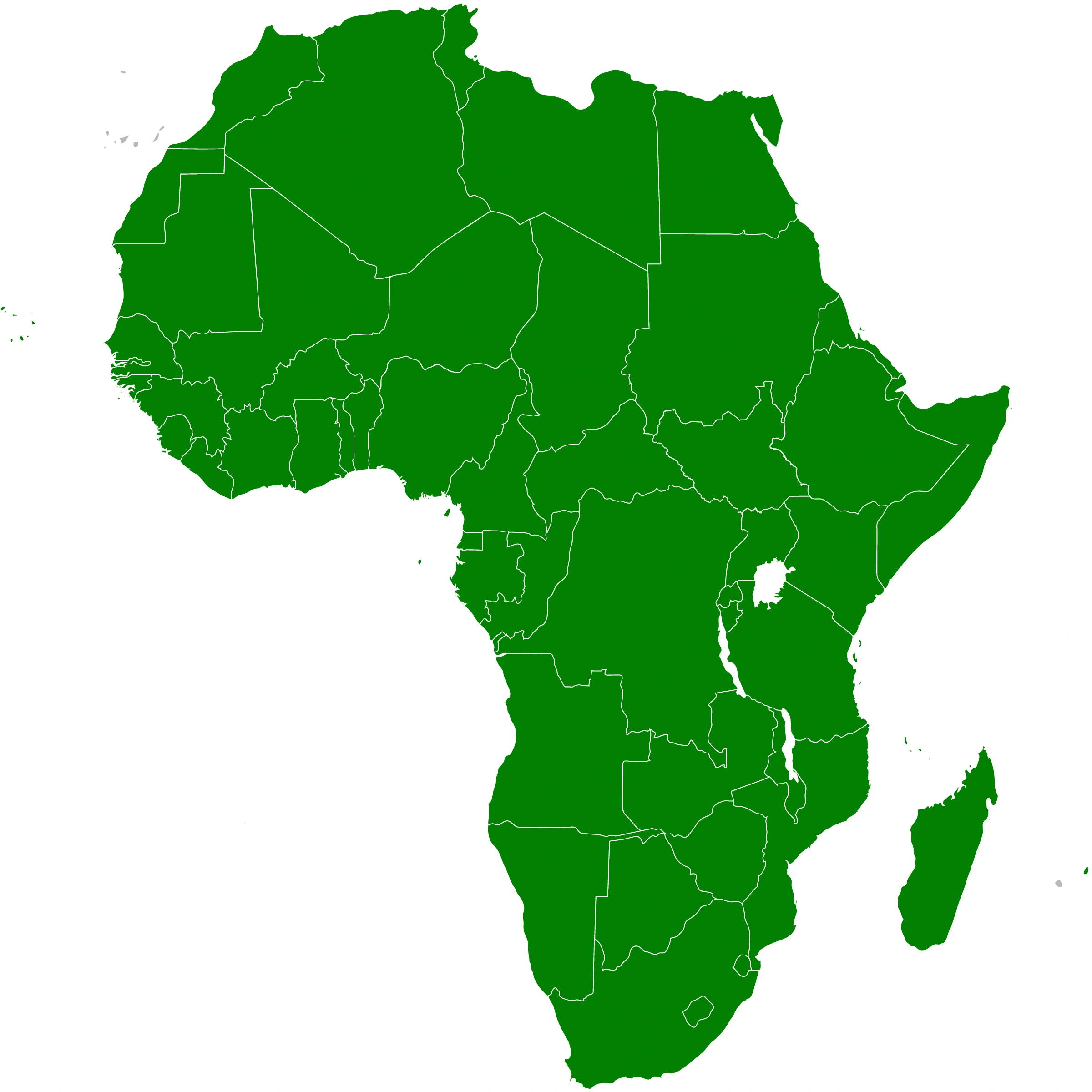
Map study
African Union geographic context: locate the Sahel, Horn of Africa and major African regions; verify current membership and suspensions separately.
- Read the source date and legend; distinguish territory, influence and geographic location.
- Historical boundaries and reference memberships are not live political or operational data.
Credit: Mangwanani · CC BY-SA 4.0 · sourceConverted to WebP on an opaque white background; proportionally resized without cropping. Original cartography and legend retained.
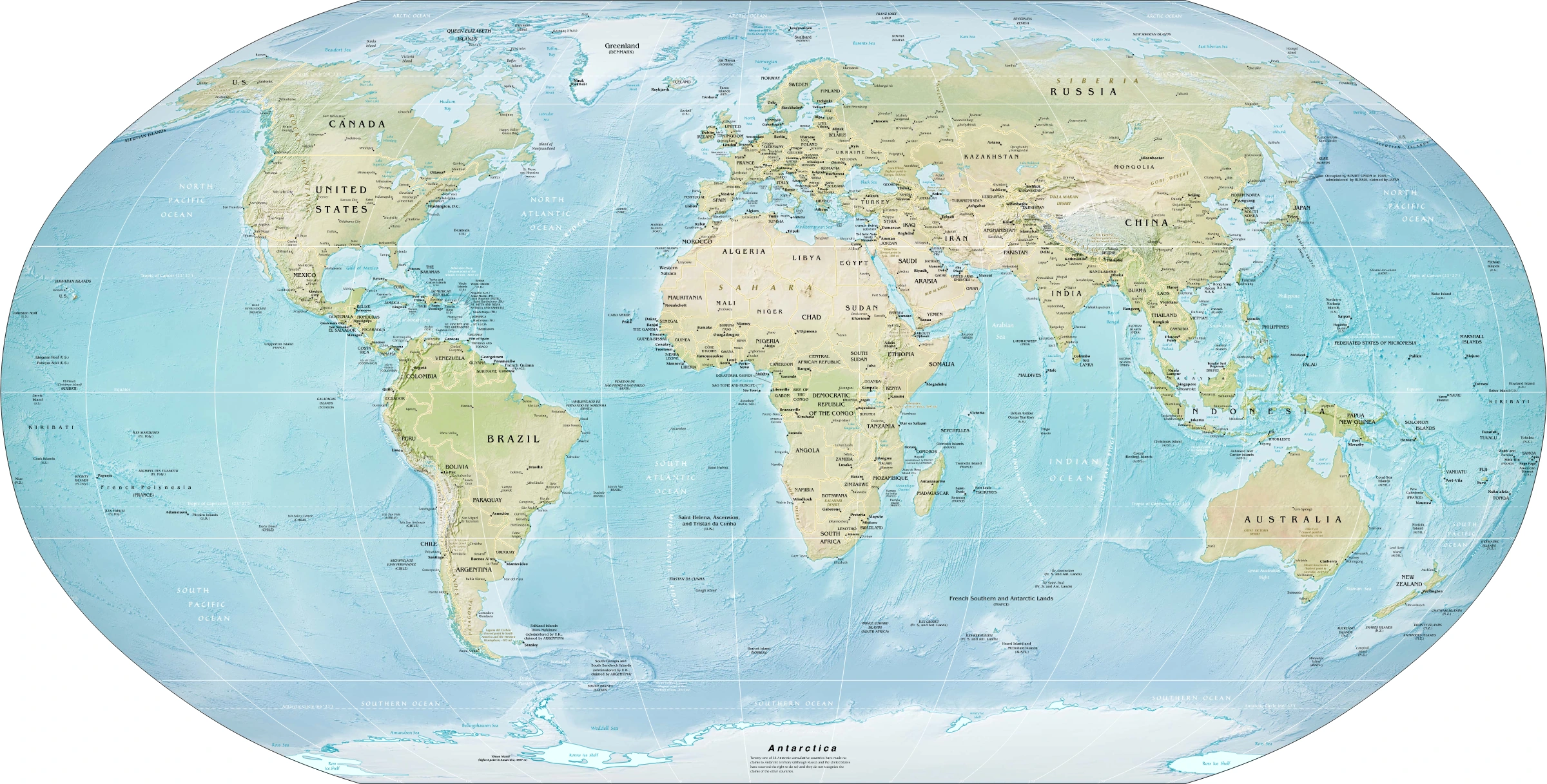
Map study
World physical relief: locate major mountain belts, plains and ocean basins. Regional orientation, not a detailed local landform survey.
- Read the source date and legend; distinguish territory, influence and geographic location.
- Historical boundaries and reference memberships are not live political or operational data.
Credit: US Government; Central Intelligence Agency · Public domain · sourceConverted to WebP on an opaque white background; proportionally resized without cropping. Original cartography and legend retained.
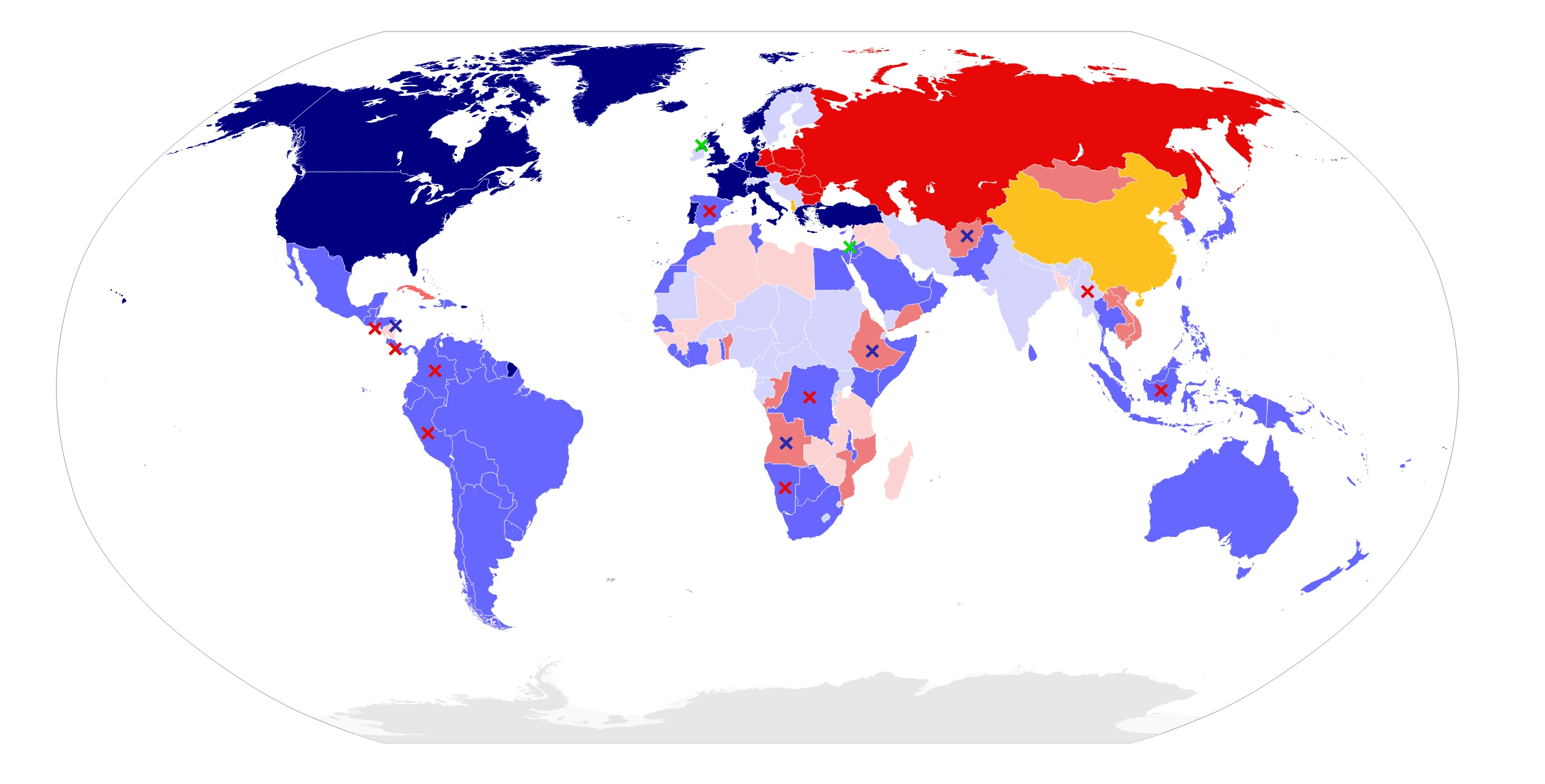
Map study
Cold War alliances in 1980: compare blocs and non-aligned regions. This historical map is not current NATO membership or present geopolitical alignments.
- Read the legend and reference date before interpreting regional patterns.
- Relate the map to the article’s topic; verify current administrative boundaries or data separately.
Credit: Chabacano; Sancebau · CC BY-SA 3.0 · sourceConverted to WebP on an opaque white background; proportionally resized without cropping. Original cartography and legend retained.
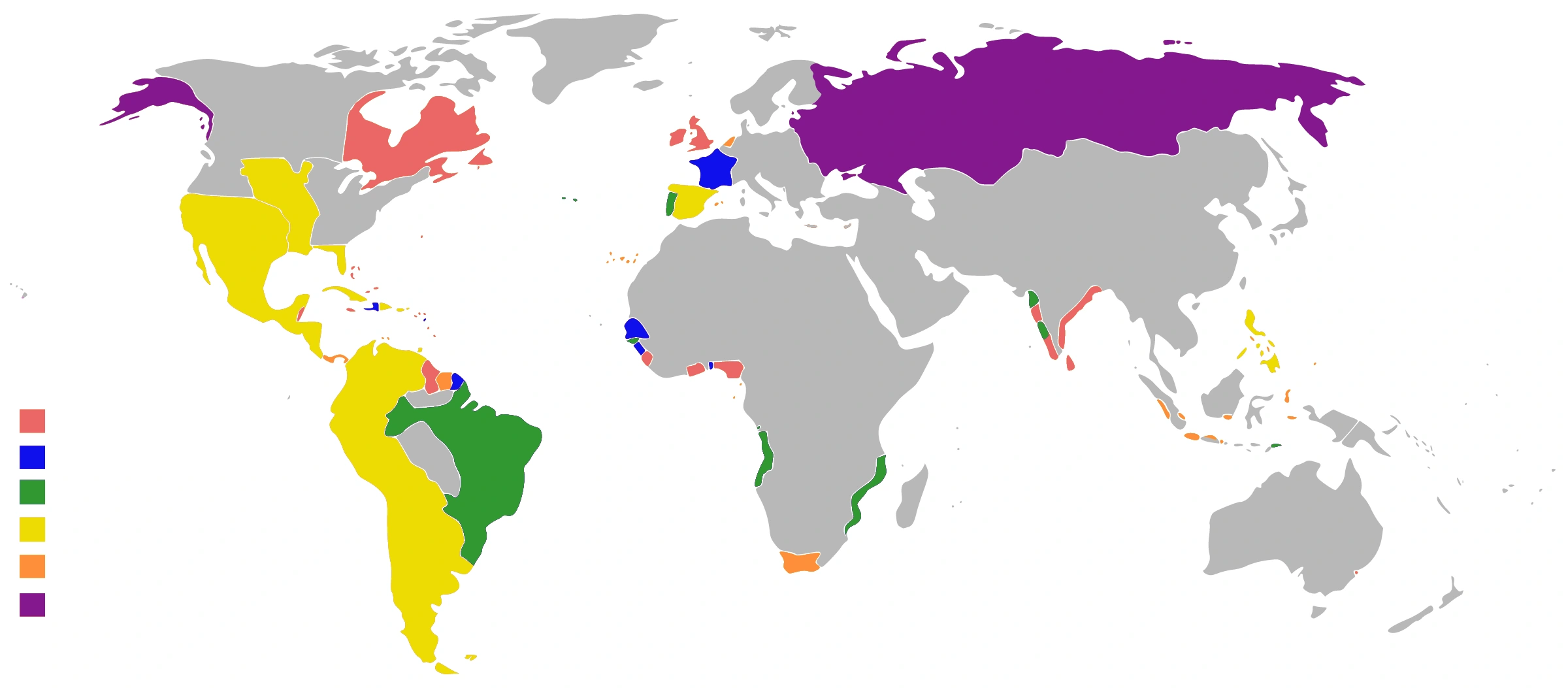
Map study
Colonial empires in 1800: global context for European expansion. A date-specific map, not the maximum territorial extent of every colonial power.
- Read the legend and reference date before interpreting regional patterns.
- Relate the map to the article’s topic; verify current administrative boundaries or data separately.
Credit: George Tsiagalakis · CC BY-SA 4.0 · sourceConverted to WebP on an opaque white background; proportionally resized without cropping. Original cartography and legend retained.
Meaning, origins and conceptual boundaries
The Global South describes countries sharing, to varying degrees, experiences of colonial domination, unequal integration into the world economy and continuing development constraints. It also expresses a political demand: countries with limited influence over international rules should have a greater role in making them. Unlike the Cold War expression Third World, it is not primarily defined by distance from two military blocs. Nor is it interchangeable with the World Bank’s income classifications.
Its intellectual and political roots lie in decolonisation, the 1955 Bandung Conference, the Non-Aligned Movement established in 1961 and developing-country coordination through UNCTAD and the G77. The 1974 demand for a New International Economic Order sought fairer trade, greater control over natural resources, technology access and reform of international finance. The Brandt Commission’s 1980 report popularised the North–South development divide.
Geography alone is misleading: India lies largely in the Northern Hemisphere, while Australia belongs to the developed North. The category also contains major differences in income, state capacity and geopolitical ambition. China is a leading industrial and financial power, while many least developed countries face narrow export bases and acute vulnerability. Consequently, the Global South is best understood as an overlapping set of interests rather than a homogeneous bloc.
- Use Global South as an analytical and political category, not as a fixed legal classification.
- Distinguish South–South cooperation among developing countries from triangular cooperation involving an additional developed-country or multilateral partner.
Timeline
1955
The Bandung Conference advances Afro-Asian solidarity and cooperation among newly independent countries.
1961–1964
The Non-Aligned Movement is established in 1961; the G77 is formed at UNCTAD in 1964.
1974
The UN General Assembly adopts the Declaration and Programme of Action on a New International Economic Order.
1980
The Brandt Commission publishes North–South: A Programme for Survival.
2023
India hosts two Voice of Global South Summits; the African Union becomes a permanent G20 member.
2024
India hosts the third Voice of Global South Summit and proposes a Global Development Compact.
Core agenda in multilateral governance
Representation is central to the Global South’s agenda. The UN Security Council’s permanent membership reflects the power distribution of 1945, and Africa has no permanent seat. IMF quotas and voting arrangements influence access to resources and decision-making, while developing countries seek stronger participation in the World Bank and other financial institutions. Reform demands therefore concern both voice in governance and the substantive rules governing development.
Economic priorities include affordable long-term finance, debt sustainability, technology transfer, infrastructure and policy space for industrialisation. External debt distress can force governments to compress health, education and investment expenditure. The G20 Common Framework, adopted in 2020, attempts to coordinate debt treatment for eligible countries, but slow negotiations and coordination problems among official and private creditors have exposed its limitations. Multilateral development bank reform should expand lending without making development finance prohibitively expensive.
At the WTO, many developing countries defend special and differential treatment, food security programmes and a development-oriented trading system. However, their positions differ: agricultural exporters and food-importing countries may disagree over subsidies and market access. Climate negotiations likewise combine shared principles with competing interests. Common but differentiated responsibilities and respective capabilities recognise unequal historical contributions and capacities, but small island states, fossil-fuel exporters and large emerging economies do not have identical negotiating priorities.
Health and digital governance have widened the agenda. COVID-19 exposed unequal vaccine access and dependence on concentrated supply chains. Developing countries seek stronger local manufacturing, resilient public health systems and equitable access to medical technologies. In the digital sphere, affordable connectivity, data governance, cybersecurity and access to artificial intelligence infrastructure are becoming important distributive questions.
- Climate justice involves mitigation, adaptation, predictable finance, technology access and support for loss and damage.
- Assess global reforms through three tests: representation, affordability and demonstrable development outcomes.
Converting development priorities into multilateral outcomes
- 1. Identify shared problems through national and regional consultations
- 2. Build issue-specific coalitions
- 3. Negotiate institutional, financial or regulatory changes
- 4. Mobilise finance, technology and implementation capacity
- 5. Evaluate outcomes and ensure partner-country accountability
Institutions and coalitions: overlapping rather than unified
The G77 provides the broadest developing-country negotiating platform within the UN system, particularly on economic and development issues. The Non-Aligned Movement emphasises sovereignty, independence and opposition to domination. UNCTAD supplies research, consensus-building and technical assistance on trade and development; it is a UN body rather than a developing-country political coalition.
BRICS offers a platform for major emerging economies and other members to seek greater influence in global governance. Its New Development Bank finances infrastructure and sustainable development. However, BRICS does not represent every developing country, and its members have significant strategic differences. The G20 is different again: it brings developed and developing economies together, making it a forum for negotiation across the North–South divide rather than an institution of the Global South.
Issue-based coalitions often explain negotiations better than broad labels. The Alliance of Small Island States presses for ambitious climate action because sea-level rise threatens its members’ survival. Least developed countries stress concessional finance and vulnerability. African states pursue regional priorities through the African Union. Effective Southern cooperation therefore requires flexible coalitions and regional ownership, not an assumption of automatic agreement.
| Platform | Principal role | Important distinction |
|---|---|---|
| G77 | Developing-country coordination in the UN system | Broad negotiating coalition, not a financing institution |
| Non-Aligned Movement | Sovereignty and political cooperation | Non-alignment does not mean neutrality on every issue |
| BRICS | Coordination on governance reform and development | Does not represent the entire Global South |
| G20 | International economic coordination | Includes both developed and developing economies |
| UNCTAD | Trade and development research and assistance | A UN body, not an exclusively Southern coalition |
India’s approach and instruments
India links its Global South engagement to anti-colonial solidarity, strategic autonomy and a more representative international order. Its approach combines participation in Southern platforms with engagement in institutions involving advanced economies. Membership of BRICS alongside participation in the Quad illustrates that development cooperation and strategic partnerships need not fit a rigid North–South alignment.
India’s 2023 G20 presidency sought to bring developing-country concerns into a forum where many affected states lack direct representation. The Voice of Global South Summits gathered perspectives on development challenges, while the African Union’s admission to the G20 provided an institutional advance in representation. At the third summit in August 2024, India proposed a Global Development Compact centred on areas including capacity-building, technology sharing, trade and development finance.
Practical instruments include the Indian Technical and Economic Cooperation programme, launched in 1964, concessional lines of credit, grants, scholarships and humanitarian assistance. The India–UN Development Partnership Fund supports projects in developing countries, including least developed countries and small island developing states. The International Solar Alliance and Coalition for Disaster Resilient Infrastructure connect development needs with climate action, though neither is restricted to the Global South.
India also promotes digital public infrastructure through experience with digital identity and interoperable payments. Such cooperation can reduce transaction costs and improve service delivery, but successful adaptation requires local ownership, privacy safeguards, cybersecurity and administrative capacity. India’s credibility ultimately depends on timely project completion, transparent terms and responsiveness to partner-country priorities rather than diplomatic declarations alone.
Constraints and the way forward
The central challenge is diversity. Large emerging economies may prioritise industrial competitiveness, while small island states emphasise climate survival and poorer countries seek basic fiscal space. India–China competition complicates claims of common leadership. Dependence on commodity exports, external technology and international capital can also constrain independent policy choices. South–South cooperation is not automatically equitable: unequal bargaining power and poorly designed projects can reproduce dependency.
A constructive approach should avoid presenting the Global South as necessarily anti-Western. Developing countries frequently seek partnerships with multiple powers while resisting exclusive alignment. Priorities should include more representative institutions, faster and fairer debt resolution, accessible climate finance, strengthened local manufacturing and accountable development partnerships. For India, leadership is most credible as a convening and problem-solving role: amplify smaller states’ voices, build issue-specific coalitions and deliver measurable public goods.
- In Mains answers, distinguish symbolic inclusion from changes in voting power, financing access and implementation.
- Balance solidarity with internal diversity; avoid treating India’s preferences as identical to those of all developing countries.
Real-world case studies
African Union membership of the G20
The African Union’s admission at the September 2023 New Delhi Summit gave Africa a collective institutional presence alongside South Africa’s existing national membership. It demonstrated India’s convening role and broadened representation. However, membership must translate into sustained influence over debt, climate finance and development priorities to deliver substantive gains.
Loss and damage funding
COP27 in 2022 agreed to establish new funding arrangements, including a fund, for vulnerable developing countries facing climate-related loss and damage. COP28 in 2023 operationalised the fund. Persistent advocacy by vulnerable-country coalitions produced an institutional outcome, but adequacy of contributions and accessible disbursement remain crucial tests.
Previous year questions
No source-linked PYQ is available here yet. Use the practice questions below.
Practice questions
Practice MCQ 1
Consider the following statements: 1. The Global South has a universally agreed membership list maintained by the United Nations. 2. The least developed country category is distinct from the Global South. Which of the statements given above is/are correct?
- A. 1 only
- B. 2 only
- C. Both 1 and 2
- D. Neither 1 nor 2
Practice MCQ 2
Which of the following organisations or platforms was established earliest?
- A. Non-Aligned Movement
- B. Group of 77
- C. World Trade Organization
- D. New Development Bank
Practice MCQ 3
Consider the following statements: 1. The African Union became a permanent member of the G20 in 2023. 2. UNCTAD is a military alliance of developing countries. 3. BRICS and the G77 have identical memberships. Which of the statements given above is/are correct?
- A. 1 only
- B. 1 and 2 only
- C. 2 and 3 only
- D. 1, 2 and 3
Mains practice · The Global South is a coalition of aspirations rather than a homogeneous geopolitical bloc. Discuss. How can India convert its engagement with the Global South into substantive multilateral outcomes? Answer in 250 words.
- Define the category and connect it to colonial legacies and unequal global governance.
- Identify shared demands concerning representation, debt, climate justice and technology.
- Explain differences in income, climate vulnerability, trade interests and strategic alignments.
- Discuss Voice of Global South Summits, African Union membership of the G20 and Indian development partnerships.
- Recommend issue-based coalitions, institutional reform, transparent finance and locally owned capacity-building.
- Conclude that credible leadership depends on delivery and inclusion rather than exclusive claims to representation.
Further reading
- NCERT, Contemporary World Politics: Contemporary South Asia; International Organisations; Environment and Natural Resources.
- Ministry of External Affairs: Voice of Global South Summit documents and development partnership resources, mea.gov.in.
- G20 New Delhi Leaders’ Declaration, September 2023.
- Group of 77: institutional history and declarations, g77.org.
- UNCTAD: Trade and Development Report, unctad.org.
- UNFCCC: decisions and official resources on the Fund for responding to Loss and Damage, unfccc.int.
Preparing for UPSC Civil Services? Get classroom teaching, answer-writing evaluation and mentorship at Pragnya IAS Academy, Ashok Nagar — see why aspirants choose us for IAS coaching in Hyderabad.