

African Union Headquarters Addis Ababa
Credit: Wang Guansen for Xinhua · Public domain · source

PD-self, from en:Image:BlankMap-World.png
Credit: Koavf at en.wikipedia · CC BY-SA 3.0 · source
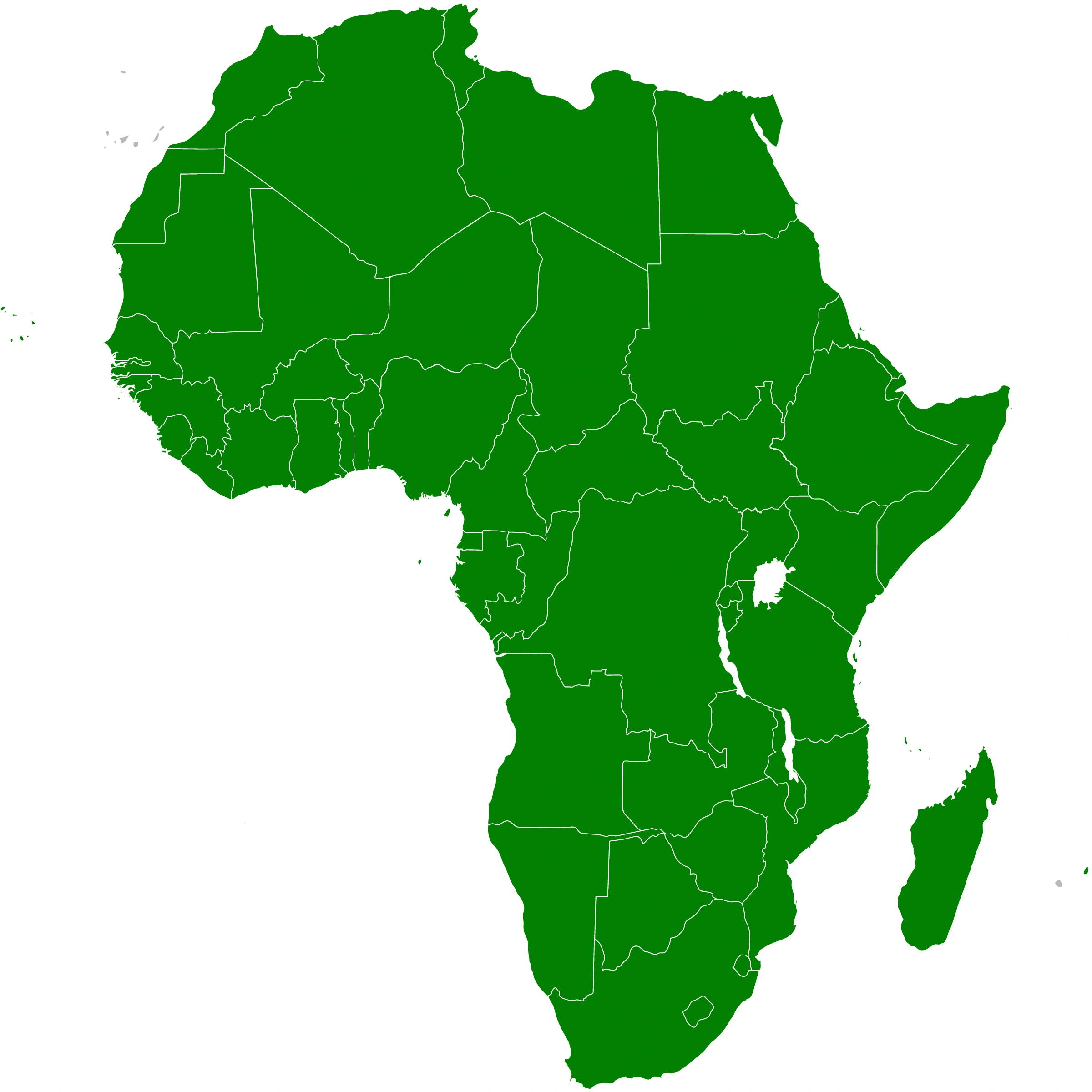
Map study
African Union geographic context: locate the Sahel, Horn of Africa and major African regions; verify current membership and suspensions separately.
- Read the source date and legend; distinguish territory, influence and geographic location.
- Historical boundaries and reference memberships are not live political or operational data.
Credit: Mangwanani · CC BY-SA 4.0 · sourceConverted to WebP on an opaque white background; proportionally resized without cropping. Original cartography and legend retained.
1. Origins, membership and foundational principles
The African Union emerged from the Organisation of African Unity, established in Addis Ababa on 25 May 1963. The OAU prioritised decolonisation, opposition to apartheid, sovereign equality and the protection of inherited borders. Although these principles helped consolidate newly independent states, strict non-interference limited collective responses to internal repression and humanitarian crises. The 1994 genocide in Rwanda exposed the inadequacy of continental and international protection mechanisms.
The September 1999 Sirte Declaration initiated the transition towards a more integrated organisation. The AU’s Constitutive Act was adopted in 2000, and the Union was launched in 2002. Its objectives include continental integration, democratic governance, human rights, sustainable development and a common African position in international negotiations. Morocco rejoined in 2017 after leaving the OAU in 1984 over the admission of the Sahrawi Arab Democratic Republic. The unresolved Western Sahara dispute continues to create diplomatic tensions.
The Constitutive Act combines respect for sovereignty with qualified collective responsibility. Article 4(h) recognises the Union’s right to intervene, pursuant to an Assembly decision, in grave circumstances involving war crimes, genocide and crimes against humanity. Article 4(j) recognises a member state’s right to request intervention to restore peace and security. These provisions underpin the shift from non-interference towards non-indifference.
Timeline
1963
Organisation of African Unity established in Addis Ababa.
1999–2002
Sirte Declaration initiates transformation; Constitutive Act adopted in 2000; AU launched in Durban in 2002.
2015
Agenda 2063 adopted as the continental development framework.
2017
Morocco rejoins, bringing AU membership to 55.
2018–2021
AfCFTA Agreement signed, enters into force and begins its trading phase.
2023
AU admitted as a permanent G20 member at the New Delhi Summit.
2. Institutions and decision-making
The Assembly of Heads of State and Government is the AU’s supreme policy-making organ. The Executive Council, generally comprising foreign ministers, coordinates policies and prepares Assembly business. The Permanent Representatives Committee supports this work through member-state representatives based in Addis Ababa. The African Union Commission is the administrative and executive secretariat; its chairperson is distinct from the annually rotating political chairperson of the Union.
The Peace and Security Council is a standing decision-making organ for conflict prevention, management and resolution. It has 15 elected members, with ten serving two-year terms and five serving three-year terms. No member holds a permanent seat or veto. Other institutions include the Pan-African Parliament, which has predominantly consultative powers, and the Economic, Social and Cultural Council, which provides a channel for civil-society participation.
African human-rights institutions include the African Commission on Human and Peoples’ Rights and the African Court on Human and Peoples’ Rights. The latter’s effectiveness depends on treaty acceptance, access rules and state compliance. The AU also recognises eight Regional Economic Communities as integration building blocks. Their overlapping memberships and differing capacities complicate coordination. Unlike a federal government, the AU relies heavily on member-state consent, financing and domestic implementation.
How continental commitments become practical outcomes
- 1. Member states negotiate a shared continental priority.
- 2. AU organs adopt a policy, decision or treaty framework.
- 3. States ratify treaties where required and align domestic policies.
- 4. Regional communities and national agencies coordinate implementation.
- 5. Financing, monitoring and peer review support delivery and correction.
3. Economic integration and Agenda 2063
Agenda 2063, adopted in 2015, translates the AU’s continental vision into successive implementation plans. Its priorities include inclusive growth, infrastructure connectivity, democratic governance, cultural identity, women’s and youth empowerment, peace and greater global influence. Flagship initiatives include the African Continental Free Trade Area, the Single African Air Transport Market and Silencing the Guns. The framework promotes African ownership, but progress depends on national budgets and administrative capacity.
The AfCFTA Agreement was signed in Kigali in March 2018, entered into force in May 2019, and began its trading phase in January 2021. Its Secretariat is located in Accra, Ghana. It seeks progressively to liberalise trade in goods and services and address investment, competition, intellectual property and other areas of economic cooperation. It is a free-trade framework, not an already completed continental customs union or common currency arrangement.
Integration could enable regional value chains, larger consumer markets and reduced dependence on exporting unprocessed commodities. However, tariff preferences alone cannot overcome unreliable electricity, weak logistics, non-tariff barriers and limited trade finance. Effective rules of origin are essential to determine which goods qualify for preferences. Smaller economies also need adjustment support, while simplified procedures and safe border facilities are important for women engaged in informal cross-border trade.
| Dimension | Organisation of African Unity | African Union |
|---|---|---|
| Historical priority | Decolonisation and opposition to apartheid | Integration, development, peace and governance |
| Sovereignty | Strong emphasis on non-interference | Non-interference alongside intervention provisions for grave circumstances |
| Security arrangements | Relatively limited continental mechanisms | Peace and Security Council and wider peace and security architecture |
| Economic agenda | Cooperation and foundations for integration | Agenda 2063 and AfCFTA-led integration |
4. Peace, security and governance challenges
The African Peace and Security Architecture links the Peace and Security Council with the Continental Early Warning System, Panel of the Wise, African Standby Force and Peace Fund. Its tools include mediation, preventive diplomacy, sanctions and peace-support operations. Article 30 of the Constitutive Act excludes governments that come to power through unconstitutional means from participation in AU activities. The African Charter on Democracy, Elections and Governance further develops continental democratic standards.
Nevertheless, military takeovers in parts of the Sahel, the war in Sudan and prolonged insecurity in Somalia demonstrate the gap between institutional commitments and operational capacity. Responses are complicated by contested state legitimacy, armed groups, external intervention and disagreements between neighbouring governments. Suspension can signal rejection of a coup, but cannot by itself restore civilian government or resolve insecurity.
Financial dependence and logistical shortfalls constrain African-led operations. The AU has pursued more predictable member-state contributions and stronger peace financing. UN Security Council Resolution 2719, adopted in December 2023, established a framework for eligible AU-led peace-support operations authorised by the Council to receive UN assessed contributions, on a case-by-case basis, up to 75 per cent of their annual budgets. Implementation remains subject to Council decisions, oversight and compliance requirements.
5. Global governance and India–AU relations
The AU coordinates African positions on climate finance, development, debt and reform of global institutions. Its 2005 Ezulwini Consensus calls for at least two permanent African seats on the UN Security Council, with all privileges of permanent membership, including the veto if retained, and five non-permanent seats. Africa’s numerical strength in the UN General Assembly contrasts with its exclusion from permanent Security Council membership.
At the September 2023 New Delhi Summit, the AU became a permanent G20 member. India strongly supported its admission, presenting it as a step towards more representative global governance. Membership creates a platform to advance African priorities, but policy influence still requires effective coordination across diverse national interests. The AU’s presence complements rather than replaces South Africa’s individual G20 membership.
India–Africa ties draw on anti-colonial solidarity, diaspora connections, trade and development cooperation. India–Africa Forum Summits were held in 2008, 2011 and 2015; all 54 African UN member states participated in the third summit. India’s engagement includes ITEC training, concessional development finance, scholarships, health cooperation and digital education initiatives such as e-VidyaBharati and e-ArogyaBharati. Partnerships also address maritime security, renewable energy and resilient supply chains. India should align projects with African priorities, improve delivery and support local capacity rather than treating Africa merely as an arena of competition with China.
Real-world case studies
AU-led Pretoria Agreement, Ethiopia, 2022
On 2 November 2022, Ethiopia’s federal government and the Tigray People’s Liberation Front signed a permanent cessation-of-hostilities agreement in Pretoria through an AU-led process. The agreement demonstrated the value of African mediation and international support. Continuing challenges involving displacement, accountability and political disputes illustrate why a ceasefire must be followed by sustained implementation and reconciliation.
Africa CDC and collective health security
Launched in 2017, the Africa Centres for Disease Control and Prevention strengthened continental coordination during COVID-19 through surveillance, laboratory networks and public-health guidance. Unequal vaccine access reinforced demands for African manufacturing and stronger health systems. The experience shows how the AU can provide cross-border public goods beyond traditional diplomacy and security.
Previous year questions
UPSC Mains 2015 · GS-II
Increasing interest of India in Africa has its pros and cons. Critically examine.
- Assess opportunities in trade, energy, development cooperation and diplomatic coordination.
- Discuss African priorities, employment creation and local value addition.
- Examine political instability, project delays, debt concerns and commercial risks.
- Recommend demand-driven, transparent and mutually beneficial partnerships.
Practice questions
Practice MCQ 1
With reference to the African Union, consider the following statements: 1. Its Peace and Security Council has permanent members with veto power. 2. Its Constitutive Act provides for intervention in specified grave circumstances. 3. Its Commission is headquartered in Addis Ababa. Which statements are correct?
- A. 1 and 2 only
- B. 2 and 3 only
- C. 1 and 3 only
- D. 1, 2 and 3
Practice MCQ 2
Which statement best describes the African Continental Free Trade Area?
- A. It established a single African currency in 2021.
- B. It replaced all African Regional Economic Communities.
- C. It provides a framework for progressively liberalising continental trade.
- D. It automatically established a common external tariff across all AU members.
Practice MCQ 3
Consider the following statements: 1. The African Union became a permanent G20 member at the 2023 New Delhi Summit. 2. Its admission ended South Africa’s individual G20 membership. Which is correct?
- A. 1 only
- B. 2 only
- C. Both 1 and 2
- D. Neither 1 nor 2
Mains practice · The African Union’s enhanced representation in global institutions must be matched by stronger continental implementation capacity. Discuss, highlighting opportunities for India–AU cooperation. Answer in 250 words.
- Introduce the AU’s G20 admission and its wider global governance agenda.
- Explain Agenda 2063, AfCFTA and collective peace and health mechanisms.
- Identify financing gaps, sovereignty concerns, conflicts and uneven institutional capacity.
- Distinguish diplomatic representation from effective policy coordination and implementation.
- Suggest Indian cooperation in skills, digital infrastructure, health, renewable energy and trade facilitation.
- Conclude with African ownership, measurable delivery and equitable partnerships.
Further reading
- African Union official website: Constitutive Act, institutional profiles and Agenda 2063.
- AfCFTA Secretariat: Agreement Establishing the African Continental Free Trade Area and implementation resources.
- Ministry of External Affairs, Government of India: India–Africa relations and India–Africa Forum Summit documents.
- G20 New Delhi Leaders’ Declaration, 2023.
- United Nations Security Council Resolution 2719 (2023).
- NCERT, Contemporary World Politics: International Organisations.
Preparing for UPSC Civil Services? Get classroom teaching, answer-writing evaluation and mentorship at Pragnya IAS Academy, Ashok Nagar — see why aspirants choose us for IAS coaching in Hyderabad.