

Calligraphic composition with verse 17.1 of the Qur'an. From the Ottoman album (muraqqa') made between 1730-1754. Persian calligraphy from 16th century. Ottoman illumination from 18th century. Arabic.
Credit: Mir Ali Heravi · Public domain · source

INCOIS Hyderabad
Credit: Arjuncm3 · CC BY-SA 3.0 · source
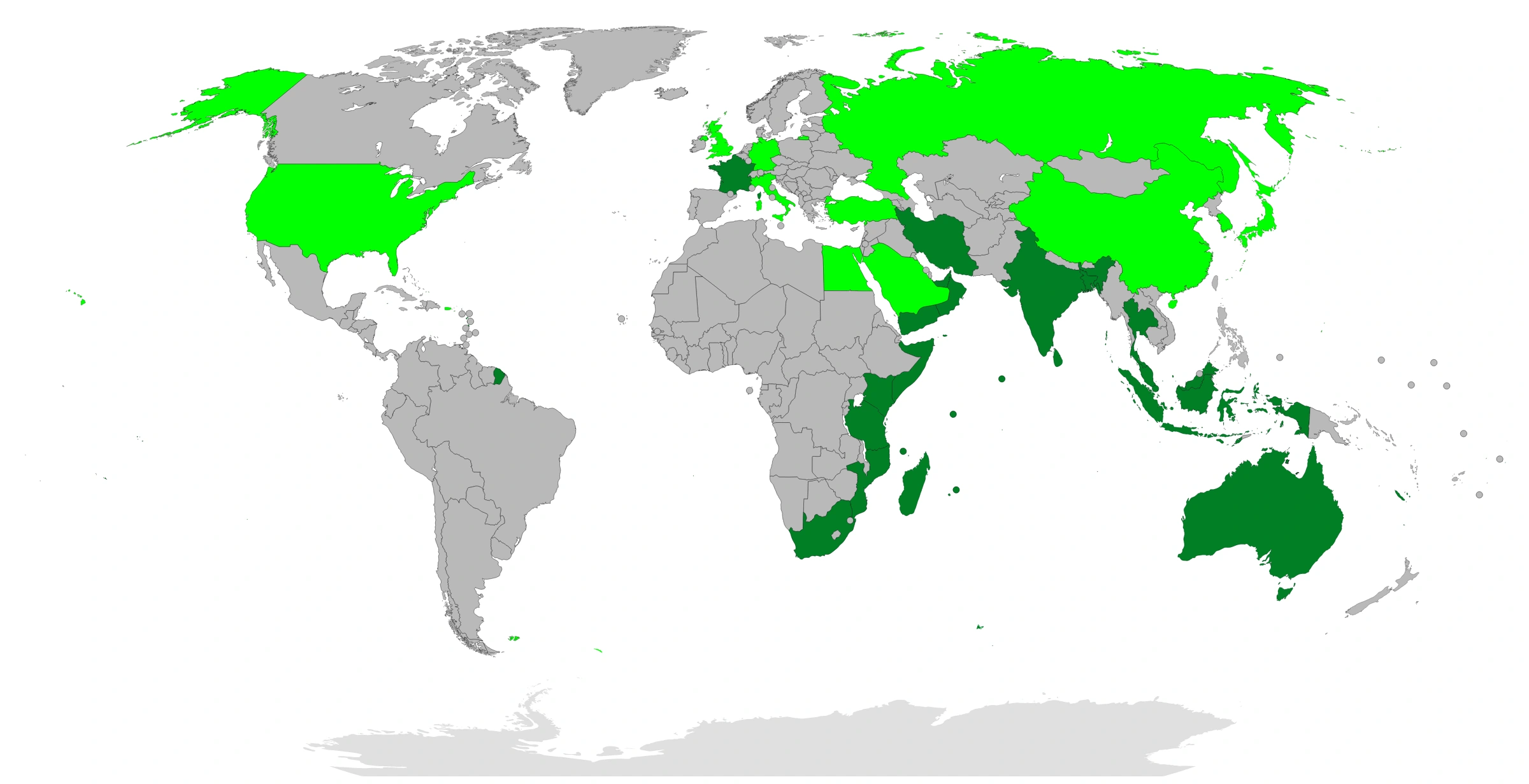
Map study
IORA members around the Indian Ocean as shown in the source map. IORA is not QUAD; use this for shared oceanic geographic context only.
- Read the source date and legend; distinguish territory, influence and geographic location.
- Historical boundaries and reference memberships are not live political or operational data.
Credit: Underdwarf58 · CC BY-SA 4.0 · sourceConverted to WebP on an opaque white background; proportionally resized without cropping. Original cartography and legend retained.
1. Origins, membership and institutional design
IORA emerged from the recognition that countries connected by the Indian Ocean required a dedicated framework for economic and functional cooperation. Its intellectual origins are often linked to Nelson Mandela’s advocacy of Indian Ocean cooperation during his 1995 visit to India. Fourteen founding members launched the association in Mauritius on 7 March 1997. The change from IOR-ARC to IORA in 2013 signalled a clearer institutional identity, rather than the creation of a new organisation.
Its 23 members are Australia, Bangladesh, Comoros, France, India, Indonesia, Iran, Kenya, Madagascar, Malaysia, Maldives, Mauritius, Mozambique, Oman, Seychelles, Singapore, Somalia, South Africa, Sri Lanka, Tanzania, Thailand, the United Arab Emirates and Yemen. France joined in 2020, reflecting its Indian Ocean presence through overseas territories, particularly Réunion. Pakistan is not a member. External powers, including China and the United States, participate as Dialogue Partners rather than member states.
The Council of Ministers provides policy direction, assisted by the Committee of Senior Officials and the Mauritius-based Secretariat. The chairmanship normally rotates every two years, supported by the preceding and incoming chairs through a troika arrangement. Working groups and specialised platforms support sectoral cooperation. Consensus protects sovereign equality and encourages participation by diverse states, but also limits the speed and ambition of collective decisions.
Timeline
1995
Nelson Mandela’s visit to India helped advance the idea of an Indian Ocean cooperation platform.
7 March 1997
IOR-ARC was established in Mauritius with 14 founding members.
2011
The Bengaluru ministerial meeting identified six priority areas of cooperation.
2013
IOR-ARC was renamed the Indian Ocean Rim Association.
7 March 2017
The first Leaders’ Summit in Jakarta adopted the Jakarta Concord and Action Plan 2017–2021.
2020
France became IORA’s 23rd member.
2022–2027
The second IORA Action Plan provides a medium-term framework for cooperation.
2. Mandate and substantive agenda
IORA’s central purpose is balanced growth and sustainable development through practical regional cooperation. Its Charter emphasises sovereign equality, territorial integrity, political independence, non-interference and peaceful coexistence. Bilateral and other issues likely to generate controversy or obstruct cooperation are excluded from deliberations. Consequently, IORA is not designed to adjudicate territorial disputes or impose collective security obligations.
The association identified six priority areas at its Bengaluru ministerial meeting in 2011. Maritime safety and security encompasses safer navigation and cooperation against challenges such as piracy. Trade and investment facilitation seeks improved business links and fewer procedural barriers. Fisheries management addresses sustainable harvesting, livelihoods and illegal, unreported and unregulated fishing. Disaster risk management promotes preparedness and resilience. Academic, science and technology cooperation strengthens knowledge networks. Tourism and cultural exchanges build connectivity and people-to-people relationships.
The blue economy and women’s economic empowerment are cross-cutting priorities. The blue economy links ocean-based livelihoods and production with ecosystem protection; it should not be reduced to offshore resource extraction. Relevant activities include sustainable fisheries, marine biotechnology, renewable energy and environmentally responsible coastal tourism. Gender mainstreaming requires attention to women’s access to finance, skills, technology and decision-making across these sectors, rather than treating women only as beneficiaries of welfare.
Indicative pathway from regional priorities to practical outcomes
- 1. Members identify a shared maritime or developmental need.
- 2. Senior officials and relevant working groups develop proposals.
- 3. The Council of Ministers provides consensus-based policy direction.
- 4. Participating members and partners mobilise funding and expertise.
- 5. Projects deliver training, research or institutional capacity.
- 6. Monitoring and reporting inform subsequent regional cooperation.
3. Strategic and economic importance for India
The Indian Ocean connects major energy-producing regions with Asian manufacturing centres and global markets. Sea routes passing through the Strait of Hormuz, Bab el-Mandeb and the Strait of Malacca are strategically important. India’s Ministry of Ports, Shipping and Waterways commonly notes that maritime transport handles approximately 95 per cent of India’s trade by volume and 70 per cent by value. These figures concern India’s maritime trade overall, not trade conducted exclusively with IORA members.
IORA provides India with a diplomatic platform linking eastern Africa, Gulf countries, island states, Southeast Asia and Australia. It complements the SAGAR vision, articulated in 2015 as Security and Growth for All in the Region. Cooperation on coastal resilience, maritime capacity-building and sustainable livelihoods helps India demonstrate that regional leadership involves providing public goods, not merely projecting naval power.
The association also supports India’s preference for an inclusive and rules-based maritime order. The United Nations Convention on the Law of the Sea, 1982, supplies the wider legal framework for maritime rights and responsibilities; IORA neither replaces UNCLOS nor serves as its enforcement agency. Economically, India can use the platform to develop port-related skills, research networks, sustainable fisheries and business partnerships. Dialogue with small island developing states is particularly important because climate vulnerability and limited administrative capacity shape their maritime priorities.
| Mechanism | Main focus | Key distinction |
|---|---|---|
| IORA | Economic, developmental and maritime cooperation | Broad Indian Ocean littoral association; consensus-based |
| Indian Ocean Naval Symposium | Naval dialogue and professional cooperation | Navy-led forum, not an economic grouping |
| Quad | Practical cooperation across the Indo-Pacific | Four participants: India, Australia, Japan and the United States |
| BIMSTEC | Multisectoral cooperation around the Bay of Bengal | Seven-member subregional organisation |
| IFC-IOR | Maritime information-sharing and domain awareness | India-hosted centre at Gurugram, not an IORA organ |
4. Achievements and limitations
IORA’s first Leaders’ Summit, held in Jakarta on 7 March 2017, adopted the Jakarta Concord and the IORA Action Plan 2017–2021. These strengthened its political visibility and connected broad objectives with a more structured cooperation agenda. The Action Plan 2022–2027 continued this approach. Regular ministerial engagement, thematic working groups, training programmes and research exchanges constitute its main achievements; assessment should focus on practical institutional development rather than expect European Union-style integration.
A major limitation is the diversity of members’ political systems, development levels and strategic alignments. Gulf energy exporters, populous Asian economies, African coastal states and vulnerable island countries do not necessarily rank regional problems similarly. Consensus can therefore produce broad declarations without sufficiently specific commitments. Limited Secretariat capacity, uneven national follow-through and dependence on member-supported projects further constrain implementation.
Geopolitical rivalry creates additional pressure. Competition involving India, China and Western powers can influence infrastructure choices, maritime access and regional narratives, even though some major powers participate only as Dialogue Partners. Conflict around the Red Sea and risks to commercial shipping illustrate the importance of maritime stability, but IORA lacks an operational mandate for collective military responses. Overlapping regional organisations can enable useful specialisation or generate duplication when coordination is weak.
5. Distinguishing IORA from other maritime frameworks
IORA should be distinguished from security dialogues and operational arrangements. The Indian Ocean Naval Symposium is a forum for cooperation among regional navies. The Quad brings together India, Australia, Japan and the United States on a wider Indo-Pacific agenda. BIMSTEC links seven countries around the Bay of Bengal through multisectoral cooperation. IORA’s comparative advantage is its wider Indian Ocean littoral membership and its combination of development, economic and maritime priorities.
Likewise, the Information Fusion Centre–Indian Ocean Region at Gurugram is an Indian initiative supporting maritime information-sharing; it is not an IORA institution. Regional tsunami warning arrangements operate through UNESCO’s Intergovernmental Oceanographic Commission, not under IORA command. These distinctions matter in examination answers: complementary mechanisms may advance similar objectives without sharing membership, legal authority or institutional ownership.
6. Reform priorities and an Indian approach
IORA should prioritise a manageable set of projects with clear timelines, financing arrangements and publicly reported results. A strengthened Secretariat and better-resourced project preparation would help smaller members participate effectively. Voluntary, member-supported projects consistent with agreed priorities can generate progress without forcing uniform obligations on every country. Partnerships should respond to regional demand and avoid creating unsustainable debt or opaque infrastructure commitments.
India can offer hydrographic expertise, coastal surveillance training, scholarships, fisheries research and disaster-management capacity-building. Particular emphasis should fall on early warning, resilient ports, marine pollution control and women-led coastal enterprises. Coordination with existing organisations can reduce duplication while preserving IORA’s inclusive character. For GS-II, the central argument is that IORA’s relevance depends on reconciling sovereign equality and strategic diversity with effective delivery of shared maritime public goods.
Real-world case studies
Jakarta Summit, 2017: political commitment and delivery
Indonesia hosted IORA’s first Leaders’ Summit on its twentieth anniversary. The Jakarta Concord articulated a peaceful, stable and prosperous Indian Ocean, while the accompanying action plan organised cooperation around priority areas. The case illustrates the value of summit diplomacy but also the need to translate declarations into funded programmes with measurable results.
Indian Ocean tsunami warning: complementary institutions
Following the December 2004 tsunami, Indian Ocean countries developed a regional warning and mitigation system coordinated through UNESCO-IOC. India’s Tsunami Early Warning Centre at INCOIS, Hyderabad, became operational in 2007. Although this is not an IORA-created system, it illustrates the scientific capacity, timely information-sharing and last-mile preparedness that can support IORA’s disaster risk management agenda.
Previous year questions
No source-linked PYQ is available here yet. Use the practice questions below.
Practice questions
Practice MCQ 1
Consider the following statements about IORA: 1. Its Secretariat is located in Mauritius. 2. It takes decisions by consensus. 3. Its Charter establishes binding collective defence obligations. Which statements are correct?
- A. 1 and 2 only
- B. 2 and 3 only
- C. 1 and 3 only
- D. 1, 2 and 3
Practice MCQ 2
Which of the following pairs consists entirely of IORA member states?
- A. India and Pakistan
- B. France and Australia
- C. China and Japan
- D. United States and United Kingdom
Practice MCQ 3
With reference to IORA, consider the following: 1. Fisheries management 2. Disaster risk management 3. A common external tariff 4. A regional monetary union. Which are among its six priority areas?
- A. 1 only
- B. 1 and 2 only
- C. 2 and 3 only
- D. 1, 2, 3 and 4
Mains practice · IORA’s comparative advantage lies in delivering maritime public goods rather than constructing a regional security bloc. Discuss its significance for India and suggest measures to improve its effectiveness. Answer in 250 words.
- Introduce IORA as a consensus-based association established in 1997.
- Explain its relevance to trade routes, sustainable fisheries, disaster resilience and small island developing states.
- Connect India’s engagement with SAGAR, inclusive regionalism and capacity-building.
- Identify constraints: diverse interests, geopolitical competition, limited institutional resources and uneven implementation.
- Propose measurable projects, stronger Secretariat capacity, sustainable financing and member-driven partnerships.
- Distinguish IORA from naval forums and operational security arrangements.
- Conclude that development-oriented delivery can strengthen regional trust without turning IORA into an alliance.
Further reading
- IORA official website: Charter, member states, Dialogue Partners and priority areas.
- IORA: Jakarta Concord, 2017.
- IORA: Action Plan 2022–2027.
- Ministry of External Affairs, Government of India: IORA briefs and Council of Ministers statements.
- INCOIS: Indian Tsunami Early Warning Centre.
- UNESCO-IOC: Indian Ocean Tsunami Warning and Mitigation System.
Preparing for UPSC Civil Services? Get classroom teaching, answer-writing evaluation and mentorship at Pragnya IAS Academy, Ashok Nagar — see why aspirants choose us for IAS coaching in Hyderabad.