

The Hemicycle of the European Parliament in Strasbourg during a plenary session in 2014.
Credit: Diliff · CC BY-SA 3.0 · source

Member states of the European Union without the United Kingdom, as at 31 January 2020
Credit: User:Ssolbergj and User:Moonraker · CC BY-SA 4.0 · source
Map study
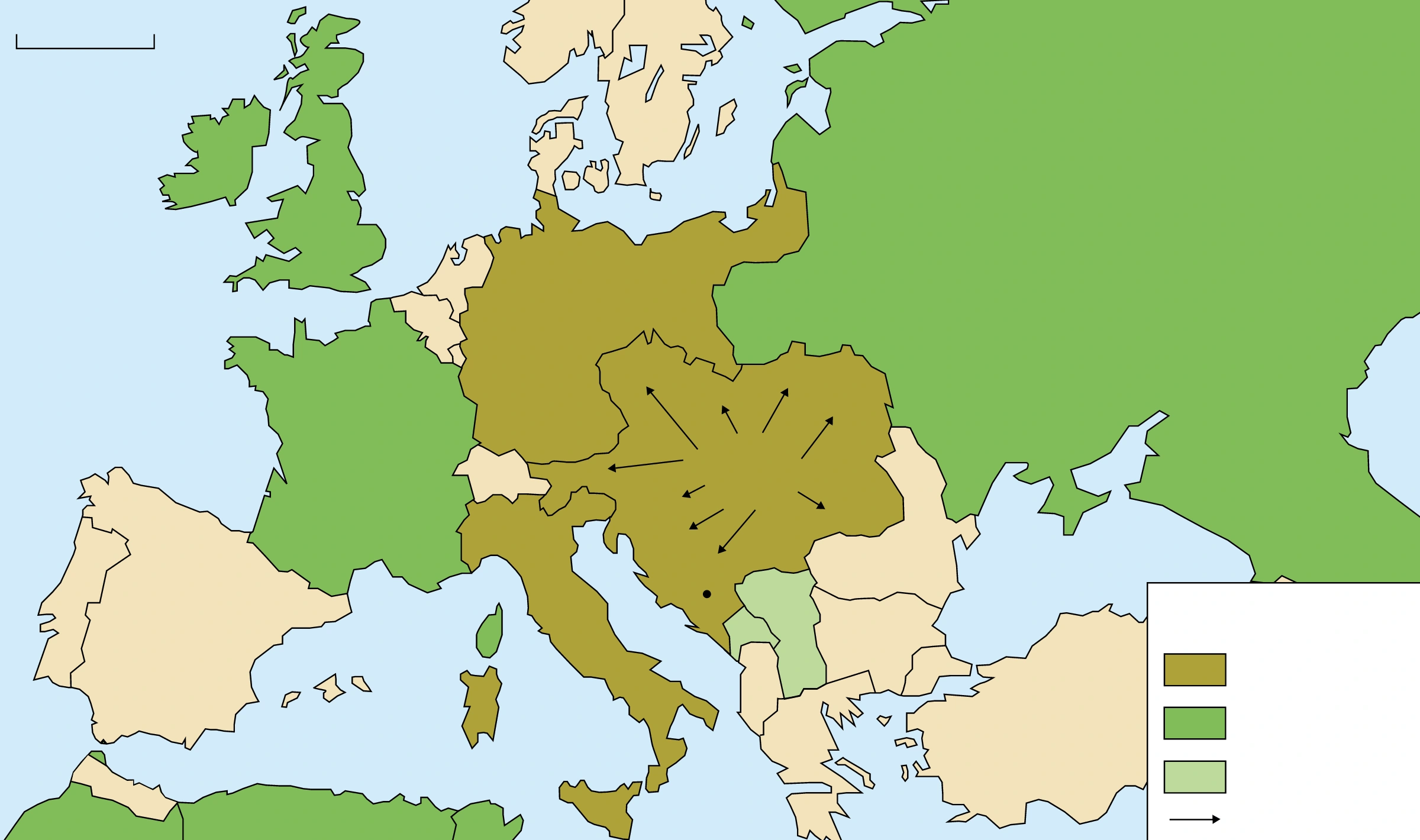
Europe’s alliances in 1914: historical background to European international relations. Distinguish these blocs from modern EU and NATO membership.
- Read the source legend and reference date before interpreting the map.
- Use spatial patterns to support topic revision; verify current official boundaries, designations and warnings separately.
Credit: historicair; Fluteflute; Bibi Saint-Pol · CC BY-SA 2.5 · sourceConverted to WebP on an opaque white background; proportionally resized without cropping. Original cartography and legend retained.
1. Origins, objectives and distinctive character
European integration emerged from the destruction of the Second World War. The underlying idea was that shared institutions and economic interdependence could make another war between European powers materially difficult. The European Coal and Steel Community, established by the 1951 Treaty of Paris, pooled strategic industries. The 1957 Treaties of Rome created the European Economic Community and Euratom. The Maastricht Treaty subsequently established the European Union, expanding integration beyond economic cooperation.
The EU is neither a sovereign federal state nor merely a conventional international organisation. In areas where treaties confer competence, its institutions can adopt binding laws. The single market rests on the free movement of goods, services, capital and persons. A customs union removes internal customs duties and applies a common external tariff. The euro represents deeper monetary integration for participating countries, but not every EU member uses it.
EU action is governed by conferral, subsidiarity and proportionality. Conferral means that the Union exercises powers granted by member states. Subsidiarity requires decisions in areas of shared competence to be taken at EU level only when objectives cannot be sufficiently achieved nationally. Proportionality limits action to what is necessary. These principles help explain recurring tensions between collective effectiveness and national sovereignty.
- Exclusive competence includes the customs union and common commercial policy; shared competence includes areas such as environment and energy.
- The EU is distinct from NATO, a collective-defence alliance, and the Council of Europe, a separate organisation associated with the European Convention on Human Rights.
Timeline
1951
Treaty of Paris establishes the European Coal and Steel Community.
1957
Treaties of Rome establish the European Economic Community and Euratom.
1993
Maastricht Treaty enters into force and the European Union comes into existence.
2004
India and the EU establish a Strategic Partnership.
2009
Treaty of Lisbon enters into force.
2020
The United Kingdom leaves the EU; membership falls to 27.
2022–2023
India–EU trade negotiations are relaunched and the Trade and Technology Council holds its first ministerial meeting.
2. Institutions, law-making and democratic accountability
The European Commission promotes the general interest of the Union, normally proposes legislation, oversees implementation and monitors compliance with EU law. The European Parliament is directly elected and shares legislative and budgetary authority with the Council of the European Union. The Council brings together national ministers according to the policy under consideration. By contrast, the European Council comprises national leaders and provides overall political direction rather than ordinarily legislating.
Under the ordinary legislative procedure, Parliament and the Council generally adopt legislation jointly on a Commission proposal. Qualified majority voting commonly requires support from at least 55 per cent of member states representing at least 65 per cent of the EU population. Sensitive matters, including many foreign-policy decisions and certain taxation measures, generally require unanimity. Thus, integration is deeper in market regulation than in diplomacy or defence.
The Court of Justice of the European Union ensures consistent interpretation and application of EU law. The European Central Bank conducts monetary policy for the euro area. EU regulations are directly applicable, while directives bind states regarding the result to be achieved but normally require national implementation. Criticism of a democratic deficit concerns institutional complexity and distance from citizens; counterarguments emphasise the elected Parliament and the accountability of national governments represented in the Council.
- The European Council and Council of the European Union are EU institutions; the Council of Europe is not.
- The European Court of Human Rights is not an EU court; it belongs to the Council of Europe system.
Simplified ordinary legislative procedure
- 1. European Commission proposes legislation
- 2. European Parliament and Council examine and amend the proposal
- 3. Both institutions agree on a common text
- 4. Legislation is adopted and published
- 5. EU and national authorities implement it according to the legal instrument
- 6. Commission monitoring and judicial review support compliance
3. The EU in global governance and strategic competition
The EU supports multilateral institutions, international law, the Paris Agreement and a rules-based trading system. It is a WTO member in its own right, alongside its member states, and the Commission negotiates trade agreements within an authorised mandate. Its large market enables regulatory influence beyond Europe, often called the Brussels effect: global firms may adopt EU standards across operations to retain access to European consumers. The General Data Protection Regulation illustrates this influence.
Russia’s full-scale invasion of Ukraine in February 2022 sharpened European debates on security, energy dependence and enlargement. The EU imposed sanctions on Russia and provided financial and other assistance to Ukraine. The Strategic Compass, adopted in March 2022, outlined stronger security and defence cooperation. Nevertheless, defence remains largely national, while NATO remains central to collective defence for its members.
European strategic autonomy seeks greater capacity to act and reduced excessive dependence in critical sectors. It does not necessarily imply separation from the United States. Relations with China combine cooperation, competition and systemic rivalry, with increasing emphasis on de-risking rather than comprehensive decoupling. Internal disagreements, unanimity requirements, energy vulnerabilities and divergent national interests constrain a unified external policy. Enlargement also raises questions about institutional reform, budgetary distribution and adherence to democratic standards.
- The Global Gateway strategy, launched in 2021, aims to mobilise up to €300 billion in connectivity investment during 2021–2027; this is a mobilisation ambition, not solely an EU budget allocation.
- EU influence is strongest when market size, common institutions and diplomatic unity reinforce one another.
| Arrangement | Main function | Important distinction |
|---|---|---|
| European Union | Political and economic integration | Treaty-based union of 27 states |
| Euro area | Common currency and monetary policy | Does not include every EU member |
| Schengen Area | Normally removes checks at internal borders | Includes non-EU states such as Switzerland and Norway |
| Council of Europe | Human rights, democracy and rule of law | Separate from the EU |
| NATO | Collective defence | Includes non-EU countries, including the United States |
4. India–EU relations: areas of convergence
India established diplomatic relations with the European Economic Community in 1962. The first India–EU Summit was held in Lisbon in 2000, followed by the Strategic Partnership in 2004. The relationship now extends beyond commerce to maritime security, sustainable development, research and technology. According to European Commission figures, bilateral trade in goods reached approximately €124 billion in 2023, making the EU India’s largest goods-trading partner that year.
Negotiations for a trade agreement began in 2007 and stalled in 2013. In June 2022, India and the EU formally relaunched trade negotiations and launched separate negotiations on investment protection and geographical indications. The negotiating agenda links tariff liberalisation with services, procurement, standards and sustainability. Aspirants should distinguish the status of each negotiating track rather than assume that progress on one automatically settles the others.
The India–EU Trade and Technology Council, announced in 2022 and first convened at ministerial level in 2023, provides cooperation on strategic technologies, clean technologies and resilient trade and investment. The 2021 Connectivity Partnership supports sustainable, transparent and rules-based connectivity. Indo-Pacific cooperation offers scope for maritime domain awareness, secure sea lanes and resilient supply chains, while education and scientific exchanges deepen societal links.
- The EU is also an important institutional investor and development partner, but trade in goods, services and investment stocks must be assessed using separate indicators.
- India’s bilateral partnerships with France, Germany and other members complement, but do not replace, engagement with EU institutions.
5. Frictions, policy choices and the way forward
Trade frictions arise over agricultural access, industrial tariffs, intellectual property, public procurement, services mobility and regulatory compliance. India seeks recognition of its development needs and greater opportunities for skilled professionals. European priorities include predictable market access and enforceable sustainability commitments. Differences over Russia, human rights and approaches to global governance can complicate cooperation without eliminating shared interests.
The Carbon Border Adjustment Mechanism illustrates the intersection of climate policy and trade. Its transitional reporting phase began in October 2023, followed by the definitive regime from 2026. Initially covered sectors include iron and steel, aluminium, cement, fertilisers, electricity and hydrogen. The EU presents it as protection against carbon leakage; India is concerned about compliance costs, competitiveness and the treatment of differentiated development responsibilities.
India should combine negotiation with domestic adaptation: improve emissions measurement, support cleaner industrial production, strengthen standards infrastructure and assist smaller exporters. Cooperation on critical minerals, trusted digital systems and clean-energy research can create reciprocal gains. A pragmatic partnership requires issue-based alignment rather than complete strategic convergence. For GS-II answers, evaluate the EU simultaneously as a market, regulatory power, multilateral actor and coalition of states with differing national interests.
- Prioritise balanced market access, feasible transition periods and transparent dispute-resolution arrangements.
- Link strategic autonomy with practical cooperation while preserving independent foreign-policy choices.
Real-world case studies
GDPR and the Brussels effect
Applicable since May 2018, the General Data Protection Regulation strengthened personal-data protections. Its reach can extend to non-EU firms offering goods or services to people in the EU or monitoring their behaviour there. Indian businesses serving European markets therefore face compliance obligations. The case shows how market access can transmit regulatory standards beyond territorial boundaries.
Brexit and the limits of disintegration
The United Kingdom’s 2016 referendum led to withdrawal on 31 January 2020 under Article 50 of the Treaty on European Union. The transition ended on 31 December 2020. Although the subsequent Trade and Cooperation Agreement provides tariff-free and quota-free trade for qualifying goods, customs formalities and regulatory barriers demonstrate that a free trade agreement does not replicate single-market membership.
Previous year questions
No source-linked PYQ is available here yet. Use the practice questions below.
Practice questions
Practice MCQ 1
Which institution brings together ministers of EU member states and shares legislative authority with the European Parliament?
- A. European Council
- B. Council of the European Union
- C. Council of Europe
- D. European Central Bank
Practice MCQ 2
Consider the following statements: 1. Every EU member uses the euro. 2. Some non-EU countries participate in the Schengen Area. 3. The Council of Europe is an EU institution. Which is correct?
- A. 1 only
- B. 2 only
- C. 1 and 3 only
- D. 2 and 3 only
Practice MCQ 3
The EU’s Carbon Border Adjustment Mechanism is primarily designed to:
- A. Introduce a common global income tax
- B. Replace all domestic European emissions regulation
- C. Address carbon leakage associated with selected imported goods
- D. Ban all imports from countries outside the Paris Agreement
Mains practice · The European Union is both a strategic opportunity and a regulatory challenge for India. Discuss with reference to trade, technology and climate governance. (250 words)
- Introduce the EU as a major market, regulatory power and strategic partner.
- Explain opportunities in investment, technology cooperation, connectivity and supply-chain diversification.
- Examine tariffs, standards, professional mobility and sustainability-related trade frictions.
- Use CBAM and GDPR to illustrate regulatory influence.
- Recognise differences over Russia and other foreign-policy issues without overstating their impact.
- Recommend balanced negotiations, exporter support, clean production and issue-based strategic cooperation.
Further reading
- NCERT, Contemporary World Politics: Contemporary Centres of Power.
- European Union official portal: EU institutions, treaties and decision-making.
- Ministry of External Affairs: India–EU relations briefs and summit documents.
- European Commission, Directorate-General for Trade: EU trade relations with India.
- European Commission, Taxation and Customs Union: Carbon Border Adjustment Mechanism.
- European External Action Service: Strategic Compass and EU Strategy for Cooperation in the Indo-Pacific.
Preparing for UPSC Civil Services? Get classroom teaching, answer-writing evaluation and mentorship at Pragnya IAS Academy, Ashok Nagar — see why aspirants choose us for IAS coaching in Hyderabad.